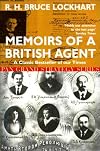
Memoirs of a British Agent
by R. H. Bruce Lockhart
On This Page
Description
When first published in 1932, this memoir was an immediate classic, both as a unique eyewitness account of Revolutionary Russia and as one man's story of struggle, and tragedy set against the background of great events. Aged 25, Lockhart became the British Vice-Consul to Moscow in 1912. With revolution in the air, it was dangerous, decadent posting. The 'Boy Ambassador' became an eyewitness to pivotal events and in 1918 was charged with establishing a diplomatic understanding with the show more Bolsheviks, to ensure that Russia remained in the war against Germany. It was a precarious mission: Whitehall could not be seen support revolutionaries; Lockhart grew wary of his masters' secret machinations; while Lenin and Trotsky's cordial relations with the British agent never quite dispelled their mistrust of the nation he represented. When Lockhart met Moura Budberg, who became the great love of his life, he was in an increasingly vulnerable position. In September 1918 he would be falsely accused of a counter-revolutionary plot to overthrow the Bolsheviks, and sent to the Loubianka. His account even inspired a Hollywood movie. From his evocative descriptions of revolutionary Moscow, where the champagne flowed as the bourgeoisie trembled, to his audiences with Trotsky and his brushes with death, this is a vivid, unique memoir. show lessTags
Recommendations




















Member Reviews
He is, however, good-natured. His enthusiasm is infectious, his pride in the revolution unbounded. "We are only doing what you have done centuries ago, but we are trying to do it better - without the Napoleon and without the Cromwell. People call me a mad idealist, but thank God for the idealists in this world. And at that moment I was prepared to thank God with him.
R.H. Bruce Lockhart was a diplomat who was posted to Moscow before and during the Russian Revolution, and his book was a world-wide bestseller when it was published in 1932, as he had first-hand contact with the famous names of both revolutions and was almost executed for spying.
His father sent him to university in Germany in the hope that he would actually do some work (he show more thought his son would spend all his time
playing sport if he went to Oxford or Cambridge), which led to him becoming fluent in French and German. After a stint working for his uncle at tea-planting in Malaya (he came home almost dead of fever - or possibly poison - after a scandalous affair with a local Prince's ward), he took the Foreign Office exams for the consular service.
By 1912 he was Vice-Consul in pre-World War I Moscow, where most of the other British residents were Lancastrians working in the cotton industry. After another affair led to him being sent back to London, he was sent back to Russia when the first revolution broke out, with the futile task of trying to keep Russia in the war. He was friends with Kerensky, the idealistic leader of the first revolutionary government, whose hopes of a revolution without a Napoleon or Cromwell were crushed when the Bolsheviks took over after the second revolution. A truly fascinating book by a man who at times seems very critical and dismissive of others, but also sees his own flaws and errors of judgement. show less
R.H. Bruce Lockhart was a diplomat who was posted to Moscow before and during the Russian Revolution, and his book was a world-wide bestseller when it was published in 1932, as he had first-hand contact with the famous names of both revolutions and was almost executed for spying.
His father sent him to university in Germany in the hope that he would actually do some work (he show more thought his son would spend all his time
playing sport if he went to Oxford or Cambridge), which led to him becoming fluent in French and German. After a stint working for his uncle at tea-planting in Malaya (he came home almost dead of fever - or possibly poison - after a scandalous affair with a local Prince's ward), he took the Foreign Office exams for the consular service.
By 1912 he was Vice-Consul in pre-World War I Moscow, where most of the other British residents were Lancastrians working in the cotton industry. After another affair led to him being sent back to London, he was sent back to Russia when the first revolution broke out, with the futile task of trying to keep Russia in the war. He was friends with Kerensky, the idealistic leader of the first revolutionary government, whose hopes of a revolution without a Napoleon or Cromwell were crushed when the Bolsheviks took over after the second revolution. A truly fascinating book by a man who at times seems very critical and dismissive of others, but also sees his own flaws and errors of judgement. show less
The derring-do, pathos, and incredible violence of early Bolshevik Russia are strikingly limned in this classic memoir. (As one blurb has it, "every page is alive." The style is very British, and all the more affectating for that.) The author, a rather romantic Scot, was truly Johnny on the spot in the midst of revolutionary chaos, and one of the few diplomats of the time who recognized the true staying power of the Bolshevik movement and its radical violence. Lots of bullets and romance!
Highly intriguing account by one of the footnote figures of the Russian Revolution. Lockhart was a consul in Moscow in the period just before and during the First World War, and in the first year or so of the Bolshevik period. He doesn't spare himself in this account, and notes the (multiple) mistakes he made, along with his indiscretions. But there are also some interesting observations, and a few what-ifs raised. It's clear from this account that the British Government was somewhat disorganized in its response to the October Revolution. Also interesting for its views on Trotsky and Lenin in their prime. Recommended.
I read the Folio Society edition printed in 2003 with the introduction and final chapter by the author's son.
Imagine running the British consulate in St Petersburg and then in Moscow during the time leading up to and during the communist take over. And during the surrender to Germany taking Russia out of WWI. Lockheart did just that while he was in his late 20s and early 30s. Fascinating tale and amazing how botched some of the allies efforts were to make things better in Russia. At the same time you feel so sad knowing that the success of the communists will end up resulting in the death of millions of their own countrymen.
Imagine running the British consulate in St Petersburg and then in Moscow during the time leading up to and during the communist take over. And during the surrender to Germany taking Russia out of WWI. Lockheart did just that while he was in his late 20s and early 30s. Fascinating tale and amazing how botched some of the allies efforts were to make things better in Russia. At the same time you feel so sad knowing that the success of the communists will end up resulting in the death of millions of their own countrymen.
Described as 'A Classic Bestseller of our Times', the book was an immediate success when published, in demand at home and internationally. The author, born in 1887, opens with a brief description of his early life and describes his journey to Singapore to begin working in the rubber industry in Malaya in 1908. Just a few years later he is in Moscow and the bulk of the book describes his time as Acting Consul-General and, after a break, as Head of the British Mission to the Bolsheviks. He graphically describes his encounters with Lenin and Trotsky and his time in Loubianka prison. What a different world it was just one hundred or so years ago! Or was it?
Interesting account of a British diplomat in Moscow and St. Petersburg during parts of 1917 and 1918 with insights into the chaos and cross-currents. He met many of the revolutionaries including Lenin and Trotsky, and also British agent Sydney Reilly, subject of the 1983 miniseries "Reilly, Ace of Spies", with Sam Neill and based on the book about Reilly written by Lockhart's son.
An interesting tale about the author's life during the russian revolution.
Members
- Recently Added By
Lists

Folio Society
831 works; 53 members

Best Books of 1926-1935
403 works; 10 members

Publisher's Weekly NON-Fiction list - 1912 - 1975
486 works; 4 members
Author Information

21+ Works 620 Members
Some Editions
Awards and Honors
Distinctions
Series
Belongs to Publisher Series
Work Relationships
Common Knowledge
- Original publication date
- 1932
- People/Characters
- Mikhail Vasilyevich Alexeyev; Arthur Balfour; Charles Clive Bayley; Henry James Bruce ('Benji'); Sir George Buchanan; Moura Budberg (show all 42); Lord Robert Cecil (1st Viscount Cecil of Chelwood); Michael Chelnokov; Georgy Chicherin; Francis Cromie (British naval attaché in St Petersburg); Anton Denikin; Felix Dzerzhinsky; David Francis (US ambassador to Russia); Denis Garstin; Maxim Gorky; Montgomery Grove; Will Hicks ('Hickie'); George Hill; Leo M. Karachan; Alexander Kerensky; Alfred Knox (British military attaché in St Petersburg); Feodor Feodorovich Kokoshkin; Lavr Georgyevich Kornilov; General Lavergne (French military mission to Moscow); Vladimir Lenin; David Lloyd George; R. H. Bruce Lockhart; George E. Lvov (Russian prince); Michael Lykiardopoulos ('Lyki'); Alfred, Viscount Milner; Wilhelm Mirbach (German ambassador to Russia); Nicholas II, Emperor of Russia; Joseph Noulens (French ambassador to Russia); Yakov Peters; Frederick Cuthbert Poole (British general); Karl Radek; Arthur Ransome; Sidney Reilly; Raymond Robins; Boris Savinkov; Leon Trotsky; Hugh Walpole
- Important places
- Moscow, Russia; St. Petersburg, Russia; Malaya
- Important events
- Russian Revolution; World War I; Russian Civil War
- Epigraph
- People pass. One has eyes. One sees them.
FROM THE FRENCH.
The Folio Society ed., 2003. - Dedication
- [None]
- First words
- My arrival in Moscow coincided with the visit of the British parliament delegation, which, on the invitation of the Russian Government, had descended upon St Petersburg and Moscow in that January of 1912.
This book of my father's climbed almost immediately to the top of the best-seller lists on both sides of the Atlantic, and Putnam, the original publisher, was kept busy with reprint after reprint.
Introduction by Ro... (show all)bin Bruce Lockhart, The Folio Society ed., 2003.
St Petersburg St Petersburg was known as Petrograd from 1914 to 1924, when it was renamed Leningrad.
Editorial notes, The Folio Society ed., 2003.
That my father was able to produce this book covering manifold world-shaking events in such detail is largely due to his keeping of extraordinarily lengthy diary material from 1915 until a few years before his death.
<... (show all)b>Epilogue by Robin Bruce Lockhart, The Folio Society ed., 2003. - Last words
- (Click to show. Warning: May contain spoilers.)My physical body was going forward, but my thoughts were back in Moscow and in the country which I was leaving - probably for ever.
(Click to show. Warning: May contain spoilers.)Both Reilly and my father, however, were condemned to death by the Revolutionary Tribunal in December, 1918, if they ever set foot in Russia again.
Epilogue by Robin Bruce Lockhart, The Folio Society ed., 2003. - Original language
- English
- Disambiguation notice
- The Folio Society edition omits the first seven chapters.
Classifications
Statistics
- Members
- 373
- Popularity
- 84,391
- Reviews
- 9
- Rating
- (3.97)
- Languages
- English, Swedish
- Media
- Paper, Ebook
- ISBNs
- 9
- ASINs
- 21