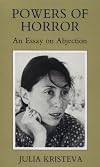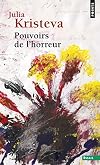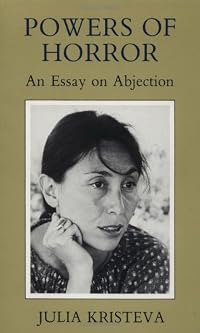
Powers of Horror: An Essay on Abjection
by Julia Kristeva
On This Page
Description
Julia Kristeva offers an extensive and profound consideration of the nature of abjection. Drawing on Freud and Lacan, she analyzes the nature of attitudes toward repulsive subjects and examines the function of these topics in the writings of Celine, Proust, Joyce, and other authors.Tags
Recommendations


Member Recommendations
Member Reviews
"Powers of Horror" seems to be an enlighted as well as enlightening book, what concerns moments of personal nausea or in the sublimated or attenuated form: moments of the belief, that one has to reject something, which would be deeply rooted in her/his unconscious; abjection here marks this borderland of repulsiveness, in which the schizophrenic process has such fertile grounds to develop.
In Kristeva's words: "These body fluids, this defilement, this shit are what life withstands, hardly and with difficulty, on the part of death. There, I am at the border of my condition as a living being. My body extricates itself, as being alive, from that border. Such wastes drop so that I might live, until, from loss to loss, nothing remains in me show more and my entire body falls beyond the limit - cadere, cadaver."
In the Translator's Notice, on page X, we are confronted with a quote from Stuart Schneiderman ("Returning to Freud"), which expresses the well-known search of Lacanian psychoanalysts for the object a:
"For the psychoanalysts the important object is the lost object, the object always desired and never attained, the object that causes the subject to desire in cases where he can never gain the satisfaction of possessing the object. Any object the subject desires will never be anything other than a substitute for the object a."
Kristeva's book is well developped in a Lacanian perspective but she seems to go beyond its limits, for she considers abjection, after clarifying the concept's meaning, in a comparative manner across modern literature, biblical texts and - last but not least - Céline's prose as a major psychological tendency which can be evaluated not only in individuals, but in collectivities. show less
In Kristeva's words: "These body fluids, this defilement, this shit are what life withstands, hardly and with difficulty, on the part of death. There, I am at the border of my condition as a living being. My body extricates itself, as being alive, from that border. Such wastes drop so that I might live, until, from loss to loss, nothing remains in me show more and my entire body falls beyond the limit - cadere, cadaver."
In the Translator's Notice, on page X, we are confronted with a quote from Stuart Schneiderman ("Returning to Freud"), which expresses the well-known search of Lacanian psychoanalysts for the object a:
"For the psychoanalysts the important object is the lost object, the object always desired and never attained, the object that causes the subject to desire in cases where he can never gain the satisfaction of possessing the object. Any object the subject desires will never be anything other than a substitute for the object a."
Kristeva's book is well developped in a Lacanian perspective but she seems to go beyond its limits, for she considers abjection, after clarifying the concept's meaning, in a comparative manner across modern literature, biblical texts and - last but not least - Céline's prose as a major psychological tendency which can be evaluated not only in individuals, but in collectivities. show less
very strong start and then a startingly quick downturn into mucking around with minutiae about "primary narcissism," "object formation," "primary repression," mommy, daddy, baby. makes me go zzzzzzzzzzzzzzzzzzzz
Gone to Lions book sale
""
Sep 2, 2015French
Ratings
Members
- Recently Added By
Lists

1980 great books
63 works; 1 member
Author Information

114+ Works 4,730 Members
Julia Kristeva is a practicing psychoanalyst and professor of linguistics at the University of Paris
Series
Belongs to Publisher Series
Common Knowledge
- Canonical title
- Powers of Horror: An Essay on Abjection
- Original title
- Pouvoirs de l'horreur : essai sur l'abjection
- Important places*
- Sliven, Bulgarije; Bulgarije
*Some information comes from Common Knowledge in other languages. Click "Edit" for more information.
Classifications
- Genres
- Nonfiction, Literature Studies and Criticism, Philosophy, Sexuality and Gender Studies
- DDC/MDS
- 100 — Philosophy & psychology Philosophy Philosophy, parapsychology and occultism, psychology
- LCC
- PQ2607 .E834 .Z73413 — Language and Literature French, Italian, Spanish and Portuguese literatures French literature Modern literature 1900-1960
- BISAC
Statistics
- Members
- 741
- Popularity
- 37,882
- Reviews
- 4
- Rating
- (3.88)
- Languages
- 7 — English, Estonian, French, Italian, Polish, Swedish, Turkish
- Media
- Paper, Ebook
- ISBNs
- 13
- ASINs
- 1