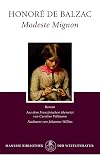
Modeste Mignon
by Honoré de Balzac
Studies of Manners (5), Scenes from Private Life (5), The Human Comedy (Études de Moeurs - Scènes de la vie privée IV | 22)
On This Page
Description
This new handbook covers the world of biophotonics not only geographically - with editors coming from different continents - but also and most importantly in terms of content, since the authors deal with the whole spectrum of biophotonic basic and applied research. Designed to set the standard for the scientific community, these three volumes break new ground by providing readers with the physics basics as well as the biological and medical background, together with detailed reports on show more recent technical advances. The handbook also adopts an application-related approach, starting with the application and then citing the various tools to solve the scientific task, making it of particular value to medical doctors. The result is a handy source for scientists seeking the basics in a condensed form, and equally a reference for quickly gathering knowledge from neighboring disciplines. Absolutely invaluable for biophotonic scientists in their daily work. The Editors: Professor Jürgen Popp Institute of Physical Chemistry, Friedrich-Schiller-University Jena and Institute of Photonic Technology, Jena, Germany Professor Valery V. Tuchin Saratov State University, Saratov, Russia Professor Arthur Chiou National Yang Ming University, Taipei, Taiwan Professor Stefan H. Heinemann Institute of Biochemistry and Department of Biophysics, Friedrich-Schiller- University Jena, Germany From the contents of Volume 3 - Photonics in Pharmaceutics, Bioanalysis and Environmental Research: ● Process Control and Quality Assurance ● On-Site Analysis ● Security Applications ● High Throughput and Content Screening show lessTags
Recommendations















Member Reviews
Modeste is a classic case of that 19th century obsession, the young woman who has read too many novels and poems. Her father, who has left her at home in Le Havre while he goes to Asia to try to rescue the finances of his shipping business, has left strict instructions with his business partner to keep an eye on her and make sure she doesn't get involved with an unsuitable man. Nonetheless, she manages to send off a clandestine fan-letter to Canalis, the popular romantic poet of the moment, and she soon finds herself engaged in a torrid correspondence in the best Bettina Brentano tradition (her correspondent actually cites Bettina as an example of why you shouldn't send unsolicited letters to poets: "If I were Bettina, I would never show more have become Frau von Arnim," she replies, sniffily). However, it isn't Canalis who is replying to her letters at all, but his much less romantic friend and secretary, Ernest de La Brière, to whom the cynical poet has passed this umpteenth fan-letter from a provincial unknown. A sure recipe for chaos, exacerbated when Modeste's identity is revealed just at the moment when there are rumours that her father is coming back from Asia with cargoes worth millions: it's not long before she has not one but three suitors sniffing around her door...
Balzac wrote this book after a lengthy stay in St Petersburg with the great love of his life, Ewelina Hańska, who seems to have been the inspiration for the central character, and perhaps that explains the unusually sunny mood - probably about as near as Balzac ever gets to being Jane Austen(!). Much like Northanger Abbey, it manages to satirise romantic plot conventions whilst staying (almost) entirely within the framework of what's permissible in a bourgeois romance. Although there's a certain amount of interest paid to the shipping trade and the provincial life of Le Havre, it is all quite sketchy, and Balzac never really seems to have captured the mood of the town in the sort of way he characterises Angoulême in Lost illusions. The main interest of the book, outside the plot itself, is in Balzac's magnificently offhand critiques of the greats of Romantic literature.
Entertaining social comedy, but probably not top-rate Balzac. show less
Balzac wrote this book after a lengthy stay in St Petersburg with the great love of his life, Ewelina Hańska, who seems to have been the inspiration for the central character, and perhaps that explains the unusually sunny mood - probably about as near as Balzac ever gets to being Jane Austen(!). Much like Northanger Abbey, it manages to satirise romantic plot conventions whilst staying (almost) entirely within the framework of what's permissible in a bourgeois romance. Although there's a certain amount of interest paid to the shipping trade and the provincial life of Le Havre, it is all quite sketchy, and Balzac never really seems to have captured the mood of the town in the sort of way he characterises Angoulême in Lost illusions. The main interest of the book, outside the plot itself, is in Balzac's magnificently offhand critiques of the greats of Romantic literature.
Entertaining social comedy, but probably not top-rate Balzac. show less
Typical romantic comedy devices at play here, although in Balzac's inimitable style: Poor girl falls for wrong guy, right guy pretends to be wrong guy, dwarf intervenes, poor girl becomes rich girl, wrong guy and other wrong guy compete with right guy for her hand, dwarf intervenes. Not the kind of story I normally gravitate to, but Balzac makes it enjoyable enough.
Probably one of Balzac’s most romantic and idealistic novels, telling a story of true love, assumed identity, and psychological tension. There are some interesting and well-developed supporting characters in here, as is usual for Balzac, including the dwarf and the poet. Not quite one of his best, but distinctive for its brighter tone and happy ending.
Příběh mladé, krásné a romantické Modesty a jejích lásek, její vzpoury proti společenskému zvyku vdát se pro peníze, její touhy po skutečném vztahu je vykreslen s hlubokou znalostí prostředí a psychologie hrdinů, jak je pro Balzaca příznačné.
Jun 24, 2024Czech
AG-1
Sep 11, 2020Catalan
Ratings
Members
- Recently Added By
Lists

French Fiction of the 18th and 19th Centuries in English Translation
169 works; 3 members

la comédie humaine
47 works; 1 member
Author Information

Born on May 20, 1799, Honore de Balzac is considered one of the greatest French writers of all time. Balzac studied in Paris and worked as a law clerk while pursuing an unsuccessful career as an author. He soon accumulated enormous debts that haunted him most of his life. A prolific writer, Balzac would often write for 14 to-16 hours at a time. show more His writing is marked by realistic portrayals of ordinary, but exaggerated characters and intricate detail. In 1834, Balzac began organizing his works into a collection called The Human Comedy, an attempt to group his novels to present a complete social history of France. Characters in this project reappeared throughout various volumes, which ultimately consisted of approximately 90 works. Some of his works include Cesar Birotteau, Le Cousin Pons, Seraphita, and Le Cousine Bette. Balzac wed his lifelong love, Eveline Hanska in March 1850 although he was gravely ill at the time. Balzac died in August of that year. (Bowker Author Biography) show less
Some Editions
Series


Work Relationships
Common Knowledge
- Canonical title
- Modeste Mignon
- Original title
- Modeste Mignon
- Original publication date
- 1844
- People/Characters*
- Simon Babylas Latournelle; Agnès Latournelle; Jean Butscha; Exupère Latournelle,; Charles Mignon de La Bastie; Madame Mignon (show all 7); Modeste Mignon
- Dedication
- To a Polish Lady. Daughter of an enslaved land, angel through love, witch through fancy, child by faith, aged by experience, man in brain, woman in heart, giant by hope, mother through sorrows, poet in thy dreams, --- to thee... (show all) belongs this book, in which thy love, the fancy, thy experience, thy sorrow, thy hope, thy dreams, are the warp through which is shot a woof less brilliant than the poesy of thy soul, whose expression, when it shines upon they countenance, is, to those who love thee, what the characters of a lost language are to scholars. De Balzac.
*Some information comes from Common Knowledge in other languages. Click "Edit" for more information.
Classifications
Statistics
- Members
- 135
- Popularity
- 242,747
- Reviews
- 5
- Rating
- (3.44)
- Languages
- 8 — English, French, German, Italian, Romanian, Russian, Spanish, Turkish
- Media
- Paper, Ebook
- ISBNs
- 38
- ASINs
- 15