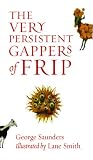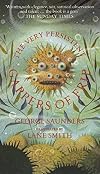
The Very Persistent Gappers of Frip
by George Saunders
On This Page
Description
"In the seaside village of Frip live three families: the Romos, the Ronsens, and a little girl named Capable and her father. The economy of Frip is based solely on goat's milk, and this is a problem because the village is plagued by gappers: bright orange, many-eyed creatures the size of softballs that love to attach themselves to goats. When a gapper gets near a goat, it lets out a high-pitched shriek of joy that puts the goats off giving milk, which means that every few hours the children show more of Frip have to go outside, brush the gappers off their goats, and toss them into the sea. The gappers have always been everyone's problem, until one day they get a little smarter, and instead of spreading out, they gang up: on Capable's goats. Free at last of the tyranny of the gappers, will her neighbors rally to help her? Or will they turn their backs, forcing Capable to bear the misfortune alone?"--Excerpt from Amazon.com. show lessTags
Recommendations






Member Recommendations

Member Reviews
This is a kids' picture book written by acclaimed literary author George Saunders. Or maybe it's just a George Saunders story cleverly disguised as a kids' book, because while it's perfectly suitable for kids (or at least for ones with decent-sized vocabularies), it delighted this particular adult as much as any of Saunders' stories ever has. It's hilarious and weird and sly and relevant, not to mention wonderfully illustrated, and I had a big grin on my face through pretty much the entire thing.
In the tiny seaside village of Frip - three houses, ten people, and numerous goats - the residents find themselves beset by gappers, tiny burr-like creatures that attach themselves to the local goats and shriek with joy, eventually driving their caprine victims into a decline. The children of Frip all spend their days ridding their goats of gappers, and throwing the pests into the sea, only to see them return the next day. Then one day, rather than attacking the goats belonging to all three of the village's families, they all attack young Capable and her father's tribe. The other two families, deciding that there must be a reason they have been more fortunate than their neighbors, refuse to help. When Capable gets rid of her goats, show more turning to fishing instead, and the gappers begin to target the other two families, will she likewise refuse to help...?
After the rave reviews from a number of friends and co-workers, I really expected to love The Very Persistent Gappers of Frip, but somehow, despite appreciating its social commentary in the abstract, I found it vaguely unsatisfying. Perhaps because the messages it seeks to communicate - humanity's lamentable tendency to look for reasons of character to explain differing levels of economic prosperity, rather than attributing much (or part) of one's social welfare to chance; the importance of not returning unjust behavior for unjust behavior - are delivered in such a ham-handed, obvious way, this short novella began to feel more like a vehicle than a true story to me. I felt, while reading, as if I should be finding the book funnier than I did. Humor is highly idiosyncratic, of course, so others will take it all in differently. However that may be, I did enjoy the idea of the book, and I found the illustrations by Lane Smith quite appealing, so I'm glad to have read it. Recommended to those who enjoy allegorical fiction, or who admire Lane Smith's artwork. show less
After the rave reviews from a number of friends and co-workers, I really expected to love The Very Persistent Gappers of Frip, but somehow, despite appreciating its social commentary in the abstract, I found it vaguely unsatisfying. Perhaps because the messages it seeks to communicate - humanity's lamentable tendency to look for reasons of character to explain differing levels of economic prosperity, rather than attributing much (or part) of one's social welfare to chance; the importance of not returning unjust behavior for unjust behavior - are delivered in such a ham-handed, obvious way, this short novella began to feel more like a vehicle than a true story to me. I felt, while reading, as if I should be finding the book funnier than I did. Humor is highly idiosyncratic, of course, so others will take it all in differently. However that may be, I did enjoy the idea of the book, and I found the illustrations by Lane Smith quite appealing, so I'm glad to have read it. Recommended to those who enjoy allegorical fiction, or who admire Lane Smith's artwork. show less
Poor Gappers! They just want to climb on the goats and shriek with happiness.
Poor goats! If they can’t sleep from the shrieking, then they can’t make milk!
A girl named Capable and her father have been trying to survive since Capable’s mother died earlier this year. Dad really would like things to stay exactly as they were that day, including the sun staying up and all his meals made of white food. Poor Capable has her hands full carrying the gappers back to the sea and preparing a chalk mixture to make Dad’s meals look white. One day, the smartest gapper realizes that Capable’s goats are fifteen feet closer than the goats of the other two families of Frip, so they descend en mass to happily visit Capable’s goats. What will show more she do? Will her neighbors help?
A clever enough tale, TVPGoF feels a little arch, a little self-congratulatory, a little too hip. There’s something about it that screams for attention despite lacking the charm of other children’s books (Fly by Night, The Girl Who Circumnavigated…). I guess I tentatively like the moral, although the narrative feels surprisingly condemning in the process of getting there. There is a surprising obstacle or two before it resolves as expected.
But what’s a children’s book without illustrations? And like The Stinky Cheese book, I’m not sure these pictures are designed to appeal to younger eyes. People resemble the distorted figures of A Nightmare Before Christmas. It’s a muted, fall palette and with detail more appropriate to a demographic that can appreciate the weathered patina on a house, or the jail-like costuming of the movers. A far cry, to be sure, from the books where a picture brings something about the story to be discovered. Still, the gappers manage to be almost cute, facilitating the idea that they are just animals doing their thing, and the goats are very goat-like. Artistically, it is well done, just not the kind of style that appeals to me personally. show less
Poor goats! If they can’t sleep from the shrieking, then they can’t make milk!
A girl named Capable and her father have been trying to survive since Capable’s mother died earlier this year. Dad really would like things to stay exactly as they were that day, including the sun staying up and all his meals made of white food. Poor Capable has her hands full carrying the gappers back to the sea and preparing a chalk mixture to make Dad’s meals look white. One day, the smartest gapper realizes that Capable’s goats are fifteen feet closer than the goats of the other two families of Frip, so they descend en mass to happily visit Capable’s goats. What will show more she do? Will her neighbors help?
A clever enough tale, TVPGoF feels a little arch, a little self-congratulatory, a little too hip. There’s something about it that screams for attention despite lacking the charm of other children’s books (Fly by Night, The Girl Who Circumnavigated…). I guess I tentatively like the moral, although the narrative feels surprisingly condemning in the process of getting there. There is a surprising obstacle or two before it resolves as expected.
But what’s a children’s book without illustrations? And like The Stinky Cheese book, I’m not sure these pictures are designed to appeal to younger eyes. People resemble the distorted figures of A Nightmare Before Christmas. It’s a muted, fall palette and with detail more appropriate to a demographic that can appreciate the weathered patina on a house, or the jail-like costuming of the movers. A far cry, to be sure, from the books where a picture brings something about the story to be discovered. Still, the gappers manage to be almost cute, facilitating the idea that they are just animals doing their thing, and the goats are very goat-like. Artistically, it is well done, just not the kind of style that appeals to me personally. show less
What a marvelous morality tale. The lesson is one that grownups also ought to hear. I love that an author who can write masterful adult literature as Lincoln in the Bardo, can also tell a children's story, in children's prose, that delivers the same level of insight into human nature. This book also makes a great graduation gift.
The Gappers are persistent, indeed! The flashy cover and size of the book called out to me from new arrival section and before you know it Gappers were in my house.
Gappers are orange, multi-eyed creatures that live in the sea near the coast of Frip. Every night they venture from the sea to three farms with goat yards. Gappers love to attach themselves to the goats which forces the children to brush them off every morning and throw them back into the sea. The smartest of the Gappers says instead of splitting up lets all go to the farm closest to the sea and we don't need to go as far. Young Capable, awakes to 3 times the usual amount of Gappers and her goats are in agony and won't give milk. Capable, however, is a real match for the show more Gappers and when options fall flat she takes matters into her own hands which changes the way Frip has lived for ages.
A smart little book with life lessons that are well known but could and should be shared with children and refreshed with adults. show less
Gappers are orange, multi-eyed creatures that live in the sea near the coast of Frip. Every night they venture from the sea to three farms with goat yards. Gappers love to attach themselves to the goats which forces the children to brush them off every morning and throw them back into the sea. The smartest of the Gappers says instead of splitting up lets all go to the farm closest to the sea and we don't need to go as far. Young Capable, awakes to 3 times the usual amount of Gappers and her goats are in agony and won't give milk. Capable, however, is a real match for the show more Gappers and when options fall flat she takes matters into her own hands which changes the way Frip has lived for ages.
A smart little book with life lessons that are well known but could and should be shared with children and refreshed with adults. show less
Hmm, well this is an odd, odd, little book -- more of a short story fairy tale than anything else, but the illustrations add to the work, and it's definitely worth the read for the pure pleasure of language in saying the very persistent gappers of Frip, and for talking about goats, and just in general.
Read this for the third time (it’s 84 pages, illustrated) and this time I did it aloud to Luke. It’s the story of a girl named Capable living in the town of Frip who’s exhausted from her job of brushing off gappers from her goats on a daily basis. Gappers are baseball-sized, multi-eyed creatures that adhere themselves to goats and then shriek joyfully. The goats get put out. Capable’s neighbors are buffoons and she comes up with a plan. It’s a bizarre and occasionally funny tale which has the importance of being neighborly as a lesson learned. George Saunders is more well-known for his offbeat short story collections (I’ve read ‘em). This book is gorgeously illustrated by Lane Smith (of Stinky Cheese Man fame).
Members
- Recently Added By
Lists

Biggest Disappointments
606 works; 164 members

Youth: Social Values
194 works; 1 member

Favorite Picture Books
479 works; 160 members
Talk Discussions
Past Discussions
Happy sea creatures cling to fence singing at goats in Name that Book (September 2014)
Author Information

50+ Works 25,490 Members
George Saunders is the author of CivilWarLand in Bad Decline and Pastoralia. (Publisher Provided) George Saunders was born in Amarillo, Texas on December 2, 1958. He received a bachelor's degree in geophysical engineering and a master's degree in creative writing from Syracuse University. He is a professor at Syracuse University and a writer of show more short stories, essays, novellas, and children's books. He won the National Magazine Award for fiction in 1994, 1996, 2000, and 2004 His books include CivilWarLand in Bad Decline, Pastoralia, The Very Persistent Gappers of Frip, The Brief and Frightening Reign of Phil, In Persuasion Nation, and Tenth of December: Stories, which won the inaugural Folio Prize in 2014. His debut novel, Lincoln in the Bardo, received the Man Booker Prize in 2017. (Bowker Author Biography) show less
All Editions
Awards and Honors
Common Knowledge
- Canonical title*
- De zeer volhardende Gappers van Frip
- Original title
- The Very Persistent Gappers of Frip
- Original publication date
- 2000
- People/Characters
- Capable
- Important places
- Frip
- Dedication
- to Toddy —LS
to Alena and Caitlin, both very Capable —GS - First words
- Ever had a burr in your sock?
Tu as deja eu une teigne dans la chausette? - Last words
- (Click to show. Warning: May contain spoilers.)Which is how Frip came to be what it is today: a seaside town known for its relatively happy fisherpeople and its bright orange shrieking fences. The End.
(Click to show. Warning: May contain spoilers.)C'est qinsi que Frip devint ce qu'il est aujourd'hui: un village du bord de mer, repute pour ses pecheurs plutot heureux et ses clotures orange vif qui poussent des cris de joie percants. - Blurbers
- Coles, Robert
*Some information comes from Common Knowledge in other languages. Click "Edit" for more information.
Classifications
Statistics
- Members
- 875
- Popularity
- 30,836
- Reviews
- 32
- Rating
- (3.97)
- Languages
- 6 — Dutch, English, French, German, Italian, Portuguese
- Media
- Paper, Audiobook, Ebook
- ISBNs
- 19
- ASINs
- 8