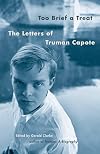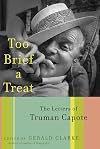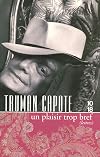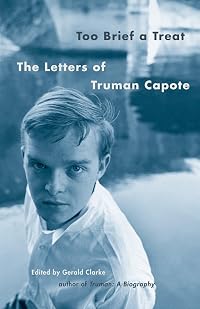
Too Brief a Treat: The Letters of Truman Capote
by Truman Capote
On This Page
Description
"In Too Brief a Treat, the biographer Gerald Clarke brings together for the first time the private letters of Truman Capote. Spanning more than four decades, these letters reveal the inner life of one of the twentieth century's most intriguing personalities. As Clarke notes in his Introduction, Capote was an inveterate correspondent who both loved and craved love without inhibition. He wrote letters as he spoke: emphatically, spontaneously, and passionately. He also wrote them at a breakneck show more pace, unconcerned with posterity. Thus, in this volume we have perhaps the closest thing possible to an elusive treasure: a Capote autobiography." "Through his letters to the likes of William Styron and Gloria Vanderbilt, as well as to his publishers and editors, his longtime companion and lover Jack Dunphy, and others, we see Capote in all his life's phases - the uncannily self-possessed naif who jumped headlong into the dynamic post-World War II New York literary scene, and the more mature, established Capote of the 1950s. Then there is the Capote of the early 1960s, immersed in the research and writing of his masterpiece, In Cold Blood. Capote's correspondence with Kansas detective Alvin Dewey, and with Perry Smith, one of the killers profiled in that work, demonstrates the writer's intense devotion to his craft, while his letters to friends like Cecil Beaton show Capote giddy with his emergence as a flamboyant mass-media celebrity following In Cold Blood's publication. Finally, we see Capote later in his life, as things seemed to be unraveling: disillusioned, isolated by his substance abuse and by personal rivalries. (Ever effusive with praise and affection, Capote could nevertheless carry a grudge like few others.)"--Jacket. show lessTags
Recommendations






Member Reviews
Again with my obsession. Reading these letters was a treat. Capote agonized over every word in his published work, so it was fun to read things he just tossed off as if he was chatting to a friend (which he did mostly by letter for many, many years). The letters reveal a kind, loving soul; not the impression one would get if one only knew about his rather wild later years. Many of the letters are gossipy, many are poignant enough to break your heart.
Books like this also make me sad, in a way, that technology has changed. I mean, who's going to want to read "The Collected E-mails of So-and-So"?
I do strongly recommend this book for Capote devotees.
Some of my favorite bits:
pp. 45,46, from a letter to Robert Linscott (his editor): I am show more working on the book and it is really my love and today I wrote two pages and oh Bob I do want it to be a beautiful book because it seems important to me that people try to write beautifully, now more than ever because the world is so crazy and only art is sane and it has been proven time after time that after the ruins of a civilization are cleared away all that remains are the poems, the paintings, the sculpture, the books.
p. 54, from a letter to Leo Lerman: If it were not for N. and you and my friends I would never come home. Not that I think it is so much better here, it is merely that I am better. Or maybe that is only because so far I don't understand the meanings of things too well, and am therefore not disturbed, as I would be at home, by the look of a child's face, a tone of voice, an accent, the quality of light in a street: nothing connects with memory, reverberates: do you see what I mean, how nice it is not to be pursued by desperate knowledge?
p. 102, from a letter to Andrew Lyndon: A copy of The World Next Door has reached me; have you tried to read it? Every now and then there are some good things in it--but I've never had the patience to pick raisins out of pudding--and God knows he writes a pudding prose, weak, lazy, hurried.
p. 123, from a letter to Leo Lerman: ...and I've got a start on the book that all along I should've known was the one possible book for me--because it really is mine. There is always such a tragic tendency to disregard what is one's own--just as we are often nicer to strangers than we are to our friends.
p. 398, from a letter to Alvin Dewey III: One cannot be taught to write. One can only learn to write by writing--and reading. Reading good books written by real artists--until you understand why they are good. I'm quite sure you have never done this; and you must.
p. 404, from a letter to Alvin Dewey III: However, you go out of your way to find an odd or long word, where a simpler one would do. Most beginning writers do this--apparently under the impression that good writing is fancy writing. It isn't. Strive for simplicity--the plain, everyday word is usually the best. It is how you arrange them that counts. show less
Books like this also make me sad, in a way, that technology has changed. I mean, who's going to want to read "The Collected E-mails of So-and-So"?
I do strongly recommend this book for Capote devotees.
Some of my favorite bits:
pp. 45,46, from a letter to Robert Linscott (his editor): I am show more working on the book and it is really my love and today I wrote two pages and oh Bob I do want it to be a beautiful book because it seems important to me that people try to write beautifully, now more than ever because the world is so crazy and only art is sane and it has been proven time after time that after the ruins of a civilization are cleared away all that remains are the poems, the paintings, the sculpture, the books.
p. 54, from a letter to Leo Lerman: If it were not for N. and you and my friends I would never come home. Not that I think it is so much better here, it is merely that I am better. Or maybe that is only because so far I don't understand the meanings of things too well, and am therefore not disturbed, as I would be at home, by the look of a child's face, a tone of voice, an accent, the quality of light in a street: nothing connects with memory, reverberates: do you see what I mean, how nice it is not to be pursued by desperate knowledge?
p. 102, from a letter to Andrew Lyndon: A copy of The World Next Door has reached me; have you tried to read it? Every now and then there are some good things in it--but I've never had the patience to pick raisins out of pudding--and God knows he writes a pudding prose, weak, lazy, hurried.
p. 123, from a letter to Leo Lerman: ...and I've got a start on the book that all along I should've known was the one possible book for me--because it really is mine. There is always such a tragic tendency to disregard what is one's own--just as we are often nicer to strangers than we are to our friends.
p. 398, from a letter to Alvin Dewey III: One cannot be taught to write. One can only learn to write by writing--and reading. Reading good books written by real artists--until you understand why they are good. I'm quite sure you have never done this; and you must.
p. 404, from a letter to Alvin Dewey III: However, you go out of your way to find an odd or long word, where a simpler one would do. Most beginning writers do this--apparently under the impression that good writing is fancy writing. It isn't. Strive for simplicity--the plain, everyday word is usually the best. It is how you arrange them that counts. show less
Interessant per a amants de l'obra de Capote, com jo, donat que en moltes cartes trobem informació interessant sobre les seves obres i el procès creatiu, però en molts moments es fa avorrit i pesat.
Jan 6, 2023Catalan
Ratings
Members
- Recently Added By
Author Information

178+ Works 57,372 Members
Truman Capote, 1924 - 1984 Novelist and playwright Truman Streckfus Person was born in 1924 in New Orleans to a salesman and a 16-year-old beauty queen. His parents divorced when he was four years old and was then raised by relatives for a few years in Monroeville. His mother was remarried to a successful businessman, moved to New York, and Truman show more adopted his stepfather's surname. He attended Greenwich High School and never went to college. When he was 17, Capote's formal education ended when he was employed at The New Yorker magazine. He belived he did not need to go to college to be a writer, since he was writing seriously since age 11. Capote's first novel was "Other Voices, Other Rooms" (1948), which told the story of a boy growing up in the Deep South. "The Grass Harp" (1951) is about a young boy and his elderly cousin discovering that some compromise is necessary for people to live together in a community and was adapted to screen in 1996. The play "The House of Flowers" (1954) is a musical set in a West Indies bordello. Capote then wrote, "Breakfast at Tiffanys" (1958), which tells the story of how Holly Golightly goes to New York seeking happiness. Capote became preoccupied with journalism and, sparked by the murder of a wealthy family in Holcomb, Kansas, began interviewing the locals to recreate the lives of the murderers and their victims. The research and writing for this novel, "In Cold Blood" (1966), took six years for him to complete. Other works of Capote's include the classic "A Christmas Memory" (1966), which is an autobiographical account of a seven-year-old boy, his cousin, and an eccentric old lady, "Music for Chameleons" (1981), which is a collection of short pieces, interviews, stories and conversations that were published in several magazines, and "One Christmas" (1982). On August 26, 1984 in Los Angeles, Truman Capote died of liver disease complicated by phlebitis and multiple drug intoxication. Published after his death were "Conversations With Capote" (1985) and "Answered Prayers: The Untitled Novel" (1986). (Bowker Author Biography) show less
All Editions
Some Editions
Common Knowledge
- Original publication date
- 2005
Classifications
- Genres
- Biography & Memoir, Fiction and Literature, Literature Studies and Criticism
- DDC/MDS
- 813.54 — Literature & rhetoric American literature in English American fiction in English 1900-1999 1945-1999
- LCC
- PS3505 .A59 .Z495 — Language and Literature American literature American literature Individual authors 1900-1960
- BISAC
Statistics
- Members
- 227
- Popularity
- 144,119
- Reviews
- 2
- Rating
- (3.81)
- Languages
- 5 — English, French, Italian, Portuguese, Spanish
- Media
- Paper, Ebook
- ISBNs
- 11
- ASINs
- 2