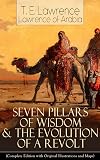
Seven Pillars of Wisdom & The Evolution of a Revolt (2 Books)
by T. E. Lawrence 
On This Page
Description
This volume contains the extraordinary book "Seven Pillars of Wisdom", as well as an amazing article titled THE EVOLUTION OF A REVOLT in which T.E.Lawrence explains his arab campaigns. The Seven Pillars of Wisdom is T.H. Lawrence's -better known as LAWRENCE OF ARABIA- major work, an account of his war experiences, edited by non other than GEORGE BERNARD SHAW. The story has inspired several movies, turning Lawrence of Arabia into a character of legend. During the war, Lawrence fought show more alongside Arab irregular troops under the command of Emir Faisal, a son of Sherif Hussein of Mecca, in extended guerrilla operations against the armed forces of the Ottoman Empire (Turkey). Lawrence obtained assistance from the Royal Navy to turn back an Ottoman attack on Yanbu in December 1916. His major contribution to the revolt was convincing the Arab leaders (Faisal and Abdullah) to co-ordinate their actions in support of British strategy. He persuaded the Arabs not to make a frontal assault on the Ottoman stronghold in Medina but to allow the Turkish army to tie up troops in the city garrison. The Arabs were then free to direct most of their attention to the Turks' weak point, the Hejaz railway that supplied the garrison. This vastly expanded the battlefield and tied up even more Ottoman troops, who were then forced to protect the railway and repair the constant damage. Lawrence developed a close relationship with Faisal, whose Arab Northern Army was to become the main beneficiary of British aid. show lessTags
Members
- Recently Added By
Lists

Non-fiction
55 works; 1 member
Author Information

100+ Works 7,923 Members
Born in Caernarvonshire in North Wales and educated at Oxford University, T. E. Lawrence was a soldier, author, archaeologist, traveler, and translator. After participating in archaeological expeditions in the Middle East from 1911 to 1914, he worked for British Army intelligence in North Africa during World War I. In 1916 he joined the Arab show more revolt against the Turks and became known as Lawrence of Arabia, the man who freed the Arabs from Turkish rule. The manuscript of his The Seven Pillars of Wisdom (1926) was lost when it had been two-thirds finished, and he rewrote the book from memory in 1919. Because it expressed certain personal and political opinions that Lawrence did not wish to publicize, it was offered for sale in 1926 in England at a prohibitive price. To ensure copyright in the United States, it was reprinted here by Doran (now Doubleday) and 10 copies were offered for sale at $20,000 each, a price "high enough to prevent their ever being sold." Doubleday then brought out a limited edition and a trade edition, substantially the same as the rare 1926 edition.Revolt in the Desert (1927) is an abridgment of The Seven Pillars, which the author made to pay the printing expenses of the original. The Mint (1955), an account of his service with the Royal Air Force, was published posthumously in an edition of 50 copies, 10 of which were offered for sale at a price of $500,000 each, to ensure no copies being sold. In 1950 a popular edition, in 1955 a limited edition, and in 1963 a paperback edition were published. After World War I, Lawrence enlisted in the Royal Air Force as Private John Hume Ross; when his real identity was discovered, he transferred to the Royal Tank Corps under the name T. E. Shaw, a name he legally assumed in 1927. In 1937 Lawrence was killed when the motorbike given to him by George Bernard Shaw (see Vol. 1) went out of control on an English country lane. Earlier biographers, including Lowell Thomas and Robert Graves, were enthusiastic and laudatory of Lawrence. Twenty years after his death, Richard Aldington wrote Lawrence of Arabia: A Biographical Enquiry, which "set off a fury of charge and countercharge." But Lawrence's saga had become legend. In tribute to this adventurous, enigmatic genius, who shunned fame, wealth, and power, King George V wrote, "His name will live in history." Public interest in "the elusive, mysterious and complex young Irishman" who led the Arab revolt was revived by Lawrence of Arabia, 1962's most honored film. In recent years the picture of Lawrence has changed again with the revelation of his illegitimacy, his readiness to embroider the truth, and other quirks and neuroses; but there were English witnesses to many of his accomplishments, and the disagreements among those who knew him have hindered efforts to discredit him in any definitive manner; even the Arabs view him with their Arab pride at stake. He remains enigmatic and eccentric, and is likely to be the subject of more research and many volumes before the truth about him is finally and fully understood. (Bowker Author Biography) show less
T. E. Lawrence has a Legacy Library. Legacy libraries are the personal libraries of famous readers, entered by LibraryThing members from the Legacy Libraries group.
Work Relationships
Contains
Common Knowledge
- People/Characters
- T. E. Lawrence
- Important places
- Arabia; Ottoman Empire
- Important events
- Arab Revolt
Classifications
- Genres
- Nonfiction, History, Biography & Memoir
- BISAC
Statistics
- Members
- 10
- Popularity
- 2,144,560
- Languages
- Czech, English
- Media
- Paper, Ebook
- ISBNs
- 4
- ASINs
- 2