

Cannery Row | Of Mice and Men
by John Steinbeck
On This Page
Description
TheLiterature Made Easy Series is more than just plot summaries. Each book describes a classic novel and drama by explaining themes, elaborating on characters, and discussing each author's unique literary style, use of language, and point of view. Extensive illustrations and imaginative, enlightening use of graphics help to make each book in this series livelier, easier, and more fun to use than ordinary literature plot summaries. An unusual feature, "Mind Map" is a diagram that summarizes show more and interrelates the most important details that students need to understand about a given work. Appropriate for middle and high school students. show lessTags
Recommendations




















Member Reviews
** Spoilers ahoy! **
At the end of the book, there is a note describing the way Steinbeck wrote this novel. It was an experiment in playable novel; that is a novel written as if it were a play. With limited locales, lots of dialogue and the chapters representing acts. It comes off very well. I could picture in my mind the bunkhouse, the barn and the little glade by the river. Equally well described were the men themselves. The action was swift and the characters very sympathetic. Even though there was so much foreshadowing, I still nearly cried at the end when George had to kill Lennie before the irate laborers, led by the boss’ son got to him.
At the end of the book, there is a note describing the way Steinbeck wrote this novel. It was an experiment in playable novel; that is a novel written as if it were a play. With limited locales, lots of dialogue and the chapters representing acts. It comes off very well. I could picture in my mind the bunkhouse, the barn and the little glade by the river. Equally well described were the men themselves. The action was swift and the characters very sympathetic. Even though there was so much foreshadowing, I still nearly cried at the end when George had to kill Lennie before the irate laborers, led by the boss’ son got to him.
On the first page Steinbeck describes the scenery around the Salinas river and a path from the highway that leads down to a green pool. There are two figures in this landscape and immediately one has the feeling there is something odd about them because Steinbeck says:
“They had walked in single file down the path and even in the open one had stayed behind the other.”
The two men are George Milton and Lennie Smalls and we learn that they are itinerant workmen walking to their next job. We also learn that while George is clever and smart Lennie has what we would call today “Learning Difficulties” It is clear that Lennie could not survive in the world without George to look after him and in addition Lennie is always getting into show more trouble, because he is a giant of a man who cannot control his own strength and so the question posed in the readers mind is why does George care and look after Lennie. The answer to this makes up one of the key themes to this novel.
The book is set in America during the depression, work is hard to come by and only back breaking menial tasks are available to the likes of George and Lenny. It is a cruel and heartless world and at once the reader feels sympathy for the childlike Lennie and for George his friend and protector. The poverty and the daily grind of trying to survive has made many working men bitter and deeply suspicious of one another, there is no way out of the poverty trap. They are in no position to marry or raise a family and must continue to tramp the highways looking for work at one ranch after another. George and Lenny get to their next workstation and flop down in a dormitory provided for the workers, they have missed the work detail of that morning, but manage to get fed at lunchtime. We meet their fellow workers and George has constantly to shield Lennie from prying questions; he is lucky on the one hand but unlucky on the other. Slim is an intelligent and good foreman, but the bosses son Curly is a short man always out to prove himself and he immediately sees a chance to pick on Lennie. Steinbeck is excellent at making the reader feel the tensions among the working men. They are all loners, not by choice but by situation, some have been almost dehumanised and are immediately suspicious of George’s friendship with Lennie. George explains this away by saying that he was charged by Lennie’s Aunt Clare to look after him, because he is not very bright, but the real reason is that George does not want to be alone. He has a friend and someone to protect which the other men do not have.
Candy who has lost a hand, clings desperately to an old sick dog, Crooks the broken backed negro locks himself away from all human contact, but when these two hear George talk about buying a plot of land that will be enough to support himself and Lennie, they all want in. It is a dream and the only dream they have, even though it is completely unattainable. The American dream even this one reduced to its most basic of needs will remain a dream for these men. Curly’s wife/Curly’s girl is not given a name, the only female character in the book. She is also desperately alone because as she says Curly is so jealous of her that the only person she can talk to is Curly. She is just as trapped in her loneliness as the men. They all avoid her because they don’t want to tangle with Curly who spends all of his time looking for his wife.
Steinbeck makes his characters pitch perfect. It is a world that exists where racism and sexism are part of normal everyday life and the reader must put himself/herself in that world to fully appreciate the novel. Steinbeck’s writing makes this easy for us to accept the situation and to follows his characters as they play out a tragedy that seems inevitable. It is a novel of desperation and false hope only alleviated by the humanity of characters like George and Slim.
Cannery Row was published eight years later and while some of the worst aspects of the depression have been eased, it is still a hard life for the inhabitants of Cannery row a small industrial town just down the coast a little from Monterey. Many of the inhabitants make their living from the sardine canning factory right on the coastline, but Steinbeck focuses his book on a collection of oddball characters that live around a vacant plot of land in the centre of town. There is Mack the leader of a group of vagrants who settle down in an old warehouse, there is Lee Chong the owner of the local store that sells everything, there is Doc the philanthropic owner of Western Biological and Dora Flood who owns and runs the local whorehouse. Whereas Of Mice and Men is a story set in the Depression; Cannery Row is more like a tone poem, a slice of life and has qualities that set it apart from the earlier novel.
There is a magical quality that permeates Cannery Row, in fact the novel has more than a hint of magical realism. The very description of Western Biological where you can order anything living and sooner or later you will get it and Doc himself who is described as living in a world of wonders of excitement: he is the fountain of philosophy. of literature and art. Small happenings in the town seem like out of world experiences: the ten year old Andy who stares deep into the Chinamans eyes and sees a world in which he is totally alone, the shipbuilder Henri who sees a ghost/vision on his boat of a beautiful young man slitting the throat of a young boy are two examples.
It is a tone poem because of the superb descriptions of the details of the town and seashore, given to us at different times of the day. There is a quality in the writing that transcends a rather scruffy little town into something both beautiful and magical. The vacant lot is transformed into a place of wonder where even the weeds are a verdant green and it becomes home to a variety of people.
“It has always seemed strange to me said Doc The things we admire in men, kindness openness, honesty, understanding and feeling are the concomitants of failure in our system. And those traits we detest, sharpness, greed, acquisitiveness, means, egotism and self-interest are then traits of success”.
These are Doc”s thoughts but they could be echoed by Mack and his gang of vagabonds referred to as the Virtues, the Beatitudes, the Beauties. There is a feeling of people opting out of the general run of society and they work, live and learn to trust each other in a living breathing community side by side of the American Dream. They make mistakes and inevitably have to pay for them, but they make their own mistakes. The book is shot through with good natured humour: the frog hunts are very funny and many of the characters brought a wry smile to this readers face.
The theme of loneliness is again present in Cannery Row, but individuals feelings of being alone are now offset by the sense of community they share with the other inhabitants. There is a wish to help each other, when they can and therefore the desperation of [Of Mice and Men] is largely absent. I have a slight uneasiness about Steinbeck”s good characters, George in Of Mice and Men and Doc and Mack in Cannery Row: perhaps the are a little over-romanticised.
Both of theses novels were five star reads for me and while I thought Of Mice and Men was a great reading experience I don’t think I would have much to gain from a re-read, apart from the simple enjoyment of reading, however Cannery Row is different entirely, because the quality of the prose takes it to another level and because the themes and ideas that are also present in Of Mice and Men are expressed in such a way that they can be more than they seem. show less
“They had walked in single file down the path and even in the open one had stayed behind the other.”
The two men are George Milton and Lennie Smalls and we learn that they are itinerant workmen walking to their next job. We also learn that while George is clever and smart Lennie has what we would call today “Learning Difficulties” It is clear that Lennie could not survive in the world without George to look after him and in addition Lennie is always getting into show more trouble, because he is a giant of a man who cannot control his own strength and so the question posed in the readers mind is why does George care and look after Lennie. The answer to this makes up one of the key themes to this novel.
The book is set in America during the depression, work is hard to come by and only back breaking menial tasks are available to the likes of George and Lenny. It is a cruel and heartless world and at once the reader feels sympathy for the childlike Lennie and for George his friend and protector. The poverty and the daily grind of trying to survive has made many working men bitter and deeply suspicious of one another, there is no way out of the poverty trap. They are in no position to marry or raise a family and must continue to tramp the highways looking for work at one ranch after another. George and Lenny get to their next workstation and flop down in a dormitory provided for the workers, they have missed the work detail of that morning, but manage to get fed at lunchtime. We meet their fellow workers and George has constantly to shield Lennie from prying questions; he is lucky on the one hand but unlucky on the other. Slim is an intelligent and good foreman, but the bosses son Curly is a short man always out to prove himself and he immediately sees a chance to pick on Lennie. Steinbeck is excellent at making the reader feel the tensions among the working men. They are all loners, not by choice but by situation, some have been almost dehumanised and are immediately suspicious of George’s friendship with Lennie. George explains this away by saying that he was charged by Lennie’s Aunt Clare to look after him, because he is not very bright, but the real reason is that George does not want to be alone. He has a friend and someone to protect which the other men do not have.
Candy who has lost a hand, clings desperately to an old sick dog, Crooks the broken backed negro locks himself away from all human contact, but when these two hear George talk about buying a plot of land that will be enough to support himself and Lennie, they all want in. It is a dream and the only dream they have, even though it is completely unattainable. The American dream even this one reduced to its most basic of needs will remain a dream for these men. Curly’s wife/Curly’s girl is not given a name, the only female character in the book. She is also desperately alone because as she says Curly is so jealous of her that the only person she can talk to is Curly. She is just as trapped in her loneliness as the men. They all avoid her because they don’t want to tangle with Curly who spends all of his time looking for his wife.
Steinbeck makes his characters pitch perfect. It is a world that exists where racism and sexism are part of normal everyday life and the reader must put himself/herself in that world to fully appreciate the novel. Steinbeck’s writing makes this easy for us to accept the situation and to follows his characters as they play out a tragedy that seems inevitable. It is a novel of desperation and false hope only alleviated by the humanity of characters like George and Slim.
Cannery Row was published eight years later and while some of the worst aspects of the depression have been eased, it is still a hard life for the inhabitants of Cannery row a small industrial town just down the coast a little from Monterey. Many of the inhabitants make their living from the sardine canning factory right on the coastline, but Steinbeck focuses his book on a collection of oddball characters that live around a vacant plot of land in the centre of town. There is Mack the leader of a group of vagrants who settle down in an old warehouse, there is Lee Chong the owner of the local store that sells everything, there is Doc the philanthropic owner of Western Biological and Dora Flood who owns and runs the local whorehouse. Whereas Of Mice and Men is a story set in the Depression; Cannery Row is more like a tone poem, a slice of life and has qualities that set it apart from the earlier novel.
There is a magical quality that permeates Cannery Row, in fact the novel has more than a hint of magical realism. The very description of Western Biological where you can order anything living and sooner or later you will get it and Doc himself who is described as living in a world of wonders of excitement: he is the fountain of philosophy. of literature and art. Small happenings in the town seem like out of world experiences: the ten year old Andy who stares deep into the Chinamans eyes and sees a world in which he is totally alone, the shipbuilder Henri who sees a ghost/vision on his boat of a beautiful young man slitting the throat of a young boy are two examples.
It is a tone poem because of the superb descriptions of the details of the town and seashore, given to us at different times of the day. There is a quality in the writing that transcends a rather scruffy little town into something both beautiful and magical. The vacant lot is transformed into a place of wonder where even the weeds are a verdant green and it becomes home to a variety of people.
“It has always seemed strange to me said Doc The things we admire in men, kindness openness, honesty, understanding and feeling are the concomitants of failure in our system. And those traits we detest, sharpness, greed, acquisitiveness, means, egotism and self-interest are then traits of success”.
These are Doc”s thoughts but they could be echoed by Mack and his gang of vagabonds referred to as the Virtues, the Beatitudes, the Beauties. There is a feeling of people opting out of the general run of society and they work, live and learn to trust each other in a living breathing community side by side of the American Dream. They make mistakes and inevitably have to pay for them, but they make their own mistakes. The book is shot through with good natured humour: the frog hunts are very funny and many of the characters brought a wry smile to this readers face.
The theme of loneliness is again present in Cannery Row, but individuals feelings of being alone are now offset by the sense of community they share with the other inhabitants. There is a wish to help each other, when they can and therefore the desperation of [Of Mice and Men] is largely absent. I have a slight uneasiness about Steinbeck”s good characters, George in Of Mice and Men and Doc and Mack in Cannery Row: perhaps the are a little over-romanticised.
Both of theses novels were five star reads for me and while I thought Of Mice and Men was a great reading experience I don’t think I would have much to gain from a re-read, apart from the simple enjoyment of reading, however Cannery Row is different entirely, because the quality of the prose takes it to another level and because the themes and ideas that are also present in Of Mice and Men are expressed in such a way that they can be more than they seem. show less
"Cannery Row" is my favorite Steinbeck novel: a cheerful whimsy.
I have not yet read "Of Mice and Men"; but I have "seen the movie"!
"Cannery Row" has one of the greatest opening lines -- indeed, opening pages -- of any American novel. It is as brilliant, in its own way, as Nabokov's opening for "Lolita."
And there's irony at the heart of this book, a light irony of presentation. This story of tramps and whores is told as if an agon of the muses. It is as elegant as Stravinsky's Apollo, and as heartening as Sibelius's Sixth Symphony. A great work, and I think Edmund Wilson was right to say Steinbeck's best . . . though, admittedly, I've not read enough really to say.
I can say that it is one of the Great American Novels . . . right up show more there with Twain's "Huckleberry Finn," Nabokov's "Lolita," and Cabell's "The Rivet in Grandfather's Neck"!
Heck, maybe I've just gone off the beam, eh? show less
I have not yet read "Of Mice and Men"; but I have "seen the movie"!
"Cannery Row" has one of the greatest opening lines -- indeed, opening pages -- of any American novel. It is as brilliant, in its own way, as Nabokov's opening for "Lolita."
And there's irony at the heart of this book, a light irony of presentation. This story of tramps and whores is told as if an agon of the muses. It is as elegant as Stravinsky's Apollo, and as heartening as Sibelius's Sixth Symphony. A great work, and I think Edmund Wilson was right to say Steinbeck's best . . . though, admittedly, I've not read enough really to say.
I can say that it is one of the Great American Novels . . . right up show more there with Twain's "Huckleberry Finn," Nabokov's "Lolita," and Cabell's "The Rivet in Grandfather's Neck"!
Heck, maybe I've just gone off the beam, eh? show less
This story shows how powerful friendship is as well as two friends quest for the American dream. The protagonist of the story is Lennie and George. Both of which are migrant workers trying to make a living. Their plan is to work until they can start a farm on their own. However, their plan is stopped at the climax of the story. This is when Lennie (who has a mild mental disability) receives a puppy from another worker on the farm. He loves touching little fluffy things, but his strength is unimaginable. He ends up killing the puppy and feels really bad and tries to apologize for his wrongdoing. When he meets the wife of the owner of the farm in the barn he wants to touch her hair as she flirts with him. When he touches it she begins to show more scream and trying to get her to stop he shakes her, however, he is too strong and breaks her neck and dies. Then everyone is looking for Lennie because they are going to kill him. George finds Lennie at their secret spot, which they made at the beginning of the book in case anything went wrong. While here the mob is coming closer and George ends up shooting Lennie in the back of the head and Lennie is dead. This story was great and the ending was even better (even though it was sad). I would recommend this book to many people because it is just such a great story. show less
Two well written stories that pull you in and identify with the characters and feel for them.
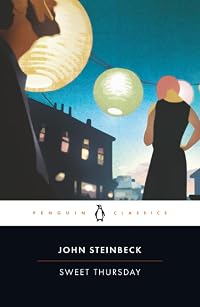
Such a good book! I have only read this book from Steinbeck and Sweet Thursday. Yes, I need to read more. I went to Monterey and went to a mall which apparently used to be a cannery. A friend who was with me nudged me to buy a used copy of this book. I read it, liked it, forgot about it. Then I saw the movie. Good movie, but I kept thinking - that's not the book. I had to re-read the book. Then I saw online that the book is really Cannery Row and Sweet Thursday combined. Okay! I read Sweet Thursday. I got my husband to read them both. He loved them, also. So we look at each other sometimes and say "Now Mack and the boys. . . ."
A great read. Every chapter is a story in itself and the whole books strings together into a beautiful story.
Members
- Recently Added By
Author Information

In recent years Steinbeck has been elevated to a more prominent status among American writers of his generation. If not quite at the world-class artistic level of a Hemingway or a Faulkner, he is nonetheless read very widely throughout the world by readers of all ages who consider him one of the most "American" of writers. Born in Salinas County, show more California on February 27, 1902, Steinbeck was of German-Irish parentage. After four years as a special student at Stanford University, he went to New York, where he worked as a reporter and as a hod carrier. Returning to California, he devoted himself to writing, with little success; his first three books sold fewer than 3,000 copies. Tortilla Flat (1935), dealing with the paisanos, California Mexicans whose ancestors settled in the country 200 years ago, established his reputation. In Dubious Battle (1936), a labor novel of a strike and strike-breaking, won the gold medal of the Commonwealth Club of California. Of Mice and Men (1937), a long short story that turns upon a melodramatic incident in the tragic friendship of two farm hands, written almost entirely in dialogue, was an experiment and was dramatized in the year of its publication, winning the New York Drama Critics Circle Award. It brought him fame. Out of a series of articles that he wrote about the transient labor camps in California came the inspiration for his greatest book, The Grapes of Wrath (1939), the odyssey of the Joad family, dispossessed of their farm in the Dust Bowl and seeking a new home, only to be driven on from camp to camp. The fiction is punctuated at intervals by the author's voice explaining this new sociological problem of homelessness, unemployment, and displacement. As the American novel "of the season, probably the year, possibly the decade," it won the Pulitzer Prize in 1940. It roused America and won a broad readership by the unusual simplicity and tenderness with which Steinbeck treated social questions. Even today, The Grapes of Wrath remains alive as a vivid account of believable human characters seen in symbolic and universal terms as well as in geographically and historically specific ones. Ma Joad is one of the most memorable characters in twentieth-century American fiction. It is her courage that sustains the family. Steinbeck's best and most ambitious novel after The Grapes of Wrath is East of Eden (1952), a saga of two American families in California from before the Civil War through World War I. Cannery Row (1945), The Wayward Bus (1947), and Sweet Thursday (1955) are lighter works that find Steinbeck returning to the lighthearted tone of Tortilla Flat as he recounts picaresque adventures of modern-day picaros. The Winter of Our Discontent (1961) struck some reviewers as being appropriately titled because of its despairing treatment of humanity's fall from grace in a wasteland world where money is king. Steinbeck also wrote important nonfiction, including Russian Journal (1948) in collaboration with the photographer Robert Capa; Once There Was a War (1958) and America and Americans (1966), which features pictures by 55 leading photographers and a 70-page essay by Steinbeck. His interest in marine biology led to two books primarily about sea life, Sea of Cortez (1941) (with Edward F. Ricketts) and The Log from the Sea of Cortez (1951). Travels with Charley (1962) is an engaging account of his journey of rediscovery of America, which took him through approximately 40 states. Steinbeck was married three times and died in New York City on December 20, 1968 of heart disease and congestive heart failure. He was 66, and had been a life-long smoker. (Bowker Author Biography) show less
Series
Belongs to Publisher Series
Work Relationships
Contains
Common Knowledge
- Canonical title
- Cannery Row | Of Mice and Men
- Original title
- Cannery Row / Of Mice and Men
- Original publication date
- 1937 (Of Mice and Men) (Of Mice and Men); 1945 (Cannery Row) (Cannery Row)
- People/Characters
- George Milton; Lennie Small; Curley; Curley's wife; Candy; Crooks (show all 25); Slim; Aunt Clara; Doc; Lee Chong; Mack; Hazel; Eddie; Jones; Hughie; Whitey; Gay; Dora Flood; Chinaman; Henri (the painter); Sam Malloy; Mrs. Malloy; Phyllis Mae; Alfred; Horace Abbeville
- Important places
- Chular, California, USA; Salinas Valley, California, USA; Monterey County, California, USA; Monterey, California, USA
- Important events
- Great Depression
- Related movies
- Of Mice and Men (1939 | IMDb); Of Mice and Men (1968 | IMDb); Of Mice and Men (1981 | IMDb); Of Mice and Men (1992 | IMDb); Of Mice and Men (2005 | IMDb); Canary Row (1950 | IMDb) (show all 7); Cannery Row (1982 | IMDb)
- First words
- Of Mice and Men: A few miles south of Soledad, the Salinas River drops in close to the hillside bank and runs deep and green.
Cannery Row: Cannery Row in Monterey in California is a poem, a stink, a grating noise, a quality of light, a tone, a habit, a nostalgia, a dream. - Last words
- (Click to show. Warning: May contain spoilers.)Of Mice and Men: And Carlson said, "Now what the hell ya suppose is eatin' them two guys?"
(Click to show. Warning: May contain spoilers.)Cannery Row: And behind the glass the rattlesnakes lay still and stared into space with their dusty frowning eyes.
Classifications
Statistics
- Members
- 1,142
- Popularity
- 21,994
- Reviews
- 8
- Rating
- (4.12)
- Languages
- English, German
- Media
- Paper
- ISBNs
- 4
- ASINs
- 22