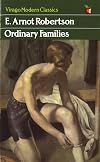
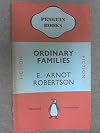
Ordinary Families
by E. Arnot Robertson
On This Page
Description
'I was running on happily because it was so good to be able to watch him under cover of my own talk, knowing exactly now what I wanted of him - mind, body, everything' Lallie is one of four children of the eccentric, quintessentially English Rush family. Boating, bird watching and inter-family rivalry are the focus of life in their village - Pin Mill, on the Suffolk marshes. Brought up on fair play and the 'family sense of humour' the Rush children soon learn to fend for themselves - on show more water and on dry land. We watch as Lallie grows to adulthood; loving and hating her 'ordinary' family, carving a space for herself in the shadow of her beautiful sister Margaret, who claims the lion's share of everything. But Lallie is special too, clear, clear-sighted, sexually aware. Just as well, for to keep the man she loves she faces the biggest family fight of all... show lessTags
Recommendations








Member Reviews
This was one of those books that it was difficult to read entirely to myself. There were passages so delightful that I wanted to read them out loud. The book is full of marvelously comic set pieces. Uproarious sailing adventures along the east coast of England and encounters with eccentric neighbors alternate with beautifully lyrical descriptions of nature and reflective observations about the lives and characters of the people who surround the novel's remarkable narrator, Lalage ("Lallie") Rush. I fell completely in love with this observant, passionate, humorous young woman who wants to be honest and kind in a boisterous family and a social world that demands small daily acts of dishonesty and unkindness. Her family is loving and show more high-spirited, but Lallie realizes that, in order to live together, even good people make compromises with their true selves. Lallie, for example, hides her love of birds and bird-watching from her family because she knows they will make a joke out of it and spoil the joy it brings her. Her family isn't cruel or horrible at all, they just like to tease each other. Like all close families, they have ways of interacting with each other, and certain expectations of each other, that often prevent the more sensitive members of the family—like Lallie—from being true to themselves. The novel is about how difficult it is to know and get close to another person, and how our need for other people often makes us compromise with ourselves. It sounds like a ponderous theme, but it's handled deftly and lightly. I read the book slowly, savoring both the humor and the lyricism. I have to admit that the very end of the novel was a bit of a disappointment, but only because I had fallen so in love with Lallie that it was hard to leave her as I had to do.
Remarkably, for a novel published in 1933, Lallie talks about having her period, and the physical and emotional effects it has on her—this, perhaps, for the first time in popular English literature (E. Arnot Robertson was a bestselling novelist in the 1930s). The novel is unflinchingly honest and observant, and wonderfully funny. I would place Lallie Rush with Cassandra Mortmain (the narrator of Dodie Smith's I Capture the Castle) at the top of my list of favorite young female narrators. show less
Remarkably, for a novel published in 1933, Lallie talks about having her period, and the physical and emotional effects it has on her—this, perhaps, for the first time in popular English literature (E. Arnot Robertson was a bestselling novelist in the 1930s). The novel is unflinchingly honest and observant, and wonderfully funny. I would place Lallie Rush with Cassandra Mortmain (the narrator of Dodie Smith's I Capture the Castle) at the top of my list of favorite young female narrators. show less
Ordinary Families is the story of an English family living in the small village of Pin Mill. Lallie is one of four children to a former adventurer, and they spend their days boating and hunting in Suffolk.
This is one of those classic coming of age stories in which one girl struggles to figure out her place in a large family, overshadowed as she is by her beautiful older sister. I liked Robertson’s descriptions of the family, especially Lallie and her father, but I also thought her descriptions of the family’s boating excursions were a bit, er, overboard at times. Robertson is good at character development and exploring the relationships between the various family members. It’s also very frank, for the 1930s, about various aspects show more of growing up. Because the plot moves along at a very slow pace, it’s very hard to follow at times. show less
This is one of those classic coming of age stories in which one girl struggles to figure out her place in a large family, overshadowed as she is by her beautiful older sister. I liked Robertson’s descriptions of the family, especially Lallie and her father, but I also thought her descriptions of the family’s boating excursions were a bit, er, overboard at times. Robertson is good at character development and exploring the relationships between the various family members. It’s also very frank, for the 1930s, about various aspects show more of growing up. Because the plot moves along at a very slow pace, it’s very hard to follow at times. show less
A curious if flawed example of the 1930s coming-of age story. It shows some influence from the avant-garde in its preoccupation with time and memory and in its episodic, life-like story line. It is also rather more frank than other novels of its kind, particularly when dealing with family allegiances and sibling rivarly as well as the exploration of a young woman's awakening to sexuality as well as romance. The ornithological descriptions are also very fine(the sailing parts, though, are rather boring), but it is finally marred by a lack of focus and purpose which the excellent first person narration cannot pull through.
Ratings
Members
- Recently Added By
Lists

Books referenced in A Very Great Profession: The Woman's Novel 1914-39
199 works; 6 members
Author Information

11+ Works 457 Members
Series
Belongs to Publisher Series
Common Knowledge
- Canonical title
- Ordinary Families
- Original publication date
- 1933
- Epigraph
- THE GREEN THINGS
If I had made this earth, I'd be too proud
Of all things green to leave mankind in doubt
Of My existence. 'Love My grass!' I'd shout,
Flinging a fierce green shadow from a cloud,
While, 'Me... (show all)rcy, Lord of leaves -!' implored aloud
The trembling priests instructed in My praise.
Seas, and the after-glow of summer days
Should be My sacred symbols to the crowd
-And scum on ponds, gratuitously green! -
Oh, I'd be merciful, and men be sure
Of immortality, absorbed in Me;
But not for love My godhead should be seen;
Rather, divine conceit - I would secure
Homage for all the green I caused to be. - Dedication
- To My Mother
Because she likes grass - First words
- Margaret and I quarrelled because she would not let me sink her makeshift boat in the marsh pool, in which a fine steep sea could be worked by hand up in a few seconds.
By the time Ordinary Families, her fourth novel, was published in 1933 when E. Arnot Robertson was twenty-nine, she had built up such a devoted and mass readership in the USA as well as in Britain that it was one of th... (show all)e literary events of the season, book club choice of the year, and greeted with almost unanimously good reviews - 'eloquent', 'exhilarating', 'brilliant' were the words most often used, although 'hard-hearted' and 'ruthless' crept in too. (Introduction) - Last words
- (Click to show. Warning: May contain spoilers.)Time. Time was starting now slowly, agonizingly, gathering way. Time, flow on.
(Click to show. Warning: May contain spoilers.)Her view of Ordinary Families might be summed up thus: ordinary families are all alike, every ordinary family is extraordinary in its own way; and she made of her theme and her vision a novel that is real as life and abstract as history. (Introduction) - Original language
- English
Classifications
Statistics
- Members
- 184
- Popularity
- 178,051
- Reviews
- 3
- Rating
- (3.44)
- Languages
- English, French
- Media
- Paper
- ISBNs
- 5
- ASINs
- 11