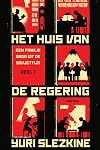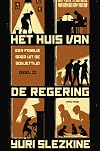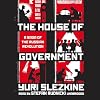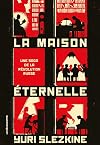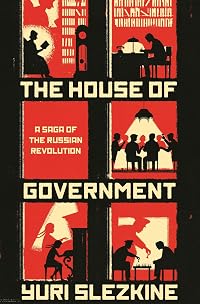
The House of Government: A Saga of the Russian Revolution
by Yuri Slezkine
On This Page
Description
"On the 100th anniversary of the Russian Revolution, the epic story of an enormous apartment building where Communist true believers lived before their destruction. The House of Government is unlike any other book about the Russian Revolution and the Soviet experiment. Written in the tradition of Tolstoy's War and Peace, Grossman's Life and Fate, and Solzhenitsyn's The Gulag Archipelago, Yuri Slezkine's gripping narrative tells the true story of the residents of an enormous Moscow apartment show more building where top Communist officials and their families lived before they were destroyed in Stalin's purges. A vivid account of the personal and public lives of Bolshevik true believers, the book begins with their conversion to Communism and ends with their children's loss of faith and the fall of the Soviet Union. Completed in 1931, the House of Government, later known as the House on the Embankment, was located across the Moscow River from the Kremlin. The largest residential building in Europe, it combined 550 furnished apartments with public spaces that included everything from a movie theater and a library to a tennis court and a shooting range. Slezkine tells the chilling story of how the building's residents lived in their apartments and ruled the Soviet state until some eight hundred of them were evicted from the House and led, one by one, to prison or their deaths. Drawing on letters, diaries, and interviews, and featuring hundreds of rare photographs, The House of Government weaves together biography, literary criticism, architectural history, and fascinating new theories of revolutions, millennial prophecies, and reigns of terror. The result is an unforgettable human saga of a building that, like the Soviet Union itself, became a haunted house, forever disturbed by the ghosts of the disappeared"--Provided by publisher. show lessTags
Recommendations
















Member Reviews
"This is a work of history. Any resemblance to fictional characters, dead or alive, is entirely coincidental"
This is a monumental, long and detailed book that is both a history of the Russian revolution, a personal reflection on the literature it produced and a collection of family stories centred on a large apartment building known as the House of Government, which was built in the early 1930s to house the elite class of the Bolshevik regime. Slezkine's other central theme is that the Bolsheviks shared all of the key attributes of a millenarian (apocalyptic) religious sect. He succeeds brilliantly in showing the all too human weaknesses that led to some of the most brutal acts of the 20th century.
I am not remotely qualified to review show more this with any academic rigour or to judge the soundness of Slezkine's wilder theories, so this is purely a personal reaction, and I apologise for being unable to do it justice. I must admit that this is not a book I would have chosen to read for myself - it was a Christmas present, and was then chosen for a group discussion in the Reading the Chunksters group.
The book is divided into six parts, an epilogue and various appendices. The first part is in three chapters, first an introduction to the book's Moscow location, then a review of the careers of the main players before the revolution and finally an introduction to Slezkine's millenarian sect theory consisting of a fascinating history of religious sects going back to Biblical times, whose relevance only gradually becomes apparent. In the second the story moves from the October revolution, through the civil war, the retreat from pure communism under the New Economic Policy, the death of Lenin and the gradual establishment of a strict party line, deviation from which proved fatal.
The House of Government finally appears over 300 pages in, in the third part, which describes its creation and the lives of some of its early tenants. There is a wealth of detail here, which makes it clear just how privileged the elite class was, as the contents of some of these apartments are itemised. The fourth part continues this exploration, focusing more on the people.
Slezkine builds a compelling picture through many personal family stories, and in the fifth part of the book brings home the full horror of the Great Terror by going through the cast itemising those who were killed or interned, when and what happened to their families, bringing out the relentless and inherently contradictory nature of the regime's deadly logic. The final section covers a much longer period from the end of the Terror until the fall of communism, largely explaining what happened to those who survived the purges and giving Slezkine's opinions on why Soviet Communism failed to endure once its founding generation were all dead.
Slezkine has clearly immersed himself in Soviet and later Russian literature, and summarises many of the key novels (Leonid Leonov's late novel The Pyramid sounds very interesting, but does not seem to available in English). The epilogue covers the works of Yuri Trifonov, who spent his childhood in the House and wrote many books about the house, its inhabitants and their attempts to come to terms with the past.
I won't apologise for describing this as an extraordinary book - its sheer size and scope may be daunting and some of the subject matter is harrowing, but it is clearly written and full of fascinating detail. show less
This is a monumental, long and detailed book that is both a history of the Russian revolution, a personal reflection on the literature it produced and a collection of family stories centred on a large apartment building known as the House of Government, which was built in the early 1930s to house the elite class of the Bolshevik regime. Slezkine's other central theme is that the Bolsheviks shared all of the key attributes of a millenarian (apocalyptic) religious sect. He succeeds brilliantly in showing the all too human weaknesses that led to some of the most brutal acts of the 20th century.
I am not remotely qualified to review show more this with any academic rigour or to judge the soundness of Slezkine's wilder theories, so this is purely a personal reaction, and I apologise for being unable to do it justice. I must admit that this is not a book I would have chosen to read for myself - it was a Christmas present, and was then chosen for a group discussion in the Reading the Chunksters group.
The book is divided into six parts, an epilogue and various appendices. The first part is in three chapters, first an introduction to the book's Moscow location, then a review of the careers of the main players before the revolution and finally an introduction to Slezkine's millenarian sect theory consisting of a fascinating history of religious sects going back to Biblical times, whose relevance only gradually becomes apparent. In the second the story moves from the October revolution, through the civil war, the retreat from pure communism under the New Economic Policy, the death of Lenin and the gradual establishment of a strict party line, deviation from which proved fatal.
The House of Government finally appears over 300 pages in, in the third part, which describes its creation and the lives of some of its early tenants. There is a wealth of detail here, which makes it clear just how privileged the elite class was, as the contents of some of these apartments are itemised. The fourth part continues this exploration, focusing more on the people.
Slezkine builds a compelling picture through many personal family stories, and in the fifth part of the book brings home the full horror of the Great Terror by going through the cast itemising those who were killed or interned, when and what happened to their families, bringing out the relentless and inherently contradictory nature of the regime's deadly logic. The final section covers a much longer period from the end of the Terror until the fall of communism, largely explaining what happened to those who survived the purges and giving Slezkine's opinions on why Soviet Communism failed to endure once its founding generation were all dead.
Slezkine has clearly immersed himself in Soviet and later Russian literature, and summarises many of the key novels (Leonid Leonov's late novel The Pyramid sounds very interesting, but does not seem to available in English). The epilogue covers the works of Yuri Trifonov, who spent his childhood in the House and wrote many books about the house, its inhabitants and their attempts to come to terms with the past.
I won't apologise for describing this as an extraordinary book - its sheer size and scope may be daunting and some of the subject matter is harrowing, but it is clearly written and full of fascinating detail. show less
Long and boring in pars, but fascinating also. The main thesis, not original, is that Bolshevism was a murderous millennial cult that devoured it's own. After murdering the kulaks, experts, and as many non-believers as they could, unlike successful millennial religions like Christianity and Islam, the commies never figured out how to incorporate family life into their belief structure. Subsequent generations were not true believers. Also, just like capitalism, children of the elite got better treatment in the gulag.
Very long. Parts, especially about the children of the officials and the purges, were fascinating but the attempt to tie Bolshevism to other religions was cumbersome.
A bit tedious and over detailed. It is a true document against the russian revolution, and as such it is very partial and skewed.
Título en español LA CASA DEL GOBIERNO
Ratings
Members
- Recently Added By
Lists

Books Read in 2020
4,379 works; 124 members

My wishlist
85 works; 1 member
Author Information

7+ Works 915 Members
Yuri Slezkine is Professor of History and Director of the Institute of Slavic, East European, and Eurasian Studies at the University of California, Berkeley
Some Editions
Awards and Honors
Awards
Distinctions
Notable Lists
Common Knowledge
- Original publication date
- 2017
- People/Characters
- Joseph Stalin
- Important places
- Moscow; Soviet Union
- Important events
- Russian Revolution
- Original language
- English
Classifications
- Genres
- History, Nonfiction, Politics and Government, General Nonfiction
- DDC/MDS
- 947.084 — History & geography History of Europe Eastern European Counties and Russia Russian & Slavic History by Period 1855- 1917-1953 ; Communist period
- LCC
- DK601 .S57 — History of Europe, Asia, Africa and Oceania Russia. Soviet Union. Former Soviet Republics – Poland History of Russia. Soviet Union. Former Soviet Republics Local history and description Russia (Federation). Russian S.F.S.R. Moscow
- BISAC
Statistics
- Members
- 545
- Popularity
- 54,479
- Reviews
- 5
- Rating
- (4.12)
- Languages
- 9 — Dutch, English, Estonian, French, German, Italian, Polish, Russian, Spanish
- Media
- Paper, Audiobook, Ebook
- ISBNs
- 21
- ASINs
- 5