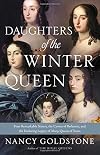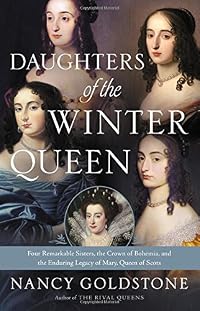
Daughters of the Winter Queen: Four Remarkable Sisters, the Crown of Bohemia, and the Enduring Legacy of Mary, Queen of Scots
by Nancy Goldstone
On This Page
Description
Documents how a betrayed Elizabeth Stuart, the daughter of James I, raised her four daughters in exile during the Dutch Golden Age, tracing how their stories shaped a three-decade war and fulfilled the promises of their great-grandmother, Mary Queen of Scots. "From the great courts, glittering palaces, and war-ravaged battlefields of the seventeenth century comes the story of four spirited sisters and their glamorous mother, Elizabeth Stuart, granddaughter of the martyred Mary, Queen of show more Scots. Upon her father's ascension to the illustrious throne of England, Elizabeth Stuart was suddenly thrust from the poverty of unruly Scotland into the fairy-tale existence of a princess of great wealth and splendor. When she was married at sixteen to a German count far below her rank, it was with the understanding that her father would help her husband achieve the kingship of Bohemia. The terrible betrayal of this commitment would ruin 'the Winter Queen,' as Elizabeth would forever be known, imperil the lives of those she loved, and launch a war that would last for thirty years. Forced into exile, the Winter Queen and her family found refuge in Holland, where the glorious art and culture of the Dutch Golden Age indelibly shaped her daughters' lives. Her eldest, Princess Elizabeth, became a scholar who earned the respect and friendship of the philosopher René Descartes. Louisa was a gifted painter whose engaging manner and appealing looks provoked heartache and scandal. Beautiful Henrietta Maria would be the only sister to marry into royalty, although at great cost. But it was the youngest, Sophia, a heroine in the tradition of a Jane Austen novel, whose ready wit and good-natured common sense masked immense strength of character, who fulfilled the promise of her great-grandmother Mary and reshaped the British monarchy, a legacy that endures to this day. Brilliantly researched and captivatingly written, filled with danger, treachery and adventure but also love, courage, and humor, Daughters of the Winter Queen follows the lives of five remarkable women who, by refusing to surrender to adversity, changed the course of history."--Dust jacket. show lessTags
Recommendations






Member Reviews
This was a fantastic group biography of the granddaughter and the four great-granddaughters of Mary, Queen of Scots. Elizabeth Stuart, the Winter Queen, was the daughter of James VI/I, and she and her four daughters helped set the stage for the world we know today. I thoroughly enjoyed Goldstone’s writing; she untangled the similarly named sons and daughters with aplomb, and her footnotes and side comments continually cracked me up.
I found this book particularly satisfying in terms of building on my knowledge. I’ve read a fair bit about British history, and to a lesser extent about continental European history, and with this book I could feel the jigsaw pieces slotting into place in my brain. That’s how wide-ranging this show more family’s social circles and interests ranged.
I’d highly recommend this if you’re interested in Scottish and European history, and if you like biographies of women in history. show less
I found this book particularly satisfying in terms of building on my knowledge. I’ve read a fair bit about British history, and to a lesser extent about continental European history, and with this book I could feel the jigsaw pieces slotting into place in my brain. That’s how wide-ranging this show more family’s social circles and interests ranged.
I’d highly recommend this if you’re interested in Scottish and European history, and if you like biographies of women in history. show less
I admit, I picked this one up because of the excellent title, then realized it was by Nancy Goldstone (and have enjoyed her work in the past) -- and -- I was continuously astonished about how much I enjoyed this book. That sounds like a backhanded compliment, but what I mean is that I have never been interested in this particular time in history, or Mary, Queen of Scots, or the reign of James I or, god forbid, Cromwell and Charles -- for whatever reason, they've never appealed to me. Now I'm fascinated by the whole clan. This book is exceptional. It's amazing. It's a soap opera with deeply far reaching future impacts, and Goldstone not only is a master storyteller for the history, but she effortlessly weaves the stunning future show more complications into the greater story without breaking the narrative. In addition to that, her somewhat snarky commentary left me giggling on more than one occasion. This isn't dry nonfiction, it's unputdownable. I love that it centers on the women, I love that it's structured in short bursts that really give you a sense of the personalities of the times, and I love the thought and research that has gone into it. Can't recommend it highly enough. show less
Elizabeth Stuart, daughter of King James I of England, was a fascinating figure. Married to Frederick V, King of Bohemia, Elizabeth bore 13 children while working tirelessly to defend her family’s empire during the Thirty Years War, and preserve the English legacy of her father and brother, Charles I. Much of her life was spent in exile from the kingdom she and Frederick held claim to, moving among various locations in Europe with the children housed by relatives to ensure their safety. Elizabeth’s four daughters (Elizabeth, Louisa, Henrietta, and Sophia), shaped by this environment, led very different lives, but each notable in her own right.
By focusing on the contributions of women, this meticulously-researched account adds show more greatly to our understanding of history. The intellectual and political abilities of Elizabeth and her daughters seem unusual for their time, but this is likely because women’s stories are so seldom told. Elizabeth’s daughters were intellectual heavyweights, able to dialogue as peers with “greats” like Descartes and Leibniz. Sophia may be the best known to modern readers, since every English monarch since George I (1714) is descended from her, but this would not have happened without Sophia’s dogged persistence and agile responses to political events.
Daughters of the Winter Queen brings these historic figures to life in a delightfully readable way, offering a fresh perspective on 17th century Europe. show less
By focusing on the contributions of women, this meticulously-researched account adds show more greatly to our understanding of history. The intellectual and political abilities of Elizabeth and her daughters seem unusual for their time, but this is likely because women’s stories are so seldom told. Elizabeth’s daughters were intellectual heavyweights, able to dialogue as peers with “greats” like Descartes and Leibniz. Sophia may be the best known to modern readers, since every English monarch since George I (1714) is descended from her, but this would not have happened without Sophia’s dogged persistence and agile responses to political events.
Daughters of the Winter Queen brings these historic figures to life in a delightfully readable way, offering a fresh perspective on 17th century Europe. show less
While books on female royals CAN be all marriage and court intrigue, this was an absolutely packed work that takes in a century of European history!
Elizabeth of Bohemia, 'The Winter Queen' (she and her husband were deposed after just one winter) was Charles I's older sister. And while, it might be argued, that three of the four surviving daughters didn't do anything massively important (two abbesses and one early death in Transylvania), the youngest effected her mother's - eventual - triumph, as matriarch of the House of Hanover (and hence British royalty.)
There's a HUGE amount of politics and alliances, as tiny principalities - and bigger powers- engage in complex struggles (I only have a vague impression of what the 30 Years War was show more all about!) But the author does a sterling job of making it as readable as is feasible.
And meanwhile events in England are highly relevant, as Elizabeth frets over her brother Charles I - and her son, Rupert, who's over there fighting for the Royalists- and as the sisters in Germany see their marriage opportunities slipping away with the negative publicity over it all.
I learnt why German rulers are termed 'electors' (the eight senior dukes got to vote for the Holy Roman Emperor.)
Don't know how much I'll remember, but gives a massive overview of 17th century European history! show less
Elizabeth of Bohemia, 'The Winter Queen' (she and her husband were deposed after just one winter) was Charles I's older sister. And while, it might be argued, that three of the four surviving daughters didn't do anything massively important (two abbesses and one early death in Transylvania), the youngest effected her mother's - eventual - triumph, as matriarch of the House of Hanover (and hence British royalty.)
There's a HUGE amount of politics and alliances, as tiny principalities - and bigger powers- engage in complex struggles (I only have a vague impression of what the 30 Years War was show more all about!) But the author does a sterling job of making it as readable as is feasible.
And meanwhile events in England are highly relevant, as Elizabeth frets over her brother Charles I - and her son, Rupert, who's over there fighting for the Royalists- and as the sisters in Germany see their marriage opportunities slipping away with the negative publicity over it all.
I learnt why German rulers are termed 'electors' (the eight senior dukes got to vote for the Holy Roman Emperor.)
Don't know how much I'll remember, but gives a massive overview of 17th century European history! show less
**I received an advanced reader’s copy of this title from the publisher through NetGalley in exchange for an honest review**
Goldstone examines the Queen of Bohemia, Elizabeth Stuart, and her four daughters in this captivating history. Much is known about King James I of England, his son Charles I, and the ensuing English civil war. Little is known (or written) about James’ daughter, Elizabeth, whose actions also cause a war. In turn, her daughters find themselves involved in conspiracies and tragedies and undesirable circumstances. But, each, along with their mother, possess the courage and independence their ancestor, Mary, Queen of Scots, showcased throughout her tumultuous life.
Thanks to Goldstone, the women’s stories come to show more life in an enthralling narrative. Peppered with witty and at times sarcastic one-liners, Goldstone shows how each woman and their interests and politics played a role in their current time, and how their influence can still be felt in contemporary times. Among the women’s stories, Goldstone also perfectly describes Europe’s atmosphere in the seventeenth century – the royal power plays, the wars, the customs, etc.
I absolutely loved this book. It’s compelling. It’s hard to put down. At times, it reads more like fiction than nonfiction, given the crazy antics that some would do in order to gain political power. Ultimately, though, it gives voice to women who rarely are mentioned in histories. One would think that these women, especially Elizabeth Stuart, would be satisfied to know that all of the sacrifices made in their lifetimes helped their descendants remain on the English throne today. A must read for royal enthusiasts and/or those interested in women’s history. Five stars. show less
Goldstone examines the Queen of Bohemia, Elizabeth Stuart, and her four daughters in this captivating history. Much is known about King James I of England, his son Charles I, and the ensuing English civil war. Little is known (or written) about James’ daughter, Elizabeth, whose actions also cause a war. In turn, her daughters find themselves involved in conspiracies and tragedies and undesirable circumstances. But, each, along with their mother, possess the courage and independence their ancestor, Mary, Queen of Scots, showcased throughout her tumultuous life.
Thanks to Goldstone, the women’s stories come to show more life in an enthralling narrative. Peppered with witty and at times sarcastic one-liners, Goldstone shows how each woman and their interests and politics played a role in their current time, and how their influence can still be felt in contemporary times. Among the women’s stories, Goldstone also perfectly describes Europe’s atmosphere in the seventeenth century – the royal power plays, the wars, the customs, etc.
I absolutely loved this book. It’s compelling. It’s hard to put down. At times, it reads more like fiction than nonfiction, given the crazy antics that some would do in order to gain political power. Ultimately, though, it gives voice to women who rarely are mentioned in histories. One would think that these women, especially Elizabeth Stuart, would be satisfied to know that all of the sacrifices made in their lifetimes helped their descendants remain on the English throne today. A must read for royal enthusiasts and/or those interested in women’s history. Five stars. show less
Elizabeth Stuart -- granddaughter of Mary, Queen of Scots and daughter to James I and his wife Anne of Denmark -- had thirteen children with her husband, Frederick V, Count/Elector Palatine. Goldstone writes of the lives of this historically prominent family, emphasizing (as the title suggests) those of the four daughters to reach maturity: the intellectually brilliant Elizabeth (who knowledgably corresponded with Descartes on matters mathematical and metaphysical), the artistically gifted Louisa Hollandine (who ended her life as the abbess at a Catholic convent in France), the beautiful but tragically short-lived Henrietta Maria (the only daughter to marry royalty), and the clever Sophia (who became Electress of Hanover and, had she show more lived an additional fifty-four days, would have become Queen of England [instead, the founding of the Hanover dynasty was to fall to her eldest son George Louis, who became George I]). The men of the family are hardly ignored: we read of Frederick's constant warfare to win -- then to win back -- the crown of Bohemia and to hold onto the Palatinate; the promising Prince Frederick Henry's sad death at age 15; the gallant Rupert's exploits in the English Civil War; Karl Ludwig's struggles to rebuild the Palatine -- and his unhappy marriage; etc. etc. -- Goldstone writes exceptionally well, clarifying complicated shifting alliances and balances of power (her use of a dance metaphor is most apt), and she brings the age to vivid life. (I caught one error early on, however: the Earl of Bothwell was Mary, Queen of Scots's THIRD husband, and Goldstone occasionally employs a jarringly contemporary turn of phrase -- likening Frederick of the Palatine to a locally-owned coffee shop compared to the Starbucks of some of Elizabeth's other exalted suitors, for example. Special kudos to the person(s) responsible for the map of Northern Europe c1650 that appears toward the beginning of the book: with one or two exceptions, ALL the place names mentioned in the text are to be found on the map (although the location shown for Marston Moor -- site of a 1644 battle during the English Civil War -- is incorrect). The inclusion of color plates of the series of family portraits done by Gerrit von Honthorst (1592-1656), as well as three selected works by Louise Hollandine -- adds much to book. Wonderful historical reading! (The author speculates what might have happened had Anne of Denmark not blocked her daughter's engagement to Gustavus Adolphus of Sweden [Denmark's long rival in Scandinavia], since both the Swedish king and Elizabeth Stuart shared many of the same leadership skills and personality traits. -- For myself, I found myself wondering what sort of Queen of England the young -- and staunchly Protestant -- Elizabeth might have made, had the Gunpowder Plot of 1605 succeeded in killing her father and her two brothers...and what sort of Queen, at age 84 (!!), Sophia would have been as well... How might the course of European history been changed, had any one of these three events taken place? Ultimately, such "what if's" are the historian's parlor game, but it's fun to speculate anyway...) show less
Almost reading like a historical soap opera, this book tells the story of Princess Elizabeth, sister of King James I(first Stuart king of England) and granddaughter of Mary Queen of Scots. The lives of Elizabeth's children, especially her daughters, is then told in interesting detail.
Elizabeth Stuart married a German count, Frederick, who was much below her rank. However, the marriage was strong and they worked together to eventually become the King and Queen of Bohemia only to reign a very short season (thus "the winter queen"). The rest of Elizabeth's life was spent attempting to regain their reign and the promotion of their children to places of position.
Elizabeth's youngest child, Sophia, is the one that eventually was able to get show more the family back as sovereign of Britain.
The trials and troubles of these peopole of royalty is almost unbelievable: marriages based on political gain, illicit affairs, crazy habits, wars, and once in a while true leadership. This is just a juicy look at a particular time in history. Interesting - sometimes confusing, but the author does a great job of explaining in a light, humorous, yet factual presentation. I would definitely read more by this author. show less
Elizabeth Stuart married a German count, Frederick, who was much below her rank. However, the marriage was strong and they worked together to eventually become the King and Queen of Bohemia only to reign a very short season (thus "the winter queen"). The rest of Elizabeth's life was spent attempting to regain their reign and the promotion of their children to places of position.
Elizabeth's youngest child, Sophia, is the one that eventually was able to get show more the family back as sovereign of Britain.
The trials and troubles of these peopole of royalty is almost unbelievable: marriages based on political gain, illicit affairs, crazy habits, wars, and once in a while true leadership. This is just a juicy look at a particular time in history. Interesting - sometimes confusing, but the author does a great job of explaining in a light, humorous, yet factual presentation. I would definitely read more by this author. show less
Members
- Recently Added By
Lists

al.vick-wishlist-history
70 works; 2 members
Author Information

16 Works 6,739 Members
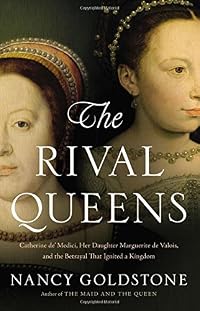
Nancy Goldstone's previous books include The Rival Queens: Catherine de' Medici, Her Daughter, Marguerite de Valois, and the Betrayal That Ignited a Kingdom and The Lady Queen: The Notorious Reign of Joanna I, Queen of Naples, Jerusalem, and Sicily. She lives in Sagaponack New York. Nancygoldstone.com
Some Editions
Common Knowledge
- Canonical title
- Daughters of the Winter Queen: Four Remarkable Sisters, the Crown of Bohemia, and the Enduring Legacy of Mary, Queen of Scots
- Original publication date
- 2018
- People/Characters
- Charles I, King of England, Scotland, and Ireland; Charles II, King of England, Scotland, and Ireland; Elizabeth of Bohemia; Sophia, Electress of Hanover; Descartes, René, 1596-1650; James VI and I, King of Scots and King of England (show all 14); Anne of Denmark; Louise Hollandine, Princess of Palatine; Elizabeth, Princess of Palatine; Henriette Marie, Princess of Palatine; Frederick V, King of Bohemia; Henry Frederick, Prince of Wales; Prince Rupert of the Rhine; Karl Ludwig, Elector Palatine
- Important places
- Bohemia; Holy Roman Empire
- Important events
- English Civil War
- Dedication
- To Lee and Larry, with all my love
- First words
- Elizabeth Stuart was born on August 19, 1596, at Dunfermline Palace, her mother's preferred summer residence, in Fife, just across the bay from Edinburgh.
- Last words
- (Click to show. Warning: May contain spoilers.)And that legacy- Mary's- endures.
- Blurbers
- Foreman, Amanda; Luthman, Johanna; Gray, Charlotte
- Original language
- English
Classifications
- Genres
- History, Nonfiction, General Nonfiction, Biography & Memoir
- DDC/MDS
- 943.7 — History & geography History of Europe Germany and neighboring central European countries Czech Republic and Slovakia
- LCC
- D244.8 .E4 .G65 — History of Europe, Asia, Africa and Oceania History (General) Modern history, 1453-
- BISAC
Statistics
- Members
- 320
- Popularity
- 99,419
- Reviews
- 16
- Rating
- (3.97)
- Languages
- Dutch, English
- Media
- Paper, Audiobook, Ebook
- ISBNs
- 13
- ASINs
- 4