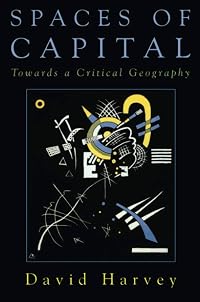
Spaces of Global Capitalism: A Theory of Uneven Geographical Development
by David Harvey
On This Page
Description
Fiscal crises have cascaded across much of the developing world with devastating results, from Mexico to Indonesia, Russia and Argentina. The extreme volatility in contemporary political economic fortunes seems to mock our best efforts to understand the forces that drive development in the world economy. David Harvey is the single most important geographer writing today and a leading social theorist of our age, offering a comprehensive critique of contemporary capitalism. In this fascinating show more book, he shows the way forward for just such an understanding, enlarging upon the key themes in his recent work: the development of neoliberalism, the spread of inequalities across the globe, and 'space' as a key theoretical concept. Both a major declaration of a new research programme and a concise introduction to David Harvey's central concerns, this book will be essential reading for scholars and students across the humanities and social sciences. show lessTags
Recommendations












Member Reviews
As is usual for David Harvey, this series of three essays considers the role of space at both the political economic and the philosophical level. The first two essays are speeches given as Hettner Lectures in Geography at the Ruprecht-Karls-Universität Heidelberg, the last essay is a reflection on space as a 'keyword' in the sense of Raymond Williams. Together, this forms a small booklet of little more than 140 pages.
The first essay, "Neo-Liberalism and the Restoration of Class Power", is an overview of the resurgence of neoliberalism in recent decades, and the deleterious effects this has had both practically and in academics. Much of this is known to any leftist and the same sort of thing can be found in any radical blog.
The second show more essay is "A Theory of Uneven Geographical Development". This essay is much more interesting and is basically a summary and example of the typical approach of Harvey in utilizing Marxist economical geography. This text can be considered an introduction to the subject, useful to look into before one would go on to read "Limits to Capital", Harvey's most important work of this kind.
The last essay, "Space as a Key Word", is a philosophical analysis of the meaning of the word space, and its various dialectical aspects. This is in my view the most novel and contributive essay in the collection, as it builds on the work of Lefebvre, Einstein and Marx to construct a concept of space at nine different levels of abstraction. Two different matrices showing the intersection of these levels are provided by Harvey, sure to give inspiration for new thinking on this subject, which I think was the essay's main intent considering its shortness.
Whether it is worth it to buy this booklet separately is hard to say. It can be quite useful as an introduction to Harvey's way of thinking, to be read before some of his real books. The last essay is also a good insight into a little discussed subject, the philosophy of space. But certainly purchase of this work is hardly necessary, any other Harvey book will do as well. show less
The first essay, "Neo-Liberalism and the Restoration of Class Power", is an overview of the resurgence of neoliberalism in recent decades, and the deleterious effects this has had both practically and in academics. Much of this is known to any leftist and the same sort of thing can be found in any radical blog.
The second show more essay is "A Theory of Uneven Geographical Development". This essay is much more interesting and is basically a summary and example of the typical approach of Harvey in utilizing Marxist economical geography. This text can be considered an introduction to the subject, useful to look into before one would go on to read "Limits to Capital", Harvey's most important work of this kind.
The last essay, "Space as a Key Word", is a philosophical analysis of the meaning of the word space, and its various dialectical aspects. This is in my view the most novel and contributive essay in the collection, as it builds on the work of Lefebvre, Einstein and Marx to construct a concept of space at nine different levels of abstraction. Two different matrices showing the intersection of these levels are provided by Harvey, sure to give inspiration for new thinking on this subject, which I think was the essay's main intent considering its shortness.
Whether it is worth it to buy this booklet separately is hard to say. It can be quite useful as an introduction to Harvey's way of thinking, to be read before some of his real books. The last essay is also a good insight into a little discussed subject, the philosophy of space. But certainly purchase of this work is hardly necessary, any other Harvey book will do as well. show less
Ratings
Members
- Recently Added By
Author Information

41+ Works 7,204 Members
David Harvey received a Bachelor's degree and Ph.D. in geography from Cambridge University. After graduating in 1961, he joined the geography department at Bristol University as a lecturer. In the following years, he held teaching positions at Johns Hopkins and Oxford universities. He has written numerous books including Justice Nature and the show more Geography of Differences, The Urban Experience, The Condition of Postmodernity, and An Enquiry into the Origins of Cultural Change. He has received many honors, among them the Outstanding Contributor Award of the Association of American Geographers, the Anders Retzuis Gold Medal of the Swedish Society of Anthropology and Geography, and the Vautrin Lud International Geography Prize. (Bowker Author Biography) show less
Classifications
Statistics
- Members
- 242
- Popularity
- 134,671
- Reviews
- 1
- Rating
- (3.33)
- Languages
- 7 — Catalan, Chinese, English, German, Polish, Spanish, Swedish
- Media
- Paper, Ebook
- ISBNs
- 15
- ASINs
- 1