Sartor Resartus
by Thomas Carlyle
On This Page
Description
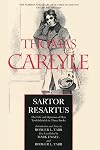
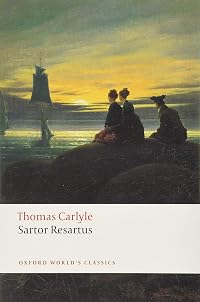
This unusual book is a must-read for fans of innovative fiction. More than a century before postmodernists like Nabokov and Barthes began to experiment with metafiction, Thomas Carlyle gave the world this playful sendup of German Idealism that purports to be a commentary on the work of fictional German philosopher Diogenes Teufelsdröckh's history of clothing..
Tags
Recommendations






















Member Reviews
Having read much Kant and too much Hegel, I discovered Carlyle's very humorous take on the German philosophers with pleasure. Carlyle's prose is always clever and often hilariously overwrought (at one point, he likens his protagonist's philosophy to a hundred fiery Minerva's springing from the forehead of Jupiter!), and his taste in philosophy is sensible (Hegel and Voltaire each merit a lampoon). That said, Carlyle sometimes buries his thoughts under so many layers of irony that I doubt whether he himself had yet decided what he meant to say. This makes much of the third part of Sartor slow reading and probably less rewarding than his later works.
A heady tangle of Masonic esotericism couched in intentionally and mockingly stilted prose. The first subtext is satire, the second subtext is occult; much like the subtext of clothes is the aletheic vision of Platonic forms, or shells, while the second subtext is their usurpation of the latter, in an inversion of a typical relation where the symbol refers to divinity. It confirms some of the obscure connections with Rousseau's esotericism and the ever-present thematic of shells that places this works squarely to the realm of the Qliphotic, in line with the Lurianic goal of restoring a limited world to infinity(it's hard to see how this could be done without destroying the world) by working with the qliphoth. It also codifies the show more magical formula elsewhere described which inverts the sigil magic of Spare, amounting to mantric exercises in Tantra.
I don't know why this is not five: I might change it in regret after time passes. The main value of the book is mostly in these stray references that supply ever-so rare signposts in an increasingly confusing network of thought.
More than anything, I don't know what destruction of the world or development of society concerns me in contrast with my own death. Is it yet another death lurking arbitrarily necessarily as a background structure? Mostly it seems that the intricate labyrinths of works and plots crumble into miniscule in the face of that event which recombines all of you into other types of things during the 8 minutes of brain activity after cessation of bodily functions. In this context the puppet masters and the dunces don't seem all that dissimilar, except as something to be avoided so that they don't produce bad karma.
"If a rock falls on your head, that is bad; but shame, infamy, opprobrium, and curses hurt only so far as they are felt" - Erasmus of Rotterdam. show less
I don't know why this is not five: I might change it in regret after time passes. The main value of the book is mostly in these stray references that supply ever-so rare signposts in an increasingly confusing network of thought.
More than anything, I don't know what destruction of the world or development of society concerns me in contrast with my own death. Is it yet another death lurking arbitrarily necessarily as a background structure? Mostly it seems that the intricate labyrinths of works and plots crumble into miniscule in the face of that event which recombines all of you into other types of things during the 8 minutes of brain activity after cessation of bodily functions. In this context the puppet masters and the dunces don't seem all that dissimilar, except as something to be avoided so that they don't produce bad karma.
"If a rock falls on your head, that is bad; but shame, infamy, opprobrium, and curses hurt only so far as they are felt" - Erasmus of Rotterdam. show less
I read this book approximately 18 times in college. Each time for a class, and each time less painful than the last. Sartor Resartus grew on me. I hope to never read it again. I keep it out of spite.
Even now that I've read it I'm not entirely sure what prompted me to pick this up at the library book sale this spring. Probably it was the back-cover text noting that the book was inspired in part by Tristram Shandy, which is one of my favorites. I do know that this one doesn't hold up nearly as well, isn't nearly as funny, and certainly won't be a book I am likely to read again.
I read this novel in a Victorian prose class in graduate school more than ten years ago. Although I enjoyed it then, I felt I was missing something because of time pressures, and I wanted to read it at a more leisurely pace. I also reread the introduction. I had forgotten how influential this book was. Its ancestors include Laurence Sterne and his imaginative novel, Tristram Shandy. Sartor’s descendents include Melville’s Moby Dick, and James Joyce’s Ulysses. The appendices, which I did not read then, proved helpful in understanding Carlyle’s thoughts during and after the writing of the novel.
As the short biography included in my edition tells us, Carlyle was the son of a dour, strict Calvinist, who viewed fiction as some form show more of deceit. This was a fairly wide-held view in the 19th century, hence the number of novels based on “found manuscripts,” which the author was careful to warn the reader that the author could not attest to the veracity of the facts related. Carlyle abandoned fiction for this dubious line of reasoning after completing Sartor.
This imaginative novel is really an essay about a made up philosopher, Diogenes Teufelsdroeckh, who has written an extensive treatise on clothes. Now, I can imagine this might sound boring to some, but it is full of humor – the extremely dry British variety, and this novel contains much of the philosophy current in the early years of the Victorian Age. Again, as the Introduction says, Sartor is key to understanding that influential period.
In fact, the Introduction also claims that Sartor did for the Victorian age what Lyrical Ballads did for the Augustan Age – turn it on its head before destroying it.
So. Am I glad I reread this novel? Yes. At just over 200 pages it only took a few hours, and I really do think I have a better understanding of Carlyle’s great novel now than I did back then. Four stars.
--Jim, 3/20/08 show less
As the short biography included in my edition tells us, Carlyle was the son of a dour, strict Calvinist, who viewed fiction as some form show more of deceit. This was a fairly wide-held view in the 19th century, hence the number of novels based on “found manuscripts,” which the author was careful to warn the reader that the author could not attest to the veracity of the facts related. Carlyle abandoned fiction for this dubious line of reasoning after completing Sartor.
This imaginative novel is really an essay about a made up philosopher, Diogenes Teufelsdroeckh, who has written an extensive treatise on clothes. Now, I can imagine this might sound boring to some, but it is full of humor – the extremely dry British variety, and this novel contains much of the philosophy current in the early years of the Victorian Age. Again, as the Introduction says, Sartor is key to understanding that influential period.
In fact, the Introduction also claims that Sartor did for the Victorian age what Lyrical Ballads did for the Augustan Age – turn it on its head before destroying it.
So. Am I glad I reread this novel? Yes. At just over 200 pages it only took a few hours, and I really do think I have a better understanding of Carlyle’s great novel now than I did back then. Four stars.
--Jim, 3/20/08 show less
Didn't finish. It's hard to enjoy a satire when you haven't experienced the satirised subject matter. Often you can't even tell whether the author is at the moment being satirical or in earnest.
"These scientific individuals have been nowhere but where we also are; have seen some hand breadths deeper than we see into the Deep that is infinite, without bottom as without shore".
Members
- Recently Added By
Lists

Trinity College Booklist (1951): Class Ten, English Literature
358 works; 5 members

School Made Us Read It
380 works; 196 members
Author Information

477+ Works 6,294 Members
Thomas Carlyle was a social critic and historian born in Ecclefechan, Dumfriesshire, Scotland, December 4, 1795, the same year as John Keats, but Carlyle is considered an early Victorian rather than a Romantic. After completing his elementary studies, he went to the University of Edinburgh but left in 1814 without a degree. His parents wanted him show more to become a minister in the Scottish church, but his independence of spirit made such a life program impossible. In 1816 he fell in love with, and was rejected by, a young woman. His love affair was followed by a period of doubt and uncertainty described vividly in Sartor Resartus, a work published in 1833 that attracted much attention. Carlyle's first literary work reveals his admiration for German thought and philosophy, and especially for the two great German poets Schiller and Goethe. The fictional autobiography of a philosopher deeply impressed Ralph Waldo Emerson who brought it back to the United States to be published there. History of the French Revolution (1837), rewritten after parts of it were mistakenly burned as kindling by John Stuart Mill, cemented Carlyle's reputation. The work brought him fame but no great wealth. As a result of his comparative poverty he was induced to give four series of public lectures. Of these the most famous were those On Heroes, Hero-Worship, and the Heroic of History delivered in 1840 and published in 1841. Past and Present (1843), and Latter Day Pamphlets (1850) present his economic and industrial theories. With The Letters and Speeches of Oliver Cromwell (1845), The Life of John Sterling (1851), and History of Frederick II of Prussia, Called Frederick the Great (1858-1865) he returned to biography. In 1865, Carlyle was made Lord Rector of Edinburgh. (Bowker Author Biography) show less
Some Editions
Awards and Honors
Series
Belongs to Publisher Series
Work Relationships
Is contained in
Is abridged in
Common Knowledge
- Canonical title
- Sartor Resartus
- Original publication date
- 1836
- First words
- Considering our present advanced state of culture, and how the Torch of Science has now been brandished and borne about, with more or less effect, for five-thousand years and upwards; how, in these times especially, not only ... (show all)the Torch still burns, and perhaps more fiercely than ever, but innumerable Rush-lights, and Sulphur-matches, kindled thereat, are also glancing in every direction, so that not the smallest cranny or doghole in Nature or Art can remain unilluminated,—it might strike the reflective mind with some surprise that hitherto little or nothing of a fundamental character, whether in the way of Philosophy or History, has been written on the subject of Clothes.
Classifications
Statistics
- Members
- 990
- Popularity
- 26,576
- Reviews
- 10
- Rating
- (3.69)
- Languages
- 6 — English, French, German, Italian, Japanese, Spanish
- Media
- Paper, Audiobook, Ebook
- ISBNs
- 62
- UPCs
- 1
- ASINs
- 45