Schomburg: The Man Who Built a Library
by Carole Boston Weatherford
On This Page
Description
Where is our historian to give us our side? Arturo asked. Amid the scholars, poets, authors, and artists of the Harlem Renaissance stood an Afro-Puerto Rican named Arturo Schomburg. This law clerk's life's passion was to collect books, letters, music, and art from Africa and the African diaspora and bring to light the achievements of people of African descent through the ages. When Schomburg's collection became so big it began to overflow his house (and his wife threatened to mutiny), he show more turned to the New York Public Library, where he created and curated a collection that was the cornerstone of a new Negro Division. A century later, his groundbreaking collection, known as the Schomburg Center for Research in Black Culture, has become a beacon to scholars all over the world. show lessTags
Recommendations






Member Reviews
I enjoyed learning about Arthur Schomburg very much. As the daughter of a historian, I take history incredibly seriously and applaud Schomburg's efforts to reclaim African history from the racist attempt to bury it in oblivion. Obviously it's important for black children to have a history to look back on, but as a white person I can't stress the importance of white people acknowledging black and African history. I was amazed to learn while *reading this book* that Audoban's mother was Creole. I had no idea! Which is appalling. I didn't know about Dumas until a few years ago. Whitewashed history is fake history and we all deserve better. Arthur Schomburg dedicated his life to that mission and I applaud him.
I received a free electronic show more ARC of this book via Netgalley from the publisher in exchange for my honest opinion. show less
I received a free electronic show more ARC of this book via Netgalley from the publisher in exchange for my honest opinion. show less
This book begins with a quote by Arturo Schomburg: "The American Negro must remake his past in order to make his future. . . . History must restore what slavery took away.”
The book not only tells how Schomburg helped with that restoration, but gives a great deal of background on works he discovered. Thus, it is actually a short survey of black history couched within the guise of a biography.
Schomburg, an Afro-Puerto Rican born in 1874, longed to read histories of his own people, but there were few materials available in either the schools of Puerto Rico where he grew up, or in New York, the city to which he immigrated at age seventeen. He felt an insatiable curiosity about Africana, however, and he haunted rare books stores in New show more York to find materials by and about black men and women. He was able to purchase the materials cheaply, because they were not considered to be valuable by white collectors.
Much of the book is given over to descriptions of the accomplishments of the heros and heroines of color whose writings and artwork Schomburg uncovered, including Phillis Wheatley, Benjamin Banneker, Paul Cuffee. He even found a 1573 book of poems by Spaniard Juan Latino, “perhaps the first printed book by a black person.”
Schomburg became actively involved in the activities of Harlem's intellectuals, and his acquaintances, the author reports, were a “Who’s Who” of the Harlem Renaissance. In addition, he corresponded with important intellects around the U.S. such as Booker T. Washington and W.E.B. Du Bois.
The author also reveals how Schomburg “navigated a maze of misinformation” to find out about other artists with black heritage whose origins had been whitewashed, including John James Audubon, Alexandre Dumas, Alexander Pushkin, and Beethoven.
In later years, Schomburg traveled all around the country and the world, not only to collect new materials, but to advocate for more attention to and resources for black history and culture.
Eventually, Schomburg's large library was purchased by the Carnegie Foundation, which donated it to the New York Public Library in 1926. The collection, called “matchless,” became the cornerstone of the NYPL’s Division of Negro History, Literature and Prints. Schomburg served as curator of the collection from 1932 until 1938, when he died.
At the end of the book, there is a time line, source notes, and a bibliography.
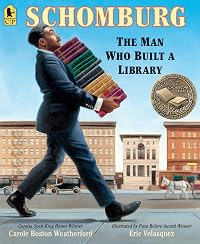
Award-winning illustrator Eric Velasquez adds richly detailed oil paintings that display his usual meticulous attention to historical detail.
Discussion: For the most part this book doesn't focus on Schomburg as much as on the historical figures whose materials he collected. Their stories are of course important as well as interesting, but I was very intrigued by Schomburg and wanted to know more. For years I have followed the excellent website of the Schomburg Center online but never took the time to learn about the founder. But clearly he should be more well-known and appreciated for the massive contributions he made to black scholarship. It is worth noting here more about the Center - his legacy - from its website:
"The Center consists of three connected buildings: The Schomburg Building, the Langston Hughes Building, and the Landmark Building. It is recognized as one of the leading institutions focusing exclusively on African-American, African Diaspora, and African experiences. Begun with the collections of Arturo Alfonso Schomburg 92 years ago, the Schomburg has collected, preserved, and provided access to materials documenting black life in America and worldwide. It has also promoted the study and interpretation of the history and culture of people of African descent. In 2015, it won the National Medal for Museum and Library Service. Today, the Schomburg continues to serve the community not just as a center and a library, but also as a space that encourages lifelong education and exploration."
Evaluation: This book is full of interesting information about black history generally. I hope teachers and librarians will help this book gain wider attention than it might have as "just" a biography of one man; it is much more. show less
The book not only tells how Schomburg helped with that restoration, but gives a great deal of background on works he discovered. Thus, it is actually a short survey of black history couched within the guise of a biography.
Schomburg, an Afro-Puerto Rican born in 1874, longed to read histories of his own people, but there were few materials available in either the schools of Puerto Rico where he grew up, or in New York, the city to which he immigrated at age seventeen. He felt an insatiable curiosity about Africana, however, and he haunted rare books stores in New show more York to find materials by and about black men and women. He was able to purchase the materials cheaply, because they were not considered to be valuable by white collectors.
Much of the book is given over to descriptions of the accomplishments of the heros and heroines of color whose writings and artwork Schomburg uncovered, including Phillis Wheatley, Benjamin Banneker, Paul Cuffee. He even found a 1573 book of poems by Spaniard Juan Latino, “perhaps the first printed book by a black person.”
Schomburg became actively involved in the activities of Harlem's intellectuals, and his acquaintances, the author reports, were a “Who’s Who” of the Harlem Renaissance. In addition, he corresponded with important intellects around the U.S. such as Booker T. Washington and W.E.B. Du Bois.
The author also reveals how Schomburg “navigated a maze of misinformation” to find out about other artists with black heritage whose origins had been whitewashed, including John James Audubon, Alexandre Dumas, Alexander Pushkin, and Beethoven.
In later years, Schomburg traveled all around the country and the world, not only to collect new materials, but to advocate for more attention to and resources for black history and culture.
Eventually, Schomburg's large library was purchased by the Carnegie Foundation, which donated it to the New York Public Library in 1926. The collection, called “matchless,” became the cornerstone of the NYPL’s Division of Negro History, Literature and Prints. Schomburg served as curator of the collection from 1932 until 1938, when he died.
At the end of the book, there is a time line, source notes, and a bibliography.
Award-winning illustrator Eric Velasquez adds richly detailed oil paintings that display his usual meticulous attention to historical detail.
Discussion: For the most part this book doesn't focus on Schomburg as much as on the historical figures whose materials he collected. Their stories are of course important as well as interesting, but I was very intrigued by Schomburg and wanted to know more. For years I have followed the excellent website of the Schomburg Center online but never took the time to learn about the founder. But clearly he should be more well-known and appreciated for the massive contributions he made to black scholarship. It is worth noting here more about the Center - his legacy - from its website:
"The Center consists of three connected buildings: The Schomburg Building, the Langston Hughes Building, and the Landmark Building. It is recognized as one of the leading institutions focusing exclusively on African-American, African Diaspora, and African experiences. Begun with the collections of Arturo Alfonso Schomburg 92 years ago, the Schomburg has collected, preserved, and provided access to materials documenting black life in America and worldwide. It has also promoted the study and interpretation of the history and culture of people of African descent. In 2015, it won the National Medal for Museum and Library Service. Today, the Schomburg continues to serve the community not just as a center and a library, but also as a space that encourages lifelong education and exploration."
Evaluation: This book is full of interesting information about black history generally. I hope teachers and librarians will help this book gain wider attention than it might have as "just" a biography of one man; it is much more. show less
Goodreads Review:
Where is our historian to give us our side, Arturo asked, to teach our people our own history?
Amid the scholars, poets, authors, and artists of the Harlem Renaissance stood an Afro-Puerto Rican man named Arturo Schomburg. His life's passion was to collect books, letters, music, and art from Africa and the African diaspora in order to bring to light the achievements of people of African descent. When his collection became so large that it threatened to overflow his house, he turned to the New York Public Library.
At the time, the collection, with Schomburg as curator, was the cornerstone of a new Division of Negro History, Literature and Prints. A century later, it is the Schomburg Center for Research in Black show more Culture—and a beacon for scholars all over the world.
In luminous paintings and arresting poems, two of children's literature's foremost African-American scholars track the journey of Arturo Schomburg and his quest to correct and expand the historical record for generations to come. show less
Where is our historian to give us our side, Arturo asked, to teach our people our own history?
Amid the scholars, poets, authors, and artists of the Harlem Renaissance stood an Afro-Puerto Rican man named Arturo Schomburg. His life's passion was to collect books, letters, music, and art from Africa and the African diaspora in order to bring to light the achievements of people of African descent. When his collection became so large that it threatened to overflow his house, he turned to the New York Public Library.
At the time, the collection, with Schomburg as curator, was the cornerstone of a new Division of Negro History, Literature and Prints. A century later, it is the Schomburg Center for Research in Black show more Culture—and a beacon for scholars all over the world.
In luminous paintings and arresting poems, two of children's literature's foremost African-American scholars track the journey of Arturo Schomburg and his quest to correct and expand the historical record for generations to come. show less
Written in a series of poems, the book chronicles
Schomburg's life and his quest to collect books,
manuscripts, and art to challenge the erasure of Black history and culture, culminating in his collection becoming the foundation for the Schomburg Center for Research in Black Culture.
Schomburg's life and his quest to collect books,
manuscripts, and art to challenge the erasure of Black history and culture, culminating in his collection becoming the foundation for the Schomburg Center for Research in Black Culture.
Carole Boston Weatherford's picture book blends poetry and narrative to tell the story of Arturo Schomburg, an Afro–Puerto Rican historian dedicated to collecting works about people of African descent. The book explores who Schomburg was, the collection he built, and his passion for preserving Black history. Weatherford’s language and thoughtful vocabulary are specifically tailored to the time period. Make the story both moving and educational. In ELAR, it’s perfect for biography, research, and author’s purpose units, and it serves well as a mentor text for writing. It’s an excellent pick for a 7th-grade library, highlighting overlooked history, the value of critical thinking, and social awareness.
Beautiful picture book about Arturo Alfonso Schomburg, a Puerto Rican/African immigrant to New York City in the nineteenth century, whose quest for knowledge about African history led him to collect books and develop a world-class African American book collection (as well as art, prints, and sculpture) that became the Schomburg Collection. The Carnegie Corporation bought it for $10,000 in 1926 and donated it to the New York Public Library, where Mr. Schomburg was the "guardian" of it. I loved the detail that he had it arranged by size and color--and even fired a librarian there for daring to use the Dewey Decimal system on it! He was a bank supervisor all his life, but managed to travel to Europe and South America, was a civic leader, show more and wrote many articles and encyclopedias on African American history. The oil painting illustrations in the book are really nice, colorful and realistic. Has bibliography and sources for all of the direct quotes. Timeline too. show less
In school, Arturo Shomburg was taught that there was no black history worth inclusion in books of American history and there was no contribution made by blacks. But, knowing that simple was not true, he fought that idea and went on to prove there was a history, and he made it a lifetime goal to shine a light on the black culture.
During his lifetime, he accumulated a library which focused on the major contributions, bringing to light the achievements made of people who are of African heritage.
In accumulating his private collection of books and materials he became the caretaker of all materials he diligently collected. Thankfully, and the New York Public Library recognized, and they appreciated his huge contribution of books and show more materials.
Creating the new division in the New York Library of Negro History, Literature and Prints, his contribution of research and his diligence in finding all that he could, shone a bright light on how very proud he was and encouraged others to recognize the major contributions of blacks in American history! Not only did he focus on the written word, but also paintings and misc. objects of supreme importance were collected as well.
Not only did he recognize and call attention to adult publications, but in addition, he focused on children's literature.
This is one man who knew that those who taught and felt there were no contributions, were very wrong. Thus, he did something about this! His actions spoke louder than his words. And, his words meant a lot.
Again, I did not know about this man until I found this beautiful book which highlighted so many of his accomplishments and endeavors.
Five Stars show less
During his lifetime, he accumulated a library which focused on the major contributions, bringing to light the achievements made of people who are of African heritage.
In accumulating his private collection of books and materials he became the caretaker of all materials he diligently collected. Thankfully, and the New York Public Library recognized, and they appreciated his huge contribution of books and show more materials.
Creating the new division in the New York Library of Negro History, Literature and Prints, his contribution of research and his diligence in finding all that he could, shone a bright light on how very proud he was and encouraged others to recognize the major contributions of blacks in American history! Not only did he focus on the written word, but also paintings and misc. objects of supreme importance were collected as well.
Not only did he recognize and call attention to adult publications, but in addition, he focused on children's literature.
This is one man who knew that those who taught and felt there were no contributions, were very wrong. Thus, he did something about this! His actions spoke louder than his words. And, his words meant a lot.
Again, I did not know about this man until I found this beautiful book which highlighted so many of his accomplishments and endeavors.
Five Stars show less
Members
- Recently Added By
Lists

At the Library ::: Children's Picture Books about Libraries
103 works; 6 members

Youth: Reading, Writing, Humor, Satire
63 works; 1 member
Author Information

86+ Works 9,795 Members
Awards and Honors
Awards
Distinctions
Notable Lists
Common Knowledge
- Canonical title*
- Schomburg : El hombre que construyó una biblioteca
- Alternate titles*
- Schomburg : El hombre que creó una biblioteca
- Original publication date
- 2017
- People/Characters
- Arturo Schomburg; Frederick Douglass; Toussaint L'Ouverture; Paul Cuffee or Cuffe
- Important places
- Harlem, New York, New York, USA
- Epigraph
- The American Negro must remake his past in order to make his future. . . . History must restore what slavery took away. --Arturo Schomburg
- Dedication
- Be curious. Be determined. Be proud. Curiosity is the seed of discovery. Discovery is the root of progress. --C.B.W.
Para Arturo Alfonso Schomburg. Gracias, maestro.--E.V. - First words
- Arturo Schomburg was more than a book lover, more than a mailroom clerk at Bankers Trust, where he supervised eleven white men, unheard-of-authority for a black man at the time.
- Last words
- (Click to show. Warning: May contain spoilers.)If a book is a garden carried in a pocket, then Schomburg yielded a bumper crop, blanketed Mount Kilimanjaro with African violets.
*Some information comes from Common Knowledge in other languages. Click "Edit" for more information.
Classifications
- DDC/MDS
- 002.075 — Computer science, information & general works Computer science, knowledge & systems Books (Science and history of the book) Standard subdivisions Bibliophilia bibliomania
- LCC
- E185.97 .S36 .W43 — History of the United States United States Elements in the population Afro-Americans Biography. Genealogy
- BISAC
Statistics
- Members
- 555
- Popularity
- 53,674
- Reviews
- 12
- Rating
- (4.29)
- Languages
- English, Spanish
- Media
- Paper, Audiobook, Ebook
- ISBNs
- 15
- ASINs
- 2