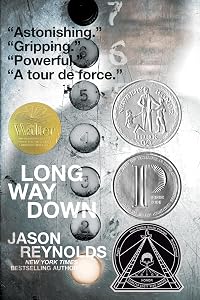
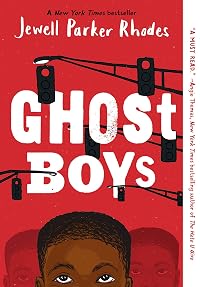
Long Way Down
by Jason Reynolds
On This Page
Description
As Will, fifteen, sets out to avenge his brother Shawn's fatal shooting, seven ghosts who knew Shawn board the elevator and reveal truths Will needs to know.Tags
Recommendations

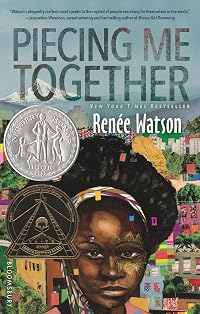
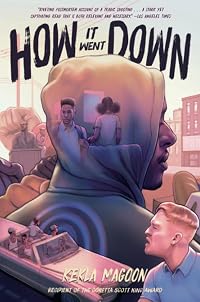
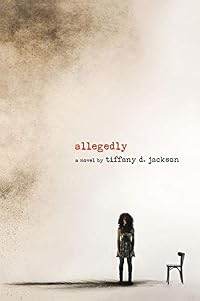
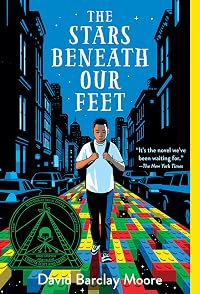


Member Reviews
Finished this book and felt like I had to talk to someone about it. What happens when the elevator door opens? The lesson given is clear to the reader, but does it have the same impact on the main character?
After his brother is murdered, Will is following "The Rules" and feels the need to get revenge and kill the guy who killed his brother. Or at least the guy he thinks kills his brother. In a kind of "Christmas Carol" device he meets others in his life who have been killed on the elevator ride down to street level and interacts with them to kind of put a lens to his own situation. The cycle of violence his family has been in that is revealed during this ride is heartbreaking.
Sparse and powerful, a quick read I didn't want to put down.
After his brother is murdered, Will is following "The Rules" and feels the need to get revenge and kill the guy who killed his brother. Or at least the guy he thinks kills his brother. In a kind of "Christmas Carol" device he meets others in his life who have been killed on the elevator ride down to street level and interacts with them to kind of put a lens to his own situation. The cycle of violence his family has been in that is revealed during this ride is heartbreaking.
Sparse and powerful, a quick read I didn't want to put down.
Thank god for bookclub! It’s books like this that remind me how lucky I am to be in a club with such a great group of ladies who love to read and know their stuff about what’s out there. The only other Jason Reynolds book I read was for bookclub (was great), but per my norm, since he writes the type of fiction that I don’t usually pursue on my own, it’s likely I would have missed out on this great read as well.
During our meeting, there was a persistent theme of us all having read it in one sitting (most of us the very day of bookclub, my bad!) due to the story being written in verse. But this decision was so much more than a device that made the book quick to read! Reynolds masterfully binds together all the strengths that can show more be gleaned from versed-novels, while deftly avoiding some of the pitfalls, such as melodrama and pretentiousness.
Instead, the limited number of words created an almost claustrophobic atmosphere that mirrored Will’s journey down the elevator. From page to page, the words would be laid out differently across the page, sometimes mimicking the topic that was being discussed, such as a jagged splatter of words about an earthquake and a question mark shape drawn in words themselves. The line breaks, and even page turns, were also effective in giving weight to moments and certain words, leaving them to fall hard on the unsuspecting reader.
Beyond the style of the book, Reynolds tackles a tough and nuanced topic in his exploration of gun violence in a poor, black neighborhood. His story is a frank reveal of the limited choices and persistent cycles that exists, without casting judgement or freeing characters from the responsibility of their actions. Again, the decision to write in verse just further supported this exploration. As the number of words are limited, Reynolds’ language is precise, clear, and devastating.
My only criticism is with the very end, and even there, I’m not entirely sure how I feel. I like the ambiguousness, but I also feel like it wrapped up rather suddenly. However, I also don’t know how else a story like this could have been finished, and the ending itself speaks to the limited and challenging options available in these communities.
----
I had the distinct pleasure of meeting Jason Reynolds while at ALA’s Annual Conference in 2017, and when I met him I got an ARC of “Long Way Down”. I hadn’t known what to expect from that book, but I knew that the concept sounded very intriguing to me. When I finally opened it up a couple months later I was pretty much blown away. I hadn’t expected to be as taken with the book, only because it’s written in verse and DAMN am I not a poetry fan. But I read it one sitting and said ‘wow’ as I set it down at the end. So when we did the B-Sides theme, I KNEW that I needed to pick “Long Way Down”.
Will is a character that the reader can instantly relate to, even if your circumstances don’t match his. He’s a person who has just suffered a great personal loss, and his grief, rage, and helplessness are pushing him towards making a huge mistake: shooting the man who he thinks killed his brother Shawn. As mentioned, this entire story, from his brother’s murder to the aftermath to Will’s experiences in the elevator, is told in poetry form. The poems split up the story into little segments, and you get the full span of anger and deep grief that Will is experiencing. Even though I don’t like poetry, it’s use in this book is incredibly evocative, and in some ways makes it more powerful because of the way Reynolds structures each poem. You know that Will is a boy who deeply loves his brother, and is within a community where cycles of violence can affect, and embitter, anyone.
I also really appreciate the way that Reynolds shows the different victims of gun violence in Will’s life, from his brother to his father to his uncle to a childhood friend. They all have different scenarios that led to their deaths, some because of a direct choice, and others because of sheer circumstance and randomness. The one that hits the hardest is that of Dani, a girl who was friends with Will when they were eight, and who died because of a stray bullet meant for someone else. But that isn’t to say that Reynolds makes any of the other victims less of a victim by including her, no matter what choices they may have made. As Serena mentioned above, Reynolds shows that they are all victims in one way or another, be it victims of gun violence of victims of a society that has forgotten about them. There are lots of greys in this book, and, as Serena mentioned, lots of ambiguity, and I think that given that life is filled with greys it hits the point home.
Reading “Long Way Down” for the second time cemented it as one of my favorite YA books as of late, and Jason Reynolds is a master who is telling stories that really need to be told. I can’t wait to see what else he brings to the literary world. show less
During our meeting, there was a persistent theme of us all having read it in one sitting (most of us the very day of bookclub, my bad!) due to the story being written in verse. But this decision was so much more than a device that made the book quick to read! Reynolds masterfully binds together all the strengths that can show more be gleaned from versed-novels, while deftly avoiding some of the pitfalls, such as melodrama and pretentiousness.
Instead, the limited number of words created an almost claustrophobic atmosphere that mirrored Will’s journey down the elevator. From page to page, the words would be laid out differently across the page, sometimes mimicking the topic that was being discussed, such as a jagged splatter of words about an earthquake and a question mark shape drawn in words themselves. The line breaks, and even page turns, were also effective in giving weight to moments and certain words, leaving them to fall hard on the unsuspecting reader.
Beyond the style of the book, Reynolds tackles a tough and nuanced topic in his exploration of gun violence in a poor, black neighborhood. His story is a frank reveal of the limited choices and persistent cycles that exists, without casting judgement or freeing characters from the responsibility of their actions. Again, the decision to write in verse just further supported this exploration. As the number of words are limited, Reynolds’ language is precise, clear, and devastating.
My only criticism is with the very end, and even there, I’m not entirely sure how I feel. I like the ambiguousness, but I also feel like it wrapped up rather suddenly. However, I also don’t know how else a story like this could have been finished, and the ending itself speaks to the limited and challenging options available in these communities.
----
I had the distinct pleasure of meeting Jason Reynolds while at ALA’s Annual Conference in 2017, and when I met him I got an ARC of “Long Way Down”. I hadn’t known what to expect from that book, but I knew that the concept sounded very intriguing to me. When I finally opened it up a couple months later I was pretty much blown away. I hadn’t expected to be as taken with the book, only because it’s written in verse and DAMN am I not a poetry fan. But I read it one sitting and said ‘wow’ as I set it down at the end. So when we did the B-Sides theme, I KNEW that I needed to pick “Long Way Down”.
Will is a character that the reader can instantly relate to, even if your circumstances don’t match his. He’s a person who has just suffered a great personal loss, and his grief, rage, and helplessness are pushing him towards making a huge mistake: shooting the man who he thinks killed his brother Shawn. As mentioned, this entire story, from his brother’s murder to the aftermath to Will’s experiences in the elevator, is told in poetry form. The poems split up the story into little segments, and you get the full span of anger and deep grief that Will is experiencing. Even though I don’t like poetry, it’s use in this book is incredibly evocative, and in some ways makes it more powerful because of the way Reynolds structures each poem. You know that Will is a boy who deeply loves his brother, and is within a community where cycles of violence can affect, and embitter, anyone.
I also really appreciate the way that Reynolds shows the different victims of gun violence in Will’s life, from his brother to his father to his uncle to a childhood friend. They all have different scenarios that led to their deaths, some because of a direct choice, and others because of sheer circumstance and randomness. The one that hits the hardest is that of Dani, a girl who was friends with Will when they were eight, and who died because of a stray bullet meant for someone else. But that isn’t to say that Reynolds makes any of the other victims less of a victim by including her, no matter what choices they may have made. As Serena mentioned above, Reynolds shows that they are all victims in one way or another, be it victims of gun violence of victims of a society that has forgotten about them. There are lots of greys in this book, and, as Serena mentioned, lots of ambiguity, and I think that given that life is filled with greys it hits the point home.
Reading “Long Way Down” for the second time cemented it as one of my favorite YA books as of late, and Jason Reynolds is a master who is telling stories that really need to be told. I can’t wait to see what else he brings to the literary world. show less
For this Library Thing I chose to read Long Way Down, by Jason Reynolds. This story is about a 15 year old boy named Will and his ride in the elevator. Will has a set of rules.
1. No Crying
2. Don’t Snitch
3. Revenge
Will is carrying out rule number 3. Someone murdered his brother and Will thinks he knows who. In Will’s world you kill the person who killed the person who you love. In this case he is killing the person who killed Shawn. Will stole Shawn’s old gun and is ready to shoot. But, the elevator ride is a long way down. At every floor Will passes, the elevator opens and a ghost from his past steps in. The ghosts have all been murdered because of the rules. They all try to talk him out of his decision. At Will’s final floor show more Shawn steps in and says “Are you coming?”.
I love this book! Jason Reynolds made my heart ache with verses of poetry. When I first read the book I didn't really understand the meaning. So, I reread the whole thing very carefully. “Are you coming?” I think it means “Are ready to join us?”. This question is deep. Every community has its rules, but these rules end in a cycle of death. If Will follows through with his plan, he will be shot by the victims loved one. I recommend this book to almost anyone, it really makes you think. show less
1. No Crying
2. Don’t Snitch
3. Revenge
Will is carrying out rule number 3. Someone murdered his brother and Will thinks he knows who. In Will’s world you kill the person who killed the person who you love. In this case he is killing the person who killed Shawn. Will stole Shawn’s old gun and is ready to shoot. But, the elevator ride is a long way down. At every floor Will passes, the elevator opens and a ghost from his past steps in. The ghosts have all been murdered because of the rules. They all try to talk him out of his decision. At Will’s final floor show more Shawn steps in and says “Are you coming?”.
I love this book! Jason Reynolds made my heart ache with verses of poetry. When I first read the book I didn't really understand the meaning. So, I reread the whole thing very carefully. “Are you coming?” I think it means “Are ready to join us?”. This question is deep. Every community has its rules, but these rules end in a cycle of death. If Will follows through with his plan, he will be shot by the victims loved one. I recommend this book to almost anyone, it really makes you think. show less
Will's brother Shawn is murdered, and even at fifteen Will knows the Rules: 1. No crying 2. No snitching 3. Get revenge. Planning on doing just that the next morning, he gets in an elevator, his brother's gun tucked in his pants. But he's in for a wild ride.
This novel in verse is intense. I thought I understood the direction it might go in, but with the first visitor Will has in his elevator, I realized I was along for the ride myself. I read it in one sitting, in only a couple of hours. Without judgment, Reynolds presents the life Will has left and the legacy of one man killing another that has led up to this moment. For all that it was short, I was completely invested and almost cried at parts.
This novel in verse is intense. I thought I understood the direction it might go in, but with the first visitor Will has in his elevator, I realized I was along for the ride myself. I read it in one sitting, in only a couple of hours. Without judgment, Reynolds presents the life Will has left and the legacy of one man killing another that has led up to this moment. For all that it was short, I was completely invested and almost cried at parts.
“MY MOTHER USED TO SAY,
I know you're young,
gotta get it out,
but just remember, when
you're walking in the nighttime,
make sure the nighttime
ain't walking into you.”
Will is fifteen. His brother was recently killed. He wants revenge. That is the rules. This excellent novel, told in verse, all happens in one minute, as Will rides an elevator, to avenge his brother's death. This is my first experience with Reynolds and it will not be my last. I am glad to see how prolific he is. This also worked wonderfully on audio, with the author nailing the delivery.
"I FELT LIKE CRYING
which felt like
another person
trapped behind my face
tiny fists punching
the backs of my eyes
feet kicking
my throat at the spot
where the swallow
starts.
Stay put, I show more whispered to him,
Stay strong, I whispered to me.
Because crying
is against
The Rules." show less
I know you're young,
gotta get it out,
but just remember, when
you're walking in the nighttime,
make sure the nighttime
ain't walking into you.”
Will is fifteen. His brother was recently killed. He wants revenge. That is the rules. This excellent novel, told in verse, all happens in one minute, as Will rides an elevator, to avenge his brother's death. This is my first experience with Reynolds and it will not be my last. I am glad to see how prolific he is. This also worked wonderfully on audio, with the author nailing the delivery.
"I FELT LIKE CRYING
which felt like
another person
trapped behind my face
tiny fists punching
the backs of my eyes
feet kicking
my throat at the spot
where the swallow
starts.
Stay put, I show more whispered to him,
Stay strong, I whispered to me.
Because crying
is against
The Rules." show less
On his way to avenge his brother's death, Will Holloman takes a minute in the elevator to consider his actions . . . with the help of some other passengers.
First of all, I loved the way the thin column of words floats around the page, drawing me along and manipulating my emotions with their placement. Genius.
Knowing nothing of the book beforehand, I was a little thrown by the introduction of a supernatural element. And as more people stepped onto the elevator, I was distracted by echoes of Bigger Thomas’ increasingly crowded cell near the end of Richard Wright's Native Son. But it all works.
Quickly consumed, but moving and powerful.
And, bonus day! As I logged the novel, I was reminded that there is a graphic novel adaptation show more available. I'm placing a hold at my library right now. show less
First of all, I loved the way the thin column of words floats around the page, drawing me along and manipulating my emotions with their placement. Genius.
Knowing nothing of the book beforehand, I was a little thrown by the introduction of a supernatural element. And as more people stepped onto the elevator, I was distracted by echoes of Bigger Thomas’ increasingly crowded cell near the end of Richard Wright's Native Son. But it all works.
Quickly consumed, but moving and powerful.
And, bonus day! As I logged the novel, I was reminded that there is a graphic novel adaptation show more available. I'm placing a hold at my library right now. show less
A unique way to explore the cycle of gun violence through one grief-stricken boy’s ride down in an elevator.
Deceptively simple writing, these somewhat minimal verses manage to speak volumes, conveying the smoky tension inside the elevator and taking you on the roller-coaster ride of this kid’s emotions as he wrestles with how to respond to his brother’s murder.
I could see some readers finding the ending unsatisfying, there are definitely other books where I’ve felt that way with an ending style similar to this, but for this story, the abrupt impact seemed really right.
Deceptively simple writing, these somewhat minimal verses manage to speak volumes, conveying the smoky tension inside the elevator and taking you on the roller-coaster ride of this kid’s emotions as he wrestles with how to respond to his brother’s murder.
I could see some readers finding the ending unsatisfying, there are definitely other books where I’ve felt that way with an ending style similar to this, but for this story, the abrupt impact seemed really right.
Members
- Recently Added By
Lists

Books about Gun Violence
54 works; 1 member

Edgar Award
418 works; 15 members

Books Read in 2019
4,052 works; 108 members

To Read
617 works; 7 members

READ IN 2021
239 works; 4 members

Literature for Children and Teens
41 works; 2 members

Youth: Personal Values
252 works; 1 member

VBL YA
49 works; 1 member

Newbery Honor Books By year - II - 1981-2035
143 works; 4 members

Books Read in 2022
5,168 works; 111 members

Books recommended by Calgary Public Library staff
1,588 works; 4 members

Reading Glasses Podcast
410 works; 3 members

EGBERTINA's List of Newbery books that I hated or found unnecessary
58 works; 3 members

Favorite Coming of Age Novels.
164 works; 51 members

Top Five Books of 2025
954 works; 303 members
Author Information

53+ Works 22,688 Members
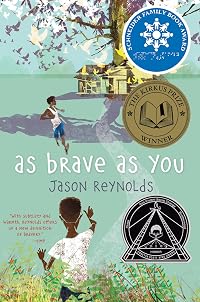
Jason Reynolds is the author of When I Was the Greatest, for which he won the Coretta Scott King/John Steptoe Award for New Talent. His debut middle grade book, As Brave As You, was awarded the 2016 Kirkus Prize for young readers'. His other works include Boy in the Black Suit, and All American Boys. (Bowker Author Biography)
Some Editions
Awards and Honors
Awards
Distinctions
Notable Lists
Work Relationships
Has the adaptation
Has as a student's study guide
Common Knowledge
- Original publication date
- 2017
- People/Characters
- William "Will" Holloman; Shawn Holloman (brother of William "Will" Holloman); Shari Holloman (mother of William "Will" Holloman); Mikey Holloman (father of William "Will" Holloman); Tony (friend of William "Will" Holloman); Leticia (girlfriend of Shawn Holloman) (show all 11); Carlson Riggs; James "Buck"; Dani; Mark Holloman (brother of Mikey Holloman); Frank "Frick"
- Important places
- elevator; United States of America
- Dedication
- For all the young brothers and sisters in detention centers around the country, the ones I’ve seen, and the ones I haven’t. You are loved.
- First words
- DON’T NOBODY
believe nothing
these days
which is why I haven’t
told nobody the story
I’m about to tell you. - Last words
- (Click to show. Warning: May contain spoilers.)You coming?
- Publisher's editor
- Dlouhy, Caitlyn
- Original language
- English
- Disambiguation notice
- Do not combine with the graphic novel
Classifications
Statistics
- Members
- 3,197
- Popularity
- 5,415
- Reviews
- 170
- Rating
- (4.33)
- Languages
- 5 — Dutch, English, French, German, Portuguese (Portugal)
- Media
- Paper, Audiobook, Ebook
- ISBNs
- 31
- ASINs
- 4