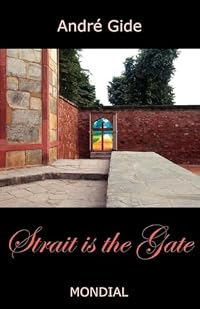
Strait is the Gate
by André Gide
On This Page
Description
A delicate boy growing up in Paris, Jerome Pallisier spends many summers at his uncle's house in the Normandy countryside, where the whole world seems 'steeped in azure'. There he falls deeply in love with his cousin Alissa and she with him. But gradually Alissa becomes convinced that Jerome's love for her is endangering his soul. In the interest of his salvation, she decides to suppress everything that is beautiful in herself - in both mind and body. A devastating exploration of show more aestheticism taken to extremes, Strait is the Gateis a novel of haunting beauty that stimulates the mind and the emotions. show lessTags
Recommendations











Member Recommendations

Member Reviews
This is a difficult story to appreciate today, removed from its original context. Alissa and Jerome love each other, and Alissa's sister Juliette also loves Jerome. Oh, and they're first cousins who grew up around each other. Alissa tries to give Jerome up to her sister, but Juliette matches the sacrifice by immediately marrying some random guy who appeared on the scene in order to remove herself from the picture.
Alissa though continues and takes to a far extreme her self-sacrifice. She has the idea that human love is vastly inferior to love of God and that it indeed gets in the way.
Though today we idealize and elevate romantic love, and the deists among us seemingly naturally place God's blessing upon it, this was not always the case. Among the turn of the twentieth century Protestants in northern France, apparently, romantic love and love of God were sometimes seen as rivals, or at least in tension with each other. Gide wrote this novel as a cautionary tale, to explore the taking of this attitude to the extreme. It is a twin tale to his novel The Immoralist, where Michel pursues the opposite extreme of earthly pleasure, also to disaster.
It was also a shot at his wife's tendencies, with whom the homosexual Gide had an unconsummated relationship. His wife who was also his cousin. While The Immoralist, in which a married homosexual man is attracted to Arab boys, is a shot at his own. show less
Alissa though continues and takes to a far extreme her self-sacrifice. She has the idea that human love is vastly inferior to love of God and that it indeed gets in the way.
"What can the soul prefer to happiness?" I cried, impetuously. She whispered: "Holiness..."She tells Jerome:
"In the first moments of your stay atshow more
Fongueusemare it was astonishment that I felt - soon after it was uneasiness - at the strange contentment that filled my whole being in your presence; 'a contentment so great,' you said, 'that I desire nothing beyond!' Alas! that is just what makes me uneasy... 'If it did not suffice, it would not be happiness,' you said, do you remember? And I did not know what to answer. No, Jerome, it does not suffice us. Jerome, it must not suffice us. I cannot take this delicious contentment for the true one... We were born for a happiness other than that..."In the name of this love of God, she continually pushes Jerome away, renouncing human love and happiness. Having renounced earthly pleasure, she naturally wastes away and dies, though only about in her late twenties. Jerome is given her diary after her death, in which she writes that she loves him so much that she has failed to love God more. Despairing, she resolved to help Jerome reach that height of religious virtue that she was unable to reach herself by making it so he could not love her any longer.
Alas! I understand now only too well: between God and him there is no other obstacle but myself. If perhaps, as he says, his love for me at first inclined him to God, now that very love hinders him; he lingers with me, prefers me, and I am become the idol that keeps him back from making further progress in virtue. One of us two must needs attain to it; and as I despair of overcoming the love in my coward heart, grant me, my God, vouchsafe me strength to teach him to love me no longer, so that at the cost of my merits I may bring Thee his, which are so infinitely preferable... Was he not born for something better than to love me?The cost of her unasked for sacrifice is soon her death, and the last line she writes is, "I should like to die now, quickly, before again realising that I am alone." As a final twist of the knife, Gide has Jerome visit Juliette ten years after Alissa's death, Juliette with 5 children now, and he tells her that he will not love another woman for the rest of his life. She asks him,
"Then you think that one can keep a hopeless love in one's heart for so long as that? And that life can breathe upon it every day, without extinguishing it?"She puts her hands to her face and begins to cry, and we cannot doubt it is her own love for Jerome of which she was speaking. Lord a'mighty.
Though today we idealize and elevate romantic love, and the deists among us seemingly naturally place God's blessing upon it, this was not always the case. Among the turn of the twentieth century Protestants in northern France, apparently, romantic love and love of God were sometimes seen as rivals, or at least in tension with each other. Gide wrote this novel as a cautionary tale, to explore the taking of this attitude to the extreme. It is a twin tale to his novel The Immoralist, where Michel pursues the opposite extreme of earthly pleasure, also to disaster.
It was also a shot at his wife's tendencies, with whom the homosexual Gide had an unconsummated relationship. His wife who was also his cousin. While The Immoralist, in which a married homosexual man is attracted to Arab boys, is a shot at his own. show less
"I advanced slowly; the sky was like my joy---warm, bright, delicately pure. No doubt she was expecting me by the other path. I was close to her, behind her, before she heard me; I stopped . . . and as if time could have stopped with me, "This is the moment," I thought, "the most delicious moment, perhaps, of all, even though it should precede happiness itself---which happiness itself will not equal." (p 96)
"Enter ye in at the strait gate: for wide is the gate and broad is the way, that leadeth to destruction and many there be which go thereat: Because strait is the gate, and narrow is the way, which leadeth unto life, and few there be that find it." (Matthew 7:13-14).
This is the text from which Gide drew the title of his short novel, show more Strait is the Gate. It is a first person narrative that begins forthrightly with the words:
"Some people might have made a book out of it; but the story I am going to tell is one that it took all my strength to live and over which I have spent all my virtue. So I shall set down my recollections quite simply, and if in places they are ragged I shall have recourse to no invention and neither patch nor connect them; any effort I might make to dress them up would take away from the last pleasure I hope to get in telling them." (p 3)
The author signals in this short paragraph the importance of virtue (of what sort we shall find out) and that these are personal "recollections", subject to the vicissitudes of memory and desire, but not invented. Finally, the narrator claims to have pleasure, or at least hopes to, in telling them. One may see already the potential for the contradiction of truth presented as fiction and fiction telling the truth.
The setting is the Protestant upper-middle-class world of Normandy in the 1880s. The narrator, Jerome Palissier, originally from Le Havre, is eleven when the story begins. His father having died he is living with his mother and a governess. He is surrounded by family including a creole aunt Lucille who alternately fascinates and terrifies him. She has two young daughters, Alissa and Juliette Bucolin, who are devoted to their father. Alissa and Jerome become childhood sweethearts and this gradually develops into a situation such that it becomes assumed, at least unofficially, that they are engaged. Unfortunately Alissa never truly agrees to any such arrangement. Complicating matters further are the feelings of Juliette for Jerome and the entry of Jerome's good friend Abel Vautier who quickly becomes infatuated with Juliette. The relations among these young people are complicated by the strength of youthful Eros, their own growth, and their search for identity. It is this search that leads Alissa in the direction of religion, in spite of which she professes to love Jerome. But she is no longer her former self and as Jerome is about to leave the country home of Fonguesemare where they have been together she claims that he has been in love with a ghost. Jerome replies that the ghost is not an illusion on his part: "Alissa, you are the woman I loved . . . What have you made yourself become?" Jerome leaves, "full of a vague hatred for what I still called virtue". Strong stuff for teenagers.
Three years later he returns but their relations are never the same; the strength of her religious convictions has altered Alissa both spiritually and physically. The affairs narrated here are apparently drawn from Gide's own life, however loosely. Their are also parallels with Gide's own work as Alissa may be seen as corresponding to Michel, the protagonist in Gide's novel, The Immoralist, written about a decade earlier. Strait is the Gate presents itself as a small gem of a literary work. With its focus on the passions and desires of young love I am reminded of Goethe's Sorrows of Young Werther. Gide's biographer, Alan Sheridan, suggests that it is also a meditation on Gide's relationship with his own wife, Madeleine. Whether that is the case or not this short novel is has a beautiful clarity of prose and a haunting style that suggests the memories of young love that, while strong enough to leave permanent impressions, in some way become ghosts of one's youth. show less
"Enter ye in at the strait gate: for wide is the gate and broad is the way, that leadeth to destruction and many there be which go thereat: Because strait is the gate, and narrow is the way, which leadeth unto life, and few there be that find it." (Matthew 7:13-14).
This is the text from which Gide drew the title of his short novel, show more Strait is the Gate. It is a first person narrative that begins forthrightly with the words:
"Some people might have made a book out of it; but the story I am going to tell is one that it took all my strength to live and over which I have spent all my virtue. So I shall set down my recollections quite simply, and if in places they are ragged I shall have recourse to no invention and neither patch nor connect them; any effort I might make to dress them up would take away from the last pleasure I hope to get in telling them." (p 3)
The author signals in this short paragraph the importance of virtue (of what sort we shall find out) and that these are personal "recollections", subject to the vicissitudes of memory and desire, but not invented. Finally, the narrator claims to have pleasure, or at least hopes to, in telling them. One may see already the potential for the contradiction of truth presented as fiction and fiction telling the truth.
The setting is the Protestant upper-middle-class world of Normandy in the 1880s. The narrator, Jerome Palissier, originally from Le Havre, is eleven when the story begins. His father having died he is living with his mother and a governess. He is surrounded by family including a creole aunt Lucille who alternately fascinates and terrifies him. She has two young daughters, Alissa and Juliette Bucolin, who are devoted to their father. Alissa and Jerome become childhood sweethearts and this gradually develops into a situation such that it becomes assumed, at least unofficially, that they are engaged. Unfortunately Alissa never truly agrees to any such arrangement. Complicating matters further are the feelings of Juliette for Jerome and the entry of Jerome's good friend Abel Vautier who quickly becomes infatuated with Juliette. The relations among these young people are complicated by the strength of youthful Eros, their own growth, and their search for identity. It is this search that leads Alissa in the direction of religion, in spite of which she professes to love Jerome. But she is no longer her former self and as Jerome is about to leave the country home of Fonguesemare where they have been together she claims that he has been in love with a ghost. Jerome replies that the ghost is not an illusion on his part: "Alissa, you are the woman I loved . . . What have you made yourself become?" Jerome leaves, "full of a vague hatred for what I still called virtue". Strong stuff for teenagers.
Three years later he returns but their relations are never the same; the strength of her religious convictions has altered Alissa both spiritually and physically. The affairs narrated here are apparently drawn from Gide's own life, however loosely. Their are also parallels with Gide's own work as Alissa may be seen as corresponding to Michel, the protagonist in Gide's novel, The Immoralist, written about a decade earlier. Strait is the Gate presents itself as a small gem of a literary work. With its focus on the passions and desires of young love I am reminded of Goethe's Sorrows of Young Werther. Gide's biographer, Alan Sheridan, suggests that it is also a meditation on Gide's relationship with his own wife, Madeleine. Whether that is the case or not this short novel is has a beautiful clarity of prose and a haunting style that suggests the memories of young love that, while strong enough to leave permanent impressions, in some way become ghosts of one's youth. show less
Gide has a rare talent for spotting important moral issues, particularly relevant to his own time, and then presenting them in a scrupulously fair manner. The Immoralist can be read as a defense of homosexuality (which I'd like to think doesn't really need a defense anymore), or as a defense of uber-menschliche Nietzscheanism (which doesn't deserve such a defense), or an attack on said Nietzscheanism (which shouldn't, but does, need such an attack). Similarly, Strait is the Gate can be read as an attack on religiosity (which remains relevant), or an attack on irreligious lust (which remains relevant), or something in between. Both books are wonderfully readable, thought out, slightly melancholy, and intellectually fascinating, provided show more you don't assume a priori that they're defending a position with which you disagree. show less
Strait is the Gate is the debut novel of French novelist, essayist, dramatist and Nobel Laureate Andre Gidé (1869-1951). At only 128 pages it's more of a novella than a novel, but it's a wonderful book to read.
Looking back on events from later in life, it tells the story, much of it in epistolary form, of a doomed love between Jerome and his cousin Alissa.
In the wake of his father's death, Jerome forms a pre-pubescent close attachment to Alissa, but it is — and remains — delicate and elusive. Both have unavailable mothers: Jerome's is subsumed by grief, and Alissa's has abandoned the family to take pleasure elsewhere. It seems to both Jerome and Alissa that love is painful and unattainable, but they deal with this in different show more ways: Jerome is absorbed in intellectual pursuits while Alissa takes on the duty of caring for her devastated father and turns to religion for solace.
Over their years from adolescence to young adulthood, their yearning is expressed in declarations of love within their letters, but when together over long summers of poetry, Bible-reading, books and music, this love is never consummated in anything more than holding hands. As time goes by, their time together is always marked by further distancing at her behest. The future is always postponed.
BEWARE: SPOILERS
Jerome's friend and confidante Abel, meanwhile, falls for Alissa's younger sister Juliette and confidently predicts a double marriage, until he realises that she is in love, hopelessly, with Jerome. Rejecting love as Jerome and Alissa do, but only because it's unattainable, Juliette makes a marriage with an older man of a different class, almost as if to punish herself. She seems contented enough, until the last page, when Jerome tells her that he could only have pretended to love another woman, if he had married.
And as in previous conversations with Juliette, Jerome processes these words through the prism of his own feelings about Alissa, noting only that Juliette might have been in tears.
The novel is often interpreted as a cautionary tale against excessive religious fervour. This is because when, finally, Jerome has finished his studies and his military service, and Alissa's father has died so there are no obstacles to fulfilment of what they both desire, she terminates the relationship so that they can give themselves to God.
This is the ultimate fulfilment of a stirring sermon that they heard after Alissa's mother ran away with her lover.
A passage in the sermon, (from which the title of the book is derived) comes from the Gospel of Luke in the Bible: Strive to enter in at the strait gate: for many, I say unto you, will seek to enter in, and shall not be able. Jerome had pledged himself to be virtuous enough to win Alissa, but Alissa ultimately interprets the strait gate as too narrow for two people in love, blocking the entrance to Paradise to both of them because each should dedicate their lives solely to God.
However, knowing that Gide was gay, makes me wonder if there can be a variation on this interpretation.
To read the rest of my review please visit https://anzlitlovers.com/2020/12/31/strait-is-the-gate-by-andre-gide-translated-... show less
Looking back on events from later in life, it tells the story, much of it in epistolary form, of a doomed love between Jerome and his cousin Alissa.
In the wake of his father's death, Jerome forms a pre-pubescent close attachment to Alissa, but it is — and remains — delicate and elusive. Both have unavailable mothers: Jerome's is subsumed by grief, and Alissa's has abandoned the family to take pleasure elsewhere. It seems to both Jerome and Alissa that love is painful and unattainable, but they deal with this in different show more ways: Jerome is absorbed in intellectual pursuits while Alissa takes on the duty of caring for her devastated father and turns to religion for solace.
Over their years from adolescence to young adulthood, their yearning is expressed in declarations of love within their letters, but when together over long summers of poetry, Bible-reading, books and music, this love is never consummated in anything more than holding hands. As time goes by, their time together is always marked by further distancing at her behest. The future is always postponed.
BEWARE: SPOILERS
Jerome's friend and confidante Abel, meanwhile, falls for Alissa's younger sister Juliette and confidently predicts a double marriage, until he realises that she is in love, hopelessly, with Jerome. Rejecting love as Jerome and Alissa do, but only because it's unattainable, Juliette makes a marriage with an older man of a different class, almost as if to punish herself. She seems contented enough, until the last page, when Jerome tells her that he could only have pretended to love another woman, if he had married.
'Ah!' said she, as though indifferently, then turning her face away from me, she bent it towards the ground, as if she were looking for something she had lost. 'Then you think that one can keep a hopeless love in one's heart for so long as that?'
'Yes, Juliette.'
'And that life can breathe upon it every day, without extinguishing it?' (p.128)
And as in previous conversations with Juliette, Jerome processes these words through the prism of his own feelings about Alissa, noting only that Juliette might have been in tears.
The novel is often interpreted as a cautionary tale against excessive religious fervour. This is because when, finally, Jerome has finished his studies and his military service, and Alissa's father has died so there are no obstacles to fulfilment of what they both desire, she terminates the relationship so that they can give themselves to God.
This is the ultimate fulfilment of a stirring sermon that they heard after Alissa's mother ran away with her lover.
A passage in the sermon, (from which the title of the book is derived) comes from the Gospel of Luke in the Bible: Strive to enter in at the strait gate: for many, I say unto you, will seek to enter in, and shall not be able. Jerome had pledged himself to be virtuous enough to win Alissa, but Alissa ultimately interprets the strait gate as too narrow for two people in love, blocking the entrance to Paradise to both of them because each should dedicate their lives solely to God.
However, knowing that Gide was gay, makes me wonder if there can be a variation on this interpretation.
To read the rest of my review please visit https://anzlitlovers.com/2020/12/31/strait-is-the-gate-by-andre-gide-translated-... show less
As with most all of Gide's best novels, this one concerns the anxiety and yearning at the heart of human experience. A very young Jerome Palissier regularly spends holidays at the house of his aunt and uncle's estate in Fongueusemare in rural Normandy. One day, he happens upon his cousin Alissa, who is distraught at her aloof, hypochondriacal mother. Both desperate to rescue her and drawn by a genuine affection, Jerome takes it upon himself to sweep in and rescue her like a good, Christian knight errant. The subtle imagery of Jerome as a kind of salvific hero is only a foreshadowing of the religious unease that drives this novel forward toward its foreordained conclusion. As Jerome portentously declares, quoting Baudelaire, "Bientot show more nous plongerons dons les froides tenebres."
Jerome and Alissa spend irenic summers together reciting poetry, reading from books to one another in their splendid garden, and enjoying music. The appropriateness of Jerome's name jumps out at you when he mentions another of their mutual literary interests: "We had procured the Gospels in the Vulgate and knew long passages of them by heart." (It was Saint Jerome who made the first Latin translation of the Bible.) Jerome wishes to become engaged before moving off to the Ecole Normale, but Alissa refuses. He is understandably upset by her rejection, but is only more spurred on by his ecstatic vision (again, that religious imagery) of eventually marrying her. Eventually, we learn that Alissa has sacrificed Jerome so that her sister, Juliette, will be able to get married first, yet even after Juliette gets married - to a boorish, business-minded vintner - Alissa continues to push him away.
He visits her at Fongueusemare while finishing both his schooling and a military stint, but every time he mentions wanting to marry her, she rejects him and requests that he leave soon, that she cannot bear his presence. Eventually, she tells him that her love of God surpasses her love for him, even though she has always passionately loved Jerome. During their last meeting together, Alissa has grown thin and pale, presumably because of her anchorite-like existence; she has also removed the books of poetry and novels she and Jerome used to read together, and replaced them with works of cheap, vulgar piety. Even while there is room here to doubt Alissa's love for Jerome, a chapter that includes her personal journals makes it perfectly clear that she loved Jerome just as much as he loved her, if not more so. Jerome has a final meeting with Juliette while she is enceinte with her fifth child by the vintner. Seeing him calls to mind both her sister's Christ-like sacrifice and makes her reflect on her own uneventful, bourgeois life. As Flaubert said: "Madame Bovary, c'est moi."
For maximum effect, as noted above, read this right next to Gide's "The Immoralist" for a most effective couple of case studies. Considering the year of publication (1909) and the ideas considered - repression, sexuality, sublimation - it should be noted that Gide almost certainly had Freud in mind when he was writing this, though it yields wonderful insights into human psychology even without a Freudian reading.
When reading a novel, sometimes the most difficult obstacle to being able to truly and fully appreciate it is the historical change that has taken place between the time in which it was written and when you read it. Judging from some of the reviews I have seen, that seems to be the case with this novel, too. In both this and "The Immoralist," Gide looks at the tension, confusion, and repression that can often come about when romantic love is pitted against, and forced to compete with, love for the divine. Since this novel was published, this antagonism has almost completely died, which may lead some readers to accuse Alissa of being frigid. Once we are able to bridge that historical gap, however, and realize that Alissa did not see her torment as self-imposed but rather something that was required of her, this novel proves itself to be a superior meditation on both romantic passion and, what was once thought to be its opposite, sacrifice. show less
Jerome and Alissa spend irenic summers together reciting poetry, reading from books to one another in their splendid garden, and enjoying music. The appropriateness of Jerome's name jumps out at you when he mentions another of their mutual literary interests: "We had procured the Gospels in the Vulgate and knew long passages of them by heart." (It was Saint Jerome who made the first Latin translation of the Bible.) Jerome wishes to become engaged before moving off to the Ecole Normale, but Alissa refuses. He is understandably upset by her rejection, but is only more spurred on by his ecstatic vision (again, that religious imagery) of eventually marrying her. Eventually, we learn that Alissa has sacrificed Jerome so that her sister, Juliette, will be able to get married first, yet even after Juliette gets married - to a boorish, business-minded vintner - Alissa continues to push him away.
He visits her at Fongueusemare while finishing both his schooling and a military stint, but every time he mentions wanting to marry her, she rejects him and requests that he leave soon, that she cannot bear his presence. Eventually, she tells him that her love of God surpasses her love for him, even though she has always passionately loved Jerome. During their last meeting together, Alissa has grown thin and pale, presumably because of her anchorite-like existence; she has also removed the books of poetry and novels she and Jerome used to read together, and replaced them with works of cheap, vulgar piety. Even while there is room here to doubt Alissa's love for Jerome, a chapter that includes her personal journals makes it perfectly clear that she loved Jerome just as much as he loved her, if not more so. Jerome has a final meeting with Juliette while she is enceinte with her fifth child by the vintner. Seeing him calls to mind both her sister's Christ-like sacrifice and makes her reflect on her own uneventful, bourgeois life. As Flaubert said: "Madame Bovary, c'est moi."
For maximum effect, as noted above, read this right next to Gide's "The Immoralist" for a most effective couple of case studies. Considering the year of publication (1909) and the ideas considered - repression, sexuality, sublimation - it should be noted that Gide almost certainly had Freud in mind when he was writing this, though it yields wonderful insights into human psychology even without a Freudian reading.
When reading a novel, sometimes the most difficult obstacle to being able to truly and fully appreciate it is the historical change that has taken place between the time in which it was written and when you read it. Judging from some of the reviews I have seen, that seems to be the case with this novel, too. In both this and "The Immoralist," Gide looks at the tension, confusion, and repression that can often come about when romantic love is pitted against, and forced to compete with, love for the divine. Since this novel was published, this antagonism has almost completely died, which may lead some readers to accuse Alissa of being frigid. Once we are able to bridge that historical gap, however, and realize that Alissa did not see her torment as self-imposed but rather something that was required of her, this novel proves itself to be a superior meditation on both romantic passion and, what was once thought to be its opposite, sacrifice. show less
This is a truly exasperating story of a man's love for a woman and how the insanity of religion destroys it. If you need proof that religion is a mental illness, look no further than the painful story of Alissa. This probably isn't how the author intended it, but how can an intelligent person interpret it otherwise? Nice translation except that the translator leaves important quotes in French that you'll have to seek out on the internet if you don't read the language.
The plot reminds me of a Jane Austen story--except filled with a pessimism that would have had Austen's characters drowning themselves by the end of the story.
The plot reminds me of a Jane Austen story--except filled with a pessimism that would have had Austen's characters drowning themselves by the end of the story.
Gide's story follows a young man, Jerome, and his love for Alissa, his cousin. The two fall in love (back when cousins marrying was completely normal) and everyone assumes they will soon marry. But Alissa becomes increasingly distant, distraught and consumed with religion.
I had a hard time becoming attached to the two main characters, Jerome and Alissa, because they seemed to talk a lot about what they loved and wanted, but never really did anything. They seemed more in love with the idea of love than with the actual reality of it. I was more interested in Alissa's passionate sister Juliette, who was the most energetic of the characters. It was beautifully written, but won't stick with me.
I had a hard time becoming attached to the two main characters, Jerome and Alissa, because they seemed to talk a lot about what they loved and wanted, but never really did anything. They seemed more in love with the idea of love than with the actual reality of it. I was more interested in Alissa's passionate sister Juliette, who was the most energetic of the characters. It was beautifully written, but won't stick with me.
Members
- Recently Added By
Lists

The Guardian's 1000 Novels Everyone Must Read
1,005 works; 546 members

Nobel Price Winners
222 works; 20 members

Western World's Greatest Books - Project Gutenberg
295 works; 15 members

1,001 BYMRBYD Concensus
723 works; 27 members

Canon de la narrativa universal del siglo XX
254 works; 6 members

My TBR
371 works; 3 members

Canon de la narrativa universal del s. XX (cicutadry)
499 works; 3 members
Author Information

368+ Works 16,692 Members
Gide, the reflective rebel against bourgeois morality and one of the most important and controversial figures in modern European literature, published his first book anonymously at the age of 18. Gide was born in Paris, the only child of a law professor and a strict Calvinist mother. As a young man, he was an ardent member of the symbolist group, show more but the style of his later work is more in the tradition of classicism. Much of his work is autobiographical, and the story of his youth and early adult years and the discovery of his own sexual tendencies is related in Si le grain ne meurt (If it die . . .) (1926). Corydon (1923) deals with the question of homosexuality openly. Gide's reflections on life and literature are contained in his Journals (1954), which span the years 1889--1949. He was a founder of the influential Nouvelle Revue Francaise, in which the works of many prominent modern European authors appeared, and he remained a director until 1941. He resigned when the journal passed into the hands of the collaborationists. Gide's sympathies with communism prompted him to travel to Russia, where he found the realities of Soviet life less attractive than he had imagined. His accounts of his disillusionment were published as Return from the U.S.S.R. (1937) and Afterthoughts from the U.S.S.R. (1938). Always preoccupied with freedom, a champion of the oppressed and a skeptic, he remained an incredibly youthful spirit. Gide himself classified his fiction into three categories: satirical tales with elements of farce like Les Caves du Vatican (Lafcadio's Adventures) (1914), which he termed soties; ironic stories narrated in the first person like The Immoralist (1902) and Strait Is the Gate (1909), which he called recits; and a more complex narrative related from a multifaceted point of view, which he called a roman (novel). The only example of the last category that he published was The Counterfeiters (1926). Throughout his career, Gide maintained an extensive correspondence with such noted figures as Valery, Claudel, Rilke, and others. In 1947, he received the Nobel Prize for Literature. (Bowker Author Biography) show less
Some Editions
Awards and Honors
Notable Lists
Series
Belongs to Publisher Series
Work Relationships
Is contained in
Has as a student's study guide
Common Knowledge
- Canonical title*
- La porte étroite; Strait is the Gate; La Porte étroite
- Original title
- La porte étroite
- Alternate titles
- The Narrow Gate
- Original publication date
- 1909
- People/Characters
- Jérôme; Alissa Bucolin
- Important places
- Paris, France; Fongueusemare, Le Havre, Normandy, France; Normandy, France
- Epigraph
- "Efforcez-vous d'entrer par la porte étroite" (Luc. XIII, 24)
"Strive to enter in at the straight gate" (Luc. XIII, 24) - Dedication
- To
M.A.G. - First words
- D'autres en auraient pu faire un livre; mais l'histoire que je raconte ici, j'ai mis toute ma force à la vivre et ma vertu s'y est usée.
Some people might have made a book out of it; but the story I am going to tell is one which took all my strength to live and over which I spent all my virtue. - Last words
- (Click to show. Warning: May contain spoilers.)A servant came in, bringing the lamp.
- Blurbers
- O'Brien, Justin
- Original language
- French
*Some information comes from Common Knowledge in other languages. Click "Edit" for more information.
Classifications
- Genres
- General Fiction, Fiction and Literature
- DDC/MDS
- 843.912 — Literature & rhetoric French & related literatures French fiction 1900- 20th Century 1900-1945
- LCC
- PQ2613 .I2 .P613 — Language and Literature French, Italian, Spanish and Portuguese literatures French literature Modern literature 1900-1960
- BISAC
Statistics
- Members
- 1,517
- Popularity
- 15,049
- Reviews
- 22
- Rating
- (3.64)
- Languages
- 14 — Catalan, Chinese, Danish, Dutch, English, Finnish, French, German, Italian, Japanese, Portuguese, Spanish, Swedish, Turkish
- Media
- Paper, Ebook
- ISBNs
- 43
- UPCs
- 1
- ASINs
- 78