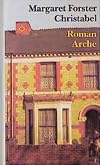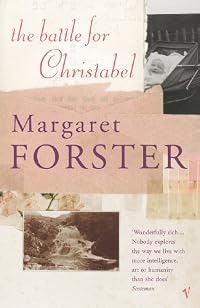
The Battle for Christabel
by Margaret Forster
On This Page
Description
When the single mother of a young child is killed, the battle lines are drawn. On one side are Christabel's indomitable Scottish grandmother, and Isobel, the unsentimental narrator. On the other, are the foster mother and the social workers. Everyone suffers, but the main casualty is the child.Tags
Recommendations




















Member Recommendations
Member Reviews
Having experienced the issue of adoption in my own family - a relative trying to get custody of a child who (like Christabel) was ultimately adopted away by Social Services - I could totally identify with this book.
Narrator Isabel writes in a conversational style; both beginning and ending at the same point in time, shortly after losing any hope of custody of Christabel to the chosen adoptive parents. She then relates the whole saga of Christabel: from her own friendship with the child's mother Rowena, and her profound irritation with her laziness and irresponsibility. Her disapproval as the promiscuous Rowena decides to give up on men and give all her love to a child; her 'using' a West Indian admirer to get pregnant... And then show more Rowena's early years as a mother - devoted yet prone to depression - and her fatal accident, leaving her child with no obvious carer.
The fiercesome Mrs Blake (Rowena's elderly mother) is adamant she can't take her on, but nonetheless uses her money and education to hamper Social Services' efforts to find her a home. Rowena's sister and narrator Isabel are both career women, unwilling to give up their freedom...but as Isabel spends more time with Christabel, she finds her feelings are changing, but too late.
Margaret Forster brings personalities to life, and also the uncertainties that go with adoption. The reader wonders if Christabel would actually be better off with Isabel (who comes across as a pretty sharp and intolerant individual) than her adoptive one. Were Social Services just out for Christabel's best interests; how far were their actions shaped by personal feelings (dislike of Mrs Blake) or official guidelines set in stone (the determination that mixed-race Christabel must go to a black family) ?
As Isabel observes: 'Nobody will ever be able to say for certain that it was better for Christabel to go to the Carmichaels than to come to us. And it is that knowledge which hurts most, the knowledge that we will never know, that we will never be given the chance to find out what kind of mother I, or what kind of father Fergus, would have made. Perhaps I would have fulfilled myself in ways I do not even know.' show less
Narrator Isabel writes in a conversational style; both beginning and ending at the same point in time, shortly after losing any hope of custody of Christabel to the chosen adoptive parents. She then relates the whole saga of Christabel: from her own friendship with the child's mother Rowena, and her profound irritation with her laziness and irresponsibility. Her disapproval as the promiscuous Rowena decides to give up on men and give all her love to a child; her 'using' a West Indian admirer to get pregnant... And then show more Rowena's early years as a mother - devoted yet prone to depression - and her fatal accident, leaving her child with no obvious carer.
The fiercesome Mrs Blake (Rowena's elderly mother) is adamant she can't take her on, but nonetheless uses her money and education to hamper Social Services' efforts to find her a home. Rowena's sister and narrator Isabel are both career women, unwilling to give up their freedom...but as Isabel spends more time with Christabel, she finds her feelings are changing, but too late.
Margaret Forster brings personalities to life, and also the uncertainties that go with adoption. The reader wonders if Christabel would actually be better off with Isabel (who comes across as a pretty sharp and intolerant individual) than her adoptive one. Were Social Services just out for Christabel's best interests; how far were their actions shaped by personal feelings (dislike of Mrs Blake) or official guidelines set in stone (the determination that mixed-race Christabel must go to a black family) ?
As Isabel observes: 'Nobody will ever be able to say for certain that it was better for Christabel to go to the Carmichaels than to come to us. And it is that knowledge which hurts most, the knowledge that we will never know, that we will never be given the chance to find out what kind of mother I, or what kind of father Fergus, would have made. Perhaps I would have fulfilled myself in ways I do not even know.' show less
Difficult to tell which time period this is set in, since the attitudes to class seem so dated. And its main narrator seems to be stuck in jolly hockeysticks mode. Ultimately it is about the fate of a little girl, yet even in the narration of this story she seems in the background, subject to other people's feelings. The reality of the manipulation of her as a weapon, as a way each character uses her to assert superiority is fairly depressing.
This is a realistic view of adoption, and presents the viewpoints of the social workers, the biological relatives, the foster parent and the child in a thoughtful way. The narrator of the novel is the best friend of the biological mother, who died unexpectly. She eventually joins in the "battle for Christabel" when her maternal urges are accelerated by her love for Christabel.
Forster has an extraordinary tendency to make her first-person narrators unsympathetic. She shows this here, and in "Over" , "The Memory Box" and "Hidden Lives".
Christabel hat schwarzen Vater
Dec 27, 2014German
Ratings
Members
- Recently Added By
Author Information

41+ Works 4,641 Members
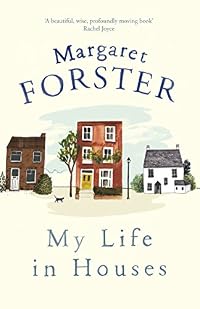
Margaret Forster was born in Carlisle, England on May 25, 1938. She read history at Somerville College, Oxford. Before her writing career took off, she was a teacher at a girls' school. She is the author of over 40 books of fiction and non-fiction. Her novel include Mother, Can You Hear Me?, Have the Men Had Enough?, Lady's Maid, Private Papers, show more Diary of an Ordinary Woman, Over, Isa and May, The Unknown Bridesmaid, and How to Measure a Cow. Georgy Girl, published in 1965, was made into a film starring Lynn Redgrave in 1966. She has written several memoirs including Hidden Lives, Precious Lives, and My Life in Houses. Her biography Elizabeth Barrett Browning won the Heinemann award and her 1993 biography of Daphne du Maurier won the Fawcett book prize and was filmed for the BBC as Daphne in 2007. She also wrote a history of feminism entitled Significant Sisters in 1984. She died of cancer on February 8, 2016 at the age of 77. (Bowker Author Biography) show less
Common Knowledge
- Original publication date
- 1991
- People/Characters
- Rowena Blake; Christabel Blake; Betty Lowe; Isabel
- Important places
- Edinburgh, Scotland, UK; London, England, UK
- Dedication
- For my friends and neighbours SUE JOHN and PRUE BURNETT, who listened
- First words
- Today, I lost the battle for Christabel.
- Last words
- (Click to show. Warning: May contain spoilers.)None of the injuries I have sustained are, after all, fatal.
Classifications
Statistics
- Members
- 112
- Popularity
- 289,227
- Reviews
- 5
- Rating
- (3.69)
- Languages
- Danish, English, German
- Media
- Paper
- ISBNs
- 14
- ASINs
- 2