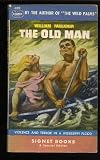
The Old Man
by William Faulkner
On This Page
Description
Bei einer Überschwemmung des Mississippi rettet ein entflohener Sträfling eine Schwangere; das schafft eine Bindung zwischen ihnen, der sich der Mann entzieht, indem er seine Freiheit aufgibt und ins Gefängnis zurückkehrt..Tags
Recommendations





















Member Reviews
"its folly and pain, which seems to be its only immortality: All in the world I want is just to surrender"
Old Man is a devastatingly poetic account of a convict who is taken out of jail to help in a huge flooding in Mississippi. After a month and 3 weeks of endless rowing along the overflowing river, the convict will taste freedom again, he will help give birth to a child, he'll save several people and in the end he'll return again to the deputy to be arrested again and charged ten additional years for "attempted escape" to his previous sentence.
The unfairness of the situation is presented in such an absurd but logical way that I couldn't help but wonder how could it be possible to make some sense out of these unpredictable and show more rambling waves of words and sentences which stream along with perfect melody, almost like a soft lullaby.
Indescribably wonderful, don't ask me why. show less
Old Man is a devastatingly poetic account of a convict who is taken out of jail to help in a huge flooding in Mississippi. After a month and 3 weeks of endless rowing along the overflowing river, the convict will taste freedom again, he will help give birth to a child, he'll save several people and in the end he'll return again to the deputy to be arrested again and charged ten additional years for "attempted escape" to his previous sentence.
The unfairness of the situation is presented in such an absurd but logical way that I couldn't help but wonder how could it be possible to make some sense out of these unpredictable and show more rambling waves of words and sentences which stream along with perfect melody, almost like a soft lullaby.
Indescribably wonderful, don't ask me why. show less
As far as I can recall I never read a Faulkner novel before. I have read a short story or two such as "Two Soldiers" which I remember liking well enough. I could never get very far into "The Sound and the Fury."
"Old Man" is not going to make me a Faulkner fan. He starts off, on page one, with one of my big pet peeves. The neverending sentence. Like the yard that went on forever. I had to go back just now and count the words in the second sentence of this novel ... 309 words. I didn't count twice so don't quote me. My brain doesn't read that way. Of course, this would not be the only sentence to run on a bit.
This story did, however, soon come to fascinate me. Reading this is hard work in several places. Still, I can admire this book - show more it is a good story. The prose isn't too dense most of the time, but at times I was re-reading trying to make sense of scene shifts and losing track of, literally, who what when where and why. The story itself is set in May 1927, with a massive flooding of the Mississippi river. I wondered if Faulkner was throwing this confusion at me the reader to emulate the confusion of the main character who is caught up in the flood and twisted around night and day. He didn't know where he was or where he was going because it constantly wasn't what he thought. He would try to get a handle on things and then be thrown again into chaos.
For a short novel this is a powerful work. But it is a roiling work and I'm not going to try and describe it further. That can be left to scholars. Honestly, though, the prose is too much for me. I thought about re-reading it when I finished to try and clear some confusion from the story, but I decided that wouldn't help me personally. I had already re-read confusing passages within the novel and remained confused.
So then I went here: http://faulkner.lib.virginia.edu/display/wfaudio16_1 and listened for about half an hour to Mr. Faulkner himself read quickly from the end of the story to a Freshman English class in May 1957. He then fields questions from them. So Faulkner tells us that this story is the counterpoint to another. He wrote a chapter of one story and then he wrote a chapter of this story. The people in this story do the exact opposite of the other story. The two stories were originally together in "The Wild Palms". Alternating chapters.
Mr. Faulkner points out that it is NOT "The Old Man". In his words: "No. It's—it's not "The Old Man," it's "Old Man." That's what the—the Negroes along the river call the river. They never call it the Mississippi nor the river. It's just Old Man. And this had to have some title and so that struck me as being a good title for it. That refers simply to the river."
The extra background from the Q&A with Faulkner added a lot. But since I don't have the point to counterpoint to ...
I don't think the other part of the story would help me understand what happened in this story. show less
"Old Man" is not going to make me a Faulkner fan. He starts off, on page one, with one of my big pet peeves. The neverending sentence. Like the yard that went on forever. I had to go back just now and count the words in the second sentence of this novel ... 309 words. I didn't count twice so don't quote me. My brain doesn't read that way. Of course, this would not be the only sentence to run on a bit.
This story did, however, soon come to fascinate me. Reading this is hard work in several places. Still, I can admire this book - show more it is a good story. The prose isn't too dense most of the time, but at times I was re-reading trying to make sense of scene shifts and losing track of, literally, who what when where and why. The story itself is set in May 1927, with a massive flooding of the Mississippi river. I wondered if Faulkner was throwing this confusion at me the reader to emulate the confusion of the main character who is caught up in the flood and twisted around night and day. He didn't know where he was or where he was going because it constantly wasn't what he thought. He would try to get a handle on things and then be thrown again into chaos.
For a short novel this is a powerful work. But it is a roiling work and I'm not going to try and describe it further. That can be left to scholars. Honestly, though, the prose is too much for me. I thought about re-reading it when I finished to try and clear some confusion from the story, but I decided that wouldn't help me personally. I had already re-read confusing passages within the novel and remained confused.
So then I went here: http://faulkner.lib.virginia.edu/display/wfaudio16_1 and listened for about half an hour to Mr. Faulkner himself read quickly from the end of the story to a Freshman English class in May 1957. He then fields questions from them. So Faulkner tells us that this story is the counterpoint to another. He wrote a chapter of one story and then he wrote a chapter of this story. The people in this story do the exact opposite of the other story. The two stories were originally together in "The Wild Palms". Alternating chapters.
Mr. Faulkner points out that it is NOT "The Old Man". In his words: "No. It's—it's not "The Old Man," it's "Old Man." That's what the—the Negroes along the river call the river. They never call it the Mississippi nor the river. It's just Old Man. And this had to have some title and so that struck me as being a good title for it. That refers simply to the river."
The extra background from the Q&A with Faulkner added a lot. But since I don't have the point to counterpoint to ...
I don't think the other part of the story would help me understand what happened in this story. show less
Repleto de analogias, descrições intermináveis de paisagens catastróficas e de narrações de estados de espíritos intemporais conta a aventura de um forçado no Mississipi.
A proximidade da Natureza e uma excelente capacidade de observação tornam este texto como aquelas conversas daquele amigo que fala apaixonadamente de um tema, e fala e descreve e fala.
A proximidade da Natureza e uma excelente capacidade de observação tornam este texto como aquelas conversas daquele amigo que fala apaixonadamente de um tema, e fala e descreve e fala.
439. The Old Man, by William Faulkner (read 29 June 1952) This book is not very long and made so little impression on me that I made no mention of it in my diary, though the previous day when I read Faulkner's The Sound and the Fury and his As I Lay Dying I was moved to mention them in my account of that day.
i am too old for faulkner. i don't want to work that hard. convict is assigned to help people in a flood. the old man is the river. that's all i know.
Ratings
Members
- Recently Added By
Author Information

462+ Works 99,076 Members
Born in an old Mississippi family, William Faulkner made his home in Oxford, seat of the University of Mississippi. After the fifth grade he went to school only off and on-lived, read, and wrote much as he pleased. In 1918, refusing to enlist with the "Yankees," he joined the Canadian Air Force, and was transferred to the British Royal Air Force. show more After the war he studied a little at the University, did house painting, worked as a night superintendent at a power plant, went to New Orleans and became a friend of Sherwood Anderson, then to Europe and back home to Oxford. By this time he had written two novels. The Sound and the Fury followed in 1929. Financial success came with Sanctuary in 1931, which he assisted in filming. Faulkner 's novels are intense in their character portrayals of disintegrating Southern aristocrats, poor whites, and African Americans. A complex stream-of-consciousness rhetoric often involves Faulkner in lengthy sentences of anguished power. Most of his tales are set in the mythical Yoknapatawpha County, Mississippi, and are characterized by the use of many recurring characters from families of different social levels spanning more than a century. His best subjects are the old, dying South and the newer materialistic South. As I Lay Dying (1930), is a grotesquely tragicomic story about a family of poor southern whites. With Absalom, Absalom! (1936); the difficult parts of his famous short novel "The Bear" (published in Go Down, Moses, 1942); and the allegorical A Fable (1954), a non-Yoknapatawpha novel set in France during World War I; Faulkner returned to an innovative and difficult style that most readers have trouble with. Yet, interspersed among such works are collections of easily read stories originally published in popular magazines. There seems to be a growing sentiment among critics that the Snopes trilogy-The Hamlet (1940), The Town (1957), and The Mansion (1959)-for the most part an example of Faulkner's "moderate" style, could well be among his most important works. Faulkner was awarded the 1949 Nobel Prize for literature "for his powerful and artistically independent contribution to the new American novel," but it would appear now that he also deserved to win that honor for his contribution to world literature. When reporting his death, the Boston Globe quoted Faulkner's having once told an interviewer: "Since man is mortal, the only immortality for him is to leave something behind him that is immortal since it will always move. That is the artist's way of scribbling "Kilroy was here" on the wall of the final and irrevocable oblivion through which he must some day pass." In addition to the Nobel Prize, Faulkner received the Howells Medal of the American Academy of Arts and Letters in 1950, and in 1951 he was given the National Book Award for his Collected Stories Collected Stories. For his novel A Fable he received the National Book Award for the second time, as well as the Pulitzer Prize in 1955. The Reivers (1962) was awarded the Pulitzer Prize in 1963. In 1957 and 1958, he was the University of Virginia's first writer-in-residence, and in January 1959 he accepted an appointment as consultant on contemporary literature to the Alderman Library of that university. Although Faulkner was not without honors in his lifetime and has received world recognition since then, it is surprising to learn that, when Malcolm Cowley edited The Portable Faulkner in 1946, he found that almost all of Faulkner's books were out of print. By arranging selections from the works to form a continuous chronicle, Cowley deserves much of the credit for making readers aware of the way in which Faulkner was creating a fictive world on a scale grander than that of any novelist since Balzac. William Faulkner died in Oxford, Mississippi, in 1962. (Bowker Author Biography) show less
Work Relationships
Is contained in
Common Knowledge
Classifications
Statistics
- Members
- 77
- Popularity
- 409,720
- Reviews
- 5
- Rating
- (3.42)
- Languages
- English, German
- Media
- Paper
- ISBNs
- 2
- ASINs
- 6