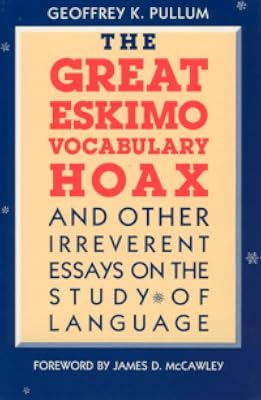
the Great Eskimo Vocabulary Hoax, and Other Irreverent Essays on the Study of Language
by Geoffrey K. Pullum
On This Page
Description
How reliable are all those stories about the number of Eskimo words for snow? How can lamps, flags, and parrots be libelous? How might Star Trek's Commander Spock react to Noam Chomsky's theories of language? These and many other odd questions are typical topics in this collection of essays that present an occasionally zany, often wry, but always fascinating look at language and the people who study it. Geoffrey K. Pullum's writings began as columns in Natural Language and Linguistic Theory show more in 1983. For six years, in almost every issue, under the banner "TOPIC. . .COMMENT," he published a captivating mélange of commentary, criticism, satire, whimsy, and fiction. Those columns are reproduced here—almost exactly as his friends and colleagues originally warned him not to publish them—along with new material including a foreword by James D. McCawley, a prologue, and a new introduction to each of these clever pieces. Whether making a sneak attack on some sacred cow, delivering a tongue-in-cheek protest against current standards, or supplying a caustic review of some recent development, Pullum remains in touch with serious concerns about language and society. At the same time, he reminds the reader not to take linguistics too seriously all of the time. Pullum will take you on an excursion into the wild and untamed fringes of linguistics. Among the unusual encounters in store are a conversation between Star Trek's Commander Spock and three real earth linguists, the strange tale of the author's imprisonment for embezzling funds from the Campaign for Typographical Freedom, a harrowing account of a day in the research life of four unhappy grammarians, and the true story of how a monograph on syntax was suppressed because the examples were judged to be libelous. You will also find a volley of humorous broadsides aimed at dishonest attributional practices, meddlesome copy editors, mathematical incompetence, and "cracker-barrel philosophy of science." These learned and witty pieces will delight anyone who is fascinated by the quirks of language and linguists. show lessTags
Recommendations


















Member Recommendations
Member Reviews
Pullum is funny, cutting, and doesn't have time to fuck around. You wouldn't want to be a confused undergrad in his class, but luckily he's embraced public outreach as well, so you can read his posts on Language Log, or articles like this one, from your armchair with your coffee and come away amused and edified with no danger of drawing his attention. This tossed-off opinion piece has become the definitive refutation of the "Eskimoes* have x words for snow" canard, despite Laura Martin's earlier yeo-work in actually looking at the development of that idea and its inconsistencies and actually, like, proving it wrong, and Steven Pinker's later misappropriation of Martin's and Pullum's work to make ad hominem attacks on Benjamin Whorf, the show more popularizer of the idea, and ridicule the broader concept of linguistic relativism of which the Eskimo vocab thing is a trivial example.
I do not know what Geoffrey Pullum's stance on linguistic relativism is, which says good things about him: he's not trying to mischaracterize anything. (As opposed to anyone: he gets in some easy digs at Whorf for being a fire-safety inspector and not a real linguist, which is fucked because the guy did good, meaningful work, but I get the feeling Pullum's just trying to entertain.) He gets in and gets out: looks at how the thing was born from an offhand observation of Boas's (that English could have had a single root meaning "water–" for words like river, lake, rain, etc., and that some languages, like Inuktitut, do in fact have multiple productive roots for kinds of snow, where we have only one). Then he looks at how it was repeated and repeated until it was management consultants saying Eskimoes have 1000 words for snow and their brain is different and you need to maximize their productivity differently! Then he looks at how it's not meaningfully the case, that there are only two productive roots, qanik 'snow in the air' and aput 'snow on the ground', and that the multiplicity of word forms is an entirely unremarkable feature of the Inuktitut language, which agglutinates to show various different features of language, so that the number of possible snow-words is essentially infinite and their frequency essentially zero. Then he notes that even if there were multiple productive roots it would not mean any more than how printers have mutiple names for fonts and type-stuffs. He does it all without even mentioning linguistic relativity, and it's quite good. Too bad he couldn't resist being a dick to Whorf for no reason but.
*as long as we're debunking the popular ignorance, why don't we stop calling them "Eskimoes," guys? Inuit. INUIT. Is this an American thing, like "Amerind" (that rare and delicious fruit)? show less
I do not know what Geoffrey Pullum's stance on linguistic relativism is, which says good things about him: he's not trying to mischaracterize anything. (As opposed to anyone: he gets in some easy digs at Whorf for being a fire-safety inspector and not a real linguist, which is fucked because the guy did good, meaningful work, but I get the feeling Pullum's just trying to entertain.) He gets in and gets out: looks at how the thing was born from an offhand observation of Boas's (that English could have had a single root meaning "water–" for words like river, lake, rain, etc., and that some languages, like Inuktitut, do in fact have multiple productive roots for kinds of snow, where we have only one). Then he looks at how it was repeated and repeated until it was management consultants saying Eskimoes have 1000 words for snow and their brain is different and you need to maximize their productivity differently! Then he looks at how it's not meaningfully the case, that there are only two productive roots, qanik 'snow in the air' and aput 'snow on the ground', and that the multiplicity of word forms is an entirely unremarkable feature of the Inuktitut language, which agglutinates to show various different features of language, so that the number of possible snow-words is essentially infinite and their frequency essentially zero. Then he notes that even if there were multiple productive roots it would not mean any more than how printers have mutiple names for fonts and type-stuffs. He does it all without even mentioning linguistic relativity, and it's quite good. Too bad he couldn't resist being a dick to Whorf for no reason but.
*as long as we're debunking the popular ignorance, why don't we stop calling them "Eskimoes," guys? Inuit. INUIT. Is this an American thing, like "Amerind" (that rare and delicious fruit)? show less
Review of title chapter/essay
We’ve all heard the old chestnut about Eskimos having [big number] of words for snow. Apart from the outdated word for Inuit and Yupik people, it’s initially charming and makes intuitive sense. The trouble is, it’s bunk, as is the case with many widely-circulated ideas about language: false etymologies (especially involving initialisms: posh, tip, fuck etc), along with “untranslatable words” (always accompanied by translations) and the converse, “language X has no word for Y”.
In the title essay, Prof Pullum explains how a fairly innocuous, but poorly-explained comment by Franz Boas in 1911 got picked up and exaggerated with almost every telling, aided by the exoticism associated with show more “Eskimos”.
Image: Snowflake (Source.)
Linguistic truth
The original point was mildly interesting, but not remotely startling. The Eskimo language Boas was studying used four root words for types of snow, whereas English uses phrases for them, rather than a single specific word: snow on the ground, falling snow, drifting snow, and a snow drift. In contrast, English has lots of water-related words that each use a different root: lake, river, brook, pond, dew etc.
In 1927, C.W. Schultz-Lorentzen's Dictionary of the West Greenlandic Eskimo Language, halved the number of root words for snow: one for snow in the air and the other for snow on the ground. All the other words are composites derived from those, much like other languages, including English.
Linguistic lies
The numbers became inflated when Benjamin Lee Whorf wrote an article in MIT’s Technology Review in 1940. His degree had been in chemical engineering, and Pullum describes him derisively as a “Connecticut fire prevention inspector and weekend language-fancier”. Whorf upped Boas’ four root words to seven, and as the myth gained traction in subsequent years, people were claiming fifty, a hundred, and more.
Image: Cartoon of Inuit person with a sun/leaf globe (Source.)
Logic
English is, obviously, not limited to phrases to describe snow; it also has specific words such as slush, sleet, blizzard, avalanche, and flurry.
“Even if there were a large number of roots for different snow types in some Arctic language, this would not, objectively, be intellectually interesting.”
There is specialist vocabulary for every group: horsebreeders, botanists, and interior decorators.
Except that, as Pullum then points out, people who live in a permanently snowy environment might not be that interested in it:
“A kind of constantly assumed background, like sand on the beach. And even beach bums have only one word for sand”
More fundamentally, the terms of the “Eskimos have X words for snow” are a huge debate in their own right: “Eskimo” covers many Arctic languages in different continents, and how do you define “word” and even “snow”? And this is where the big numbers are not entirely misleading: the Eskimo languages typically have far more inflectional endings, so there are more possible permutations, but whether or not they’re separate words is more contentious.
“The tragedy is not that so many people got the facts wildly wrong; it is that in the mentally lazy and anti-intellectual world we live in today, hardly anyone cares enough to think about trying to determine what the facts are.”
Image: “Snow” in snow (Source.)
Sources
I’m sure I’ve got a copy of this and that I’ve read the whole book. I’ve certainly read Prof Pullum (and a few others) on the subject of snow words several times over more than a decade on Language Log (though in the last couple of years, it’s mainly Victor Mair’s Chinese Language Log) and elsewhere, as well as his articles on other linguistic topics.
Anyway, the title article is widely available online, including HERE. It’s only a few pages long, and you don’t need to be an academic linguist to enjoy it and learn from it.
The idea of language constraining how we think is sometimes referred to as the Sapir-Whorf hypothesis. In its “strong” form, it’s largely dismissed as linguistic determinism, but the weaker form, linguistic relativity, is more supported. See HERE.
If you enjoy Pullum’s pugnacious style of demolishing popular linguistic myths and their proponents, read his views of Strunk and White’s The Elements of Style. The title sets the tone: 50 Years of Stupid Grammar Advice.
You can find links to many of his articles and essays on his website, HERE.
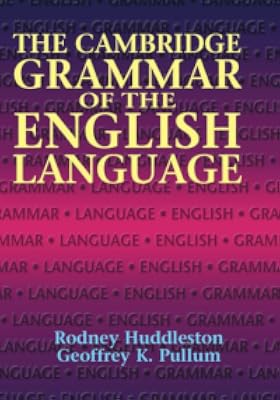
The Cambridge Grammar of the English Language, which he wrote with Rodney Huddleston, is an excellent source of clear explanations of grammar, punctuation, and orthography. It's especially good for authoritative answers on zombie rules and pedantic but erroneous peeves such as singular "they" and split infinitives. (I have yet to review it.) show less
We’ve all heard the old chestnut about Eskimos having [big number] of words for snow. Apart from the outdated word for Inuit and Yupik people, it’s initially charming and makes intuitive sense. The trouble is, it’s bunk, as is the case with many widely-circulated ideas about language: false etymologies (especially involving initialisms: posh, tip, fuck etc), along with “untranslatable words” (always accompanied by translations) and the converse, “language X has no word for Y”.
In the title essay, Prof Pullum explains how a fairly innocuous, but poorly-explained comment by Franz Boas in 1911 got picked up and exaggerated with almost every telling, aided by the exoticism associated with show more “Eskimos”.
Image: Snowflake (Source.)
Linguistic truth
The original point was mildly interesting, but not remotely startling. The Eskimo language Boas was studying used four root words for types of snow, whereas English uses phrases for them, rather than a single specific word: snow on the ground, falling snow, drifting snow, and a snow drift. In contrast, English has lots of water-related words that each use a different root: lake, river, brook, pond, dew etc.
In 1927, C.W. Schultz-Lorentzen's Dictionary of the West Greenlandic Eskimo Language, halved the number of root words for snow: one for snow in the air and the other for snow on the ground. All the other words are composites derived from those, much like other languages, including English.
Linguistic lies
The numbers became inflated when Benjamin Lee Whorf wrote an article in MIT’s Technology Review in 1940. His degree had been in chemical engineering, and Pullum describes him derisively as a “Connecticut fire prevention inspector and weekend language-fancier”. Whorf upped Boas’ four root words to seven, and as the myth gained traction in subsequent years, people were claiming fifty, a hundred, and more.
Image: Cartoon of Inuit person with a sun/leaf globe (Source.)
Logic
English is, obviously, not limited to phrases to describe snow; it also has specific words such as slush, sleet, blizzard, avalanche, and flurry.
“Even if there were a large number of roots for different snow types in some Arctic language, this would not, objectively, be intellectually interesting.”
There is specialist vocabulary for every group: horsebreeders, botanists, and interior decorators.
Except that, as Pullum then points out, people who live in a permanently snowy environment might not be that interested in it:
“A kind of constantly assumed background, like sand on the beach. And even beach bums have only one word for sand”
More fundamentally, the terms of the “Eskimos have X words for snow” are a huge debate in their own right: “Eskimo” covers many Arctic languages in different continents, and how do you define “word” and even “snow”? And this is where the big numbers are not entirely misleading: the Eskimo languages typically have far more inflectional endings, so there are more possible permutations, but whether or not they’re separate words is more contentious.
“The tragedy is not that so many people got the facts wildly wrong; it is that in the mentally lazy and anti-intellectual world we live in today, hardly anyone cares enough to think about trying to determine what the facts are.”
Image: “Snow” in snow (Source.)
Sources
I’m sure I’ve got a copy of this and that I’ve read the whole book. I’ve certainly read Prof Pullum (and a few others) on the subject of snow words several times over more than a decade on Language Log (though in the last couple of years, it’s mainly Victor Mair’s Chinese Language Log) and elsewhere, as well as his articles on other linguistic topics.
Anyway, the title article is widely available online, including HERE. It’s only a few pages long, and you don’t need to be an academic linguist to enjoy it and learn from it.
The idea of language constraining how we think is sometimes referred to as the Sapir-Whorf hypothesis. In its “strong” form, it’s largely dismissed as linguistic determinism, but the weaker form, linguistic relativity, is more supported. See HERE.
If you enjoy Pullum’s pugnacious style of demolishing popular linguistic myths and their proponents, read his views of Strunk and White’s The Elements of Style. The title sets the tone: 50 Years of Stupid Grammar Advice.
You can find links to many of his articles and essays on his website, HERE.
The Cambridge Grammar of the English Language, which he wrote with Rodney Huddleston, is an excellent source of clear explanations of grammar, punctuation, and orthography. It's especially good for authoritative answers on zombie rules and pedantic but erroneous peeves such as singular "they" and split infinitives. (I have yet to review it.) show less
essays from linguistics, some technical, some funny
Ratings
Members
- Recently Added By
Lists

Used books to buy next
565 works; 1 member
Author Information

11 Works 830 Members
Geoffrey K. Pullum is Professor of General Linguistics in the School of Philosophy, Psychology and Language Sciences at the University of Edinburgh.
Common Knowledge
- Canonical title
- the Great Eskimo Vocabulary Hoax, and Other Irreverent Essays on the Study of Language
- Original publication date
- 1991
Classifications
- Genres
- Nonfiction, General Nonfiction
- DDC/MDS
- 410 — Language Linguistics Linguistics
- LCC
- P27 .P85 — Language and Literature Philology. Linguistics General
- BISAC
Statistics
- Members
- 260
- Popularity
- 125,176
- Reviews
- 3
- Rating
- (4.21)
- Languages
- English
- Media
- Paper
- ISBNs
- 2
- ASINs
- 1