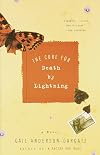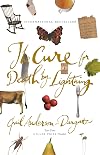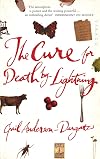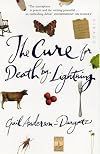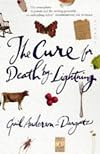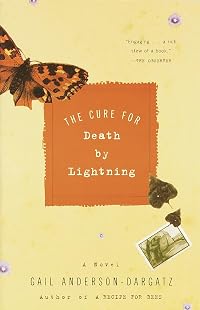
The Cure for Death by Lightning
by Gail Anderson-Dargatz
On This Page
Description
Gail Anderson-Dargatz's evocative first novel -- a richly atmospheric coming-of-age tale set on a remote Canadian farm in the midst of World War II -- reveals an assured and original voice.The Cure for Death by Lightning is the story of Beth Weeks, a young girl whose life is thrown into turmoil by her abusive father, a mysterious stalker, and her own awakening sexuality. But friendship with a girl from the nearby Indian reservation connects her to an enriching mythology, and an unexpected show more protector ultimately shores up her world. The novel is sprinkled throughout with recipes and remedies from the scrapbook Beth's mother keeps, a boon to Beth as she faces down her demons and discovers what she is made of -- and one of many elements that gives The Cure for Death by Lightning its enchanting vitality. show lessTags
Recommendations










Member Recommendations
bnbookgirl great author
Member Reviews
This book is very well written and has some great moments but it is pretty bleak and I need a happy book now!I loved the descriptions of day-to-day life on the farm and the view of life in town as well. I enjoyed the inclusion of Native lore and magical realism very much as it felt true to the reality of having Native neighbors, friends and farmhands. I had previously read [b:Turtle Valley|2164768|Turtle Valley|Gail Anderson-Dargatz|https://d.gr-assets.com/books/1320500180s/2164768.jpg|4435620], not knowing that is a "sort-of sequel" and wish I had known that beforehand and had it to read now as I don't remember it well and want to know what happens to the characters.
*SPOILER ALERT* -I am conflicted by the abuse in the book as I feel show more the book could have been just as good without (some of) it and I am finding that there is so much of it in literature lately that I am becoming desensitized to it - and I don't like that feeling. While I am very aware it is a horrific and prevalent problem, for me it is starting to feel like a writing cliché. I hate even writing this, but it is getting to the point where I will avoid books where this is part of the plot. show less
*SPOILER ALERT* -I am conflicted by the abuse in the book as I feel show more the book could have been just as good without (some of) it and I am finding that there is so much of it in literature lately that I am becoming desensitized to it - and I don't like that feeling. While I am very aware it is a horrific and prevalent problem, for me it is starting to feel like a writing cliché. I hate even writing this, but it is getting to the point where I will avoid books where this is part of the plot. show less
I don't know why, but I had it in my head that this was a fun, light-hearted book, sort of in the way that [b:Amphibian|6452033|Amphibian|Carla Gunn|http://d202m5krfqbpi5.cloudfront.net/books/1328759365s/6452033.jpg|6642202] by [a:Carla Gunn|2922903|Carla Gunn|http://d202m5krfqbpi5.cloudfront.net/authors/1306197890p2/2922903.jpg] is. See, I tend to quickly read summaries of books, decide if it's of interest, and then add it to my "to read" list. I never again look at what the book is supposed to be about so that nothing is given away.
It must have been the title and the cover that made me think this book was entertaining. The content is way too heavy to be considered "light-hearted."
(Stop reading here if you want "nothing given show more away".)
Beth is a farmer's daughter to a poor family in rural country during WWII. They're so rural and back-country that it might as well be 100 years ago. Her father went crazy about a year prior and is prone to fly into rages unexpectedly. Her mother is part submissive, part willfully blind to the abuse he gives his family, the daughter in particular. The older brother is mostly "normal" until you find out he's got a thing for cows. Beth drops out of school after being stripped and tormented by the other kids. Even when she confesses to her mother what happened, her mother refuses to believe it "they're nice kids, they'd never do that." So Beth finds friendship with a local biracial Aboriginal girl and the two of them explore their sexuality together.
All the while, there's another local "crazy man" who's been possessed by the trickster Coyote and has a hunger for young children. Beth is haunted and stalked by Coyote.
It's all very dark and other-worldly. Not at all whimsical and fun. The writing captivated me and compelled me to keep reading, but the storyline also caused me some stress because of all the awfulness that went on.
Great Canadian literature, but don't let the cover & title fool you! show less
It must have been the title and the cover that made me think this book was entertaining. The content is way too heavy to be considered "light-hearted."
(Stop reading here if you want "nothing given show more away".)
Beth is a farmer's daughter to a poor family in rural country during WWII. They're so rural and back-country that it might as well be 100 years ago. Her father went crazy about a year prior and is prone to fly into rages unexpectedly. Her mother is part submissive, part willfully blind to the abuse he gives his family, the daughter in particular. The older brother is mostly "normal" until you find out he's got a thing for cows. Beth drops out of school after being stripped and tormented by the other kids. Even when she confesses to her mother what happened, her mother refuses to believe it "they're nice kids, they'd never do that." So Beth finds friendship with a local biracial Aboriginal girl and the two of them explore their sexuality together.
All the while, there's another local "crazy man" who's been possessed by the trickster Coyote and has a hunger for young children. Beth is haunted and stalked by Coyote.
It's all very dark and other-worldly. Not at all whimsical and fun. The writing captivated me and compelled me to keep reading, but the storyline also caused me some stress because of all the awfulness that went on.
Great Canadian literature, but don't let the cover & title fool you! show less
This story has one of my favorite opening sentences:
It really sets the tone for what I can only describe as a compelling coming-of-age story. A wonderful blending of isolated rural community living, family histories, native folklore, evocative memories stirred by the wonders captured within the pages of her mother's scrapbook and the luscious descriptions of food, gardening and bizarre remedies. It is a wonderful throw-back to a forgotten era and I love how Beth show more reminds us that the story she is telling is something that occurred in her past, not her present. The writing is a delight to experience, like this description of eating cherries fresh off a cherry tree:
I delighted in the recipes and remedies that are strewn throughout the story. The kinds of recipes and remedies that are handed down from generation to generation so I was very happy to see the index at the back of the book. While the story is set in the Turtle Valley region of British Columbia, it is easy to picture it as taking place in almost any Northwest valley farming community with an reserve nearby. Canadian specific references to such things as Vancouver, Vernon and residential schools are kept to a minimum. As with most coming-of-age stories, it has elements that are harrowing and emotional. Anderson-Dargatz focuses on how Beth reacts/deals with situations, instead of exposing the reader to minute details of the situations themselves. A nice touch as some of the topics are disturbing enough without having the read through pages and pages of ugly details.
Overall, a really good read. show less
"The cure for death by lightning was handwritten in thick, messy blue ink in my mother’s scrapbook, under the recipe for my father’s favorite oatcakes: Dunk the dead by lightning in a cold water bath for two hours and if still dead, add vinegar and soak for an hour more."
It really sets the tone for what I can only describe as a compelling coming-of-age story. A wonderful blending of isolated rural community living, family histories, native folklore, evocative memories stirred by the wonders captured within the pages of her mother's scrapbook and the luscious descriptions of food, gardening and bizarre remedies. It is a wonderful throw-back to a forgotten era and I love how Beth show more reminds us that the story she is telling is something that occurred in her past, not her present. The writing is a delight to experience, like this description of eating cherries fresh off a cherry tree:
"When you eat a ripe cherry straight from the tree on a sunny day, its juice is so hot, thick, and red that it has the feel of blood running down your chin, staining your lips, and filling your mouth. Once you've sucked all you can from it, you spit out the pit and go for another warm cherry off the tree, and another and another, because the cherry will seduce you every time. You don't see that ripeness, that hot blood juice, in a store-bought cherry. But a cherry sun-hot off the tree, well, that's where it came from, the insinuation of lust in the cherry, the smut-name put to the ripe button-love of a woman. Cherry. It's all juice and warmth, a O in your mouth, a soft marble for your tongue to play with, a sweet soft thing with a core cloaked in flesh."
I delighted in the recipes and remedies that are strewn throughout the story. The kinds of recipes and remedies that are handed down from generation to generation so I was very happy to see the index at the back of the book. While the story is set in the Turtle Valley region of British Columbia, it is easy to picture it as taking place in almost any Northwest valley farming community with an reserve nearby. Canadian specific references to such things as Vancouver, Vernon and residential schools are kept to a minimum. As with most coming-of-age stories, it has elements that are harrowing and emotional. Anderson-Dargatz focuses on how Beth reacts/deals with situations, instead of exposing the reader to minute details of the situations themselves. A nice touch as some of the topics are disturbing enough without having the read through pages and pages of ugly details.
Overall, a really good read. show less
Set on a farm near a reserve in the interior of British Columbia during WWII, this is fifteen-year-old Beth Weeks' coming-of-age story. Her father was injured in the first war, presumably intended as an explanation of his brutish behaviour, but as this would have happened more than twenty years earlier I'm more inclined to think that it is his true nature. There is a large cast of characters, few particularly likeable, and most are in conflict with each other. While I liked Beth's mother and her scrapbook of collected recipes and household tips from which the title comes, I found the rest of the characters were overwhelmed by aberrants of one kind or another. Anderson-Dargatz had a choice of writing nostalgic memories of growing up in a show more farming community mid-century with the tragedies and sad occurences of normal life, but instead emphasized a dismal story of abuse, violence, misogyny and conflict. And despite some good writing, there was little sense of place. Disappointing. show less
Beth Weeks is fifteen and growing up in a small farming town in British Colombia during WWII. Her father was traumatised during the First World War and his behaviour is becoming increasingly bizarre and extreme. This leads to a further isolation of the family from their neighbours.
I found this book quirky and enchanting. As a picture of life in this time and place the story worked well. Maybe there were a few too many people with mental problems in this debut novel, bearing in mind the small cast of characters, but I still liked most of them. There are some extremely disturbing scenes but I think the way Gail Anderson-Dargatz told the story was worth a bit of distress.
Gritty and disturbing but one I am pleased to have read and I will show more definitely be reading more of this author's work. show less
I found this book quirky and enchanting. As a picture of life in this time and place the story worked well. Maybe there were a few too many people with mental problems in this debut novel, bearing in mind the small cast of characters, but I still liked most of them. There are some extremely disturbing scenes but I think the way Gail Anderson-Dargatz told the story was worth a bit of distress.
Gritty and disturbing but one I am pleased to have read and I will show more definitely be reading more of this author's work. show less
Books in Canada
In The Cure for Death by Lightning, Beth Weeks, now an adult, reflects on a pivotal year in her life, the year she turned fifteen. It was "the year the world fell apart and began to come together again," with the Second World War raging in the world at large and the Weeks family war raging at home.
Beth's life had been, by her own account, fairly average, almost idyllic, on a farm in rural British Columbia where she and her older brother Dan attended school, helped with the daily chores, explored the surrounding countryside. All this changes suddenly after her father's almost fatal encounter with a grizzly in the bush. The terrifying experience pushes John Weeks over the edge, changes him into a cruel, abusive man who show more drowns kittens, cuts the ovaries out of a cow, obsesses about destroying his neighbour's fence, and overall turns his household into a domestic hell with his aggressive sullenness. Eventually, his behaviour ostracizes the whole Weeks family from the community, and this too becomes part of the increasing turmoil Beth has to deal with.
All this, however, is only the surface of a richly layered story. One of Beth's classmates, Sarah Kemp, has been-supposedly-killed by a bear, but there is an air of uncertainty about what might have really happened. Is there something or someone else out there in the bush? Beth often feels as though there is someone following her, and at the nearby Indian reservation the belief is that Coyote, legendary trickster, is on the prowl. The tension increases when children go missing from the reserve.
Meanwhile, the harassment of Beth escalates on every front. Her best friend Nora wants her to run away with her to the city; her mother renders herself oblivious to her developing sexuality; she is attacked by her schoolmates.
In all this turmoil, the one anchor, the sole remainder of Beth's lost reality-almost a character itself-is her mother's cherished scrapbook, her "mother's way of setting down the days so they wouldn't be forgotten." It is a collection of recipes, remedies, newspaper clippings, and funeral notices, an "objective correlative" of sorts to Beth's own memories and subjectivity: "No-one can tell me these events didn't happen, or that it was all a girl's fantasy. The reminders are there, and I remember them all." Anderson-Dargatz sets down these remembrances, in the process tracing Beth's rite of passage to womanhood, with precision and empathy. The result is a powerful novel that, much like Fall on Your Knees, illuminates the myths at work in personal lives. show less
In The Cure for Death by Lightning, Beth Weeks, now an adult, reflects on a pivotal year in her life, the year she turned fifteen. It was "the year the world fell apart and began to come together again," with the Second World War raging in the world at large and the Weeks family war raging at home.
Beth's life had been, by her own account, fairly average, almost idyllic, on a farm in rural British Columbia where she and her older brother Dan attended school, helped with the daily chores, explored the surrounding countryside. All this changes suddenly after her father's almost fatal encounter with a grizzly in the bush. The terrifying experience pushes John Weeks over the edge, changes him into a cruel, abusive man who show more drowns kittens, cuts the ovaries out of a cow, obsesses about destroying his neighbour's fence, and overall turns his household into a domestic hell with his aggressive sullenness. Eventually, his behaviour ostracizes the whole Weeks family from the community, and this too becomes part of the increasing turmoil Beth has to deal with.
All this, however, is only the surface of a richly layered story. One of Beth's classmates, Sarah Kemp, has been-supposedly-killed by a bear, but there is an air of uncertainty about what might have really happened. Is there something or someone else out there in the bush? Beth often feels as though there is someone following her, and at the nearby Indian reservation the belief is that Coyote, legendary trickster, is on the prowl. The tension increases when children go missing from the reserve.
Meanwhile, the harassment of Beth escalates on every front. Her best friend Nora wants her to run away with her to the city; her mother renders herself oblivious to her developing sexuality; she is attacked by her schoolmates.
In all this turmoil, the one anchor, the sole remainder of Beth's lost reality-almost a character itself-is her mother's cherished scrapbook, her "mother's way of setting down the days so they wouldn't be forgotten." It is a collection of recipes, remedies, newspaper clippings, and funeral notices, an "objective correlative" of sorts to Beth's own memories and subjectivity: "No-one can tell me these events didn't happen, or that it was all a girl's fantasy. The reminders are there, and I remember them all." Anderson-Dargatz sets down these remembrances, in the process tracing Beth's rite of passage to womanhood, with precision and empathy. The result is a powerful novel that, much like Fall on Your Knees, illuminates the myths at work in personal lives. show less
This is the story of fifteen-year-old Beth Weeks and her family who live in a remote farming community in British Columbia during the Second World War. A plethora of eccentric and peculiar characters, a reserve of superstitious native Americans (or should that be Canadians?), a wild bear, a dead girl, a smattering of incest and the spirit of Coyote.
One of those books which I particularly love, where nothing much happens, but full of fascinating characterisation and breathtaking descriptions of the landscape. And a constant sense of the spirit world, right there on the edges of your vision where light meets dark.
So impressed I'm going to look out for her other book, charmingly called A Recipe for Bees!
One of those books which I particularly love, where nothing much happens, but full of fascinating characterisation and breathtaking descriptions of the landscape. And a constant sense of the spirit world, right there on the edges of your vision where light meets dark.
So impressed I'm going to look out for her other book, charmingly called A Recipe for Bees!
Members
- Recently Added By
Lists

CBC Books - Canada's 100 (+ bonus 10): Which have you read?
110 works; 23 members

Books Set in Canada
80 works; 16 members

Myth (Reuse and Retelling)
188 works; 24 members

CBC's Great Canadian Reading List
149 works; 5 members
Canadian Historical Fiction 🇨🇦
157 works; 8 members

Books recommended by Calgary Public Library staff
1,588 works; 4 members
Author Information

31 Works 2,055 Members
Gail Anderson-Dargatz wrote The Miss Herford Stories, a collection of short stories, A Recipe for Bees, and The Cure for Death by Lightning, which won the Ethel Wilson Fiction Prize and the British Columbia Book Prize. (Bowker Author Biography) Gail Anderson-Dargatz is also the author of the award-winning "The Cure for Death by Lightning". She show more lives with her husband on Vancouver Island, British Columbia. (Bowker Author Biography) show less
Awards and Honors
Awards
Common Knowledge
- Canonical title
- The Cure for Death by Lightning
- Original publication date
- 1996
- People/Characters
- Beth Weeks; Bertha Moses
- Important places
- British Columbia, Canada; Shuswap County, British Columbia, Canada
- Dedication
- For Frances Hickling
- First words
- The cure for death by lightning was handwritten in thick, messy blue ink in my mother's scrapbook, under the recipe for my father's favorite oatcakes:
Dunk the dead by lightning in a cold water bath for two hours a... (show all)nd if still dead, add vinegar and soak for an hour more. - Last words
- (Click to show. Warning: May contain spoilers.)After a time my mother reached over to my father, and he took her hand in his fist and held on to it for dear life.
- Blurbers
- Hodgins, Jack; Weldon, Fay; Forster, Margaret; Turbide, Diane; Heller, Amanda; Kelman, Suanne
Classifications
- Genres
- General Fiction, Fiction and Literature, Historical Fiction
- DDC/MDS
- 813.54 — Literature & rhetoric American literature in English American fiction in English 1900-1999 1945-1999
- LCC
- PR9199.3 .A49 .C87 — Language and Literature English English Literature English literature: Provincial, local, etc.
- BISAC
Statistics
- Members
- 824
- Popularity
- 33,463
- Reviews
- 18
- Rating
- (3.53)
- Languages
- 6 — Danish, Dutch, English, French, German, Swedish
- Media
- Paper, Ebook
- ISBNs
- 18
- ASINs
- 5