
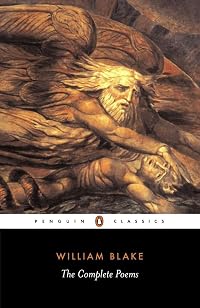
William Blake: The Complete Poems
by William Blake
On This Page
Description
Though his extraordinary talent went largely unrecognized during his own lifetime, British painter and poet William Blake is now regarded as one of the most important creative figures of the late-eighteenth and early-nineteenth centuries. Characterized by their mystical but accessible quality, Blake's poems prefigured the Romantic movement that would take hold later in the 1800s. This volume brings together Blake's best-known verse..
Tags
Recommendations







Member Reviews
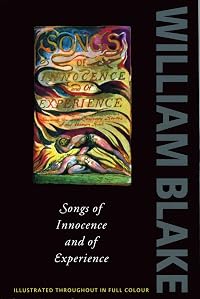
This book contains Songs of Innocence and of Experience, followed by an Appendix containing A Divine Image and The Book of Thel. My favourite poems are in Songs of Experience. They are darker and more critical of society, human nature and the Church than the Songs of Innocence. As they are well out of copyright, I will include a couple of them here.
The Garden of Love
I laid me down upon a bank
Where Love lay sleeping
I heard among the rushes dank
Weeping, weeping
Then I went to the heath and the wild
To the thistles and thorns of the waste
And they told me how they were beguiled
Driven out, and compelled to the chaste
I went to the Garden of Love
And saw what I never had seen
A Chapel was built in the midst
Where I used to play on the green
And the show more gates of this Chapel were shut
And "Thou shalt not," writ over the door
So I turned to the Garden of Love
That so many sweet flowers bore
And I saw it was filled with graves
And tombstones where flowers should be
And priests in black gowns were walking their rounds
And binding with briars my joys and desires
London
I wander through each chartered street,
Near where the chartered Thames does flow,
And mark in every face I meet,
Marks of weakness, marks of woe.
In every cry of every man,
In every infant’s cry of fear,
In every voice, in every ban,
The mind-forged manacles I hear.
How the chimney-sweeper’s cry
Every blackening church appalls;
And the hapless soldier’s sigh
Runs in blood down palace-walls.
But most, through midnight streets I hear
How the youthful harlot’s curse
Blasts the new-born infant’s tear,
And blights with plagues the marriage-hearse. show less
The Garden of Love
I laid me down upon a bank
Where Love lay sleeping
I heard among the rushes dank
Weeping, weeping
Then I went to the heath and the wild
To the thistles and thorns of the waste
And they told me how they were beguiled
Driven out, and compelled to the chaste
I went to the Garden of Love
And saw what I never had seen
A Chapel was built in the midst
Where I used to play on the green
And the show more gates of this Chapel were shut
And "Thou shalt not," writ over the door
So I turned to the Garden of Love
That so many sweet flowers bore
And I saw it was filled with graves
And tombstones where flowers should be
And priests in black gowns were walking their rounds
And binding with briars my joys and desires
London
I wander through each chartered street,
Near where the chartered Thames does flow,
And mark in every face I meet,
Marks of weakness, marks of woe.
In every cry of every man,
In every infant’s cry of fear,
In every voice, in every ban,
The mind-forged manacles I hear.
How the chimney-sweeper’s cry
Every blackening church appalls;
And the hapless soldier’s sigh
Runs in blood down palace-walls.
But most, through midnight streets I hear
How the youthful harlot’s curse
Blasts the new-born infant’s tear,
And blights with plagues the marriage-hearse. show less
My first foray into Blake. Knew about him, of course, tyger, tyger, and all of that, but read through a bunch of things now with the book club. Didn't get into Jerusalem and Milton and the harder things; that was just a little too far off for me. I think I'd like to read a biography of him, just sounds fascinating.
An extraordinary collection. Blake was one of the most amazing poets ever to have written in English. The language would have been poorer had he not existed.
An awesome little book full of great poems. Blake is a favorite of mine so I was very happy to get my hands on this and add it to my library!
William Blake was a major influence on Allen Ginsberg and on 'Howl,' especially 'Footnote to Howl' with its exclamations of 'Holy! Holy! Holy!' and ecstatic repetition.
An eternal source of inspiration. Beyond staggering.
Members
- Recently Added By
Lists

Well-Educated Mind
150 works; 3 members
Author Information

501+ Works 20,199 Members
William Blake's poems, prophecies, and engravings represent his strong vision and voice for rebellion against orthodoxy and all forms of repression. Born in London in November 1757; his father, a hosier of limited means, could do little for the boy's education. However, when the young Blake's talent for design became apparent, his wise father sent show more him to drawing school at the age of 10. In 1771 Blake was apprenticed to an engraver. Blake went on to develop his own technique, a method he claimed that came to him in a vision of his deceased younger brother. In this, as in so many other areas of his life, Blake was an iconoclast; his blend of printing and engraving gave his works a unique and striking illumination. Blake joined with other young men in support of the Revolutions in France and America. He also lived his own revolt against established rules of conduct, even in his own home. One of his first acts after marrying his lifetime companion, Catherine Boucher, was to teach her to read and write, rare for a woman at that time. Blake's writings were increasingly styled after the Hebrew prophets. His engravings and poetry give form and substance to the conflicts and passions of the elemental human heart, made real as actual characters in his later work. Although he was ignored by the British literary community through most of his life, interest and study of his work has never waned. Blake's creativity and original thinking mark him as one of the earliest Romantic poets, best known for his Songs of Innocence (1789) and Songs of Experience (1794) and The Tiger. Blake died in London in 1827. (Bowker Author Biography) show less
Some Editions
Awards and Honors
Notable Lists
Series
Belongs to Publisher Series
Work Relationships
Has as a student's study guide
Common Knowledge
- Canonical title
- William Blake: The Complete Poems
- Original title
- The Complete Poems
- Original publication date
- 1827
- Original language
- English
Classifications
Statistics
- Members
- 1,499
- Popularity
- 15,412
- Reviews
- 7
- Rating
- (4.28)
- Languages
- English, Italian, Spanish
- Media
- Paper, Audiobook, Ebook
- ISBNs
- 70
- ASINs
- 30