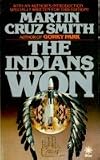
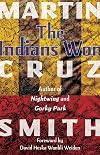
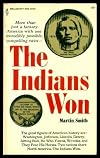
The Indians Won
by Martin Cruz Smith
On This Page
Description
"First published in 1970 and long out of print, The Indians Won is a stunning work of speculative fiction that imagines that, following the defeat of Custer and Benteen at the Little Bighorn in 1876, the many Indigenous tribes of America formed an alliance to sweep the whites out of the center of the country and form a new nation, bounded on both coasts by the United States. One hundred years later the two nations, having taken very different paths toward stewardship of the land and show more resources, are on the brink of war again, as the five hundred million wasichu of the United States eye the vast, open center of the continent, just as they had prior to their explusion in the nineteenth century. The difference is, now they are both nuclear powers. Imaginative, enthralling, rich in historical detail, and written from the perspective of a Native American writer, The Indians Won is an emotionally charged novel that asks the question: What if the Indians had won?"--Page 4 of cover. show lessTags
Recommendations


















Member Reviews
A good plot, but not well executed--I wish someone else would develop this better. The writing jumps without warning from the 1800's to the late 1900's. The major portion of the beginning was just throwing at us names of famous Native American leaders and warriors, and Civil War era generals, and their real or fictional encounters.
One good piece is when He Who Yawns (Geronimo) complains that the united Indian nations are ordering his people around the same as the US Army did, when they just want to stay in their own land.
Smith also makes a politically correct assessment of the Indian nations of being able to maintain their all tribal government because they had a tradition of all people contributing to the social welfare of the nation show more and of not taking more than on needed. I liked the section where settlers first made mockery of the native practice of taking care of the land they farmed, but later when the Depression/Dust Storms hit, were envious that the Indian Country was the only area not suffering. There is even a quote for bibliophiles like us (o,r rather, satirizing us. show less
One good piece is when He Who Yawns (Geronimo) complains that the united Indian nations are ordering his people around the same as the US Army did, when they just want to stay in their own land.
Smith also makes a politically correct assessment of the Indian nations of being able to maintain their all tribal government because they had a tradition of all people contributing to the social welfare of the nation show more and of not taking more than on needed. I liked the section where settlers first made mockery of the native practice of taking care of the land they farmed, but later when the Depression/Dust Storms hit, were envious that the Indian Country was the only area not suffering. There is even a quote for bibliophiles like us (o,r rather, satirizing us. show less
Ratings
Members
- Recently Added By
Lists

What if... a speculative history list
25 works; 2 members
Author Information

37+ Works 18,975 Members
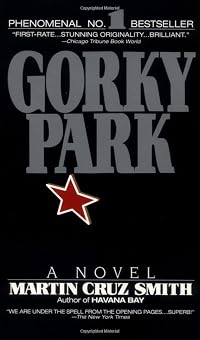
Martin Cruz Smith is a writer of suspense novels. He was born in Reading, Pennsylvania, on November 3, 1942 but grew up in New Mexico and the Philadelphia area. Smith earned a B.A. from the University of Pennsylvania. Smith worked for local television stations, newspapers, and the Associated Press. His early work was published under the names show more Simon Quinn, Jake Logan, and Martin Smith. Smith is best known for a series of suspense/thrillers featuring Investigator Arkady Renko. The first of these books, Gorky Park, was published in 1981 and adapted as a film starring William Hurt and Lee Marvin two years later. An earlier film of his work, Nightwing, directed by Arthur Hiller, was released in 1979. Smith is a member of the Authors League of America and the Authors Guild. In 2013 his title Tatiana made The New York Times Best Seller List. The Girl from Venice also became a bestseller. (Bowker Author Biography) show less
Common Knowledge
- Canonical title
- The Indians Won
- Original publication date
- 1970
- Epigraph
- [None]
- Dedication
- For Em and in memory of Robert Riggs
- First words
- In the chateau of Azay le Rideau, in the summer of 1875, a private conference was being held between representatives of five nations.
Introduction: In the fall of 1969, in Paris, I ran into a friend of mine, an editor. - Quotations
- The large personal library is the treasure of the intelligent idiot.
- Last words
- (Click to show. Warning: May contain spoilers.)"Hey," the President asked, "could you make one for me?"
- Original language
- English US
Classifications
Statistics
- Members
- 76
- Popularity
- 416,153
- Reviews
- 1
- Rating
- (3.43)
- Languages
- English, German
- Media
- Paper, Ebook
- ISBNs
- 7
- ASINs
- 3