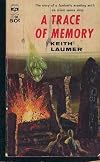
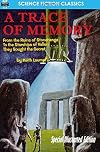
A Trace of Memory
by Keith Laumer
On This Page
Description
Great Pulp Space Adventure Classic from Hugo and Nebula and Hugo Nominee Author! From the Ruins of Stonehenge to the Starships of Vallon he sought the secret of a trace of memory.Tags
Recommendations















Member Reviews
Written at the beginning of Laumer's peak in popularity, A Trace of Memory is a fast-paced adventure/thriller mystery about a lone-wolf human aiding and befriending a stranded humanoid alien on Earth. Legion is a layabout itinerant worker with former Army intelligence training, who uses an opaque job posting in the paper to avoid going to jail. Foster, the large and imposing man who posted the advertisement (seeking a willing companion for an unspecified adventure) suffers from long-term amnesia, but possesses an indestructible journal with indecipherable hints as to his history.
The novel version of A Trace of Memory still roughly contains the three chunks that it was serialized in, all told through the first person perspective of show more Legion. Unfortunately, some of these chunks are better drawn than others. Perhaps the best of the three is the first, where the majority of Foster's identity is unraveled through high-action drama. The pair travel to Stonehenge, battle mysterious life-stealing orbs, and cope with Foster's sudden rejuvenation into a younger body. Laumer throws lots of twists and turns into the mix which keeps things fresh and exciting, diverting attention away from a plot that suffers from a lot of conveniences and believability issues. The middle third is by comparison more bland, bridging the gap between more interesting plot threads with Legion's rise to wealth exploiting some of Foster's alien technology. Doing so exposes him to the fury of U.S. and Russian government agencies, which he predictably escapes the clutches of by seeking asylum on his friend's distant world.
The climactic final portion is certainly the most interesting from an ideas perspective but is also messy and less coherent than the other two. Foster's alien culture has achieved near immortality through bodily rejuvenation and memory transference, though it's implied that his species and humans come from the same stock, the difference being that they developed an inoculation against a disease that causes aging in both body and mind. Because of their longevity, they have the continuity required to develop a better form of society and high technology. It is in describing this culture that Laumer can tend towards clunky, mystifying passages. Unfortunately for Legion, the society he finds on the planet has fallen from these heights into a more socially mobile version of medieval earth, complete with feudal territories, slavery, despot kings, and war. Legion must climb the social ladder and find Foster while trying to unleash the potential that he knows exist within this alien world.
Unlike a lot of serialized adventure stories of the time, the central relationship is not one between a macho hero and a witless princess. The camaraderie between Foster and Legion is at the core of the novel, and with it comes a certain brand of uncontained optimism about human endurance and ingenuity. Despite seemingly insurmountable odds Legion never seriously doubts his ability to overcome his circumstances. Even when faced with certain death, Legion's internal monologue comforts him with the thought that at least he tried his best for his friend. Legion ends up sacrificing a lot for his friendship with Foster, but is ultimately rewarded for it.
Legion's biblical name suggests even more positivity, implying that most people (at least men) are capable of great achievements despite their mortal failings and limitations. Legion himself, however, suffers from an unbearable case of being a smartass, who is unable to stop himself from responding to every circumstance or question with dated zingers (like comparing Foster's forgotten spaceship to a taxi parked with the meter running). I could practically hear the drum sting implied with these lines which left me seriously distracted.
A Trace of Memory is a decent but unimpressive showing from Laumer, and from what I understand typical of his trappings and style. Despite some of the novelties it has in comparison to pulp contemporaries, it doesn't come off as very memorable or remarkable. Best fit for a brainless action/SF movie. show less
The novel version of A Trace of Memory still roughly contains the three chunks that it was serialized in, all told through the first person perspective of show more Legion. Unfortunately, some of these chunks are better drawn than others. Perhaps the best of the three is the first, where the majority of Foster's identity is unraveled through high-action drama. The pair travel to Stonehenge, battle mysterious life-stealing orbs, and cope with Foster's sudden rejuvenation into a younger body. Laumer throws lots of twists and turns into the mix which keeps things fresh and exciting, diverting attention away from a plot that suffers from a lot of conveniences and believability issues. The middle third is by comparison more bland, bridging the gap between more interesting plot threads with Legion's rise to wealth exploiting some of Foster's alien technology. Doing so exposes him to the fury of U.S. and Russian government agencies, which he predictably escapes the clutches of by seeking asylum on his friend's distant world.
The climactic final portion is certainly the most interesting from an ideas perspective but is also messy and less coherent than the other two. Foster's alien culture has achieved near immortality through bodily rejuvenation and memory transference, though it's implied that his species and humans come from the same stock, the difference being that they developed an inoculation against a disease that causes aging in both body and mind. Because of their longevity, they have the continuity required to develop a better form of society and high technology. It is in describing this culture that Laumer can tend towards clunky, mystifying passages. Unfortunately for Legion, the society he finds on the planet has fallen from these heights into a more socially mobile version of medieval earth, complete with feudal territories, slavery, despot kings, and war. Legion must climb the social ladder and find Foster while trying to unleash the potential that he knows exist within this alien world.
Unlike a lot of serialized adventure stories of the time, the central relationship is not one between a macho hero and a witless princess. The camaraderie between Foster and Legion is at the core of the novel, and with it comes a certain brand of uncontained optimism about human endurance and ingenuity. Despite seemingly insurmountable odds Legion never seriously doubts his ability to overcome his circumstances. Even when faced with certain death, Legion's internal monologue comforts him with the thought that at least he tried his best for his friend. Legion ends up sacrificing a lot for his friendship with Foster, but is ultimately rewarded for it.
Legion's biblical name suggests even more positivity, implying that most people (at least men) are capable of great achievements despite their mortal failings and limitations. Legion himself, however, suffers from an unbearable case of being a smartass, who is unable to stop himself from responding to every circumstance or question with dated zingers (like comparing Foster's forgotten spaceship to a taxi parked with the meter running). I could practically hear the drum sting implied with these lines which left me seriously distracted.
A Trace of Memory is a decent but unimpressive showing from Laumer, and from what I understand typical of his trappings and style. Despite some of the novelties it has in comparison to pulp contemporaries, it doesn't come off as very memorable or remarkable. Best fit for a brainless action/SF movie. show less
The description for this book doesn’t do it justice. The scope of the book was amazing, not so much in the complexity of the plot, but in the range of ideas, settings and imagination. It was a fun trip with some surprisingly likeable characters. Certainly a different type of sci fi for me that has left me eager to read more by this author.
It's an intriguing concept: people who can store their memories and transfer them to a completely renewed body. Until someone messes with the transfer and the man finds himself marooned on earth with no idea who he is. Lucky for him that he meets down-on-his luck Legion...
Interesting in that the book manages to transcend the pulp content that I think a lot of Laumer's other books pretty much have perfected. It deals with immortality, memory and instantaneous learning. Many novel and interesting ideas for a sci-fi this old (1963).
Old but good
A little more of an action/drama type than I normally like, but still solid science fiction. An early work of Laumer, his later novels are better
A little more of an action/drama type than I normally like, but still solid science fiction. An early work of Laumer, his later novels are better
ook uitgebracht als Het verloren geheugen
Het ingeblikte geheugen was een cilinder, gevonden bij een onzegbaar oude druïdenplaats: Stonehenge, Engeland. Maar welk lichaam hoorde bij dit brein? Legion, een schooier, een man zonder wortels en een blijmoedig cynicus, wilde het antwoord weten. Gehersenspoeld door de CIA, gebombardeerd door de Russen, vluchtte hij met een ruimtesloep naar het einde van het heelal om daar een verloren beschaving te vinden die was gezonken in Middeleeuws barbarendom. Eerst als slaaf, later als meester, nam hij het op tegen een brein dat duizenden jaren oud was en dat zijn eigen brein had overweldigd. En waarom? Omdat eens, op de Aarde, een oude miljonair vriendelijk voor hem was geweest. Daarna was hij gestorven, om weer wakker te worden als gezonde show more twen. Echter, met een brein dat alles vergeten was... * Dit boek is ook uitgebracht onder de titel Het verloren geheugen. show less
Mar 27, 2025Dutch
Members
- Recently Added By
Author Information

267+ Works 17,375 Members
Keith Laumer was born John Keith Laumer in Syracuse, New York on June 9, 1925. Before becoming a full-time writer, he was an officer in the U.S. Air Force and a U.S. diplomat. He is best known for the Bolo stories and Retief series. His other works include The Other Side of Time, A Trace of Memory, Dinosaur Beach, and A Plague of Demons. He show more suffered a stroke in 1971, which negatively affected the quality of his work and his career declined. He was also a model airplane enthusiast, and published two dozen designs between 1956 and 1962 in the magazines Air Trails, Model Airplane News, Flying Models, and Aero Modeler. In 1960, he published How to Design and Build Flying Models. He died on January 23, 1993 at the age of 67. (Bowker Author Biography) show less
Some Editions
Work Relationships
Is contained in
Common Knowledge
- Original publication date
- 1963; 1962 (serialized in Amazing Jul, Aug, Sep) (serialized in Amazing Jul, Aug, Sep); 1963-06 (book) (book)
- First words*
- Si svegliò e rimase per un momento a fissare il soffitto basso, appena visibile nella luce rossastra.
- Last words*
- (Click to show. Warning: May contain spoilers.)- Ne approfitterò.
*Some information comes from Common Knowledge in other languages. Click "Edit" for more information.
Classifications
Statistics
- Members
- 319
- Popularity
- 99,376
- Reviews
- 8
- Rating
- (3.53)
- Languages
- 5 — Dutch, English, German, Italian, Swedish
- Media
- Paper, Ebook
- ISBNs
- 21
- ASINs
- 14