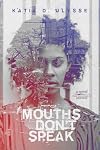
Mouths Don't Speak
by Katia D. Ulysse
On This Page
Description
"No one was prepared for the massive earthquake that struck Haiti in 2010, taking over a quarter-million lives, and leaving millions of others homeless. Three thousand miles away, Jacqueline Florestant mourns the presumed death of her parents, while her husband, a former US Marine and combat veteran, cares for their three-year-old daughter as he fights his own battles with acute PTSD. Horrified and guilt-ridden, Jacqueline returns to Haiti in search of the proverbial closure. Unfortunately, show more the Haiti she left as a child twenty-five years earlier has disappeared. Her quest turns into a tornado of deception, desperation, and more death. So Jacqueline holds tightly to her daughter--the only one who must not die"--Page [4] of cover. show lessTags
Recommendations
























Member Reviews
First, I have to note that the blurb on this book was incredibly misleading. I'd argue that, in some ways, it's simply false. And the truth is, if it had been more accurate, I likely wouldn't have picked up the book to begin with. Much as I respect Akashic Books and have loved their books in the past, I have to think the primary purpose of the blurb was selling books, vs. accuracy.
While some of Ulysse's prose is lovely, this is a somewhat plot-less and unevenly paced novel, and considering how sympathetic the characters Should be (based on what they go through), they're incredibly unsympathetic, to the point where I got more and more tired of reading about them, and could only care about the most minor characters in the book. There's show more also a real lack of plot, partly because the book spends a great deal of time building and building, and then speeds through what seems to count for a climax and ending. It would be insanely predictable also, if the blurb were accurate.
In general, this feels like a book that was rushed to publication, and perhaps pulled together from a number of short stories that were never destined to be a strong novel. In my opinion, it needed quite a bit more work, this only made worse by the fact that the powerful themes and events which are showcased on the back of the book as being primary to plot and conflict--the earthquake that struck Haiti in 2010 and a vet's battles with PTSD--serve more as backstory and jumping-off points than getting any real depth or focus, to the extent that I can't help half-wondering if they're mentioned so prominently in order to sell books and make this seem more unique than it actually is, vs. being relevant.
So, all told, I would not recommend this book. I feel a bit cheated for having so looked forward to it and then spent time on it, honestly. show less
While some of Ulysse's prose is lovely, this is a somewhat plot-less and unevenly paced novel, and considering how sympathetic the characters Should be (based on what they go through), they're incredibly unsympathetic, to the point where I got more and more tired of reading about them, and could only care about the most minor characters in the book. There's show more also a real lack of plot, partly because the book spends a great deal of time building and building, and then speeds through what seems to count for a climax and ending. It would be insanely predictable also, if the blurb were accurate.
In general, this feels like a book that was rushed to publication, and perhaps pulled together from a number of short stories that were never destined to be a strong novel. In my opinion, it needed quite a bit more work, this only made worse by the fact that the powerful themes and events which are showcased on the back of the book as being primary to plot and conflict--the earthquake that struck Haiti in 2010 and a vet's battles with PTSD--serve more as backstory and jumping-off points than getting any real depth or focus, to the extent that I can't help half-wondering if they're mentioned so prominently in order to sell books and make this seem more unique than it actually is, vs. being relevant.
So, all told, I would not recommend this book. I feel a bit cheated for having so looked forward to it and then spent time on it, honestly. show less
 This review was written for LibraryThing Early Reviewers.
MOUTHS DON’T SPEAK by Katia D. Ulysse is one of Akashic Book’s newest releases.
Ms. Ulysse has written a powerful story about “the massive earthquake that struck Haiti in 2010, taking over a quarter-million lives, and leaving millions of others homeless. 3,000 miles away, Jacqueline Florestant mourns the presumed death of her parents, while her husband, a former Marine and combat veteran, cares for their three-year-old daughter as he fights his own battles with PTSD. Horrified and guilt-ridden, Jacqueline returns to Haiti in search of the proverbial ‘closure’. Unfortunately the Haiti she left as a child 25 years earlier has disappeared. Her quest turns into a tornado of deception, desperation and more death. So, Jacqueline show more holds tightly to her daughter - the only one who must not die.” (Press Kit)
The earthquake statistics and descriptions are very horrifying.
The book opens with the earthquake and there is a sense of foreboding right from the get-go. I just knew the book was going to end badly.
I was never that sympathetic towards Jacqueline. She didn’t seem overly engaged with her daughter, Amber, or her husband, Kevin. Once she met Leyla (the cafe owner with whom she studied Creole), Jacqueline seemed to be too focused and attached to her.
Although she seemed enthusiastic about her work as an art teacher, she just threw her job and students ‘under the bus’ if and when she was inconvenienced.
Jacqueline’s parents, Annette and Paul Florestant, were beyond belief - hateful, selfish, self-absorbed, prejudiced, spiteful and lazy. The very painful and despicable class and economic divide in Haiti seems to be told through the Florestant elders.
I don’t think Kevin comes off that great, either. Yes, he suffers from PTSD, but doesn’t seem to want to help himself. He wants drugs from an old friend - drugs that seem to make him more unstable.
The long-suffering Pachou. I hope he was able to gain some solace.
MOUTHS DON’T SPEAK held many highlights for me.
a strong sense of place - both in Baltimore and in Haiti
the layering of personalities in each character; sometimes multiple layers in 1 character
Leyla and Jacqueline dancing the Yanvalou to voodoo jazz music
While looking at photos with Annette, Jacqueline thinks that “each picture was a shovel of dirt in the excavation of a childhood she had buried long ago “ (p. 140)
Immediately “The word immediately had a different definition in Haiti. Things moved at the speed of the heat, slow and punishing.” (p. 153+154)
The translation of Jacqueline’s vivid memories of Haiti into her artwork.
The book is very powerful and emotional. A painful pleasure to read at times. show less
Ms. Ulysse has written a powerful story about “the massive earthquake that struck Haiti in 2010, taking over a quarter-million lives, and leaving millions of others homeless. 3,000 miles away, Jacqueline Florestant mourns the presumed death of her parents, while her husband, a former Marine and combat veteran, cares for their three-year-old daughter as he fights his own battles with PTSD. Horrified and guilt-ridden, Jacqueline returns to Haiti in search of the proverbial ‘closure’. Unfortunately the Haiti she left as a child 25 years earlier has disappeared. Her quest turns into a tornado of deception, desperation and more death. So, Jacqueline show more holds tightly to her daughter - the only one who must not die.” (Press Kit)
The earthquake statistics and descriptions are very horrifying.
The book opens with the earthquake and there is a sense of foreboding right from the get-go. I just knew the book was going to end badly.
I was never that sympathetic towards Jacqueline. She didn’t seem overly engaged with her daughter, Amber, or her husband, Kevin. Once she met Leyla (the cafe owner with whom she studied Creole), Jacqueline seemed to be too focused and attached to her.
Although she seemed enthusiastic about her work as an art teacher, she just threw her job and students ‘under the bus’ if and when she was inconvenienced.
Jacqueline’s parents, Annette and Paul Florestant, were beyond belief - hateful, selfish, self-absorbed, prejudiced, spiteful and lazy. The very painful and despicable class and economic divide in Haiti seems to be told through the Florestant elders.
I don’t think Kevin comes off that great, either. Yes, he suffers from PTSD, but doesn’t seem to want to help himself. He wants drugs from an old friend - drugs that seem to make him more unstable.
The long-suffering Pachou. I hope he was able to gain some solace.
MOUTHS DON’T SPEAK held many highlights for me.
a strong sense of place - both in Baltimore and in Haiti
the layering of personalities in each character; sometimes multiple layers in 1 character
Leyla and Jacqueline dancing the Yanvalou to voodoo jazz music
While looking at photos with Annette, Jacqueline thinks that “each picture was a shovel of dirt in the excavation of a childhood she had buried long ago “ (p. 140)
Immediately “The word immediately had a different definition in Haiti. Things moved at the speed of the heat, slow and punishing.” (p. 153+154)
The translation of Jacqueline’s vivid memories of Haiti into her artwork.
The book is very powerful and emotional. A painful pleasure to read at times. show less
Ulysee tackles two very difficult subjects - the effects of the contemporary earthquake in Haiti as well as the lives of US soldiers living with PTSD - in one very slim book. The author had enough material for a much longer book. As a result, MOUTHS DON'T SPEAK only gives its readers a taste of what could be. We are left wanting more: more information on Haiti and of class differences within Haiti, more trips inside the mind of Jacqueline and her relationship to her art, more exposure to Jacqueline's husband and his disorder, and more insight into the relationship between Jacqueline and Leyla. Instead, we get teased by small tidbits and are left wondering about the gaping holes. We, as readers, are, in a way, similar to Jacqueline show more herself who seems to have more than her shares of holes in life.
Jacqueline is from a wealthy Haitian family and was farmed out to boarding schools from a young age so that she grew up as a Haitian without a country. As an adult, living in the US, Jacqueline marries a man who has served in the military. She loves him, and they have a little girl together. Amber. Jacqueline is an artist and an art teacher. There are many scenes in the book of Jacqueline unable to pick up her paint brush or of Jacqueline painting, but there never seems to be any real connection between Jacqueline and her art. Because it is a large part of her life and identity, the reader wants more detail. Why does she paint? What satisfaction does it give her? What colors does she use? What do they say about what's in her mind? The art seems to be a key piece to understanding Jacqueline, yet we never seem to get past the doors of her art studio and into her head.
We know Jacqueline is depressed. As the book opens, she is mired in grief as news of the mammoth earthquake in Haiti has made its way onto US TV screens. Although she has not been in her native country for years, she thinks of her parents living there and wonders if they are alive. For a character who is portrayed as having a very difficult relationship with her parents - largely because they shipped her off to boarding school to enable themselves to have a freer, jet setting lifestyle - her grief and upset and inability to show up for work seem almost unconvincing. But somehow, out of all of this, Jacqueline emerges with a desire to connect to her home country. She answers an ad to learn (in her case, re-learn) Haitian Creole, and meets a fluent Creole speaking white woman who almost overnight becomes her best friend.
Against the backdrop of Jacqueline re-engaging with her birth culture, there is the almost competitive relationship that she and her husband have over their little girl, Amber. It seems as though the parents each think of her as a possession more important to each parent alone as opposed to a wonderful piece of the family unit. In a very predictable way, Jacqueline makes a decision to go to visit her parents in Haiti and to take Amber with her. The reader is not surprised when the husband refuses to accompany them. This is just one predictable piece of MOUTHS DON'T SPEAK. The others are the large event with which the book culminates and the revelation about the family's servant. Both of these are believable, but they are also so predictable as to make the reader sigh with impatience.
Ulysee has talent. Her book of short stories, DRIFTING, showed that. But to rise to the level of Danticat in THE FARMING OF BONES or to bring back the spirit of the writings of Marie Vieux Chauvet, probably one of Haiti's best writers, Ulysee has a road ahead. Stronger character development and more descriptive writing would have helped the book tremendously. show less
Jacqueline is from a wealthy Haitian family and was farmed out to boarding schools from a young age so that she grew up as a Haitian without a country. As an adult, living in the US, Jacqueline marries a man who has served in the military. She loves him, and they have a little girl together. Amber. Jacqueline is an artist and an art teacher. There are many scenes in the book of Jacqueline unable to pick up her paint brush or of Jacqueline painting, but there never seems to be any real connection between Jacqueline and her art. Because it is a large part of her life and identity, the reader wants more detail. Why does she paint? What satisfaction does it give her? What colors does she use? What do they say about what's in her mind? The art seems to be a key piece to understanding Jacqueline, yet we never seem to get past the doors of her art studio and into her head.
We know Jacqueline is depressed. As the book opens, she is mired in grief as news of the mammoth earthquake in Haiti has made its way onto US TV screens. Although she has not been in her native country for years, she thinks of her parents living there and wonders if they are alive. For a character who is portrayed as having a very difficult relationship with her parents - largely because they shipped her off to boarding school to enable themselves to have a freer, jet setting lifestyle - her grief and upset and inability to show up for work seem almost unconvincing. But somehow, out of all of this, Jacqueline emerges with a desire to connect to her home country. She answers an ad to learn (in her case, re-learn) Haitian Creole, and meets a fluent Creole speaking white woman who almost overnight becomes her best friend.
Against the backdrop of Jacqueline re-engaging with her birth culture, there is the almost competitive relationship that she and her husband have over their little girl, Amber. It seems as though the parents each think of her as a possession more important to each parent alone as opposed to a wonderful piece of the family unit. In a very predictable way, Jacqueline makes a decision to go to visit her parents in Haiti and to take Amber with her. The reader is not surprised when the husband refuses to accompany them. This is just one predictable piece of MOUTHS DON'T SPEAK. The others are the large event with which the book culminates and the revelation about the family's servant. Both of these are believable, but they are also so predictable as to make the reader sigh with impatience.
Ulysee has talent. Her book of short stories, DRIFTING, showed that. But to rise to the level of Danticat in THE FARMING OF BONES or to bring back the spirit of the writings of Marie Vieux Chauvet, probably one of Haiti's best writers, Ulysee has a road ahead. Stronger character development and more descriptive writing would have helped the book tremendously. show less
This review was written for LibraryThing Early Reviewers.acqueline is an immigrant from Haiti, married to an ex-Marine with several combat tours behind him and untreated PTSD. They have a young daughter.
Jacqueline was neglected by her upper class Haitian parents as a child. When she was very young, she had been left in a boarding school while her parents toured the world. She had minimal parental contact from that point onward.
Nevertheless, she is frantic when she cannot contact them after the Haiti earthquake. She dials their unresponsive phone obsessively as the days turn into weeks. And yet, sometimes the unexpected happens.
Jacqueline decides to return to Haiti with her daughter to renew family ties and to reconnect with her home country. Her husband refuses to go with her as he show more considers the chaos in Haiti to be a virtual state of war.
Tragedy happens. The marriage is tested to its limits and then once again we return to the Haitian class divisions.
This is actually a very short novel, with many different themes braided into it. They are all interesting themes, but I felt that they were worthy of more development. Too many themes, like too many spices in a dish, can muddle the story. In addition this fairly bleak novel was tied up with a bow at the end, which was rather unexpected and I'm not sure fit with the rest of the novel. Can trauma be solved that easily?
However, it was a compelling read, that kept me quite interested. I also was fascinated by this look at the wealthy in Haiti and this view of the country. This is an interesting novel by a young author – I would definitely be interested in her next book.
I received a copy of this book through LibraryThing Early Reviewers program in exchange for an honest review. show less
Jacqueline was neglected by her upper class Haitian parents as a child. When she was very young, she had been left in a boarding school while her parents toured the world. She had minimal parental contact from that point onward.
Nevertheless, she is frantic when she cannot contact them after the Haiti earthquake. She dials their unresponsive phone obsessively as the days turn into weeks. And yet, sometimes the unexpected happens.
Jacqueline decides to return to Haiti with her daughter to renew family ties and to reconnect with her home country. Her husband refuses to go with her as he show more considers the chaos in Haiti to be a virtual state of war.
Tragedy happens. The marriage is tested to its limits and then once again we return to the Haitian class divisions.
This is actually a very short novel, with many different themes braided into it. They are all interesting themes, but I felt that they were worthy of more development. Too many themes, like too many spices in a dish, can muddle the story. In addition this fairly bleak novel was tied up with a bow at the end, which was rather unexpected and I'm not sure fit with the rest of the novel. Can trauma be solved that easily?
However, it was a compelling read, that kept me quite interested. I also was fascinated by this look at the wealthy in Haiti and this view of the country. This is an interesting novel by a young author – I would definitely be interested in her next book.
I received a copy of this book through LibraryThing Early Reviewers program in exchange for an honest review. show less
This review was written for LibraryThing Early Reviewers.Perhaps Ulysse tries to cover too much material in too little space. This story of a woman with a dysfunctional relationship with her parents and a husband with PTSD jumps all over the place. She lives in Baltimore and is trying to come to terms with the aftermath of the earthquake in Haiti--where her parents live but where she herself hasn't lived since she was ten years old. With several digressions, switches in points of view, characters who really don't add to the story, I just couldn't get a handle on what story she was trying to tell.
Free copy from publisher through LibraryThing Early Reviewers.
Free copy from publisher through LibraryThing Early Reviewers.
This review was written for LibraryThing Early Reviewers.In this novel Ulysse gives us a glimpse of Haiti, including its poverty and chaos, as well as its opulence, when the main character, Jacqueline Florestant, returns there after the 2010 earthquake. Jacqqueline must confront a past that includes her wealthy, neglectful parents and a present living with her American husband, who suffers from PTSD. She faces tragedy during her trip to Haiti and must reevaluate her life afterwards. The story is well written and compelling.
This review was written for LibraryThing Early Reviewers.love to read books about diverse cultures and this one is about Haiti, the earthquake in 2010, the rich and the poor and Haitian culture. The story brought out all of that out. It started with Jacqueline Florestant in Brooklyn weeping and sobbing at the news about the earthquake. She had only spent the first ten years of her life there. Her parents, being very rich, sent her away to boarding school.
Jacqueline remembers Haiti as being a paradise behind the walls of her home. Her husband, Kevin, took care of their daughter, Amber while Jacqueline sobbed over the news. Kevin had PTSD and only felt attached to his daughter while she seems detached or seems to take Amber for granted. It was hard to identity with either character right from show more the beginning of the story. She was from the privileged elite in Haiti. The rich elite are a small part of the total population, but they seem only interested in perpetuating their wealth and enjoying life. They were not interested in helping the enormous amount of poor people.
Jacqueline worries about her parents but she also has bad memories of them. She tried calling them for weeks and thought they might be dead. Then she got a call from her mother. Her father had to have his legs amputated because he was trying to save the employees in their factory. Her mother seems to have no empathy for her husband, Jacqueline, or for the poor of Haiti.
Jacqueline lets go of her job and heads for Haiti. She leaves with Amber and has much to learn.
This book is very fast paced and hold onto your interest fiercely. I learned more about the Haitian culture and the financial divide. That encourages me to read more about this unusual country. I never felt sympathetic to the main characters except for her father who had begun to care. The language was very rough when the author had the Jacqueline talk about her students. This is realistic though, I know from when my mother taught grade school in the inner city. I just thought that it could have been handled differently, maybe shortened. But it is a valuable book to read and learn from.
I received this Advance Copy as a win from LibraryThing from the publishers in exchange for a fair book review. My thoughts and feelings in this review are totally my own. show less
Jacqueline remembers Haiti as being a paradise behind the walls of her home. Her husband, Kevin, took care of their daughter, Amber while Jacqueline sobbed over the news. Kevin had PTSD and only felt attached to his daughter while she seems detached or seems to take Amber for granted. It was hard to identity with either character right from show more the beginning of the story. She was from the privileged elite in Haiti. The rich elite are a small part of the total population, but they seem only interested in perpetuating their wealth and enjoying life. They were not interested in helping the enormous amount of poor people.
Jacqueline worries about her parents but she also has bad memories of them. She tried calling them for weeks and thought they might be dead. Then she got a call from her mother. Her father had to have his legs amputated because he was trying to save the employees in their factory. Her mother seems to have no empathy for her husband, Jacqueline, or for the poor of Haiti.
Jacqueline lets go of her job and heads for Haiti. She leaves with Amber and has much to learn.
This book is very fast paced and hold onto your interest fiercely. I learned more about the Haitian culture and the financial divide. That encourages me to read more about this unusual country. I never felt sympathetic to the main characters except for her father who had begun to care. The language was very rough when the author had the Jacqueline talk about her students. This is realistic though, I know from when my mother taught grade school in the inner city. I just thought that it could have been handled differently, maybe shortened. But it is a valuable book to read and learn from.
I received this Advance Copy as a win from LibraryThing from the publishers in exchange for a fair book review. My thoughts and feelings in this review are totally my own. show less
This review was written for LibraryThing Early Reviewers.Members
- Recently Added By
Lists

History: Africa & Latin America
38 works; 1 member
Author Information

4+ Works 81 Members
Classifications
Statistics
- Members
- 52
- Popularity
- 581,866
- Reviews
- 13
- Rating
- (3.37)
- Languages
- English
- Media
- Paper, Audiobook, Ebook
- ISBNs
- 3
- ASINs
- 1