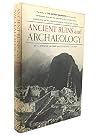
Citadels of Mystery
by L. Sprague de Camp, Catherine Crook De Camp
On This Page
Tags
Recommendations



















Member Reviews
De Camp was a man of many talents (or a wearer of many hats, at any rate), but he was neither an archaeologist nor an anthropologist. Citadels of Mystery, therefore, reads like what it is: the scribblings of a hobbyist who had sufficient funds and leisure to travel the world taking snapshots of ancient ruins. He references many other authors, but De Camp's terse pronouncements are absurdly funny considering how little he knew about the subject himself. "If they sprang from a common civilized center, the Egyptians and the Mayas ought to have shared such things as maize and smallpox," concludes De Camp, blissfully unaware of what the two civilizations did share: an identical solar calendar with the basic length of 360 days, rounding off show more the year with a short month of five "bad" or "nameless" days. That's an unusually specific commonality between two cultures whose paths, according to the author, never crossed. "Present informed opinion does not take the Diffusionist claims seriously," he declares elsewhere. How chagrined De Camp would be to read the conclusion of a recent study published in Current Biology (October 2017): that, while researchers have found no evidence of genetic intermingling between South American natives and Easter Islanders, they concede that "some cultural exchange occurred between the Americas and Polynesia before the impact of European colonization." In other words, Sprague, the Diffusionist claims have withstood the rigors of science...while you are deader than the dodo. (Interestingly, De Camp's Wikipedia page notes that his parents sent him to a military-style school "to cure him of intellectual arrogance." I offer no further comment, except to say that perhaps the cure didn't take.)
Two stars for the inclusion of Great Zimbabwe and Nan Madol, fascinating archaeological sites about which relatively little has been written.
(Update: On September 11, 2024, the scientific journal Nature published a study entitled "Ancient Rapanui genomes reveal resilience and pre-European contact with the Americas." Therein, J. Victor Moreno-Mayar and his fellow researchers detailed their reconstruction of the genomic history of the Easter Islanders, finding a Native American admixture of "about 10%" in the genetic makeup of the ancient and present-day inhabitants of the island. We now have conclusive evidence of contact between Easter Island and the Americas. Diffusionism, which was such a dirty word among orthodox historians and archaeologists, is scientifically valid.) show less
Two stars for the inclusion of Great Zimbabwe and Nan Madol, fascinating archaeological sites about which relatively little has been written.
(Update: On September 11, 2024, the scientific journal Nature published a study entitled "Ancient Rapanui genomes reveal resilience and pre-European contact with the Americas." Therein, J. Victor Moreno-Mayar and his fellow researchers detailed their reconstruction of the genomic history of the Easter Islanders, finding a Native American admixture of "about 10%" in the genetic makeup of the ancient and present-day inhabitants of the island. We now have conclusive evidence of contact between Easter Island and the Americas. Diffusionism, which was such a dirty word among orthodox historians and archaeologists, is scientifically valid.) show less
(original title Ancient Ruins and Archaeology)
Reading Ancient Engineers inspired me to dig out and reread my copy of Citadels of Mystery (and log it into LibraryThing as it wasn't already logged). A useful gaming reference especially for pulp era games; the book describes 12 sites, debunks various myths associated with them and speculates on their actual history and purpose. The sites covered are:
Atlantis and the City of Silver
Pyramid Hill and the Claustrophobic King
Stonehenge and the Giants' Dance
Troy and the Nine Cities
Ma'rib and the Queen of Sheba
Zimbabwe and King Solomon's Mines
Tintagel and the Table Round
Angkor and the Golden Window
Tikal and the Feathered Elephants
Machu Picchu and the Unwalled Fortress
Nan Matol and the Sacred show more Turtle
Rapa Nui and the Eyeless Watchers
Again, an old book (originally published in 1964), with a post script which probably dates from the 1972 reprint. This adds the Santorini connection to the Atlantis legend, and adds more on the Stonehenge calendar theory. I found the writing style to be more accessible than Ancient Engineers.
For what it does, fine, but as with Ancient Engineers don't expect any in-depth exposition. It reads rather like a Ken Hite column, especially from Suppressed Transmission although with more Theosophy etc than Antarctic Space Nazis. Also reminscent of the more recent Osprey titles along the same lines. show less
Reading Ancient Engineers inspired me to dig out and reread my copy of Citadels of Mystery (and log it into LibraryThing as it wasn't already logged). A useful gaming reference especially for pulp era games; the book describes 12 sites, debunks various myths associated with them and speculates on their actual history and purpose. The sites covered are:
Atlantis and the City of Silver
Pyramid Hill and the Claustrophobic King
Stonehenge and the Giants' Dance
Troy and the Nine Cities
Ma'rib and the Queen of Sheba
Zimbabwe and King Solomon's Mines
Tintagel and the Table Round
Angkor and the Golden Window
Tikal and the Feathered Elephants
Machu Picchu and the Unwalled Fortress
Nan Matol and the Sacred show more Turtle
Rapa Nui and the Eyeless Watchers
Again, an old book (originally published in 1964), with a post script which probably dates from the 1972 reprint. This adds the Santorini connection to the Atlantis legend, and adds more on the Stonehenge calendar theory. I found the writing style to be more accessible than Ancient Engineers.
For what it does, fine, but as with Ancient Engineers don't expect any in-depth exposition. It reads rather like a Ken Hite column, especially from Suppressed Transmission although with more Theosophy etc than Antarctic Space Nazis. Also reminscent of the more recent Osprey titles along the same lines. show less
de Camp looks at twelve ancient sites around the world and talks about the myths (and some of the more "crackpot" theories) that have been built up around them; the history of their discoveries; the explorers, antiquarians and archaeologists involved; and tries too present as good an explanation for their existence as he can.
I'm sure that other people have written at greater length about all the places but as a brief overview this does work very well. I had heard of eleven of the twelve sites before (the only exception was Nan Matol, in the Caroline Islands) and I can't really quibble with what he has to say about them. The only issue is that this was published in the 1960's, originally, and archaeology and thoughts have moved on since show more then, but I still enjoyed it. My copy is from 1972 and includes a postscript about further thoughts on Atlantis and Stonehenge following some more archaeological discoveries. I'm sure that if there is a more up-to-date version it would be worth tracking down. show less
I'm sure that other people have written at greater length about all the places but as a brief overview this does work very well. I had heard of eleven of the twelve sites before (the only exception was Nan Matol, in the Caroline Islands) and I can't really quibble with what he has to say about them. The only issue is that this was published in the 1960's, originally, and archaeology and thoughts have moved on since show more then, but I still enjoyed it. My copy is from 1972 and includes a postscript about further thoughts on Atlantis and Stonehenge following some more archaeological discoveries. I'm sure that if there is a more up-to-date version it would be worth tracking down. show less
co-author Catherine C. De Camp; original title "Ancient Ruins and Archaeology" (1964); earlier copyrights by L.S. De Camp 1946, 1950, 1956, 1957, 1962
Ratings
Members
- Recently Added By
Author Information

328+ Works 25,101 Members
L. Sprague de Camp, winner of the World Fantasy Award for Life Achievement, was fluent in several languages and traveled the world. He was chased by a hippopotamus in Uganda and sea lions in the Galapagos Islands. He saw tigers and rhinoceroses from elephantback in India, and he was bitten by a lizard in the jungles of Guatemala. His fascinating show more autobiography. Time and Chance, won the 1997 Hugo Award for best nonfiction. L. Sprague de Camp passed away in May 2000 show less

16+ Works 1,100 Members
Series
Belongs to Publisher Series
Common Knowledge
- Original title
- Ancient Ruins and Archaeology
- Alternate titles
- Citadels of Mystery; Ancient Ruins: The Past Uncovered
- Original publication date
- 1946
- Important places
- Atlantis; Troy; Egypt; Tikal, Guatemala; Stonehenge, Wiltshire, England, UK; Zimbabwe (show all 12); Tintagel Castle, Cornwall, England, UK; Ma'rib; Machu Picchu, Peru; Rapa Nui; Angkor Wat, Cambodia; Nan Matol
- Dedication
- This book is dedicated to our old friend and collaborator, P. Schuyler Miller, who is what we have often secretly wished to be: a real archaeologist.
- First words
- A ruin strikes a romantic chord in all of us.
- Last words
- (Click to show. Warning: May contain spoilers.)As the archaeologist Petrie said: "The man who knows and dwells in history adds a new dimension to his existence; he no longer lives in the one plane of present ways and thoughts, he lives in the whole space of life, past, present, and dimly future."
- Disambiguation notice
- Published as Ancient Ruins and Archaeology (1964), and as Citadels of Mystery (1973).
Classifications
Statistics
- Members
- 240
- Popularity
- 135,388
- Reviews
- 4
- Rating
- (3.32)
- Languages
- English, French, German
- Media
- Paper
- ISBNs
- 7
- UPCs
- 1
- ASINs
- 15