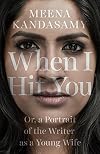
When I Hit You
by Meena Kandasamy
On This Page
Description
"Set in modern India, the unnamed narrator falls in love with a university professor and agrees to be his wife. Based on the author's own experience of marriage, soon the newly-wed experiences extreme violence at her husband's hands and finds herself socially isolated. Intellectual and physical cruelty is explored. Yet hope keeps her alive. Writing becomes her salvation, a supreme act of defiance and, as the subtitle suggests, the novel is also about the act of writing itself and the way show more that fiction and stories can help you escape" -- show lessTags
Recommendations









Member Reviews
Told in the first person, this is an powerful account of an abusive marriage in India. Kandasamy's protagonist is no victim, but horribly penned in by her new husband's jealousy and paranoia. From wanting her email passwords to violent abuse, she chronicles the loss of writing career, sense of self and control of her own body, as doctors, family and friends fail to see what is happening and her parents urge her not to leave her husband for fear of loss of 'face'. Tracking her experiences through imagining it as a film, a book, a love letter, the (never named, I think) protagonist distances herself from her own abuse. When she is finally able to leave, which we know has happened at the very beginning of the book, her parents' reactions show more are some kind of light relief: her mother's attempts to talk about her appearance when she arrived at the family home (her feet!), her father's denial that he has any influence over his daughter. The contrast between her 'modern' freelance lifestyle, and being uninvited from a wedding as a divorced woman, is particularly stark.
"I am the woman whose reputation is rusting. Who dissolves her once-upon-a-time in vodka with sliced lime, whole green chillies and sea salt. Who swallows it in the sweet heat of a neat whisky and rolls it into tight joints, smoking it up in circles of regret. I wear it in leopard print. I walk it around in red, outrageous stilettos. I take it to every seedy bar in town... I am the woman who did not know this woman myself, wild and ecstatic, trapped inside me. She is the stranger I am taking to town. She is the stranger I am getting to know, the rebellious stranger under my skin who refuses to stand to any judgement."
Highly recommended. show less
"I am the woman whose reputation is rusting. Who dissolves her once-upon-a-time in vodka with sliced lime, whole green chillies and sea salt. Who swallows it in the sweet heat of a neat whisky and rolls it into tight joints, smoking it up in circles of regret. I wear it in leopard print. I walk it around in red, outrageous stilettos. I take it to every seedy bar in town... I am the woman who did not know this woman myself, wild and ecstatic, trapped inside me. She is the stranger I am taking to town. She is the stranger I am getting to know, the rebellious stranger under my skin who refuses to stand to any judgement."
Highly recommended. show less
This is a deeply moving and shocking account of how a woman becomes trapped in an abusive marriage, unable to break free. It is also a fractured picture of the woman who did eventually walk out and sought to re-build herself. And it's also an exploration of how she distanced herself from reality, both within the marriage and afterwards, through a writerly detachment so that the reader is never quite sure where the boundary lies between honest and fictitious, open and hidden. There is little focus on the husband or exploration of his motivation - the author's freedom to choose and it clearly would have been a different book with the addition of this element but it frustrated me at times. And there seems to be a sideline in addressing show more what might be termed feminist orthodoxy, not something I am familiar with so the point of it probably escaped me. Nevertheless a book which gives this reader much to ponder. July 2020 show less
In a Nutshell: Has its merits but I couldn’t connect with the writing style. Feels more like a feminist essay-cum-manifesto than a fictional story about domestic violence.
Story Synopsis:
This book had created quite a buzz in Indian FB groups a few years ago as an eye-opening revelation of domestic abuse. (Feminism-driven books are quite rare here.) The novel also made it to the longlist of the Dylan Thomas Prize in 2018 and was nominated for the Women's Prize for Fiction in the same year. Is it any surprise then that I have been eager to get my hands on this book since that last few years? But now that I’ve read it, I can’t help feeling disappointed. Which shouldn’t be a surprise because I feel this way about most literary Prize winners or nominees.
Anyhoo…
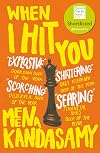
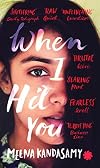
Through the hype and the reviews, and because of the powerful title and cover, I was under the impression that this was either a memoir, or an expository nonfiction about domestic abuse. (I wasn’t aware of its fiction award nominations then.) After I discovered that it was a fictional novel, I prepared myself for the hardhitting story of a disastrous marriage. However, though the book had some intense content, it felt impactful only to a certain extent. And this is to be blamed primarily on the title and the writing approach.
The title doesn’t suit the book at all, though one part of the book contains a reference that helps us understand why it has been chosen. It’s more like a clickbait heading because most of the content doesn’t talk about that aspect of the abusive marriage.
The content is akin to a combination of essay plus manifesto, with the focus being more on the lessons learnt by the narrator and the discussions she had with her husband on irrelevant topics such as communism and writing and Facebook than on her direct experiences as the recipient of abuse. Her husband's philosophy and beliefs find more space on the page than merited by the premise. Not that I like reading about physical abuse, but isn't that what the title promised?
Of course, abuse is not only physical but also psychological. In this regard, the book does perform somewhat better, highlighting the various manipulative ways such as gaslighting, bodyshaming and guilt-tripping that the husband used to mess up her mind. Then again, the narrator keeps reiterating that she was an independent and educated writer (The “writer” angle is drilled in us repeatedly), so how did she go from entering a love marriage with a person she herself chose to wearing shabby clothes and letting her hair be full of lice within just four months – this aspect is never clarified. I’m not questioning her claims nor denying her trauma; I just wanted a clearer transition from point A to point B.
Furthermore, as the narration comes to us in a flashback from five years later, there is no curiosity about what happens. We already know that she has left her husband’s home and returned to her parents within just four months. All we have to wait for is the ‘how’, and that takes hardly a few pages. The rest is just a tirade.
As every single main character of the book stays unnamed, I felt distanced from their feelings and thought process, except for the narrator whose thoughts are more about vehemence than about emotions. I couldn’t feel any connect with the narrator! Imagine reading a book about such physical and mental abuse and still coming away feeling not an ounce of sympathy for the protagonist. Something went drastically wrong between thought and paper for this novel.
On the pro side, there are some outstanding points about domestic abuse and marital rape being raised, all of which are quite infuriating as we realise that there are still men who consider their wives their property to be used or abused the way they want. The book also highlights how it isn’t only the poor or the illiterate who go through physical abuse. There is enough fodder for thought, even if the fodder is shoved into your brain than being offered for perusal.
One more point I liked was that the abusive relationship was not through an arranged marriage but a love marriage. (Yup, we do have love marriages in India. Tons of them!) It has become the norm to diss arranged marriages and blame them for every single marital issue in the country, but the fact is that arranged marriages and love marriages both have their pros and cons. For once, a feminist book from the country has spotlighted that a love marriage can also end in pain.
(I must clarify that there’s a difference between forced arranged marriage [Bad!] and arranged marriage by consent [Works quite well!]. Many outsiders are so hasty to jumping to wrong conclusions about India that I feel like every declaration I make about the country needs to be explained in detail. Sigh.)
The story made decent use of the locations - Tamil Nadu, Kerala, Mangalore in Karnataka, though the Keralite portrayal seemed quite stereotypical with only communism as the main topic, as if people in Kerala discuss nothing else. My native place is Mangalore, so it was exciting to finally read a book that mentions Mangalore (Every writer wanting a Karnataka-based location seems fixated on Bangalore otherwise!) and also talks of a few of its popular spots.
So yes, the book does have its strengths. But considering what was promised, the strengths failed to make me forgive the shortcomings.
On the whole, reading this book was a very frustrating experience. I might – this is a highly conditional “might” – have liked this book had I been prepared for its approach towards the story. Because of the bombastic style, the emotions feel more ostentatious than genuine. I think the book would have been far more impactful as a memoir, because in its current format, it straddles both fiction and nonfiction and does justice to neither.
Unfortunately, this is the kind of feminist work that delights in generalised male-bashing. I firmly believe in #NotAllMen; there are enough kind-hearted and loving and caring men out there. So I cannot agree with any “feminist” who believes in the superiority and moral perfection of women. (Coming to think of it, they might like this book better.) Give me [a:Chimamanda Ngozi Adichie|19992417|Chimamanda Ngozi Adichie|https://images.gr-assets.com/authors/1628721308p2/19992417.jpg]’s [b:We Should All Be Feminists|22738563|We Should All Be Feminists|Chimamanda Ngozi Adichie|https://i.gr-assets.com/images/S/compressed.photo.goodreads.com/books/1430821222l/22738563._SX50_.jpg|42278179] over this rubbish ideology any day.
The author has revealed in interviews that this book is based on her own experiences. As this is then an autofiction, I am really sorry that she had to go through such a traumatic marriage. But as I always say, a review is an opinion about the book and not about the person writing it. And as a book, this novel didn’t work for me the way I wanted it to.
2.5 stars. Cannot bring myself to round this up as it would then indicate that “I liked it.”
~~~~~~~~~~~~~~~~~~~~~~~~~~~~~
Connect with me through:
My Blog | The StoryGraph | Instagram | Facebook | Twitter show less
Story Synopsis:
Written in first person, our narrator, who remains unnamed throughout the book, tells us of her marital experience. Five years ago, she fell in love with a leftist university professor, who was much older than her, and married him for reasons other than love. Unfortunately, for her husband, marriage is akin to ownership, and he soon dominates her, dictating every move she makes. After resisting for four months, she finally makes her escape. (This isn’t a spoiler but mentioned in Chapter One.)show more
Now speaking to us five years down the line, she dissects
her marriage and her life choices.
This book had created quite a buzz in Indian FB groups a few years ago as an eye-opening revelation of domestic abuse. (Feminism-driven books are quite rare here.) The novel also made it to the longlist of the Dylan Thomas Prize in 2018 and was nominated for the Women's Prize for Fiction in the same year. Is it any surprise then that I have been eager to get my hands on this book since that last few years? But now that I’ve read it, I can’t help feeling disappointed. Which shouldn’t be a surprise because I feel this way about most literary Prize winners or nominees.
Anyhoo…
Through the hype and the reviews, and because of the powerful title and cover, I was under the impression that this was either a memoir, or an expository nonfiction about domestic abuse. (I wasn’t aware of its fiction award nominations then.) After I discovered that it was a fictional novel, I prepared myself for the hardhitting story of a disastrous marriage. However, though the book had some intense content, it felt impactful only to a certain extent. And this is to be blamed primarily on the title and the writing approach.
The title doesn’t suit the book at all, though one part of the book contains a reference that helps us understand why it has been chosen. It’s more like a clickbait heading because most of the content doesn’t talk about that aspect of the abusive marriage.
The content is akin to a combination of essay plus manifesto, with the focus being more on the lessons learnt by the narrator and the discussions she had with her husband on irrelevant topics such as communism and writing and Facebook than on her direct experiences as the recipient of abuse. Her husband's philosophy and beliefs find more space on the page than merited by the premise. Not that I like reading about physical abuse, but isn't that what the title promised?
Of course, abuse is not only physical but also psychological. In this regard, the book does perform somewhat better, highlighting the various manipulative ways such as gaslighting, bodyshaming and guilt-tripping that the husband used to mess up her mind. Then again, the narrator keeps reiterating that she was an independent and educated writer (The “writer” angle is drilled in us repeatedly), so how did she go from entering a love marriage with a person she herself chose to wearing shabby clothes and letting her hair be full of lice within just four months – this aspect is never clarified. I’m not questioning her claims nor denying her trauma; I just wanted a clearer transition from point A to point B.
Furthermore, as the narration comes to us in a flashback from five years later, there is no curiosity about what happens. We already know that she has left her husband’s home and returned to her parents within just four months. All we have to wait for is the ‘how’, and that takes hardly a few pages. The rest is just a tirade.
As every single main character of the book stays unnamed, I felt distanced from their feelings and thought process, except for the narrator whose thoughts are more about vehemence than about emotions. I couldn’t feel any connect with the narrator! Imagine reading a book about such physical and mental abuse and still coming away feeling not an ounce of sympathy for the protagonist. Something went drastically wrong between thought and paper for this novel.
On the pro side, there are some outstanding points about domestic abuse and marital rape being raised, all of which are quite infuriating as we realise that there are still men who consider their wives their property to be used or abused the way they want. The book also highlights how it isn’t only the poor or the illiterate who go through physical abuse. There is enough fodder for thought, even if the fodder is shoved into your brain than being offered for perusal.
One more point I liked was that the abusive relationship was not through an arranged marriage but a love marriage. (Yup, we do have love marriages in India. Tons of them!) It has become the norm to diss arranged marriages and blame them for every single marital issue in the country, but the fact is that arranged marriages and love marriages both have their pros and cons. For once, a feminist book from the country has spotlighted that a love marriage can also end in pain.
(I must clarify that there’s a difference between forced arranged marriage [Bad!] and arranged marriage by consent [Works quite well!]. Many outsiders are so hasty to jumping to wrong conclusions about India that I feel like every declaration I make about the country needs to be explained in detail. Sigh.)
The story made decent use of the locations - Tamil Nadu, Kerala, Mangalore in Karnataka, though the Keralite portrayal seemed quite stereotypical with only communism as the main topic, as if people in Kerala discuss nothing else. My native place is Mangalore, so it was exciting to finally read a book that mentions Mangalore (Every writer wanting a Karnataka-based location seems fixated on Bangalore otherwise!) and also talks of a few of its popular spots.
So yes, the book does have its strengths. But considering what was promised, the strengths failed to make me forgive the shortcomings.
On the whole, reading this book was a very frustrating experience. I might – this is a highly conditional “might” – have liked this book had I been prepared for its approach towards the story. Because of the bombastic style, the emotions feel more ostentatious than genuine. I think the book would have been far more impactful as a memoir, because in its current format, it straddles both fiction and nonfiction and does justice to neither.
Unfortunately, this is the kind of feminist work that delights in generalised male-bashing. I firmly believe in #NotAllMen; there are enough kind-hearted and loving and caring men out there. So I cannot agree with any “feminist” who believes in the superiority and moral perfection of women. (Coming to think of it, they might like this book better.) Give me [a:Chimamanda Ngozi Adichie|19992417|Chimamanda Ngozi Adichie|https://images.gr-assets.com/authors/1628721308p2/19992417.jpg]’s [b:We Should All Be Feminists|22738563|We Should All Be Feminists|Chimamanda Ngozi Adichie|https://i.gr-assets.com/images/S/compressed.photo.goodreads.com/books/1430821222l/22738563._SX50_.jpg|42278179] over this rubbish ideology any day.
The author has revealed in interviews that this book is based on her own experiences. As this is then an autofiction, I am really sorry that she had to go through such a traumatic marriage. But as I always say, a review is an opinion about the book and not about the person writing it. And as a book, this novel didn’t work for me the way I wanted it to.
2.5 stars. Cannot bring myself to round this up as it would then indicate that “I liked it.”
~~~~~~~~~~~~~~~~~~~~~~~~~~~~~
Connect with me through:
My Blog | The StoryGraph | Instagram | Facebook | Twitter show less
A powerful story about a woman taking back control over her own narrative after leaving her abusive husband. This novel explores the power dynamic at play in a dysfunctional relationship, but also how power can be regained through artistic expression. This book contains many hard-hitting and harrowing moments, but it is also a poetic, well-constructed, multi-dimensional portrayal.
Domestic abuse is something that has begun to receive more of a dialogue in the mainstream media lately, which is hugely important, given how common it is. When I Hit You (or a portrait of the writer as a young wife) is an incredibly heart-wrenching, painfully important and raw account of a young Indian woman’s experience with domestic abuse.
We are taken through the life of an intelligent young writer who falls in love with a uni professor, and shortly afterwards accepts his marriage proposal. This short-lived romantic phase slowly turns into the disabling, isolation, repression, psychological manipulation, rape and physical abuse of the narrators character. The abuse within this story is best described as malignant, and Kandasamy show more does an excellent job of portraying just how difficult it is to break away from something so malevolent, especially as a woman.
With a strong, intelligent Feminist voice, the narrator describes her horrid journey of marriage in modern day India, and we’re left feeling exhausted yet awakened to the brutality that unfortunately lives in many homes around us today. An extremely important book.
- from polreaderblog[dot]wordpress[dot]com show less
We are taken through the life of an intelligent young writer who falls in love with a uni professor, and shortly afterwards accepts his marriage proposal. This short-lived romantic phase slowly turns into the disabling, isolation, repression, psychological manipulation, rape and physical abuse of the narrators character. The abuse within this story is best described as malignant, and Kandasamy show more does an excellent job of portraying just how difficult it is to break away from something so malevolent, especially as a woman.
With a strong, intelligent Feminist voice, the narrator describes her horrid journey of marriage in modern day India, and we’re left feeling exhausted yet awakened to the brutality that unfortunately lives in many homes around us today. An extremely important book.
- from polreaderblog[dot]wordpress[dot]com show less
I never thought that I will like so much a book that is so hard to read. Based in her real case [a:Meena Kandasamy|3027717|Meena Kandasamy|https://images.gr-assets.com/authors/1360459496p2/3027717.jpg] tell us the story of an abusive marriage and how she manage to escape. The book is important not only for women that are in that situation, but to all of us, to learn not to judge very fast when a woman is a victim of violence, to understand why is so difficult to report these abuses. Since she is also a poet we can see how part of the story sounds like a long poem. It makes it easy to read something as hard as home violence.
*internal screaming*
Members
- Recently Added By
Published Reviews
ThingScore 75
Her second novel tells the story of a newly-wed writer experiencing rapid social isolation and extreme violence at her husband’s hands...The journey towards that assertion is a tough one. It begins with a stripping of the narrator’s autonomy after her marriage to a university lecturer, Marxist and one-time revolutionary in south India who uses communist ideas “as a cover for his own show more sadism”. When she moves with him to an unfamiliar city, an assault on her tongue, mind and body begins....Shame, pride and a society in which everyone from parents to police expects a woman to put up and shut up force the realisation that only she can save herself... Open it, however, and a voice emerges that expresses desire, feels pain and has steely courage. It screams from its demure outerwear, refusing to be silenced in its search for love. The reader is left with the impact and implications of that, and the ideal of servile Indian femininity is in tatters at last. show less
added by vancouverdeb
Lists

2018 Women's Prize for Fiction Longlist
16 works; 11 members

Baileys Women's Prize for Fiction Winners and Shortlisted Books
61 works; 11 members

Top Five Books of 2021
604 works; 181 members
Author Information

17+ Works 460 Members
Awards and Honors
Awards
Common Knowledge
- Original title
- When I Hit You : Or, A Portrait of the Writer as a Young Wife
- Important places
- India
- First words*
- Ma mère en parle encore.
*Some information comes from Common Knowledge in other languages. Click "Edit" for more information.
Classifications
Statistics
- Members
- 268
- Popularity
- 120,972
- Reviews
- 11
- Rating
- (3.95)
- Languages
- English, French, German, Spanish
- Media
- Paper, Audiobook, Ebook
- ISBNs
- 15
- ASINs
- 3