
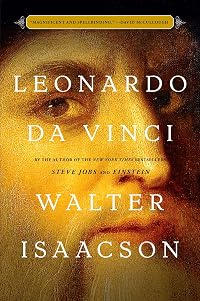
Leonardo da Vinci
by Walter Isaacson
On This Page
Description
The #1 New York Times bestseller from Walter Isaacson brings Leonardo da Vinci to life in this exciting new biography that is "a study in creativity: how to define it, how to achieve it...Most important, it is a powerful story of an exhilarating mind and life" (The New Yorker).Based on thousands of pages from Leonardo da Vinci's astonishing notebooks and new discoveries about his life and work, Walter Isaacson "deftly reveals an intimate Leonardo" (San Francisco Chronicle) in a narrative show more that connects his art to his science. He shows how Leonardo's genius was based on skills we can improve in ourselves, such as passionate curiosity, careful observation, and an imagination so playful that it flirted with fantasy.
He produced the two most famous paintings in history, The Last Supper and the Mona Lisa. With a passion that sometimes became obsessive, he pursued innovative studies of anatomy, fossils, birds, the heart, flying machines, botany, geology, and weaponry. He explored the math of optics, showed how light rays strike the cornea, and produced illusions of changing perspectives in The Last Supper. His ability to stand at the crossroads of the humanities and the sciences, made iconic by his drawing of Vitruvian Man, made him history's most creative genius.
In the "luminous" (Daily Beast) Leonardo da Vinci, Isaacson describes how Leonardo's delight at combining diverse passions remains the ultimate recipe for creativity. So, too, does his ease at being a bit of a misfit: illegitimate, gay, vegetarian, left-handed, easily distracted, and at times heretical. His life should remind us of the importance to be imaginative and, like talented rebels in any era, to think different. Here, da Vinci "comes to life in all his remarkable brilliance and oddity in Walter Isaacson's ambitious new biography...a vigorous, insightful portrait" (The Washington Post). show less
Tags
Recommendations








Member Reviews
People throw around the word genius a lot these days and you can become pretty jaded about it. That’s why reading about someone as staggeringly brilliant as Leonardo can be a bit exhausting. Not only is it the sheer number of things he pioneered or perfected, but the detail Isaacson goes into. That is the main reason it took me most of a year to finish this book. Another is that it is a bit repetitive in the sense that his paintings, studies, notebooks and life circumstances didn’t differ that much and all received the same breathless awe.
Not that he wasn’t deserving; he was. He more than many others. Here are a few things I learned and loved about Leonardo -
> He was gay and almost out...as out as you could be at this time
> He show more eschewed religion, but paid it lip service as the times and patrons dictated
> He had a fine sense of frivolity and whimsy
> He invented musical instruments, but didn’t play them
> He didn’t complete a lot of paintings and left very few completed ones behind considering how revered he is as a painter
> He is the first person to have understood and explained that arteriosclerosis is a function of time
> He discovered that the blood itself makes heart valves work
> He was often distracted and did not complete a lot of his work, or else bring it to its most logical conclusion
> He hardly published anything
> Some paintings are lost as are some notebooks, but surprisingly a lot survived
Early on we understand that while Leonardo was a book buyer and had an extensive library, he wasn’t formally educated and considered it a benefit. He was of the opinion that rote learning stifled true discovery and thinking. He preferred to experiment and not just take someone else’s conclusions as the truth. Admirable and the genesis of the modern scientific method. It is too bad that he didn’t publish his findings as they could have been beneficial decades and even centuries before someone else found the same thing and it became commonly accepted or the de facto best practice.
An amazing person and an interesting book, but one that tried my patience at times. show less
Not that he wasn’t deserving; he was. He more than many others. Here are a few things I learned and loved about Leonardo -
> He was gay and almost out...as out as you could be at this time
> He show more eschewed religion, but paid it lip service as the times and patrons dictated
> He had a fine sense of frivolity and whimsy
> He invented musical instruments, but didn’t play them
> He didn’t complete a lot of paintings and left very few completed ones behind considering how revered he is as a painter
> He is the first person to have understood and explained that arteriosclerosis is a function of time
> He discovered that the blood itself makes heart valves work
> He was often distracted and did not complete a lot of his work, or else bring it to its most logical conclusion
> He hardly published anything
> Some paintings are lost as are some notebooks, but surprisingly a lot survived
Early on we understand that while Leonardo was a book buyer and had an extensive library, he wasn’t formally educated and considered it a benefit. He was of the opinion that rote learning stifled true discovery and thinking. He preferred to experiment and not just take someone else’s conclusions as the truth. Admirable and the genesis of the modern scientific method. It is too bad that he didn’t publish his findings as they could have been beneficial decades and even centuries before someone else found the same thing and it became commonly accepted or the de facto best practice.
An amazing person and an interesting book, but one that tried my patience at times. show less
Leonardo da Vinci remains a household name, despite having lived more than half a millennium ago, due to the legacy of beauty, creativity and innovation he bequeathed to the world. Beyond his name, though, how much does the average person today really know about him? I myself could have ticked off perhaps 5-10 da Vinci facts prior to reading this biography, but I've now discovered there was much more to this genius.
With the benefit of a 21st-century lens, among the first observations I made based on the text is that he appears to have been experiencing some sort of lifelong attention deficit, flitting from project to project as the mood struck him, often abandoning works unfinished, to the dismay of his patrons/financiers. I loved the show more ephemera he fastidiously included in his myriad notebooks, from inventories of clothing and books he owned, a breakdown of his mother's funeral expenses, peculiar to-do lists, etc. Da Vinci was a man ahead of his time with respect to his discoveries in physics, anatomy, geology and engineering. In fact, a recurring theme throughout the book is the astounding number of innovations and breakthroughs across multiple disciplines that would be neither fully appreciated during his lifetime nor even replicated until hundreds of years after his death, which feels a little bit tragic. Also kind of heartbreaking are all of his grand hydraulic, military and architectural schemes which never came to fruition, though to be fair many were arguably unrealistic. I have just two minor complaints: First, the book is quite heavy due to the weight of the paper necessitated by the number of quality color photographs. It was not a cozy book to curl up with. Second, some portions of the narrative jump around due to the way the author has chosen to organize the topics, probably for dramatic effect. I would have appreciated a greater adherence to a more chronological timeline. That said, this book was a well-researched, educational and wow-inducing experience, and I would recommend it to anyone who shares da Vinci's intellectual curiosity. show less
With the benefit of a 21st-century lens, among the first observations I made based on the text is that he appears to have been experiencing some sort of lifelong attention deficit, flitting from project to project as the mood struck him, often abandoning works unfinished, to the dismay of his patrons/financiers. I loved the show more ephemera he fastidiously included in his myriad notebooks, from inventories of clothing and books he owned, a breakdown of his mother's funeral expenses, peculiar to-do lists, etc. Da Vinci was a man ahead of his time with respect to his discoveries in physics, anatomy, geology and engineering. In fact, a recurring theme throughout the book is the astounding number of innovations and breakthroughs across multiple disciplines that would be neither fully appreciated during his lifetime nor even replicated until hundreds of years after his death, which feels a little bit tragic. Also kind of heartbreaking are all of his grand hydraulic, military and architectural schemes which never came to fruition, though to be fair many were arguably unrealistic. I have just two minor complaints: First, the book is quite heavy due to the weight of the paper necessitated by the number of quality color photographs. It was not a cozy book to curl up with. Second, some portions of the narrative jump around due to the way the author has chosen to organize the topics, probably for dramatic effect. I would have appreciated a greater adherence to a more chronological timeline. That said, this book was a well-researched, educational and wow-inducing experience, and I would recommend it to anyone who shares da Vinci's intellectual curiosity. show less
Summary: A biography of da Vinci, from his illegitimate birth, his life long quest for patrons, his insatiable curiosity, his various artworks, and the notebooks, in which are revealed so much of the genius of da Vinci.
This is a magnificent biography in every way. Isaacson delves deeply into the life, the notebooks, the travels, and the works of art of da Vinci and renders an account of the peculiar, dazzling, and flawed genius of Leonardo. This is a book you need to read in print. It is a heavy book because it is printed on high quality paper with ample, full-color Figures rendering the notebooks and artworks of Leonardo. A full-color timeline at the front of the book highlights the works of Leonardo, and the key events of and during show more his life.
A theme that runs through this book is the insatiable and child-like curiosity of Leonardo, who wonders why the sky is blue (and arrived at a basically accurate explanation of this phenomenon) and wanted to describe the tongue of the woodpecker. He was fascinated with optics, from how the eye works to how light was refracted, and why distant objects appear different in color and distinctness from those closer up. He was an innovator in applying these insights in his use of perspective of his paintings. He did pioneering studies of human anatomy that, if published, would have advanced the understanding of anatomy a hundred years earlier. His fascination with hydraulics resulted in an accurate explanation of the closure of the heart's aortic valve. His notebooks contain speculations questioning a geocentric universe in advance of Copernicus.
Leonardo was an observer. He not only was curious about everything, but he closely studied the objects of his interest, whether it was the play of light on his subjects, the proportions of the human body, consummately illustrated in his Vitruvian Man, the movements of the wings of a dragonfly, the contractions of the leg muscles of a horse, or the way water flowed in a river. Isaacson notes: "Here's a test. All of us have looked at birds in flight, but have you ever stopped to look closely enough to see whether a bird moves its wing upward at the same speed as it flaps it down? Leonardo did...."
Leonardo had the ability to draw upon everything he knew with anything he did. This was one of the things that made him such a fascinating subject for Isaacson, who writes, "I embarked on this book because Leonardo da Vinci is the ultimate example of the main theme of my previous biographies: how the ability to make connections across disciplines-arts and sciences, humanities and technology-is a key to innovation, imagination, and genius." His study of light and optics shows up in his use of sfumato in painting, where objects are not defined by hard lines, but gradual shadings of tones into one another. He sees analogs between root and branch systems in plants and the human circulatory system. His anatomical studies culminate in the mysterious smile of Mona Lisa and his anatomical drawings are themselves works of art.
Isaacson also traces the peculiar genius of Leonardo, who conceives of giant cross bows, flying machines, and engineering projects, all of which are never executed. He was a path-breaking scientist who never published the results of his studies. Thankfully, even after 500 years, we still have 7200 pages of his notebooks. A number of his paintings were never "finished" and even Mona Lisa was still in his studio when he died. He abandoned commissions that he never finished. He experimented with techniques of mural painting that were spectacular failures and have challenged preservation efforts ever since.
Isaacson candidly discusses Leonardo's personal life without becoming lurid. He covers his illegitimacy, his ambivalent relationship with his father, and his homosexuality, including his relationship with his apprentice, Salai. He traces his lifelong quest for patrons, courting the various powerful families of Florence and Milan, and ending with King Francis I of France, who, legend has it, cradled the head of Leonardo in his death throes (a legend that has been questioned).
The author concludes with lessons from Leonardo's life, some that run through this review. Even if you don't buy this book, I would encourage you to peruse these. The front cover jacket copy refers to Leonardo as "history's most creative genius." Isaacson's biography makes that case, and does so with exquisite writing, typography and graphic design. This one's a keeper! show less
This is a magnificent biography in every way. Isaacson delves deeply into the life, the notebooks, the travels, and the works of art of da Vinci and renders an account of the peculiar, dazzling, and flawed genius of Leonardo. This is a book you need to read in print. It is a heavy book because it is printed on high quality paper with ample, full-color Figures rendering the notebooks and artworks of Leonardo. A full-color timeline at the front of the book highlights the works of Leonardo, and the key events of and during show more his life.
A theme that runs through this book is the insatiable and child-like curiosity of Leonardo, who wonders why the sky is blue (and arrived at a basically accurate explanation of this phenomenon) and wanted to describe the tongue of the woodpecker. He was fascinated with optics, from how the eye works to how light was refracted, and why distant objects appear different in color and distinctness from those closer up. He was an innovator in applying these insights in his use of perspective of his paintings. He did pioneering studies of human anatomy that, if published, would have advanced the understanding of anatomy a hundred years earlier. His fascination with hydraulics resulted in an accurate explanation of the closure of the heart's aortic valve. His notebooks contain speculations questioning a geocentric universe in advance of Copernicus.
Leonardo was an observer. He not only was curious about everything, but he closely studied the objects of his interest, whether it was the play of light on his subjects, the proportions of the human body, consummately illustrated in his Vitruvian Man, the movements of the wings of a dragonfly, the contractions of the leg muscles of a horse, or the way water flowed in a river. Isaacson notes: "Here's a test. All of us have looked at birds in flight, but have you ever stopped to look closely enough to see whether a bird moves its wing upward at the same speed as it flaps it down? Leonardo did...."
Leonardo had the ability to draw upon everything he knew with anything he did. This was one of the things that made him such a fascinating subject for Isaacson, who writes, "I embarked on this book because Leonardo da Vinci is the ultimate example of the main theme of my previous biographies: how the ability to make connections across disciplines-arts and sciences, humanities and technology-is a key to innovation, imagination, and genius." His study of light and optics shows up in his use of sfumato in painting, where objects are not defined by hard lines, but gradual shadings of tones into one another. He sees analogs between root and branch systems in plants and the human circulatory system. His anatomical studies culminate in the mysterious smile of Mona Lisa and his anatomical drawings are themselves works of art.
Isaacson also traces the peculiar genius of Leonardo, who conceives of giant cross bows, flying machines, and engineering projects, all of which are never executed. He was a path-breaking scientist who never published the results of his studies. Thankfully, even after 500 years, we still have 7200 pages of his notebooks. A number of his paintings were never "finished" and even Mona Lisa was still in his studio when he died. He abandoned commissions that he never finished. He experimented with techniques of mural painting that were spectacular failures and have challenged preservation efforts ever since.
Isaacson candidly discusses Leonardo's personal life without becoming lurid. He covers his illegitimacy, his ambivalent relationship with his father, and his homosexuality, including his relationship with his apprentice, Salai. He traces his lifelong quest for patrons, courting the various powerful families of Florence and Milan, and ending with King Francis I of France, who, legend has it, cradled the head of Leonardo in his death throes (a legend that has been questioned).
The author concludes with lessons from Leonardo's life, some that run through this review. Even if you don't buy this book, I would encourage you to peruse these. The front cover jacket copy refers to Leonardo as "history's most creative genius." Isaacson's biography makes that case, and does so with exquisite writing, typography and graphic design. This one's a keeper! show less
A 4-star audiobook or a 5-star? By the end, I decided on a 5-star. I loved listening to stories of his personal life, though some of his paintings were so thoroughly analyzed that I sometimes spaced out, especially since there were no pictures to examine. (The narrator kept referring to Figure XX in the PDF, which I did not have.)
By the end, I'd become more interested in his art and pulled up numerous paintings online to follow the narration. I especially liked Lady with an Ermine, Last Supper, and Mona Lisa, all the more because of the descriptions and analyses that covered details I'd never noticed. So my appreciation of art has been enriched.
As a civil engineer, I also liked his creative projects with city planning and waterworks, as show more well as his many mechanical engineering efforts, such as flying machines, etc.
For an excellent overview, see Xavier's review from November 22, 2019.
Highly recommended to anyone interested in this important historical giant.
P.S. Leonardo was an unapologetic gay man who challenged the church so his biographies will likely be removed from Florida schools. show less
By the end, I'd become more interested in his art and pulled up numerous paintings online to follow the narration. I especially liked Lady with an Ermine, Last Supper, and Mona Lisa, all the more because of the descriptions and analyses that covered details I'd never noticed. So my appreciation of art has been enriched.
As a civil engineer, I also liked his creative projects with city planning and waterworks, as show more well as his many mechanical engineering efforts, such as flying machines, etc.
For an excellent overview, see Xavier's review from November 22, 2019.
Highly recommended to anyone interested in this important historical giant.
P.S. Leonardo was an unapologetic gay man who challenged the church so his biographies will likely be removed from Florida schools. show less
This richly illustrated biography of Leonardo draws on his notebooks to give us a sense of the man and his career. Isaacson does well in analyzing a number of the master's most famous paintings. It was also interesting to see Leonardo's social context. Isaacson points out that his illegitimate birth was a challenge in some respects yet his father still played a major role in supporting his career by arranging commissions. For example, he had a retinue living and working with him for much of his career. Leonardo was no lone genius and Isaacson shows this well. The regular hunt for new patrons was striking.
At times, Leonardo's far ranging interests and sheer curiosity come at the expanse of productivity as we understand it today. Several show more aspects of Leonardo's insights regarding water and anatomy are particularly striking. It is sad to see that Leonardo never followed through to publish his insights so many of them had to be rediscovered later on. Perhaps Leonardo might have published more if he had found the right people to collaborate with?
The final chapters were some of my favorites. In France, Leonardo finds his ideal patron in Francis I - a patron with deep pockets, curiosity and few demands on output. Isaacson's summation of Leonardo's traits and what we can from him was also solid. Isaacson's comparisons between Leonardo and Steve Jobs (the subject of a previous Isaacson) were also intriguing.
On a personal note: I kept picturing Leonardo's character, played by John Rhys-Davies, from "Star Trek: Voyager" as I read the book. :-) show less
At times, Leonardo's far ranging interests and sheer curiosity come at the expanse of productivity as we understand it today. Several show more aspects of Leonardo's insights regarding water and anatomy are particularly striking. It is sad to see that Leonardo never followed through to publish his insights so many of them had to be rediscovered later on. Perhaps Leonardo might have published more if he had found the right people to collaborate with?
The final chapters were some of my favorites. In France, Leonardo finds his ideal patron in Francis I - a patron with deep pockets, curiosity and few demands on output. Isaacson's summation of Leonardo's traits and what we can from him was also solid. Isaacson's comparisons between Leonardo and Steve Jobs (the subject of a previous Isaacson) were also intriguing.
On a personal note: I kept picturing Leonardo's character, played by John Rhys-Davies, from "Star Trek: Voyager" as I read the book. :-) show less
Overall impression: It isn't magnificent, but it's solid and admirable enough. Lots of editorial slips. Also a fair amount of repetition. I wonder how much of the author's expertise is borrowed.
Beautiful printing job. Really nice paper, enough so that I couldn't bring myself to mark errors or make marginal comments. Coated stock favors fine color reproductions of works. I liked the detailed descriptive explanations of the paintings and drawings and the emphasis on placing them within their physical, historical, and biographical contexts. I also learned some things that I have since applied in the art classes I take, such as the reason for the use of sfumato techniques (blurring the edges of things), and in looking at the work of other show more artists, such as their treatment of perspective and their rendering of movement.
A few quotes I liked:
Paper turns out to be a superb information-storage technology, still readable after five hundred years, which our own tweets likely won't be. (page 4)
The glory of being an artist, [Leonardo] realized, was that reality should inform but not constrain. (page 47)
Any person who puts 'Describe the tongue of the woodpecker' on his to-do list is overendowed with the combination of curiosity and acuity. (page 178)
This is the heart of Leonardo's philosophy: the replication and relationships of the patterns of nature, from the cosmic to the human. (page 487)
On the other hand, in addition to numerous dubious word choices (fulsome, bevy, enormity), we have egregious sentences like this one, which mixes no fewer than six metaphors:
Leonardo's willingness to pursue whatever shiny subject caught his eye made his mind richer and filled with more connections. (page 363)
We also have, in the course of more than 600 pages, some pertinent things that are overexplained and some that are never explained at all. For instance, I had to go elsewhere and dig around on the internet to find out what he meant by "nutcracker man," a term he used over and over but never defined.
Random curious fact: The Mona Lisa's eyebrows may have been lost. They were described in detail by a contemporary. The painting was done in many layers, and they may have been taken off during a cleaning, an explanation that makes more sense than that Leonardo left them off or that the sitter didn't have any.
I liked Isaacson's biography of Steve Jobs a lot, and I grant that this one tackles a much more difficult and complex subject. Although it gets bonus points for ambition, I still have to take off for ways in which it falls short of the mark. As is so often true for me, I wonder why the obviously high budget didn't spare more for editorial support. show less
Beautiful printing job. Really nice paper, enough so that I couldn't bring myself to mark errors or make marginal comments. Coated stock favors fine color reproductions of works. I liked the detailed descriptive explanations of the paintings and drawings and the emphasis on placing them within their physical, historical, and biographical contexts. I also learned some things that I have since applied in the art classes I take, such as the reason for the use of sfumato techniques (blurring the edges of things), and in looking at the work of other show more artists, such as their treatment of perspective and their rendering of movement.
A few quotes I liked:
Paper turns out to be a superb information-storage technology, still readable after five hundred years, which our own tweets likely won't be. (page 4)
The glory of being an artist, [Leonardo] realized, was that reality should inform but not constrain. (page 47)
Any person who puts 'Describe the tongue of the woodpecker' on his to-do list is overendowed with the combination of curiosity and acuity. (page 178)
This is the heart of Leonardo's philosophy: the replication and relationships of the patterns of nature, from the cosmic to the human. (page 487)
On the other hand, in addition to numerous dubious word choices (fulsome, bevy, enormity), we have egregious sentences like this one, which mixes no fewer than six metaphors:
Leonardo's willingness to pursue whatever shiny subject caught his eye made his mind richer and filled with more connections. (page 363)
We also have, in the course of more than 600 pages, some pertinent things that are overexplained and some that are never explained at all. For instance, I had to go elsewhere and dig around on the internet to find out what he meant by "nutcracker man," a term he used over and over but never defined.
Random curious fact: The Mona Lisa's eyebrows may have been lost. They were described in detail by a contemporary. The painting was done in many layers, and they may have been taken off during a cleaning, an explanation that makes more sense than that Leonardo left them off or that the sitter didn't have any.
I liked Isaacson's biography of Steve Jobs a lot, and I grant that this one tackles a much more difficult and complex subject. Although it gets bonus points for ambition, I still have to take off for ways in which it falls short of the mark. As is so often true for me, I wonder why the obviously high budget didn't spare more for editorial support. show less
I listened to this on audio which might seem strange for a book where the illustrations matter but it actually works well. I don't know that I would have gotten through the detail when reading it but on audio it didn't matter so much. I did slightly speed up the narration as I found it a bit slow.
Like most people I know a little bit about Leonardo and I have seen some of the notebooks in the British Library but a little was all it was.
I now know a lot more and very interesting it was too. For a man who rarely completed anything he's pretty famous!!! Gives hope to all us procrastinators ;) Recommended read.
Like most people I know a little bit about Leonardo and I have seen some of the notebooks in the British Library but a little was all it was.
I now know a lot more and very interesting it was too. For a man who rarely completed anything he's pretty famous!!! Gives hope to all us procrastinators ;) Recommended read.
Members
- Recently Added By
Lists

Best Biographies, Autobiographies and Memoirs
465 works; 160 members

Top Five Books of 2017
757 works; 230 members

Non-Fiction Worth Reading
1,015 works; 255 members

Books Read in 2018
4,360 works; 110 members

Books Read in 2021
5,361 works; 114 members

Art History and Appreciation
36 works; 1 member

Library Non-Fiction
157 works; 1 member
Author Information

39+ Works 35,734 Members
Walter Isaacson was born on May 20, 1952 in New Orleans, Louisiana. He received a B. A. in history and literature from Harvard College. He then attended the University of Oxford, where he was a Rhodes Scholar at Pembroke College and read philosophy, politics, and economics. He began his career in journalism at The Sunday Times of London and then show more the New Orleans Times-Picayune/States-Item. He joined TIME in 1978 and served as a political correspondent, national editor and editor of new media before becoming the magazine's editor in 1996. He became Chairman and CEO of CNN in 2001, and then president and CEO of the Aspen Institute in 2003. He has written numerous books including American Sketches, Einstein: His Life and Universe, Benjamin Franklin: An American Life, Kissinger: A Biography, Steve Jobs, and The Innovators: How a Group of Hackers, Geniuses, and Geeks Created the Digital Revolution. He is the co-author, with Evan Thomas, of The Wise Men: Six Friends and the World They Made. (Bowker Author Biography) show less
All Editions
Some Editions
Awards and Honors
Awards
Distinctions
Work Relationships
Is contained in
Has as a reference guide/companion
Common Knowledge
- Canonical title
- Leonardo da Vinci
- Original title
- Leonardo da Vinci
- Original publication date
- 2017
- People/Characters
- Leonardo da Vinci; Michelangelo Buonarroti
- Important places
- Florence, Tuscany, Italy; Tuscany, Italy; Italy
- Important events
- Italian Renaissance; Renaissance; 15th century
- First words
- (Introduction) Around the time that he reached the unnerving milestone of turning thirty, Leonardo da Vinca wrote a letter to the ruler of Milan listing the reasons he should be given a job.
Leonardo da Vinci had the good luck to be born out of wedlock. - Last words
- (Click to show. Warning: May contain spoilers.)Be open to mystery. Not everything needs sharp lines.
(Click to show. Warning: May contain spoilers.)(Coda) Just out of curiosity. Pure curiosity. - Blurbers
- McCullough, David
- Original language
- English US
Classifications
Statistics
- Members
- 4,104
- Popularity
- 3,753
- Reviews
- 85
- Rating
- (4.16)
- Languages
- 17 — Czech, Danish, Dutch, English, Estonian, Finnish, French, German, Hungarian, Italian, Polish, Portuguese, Russian, Spanish, Swedish, Turkish, Chinese, traditional
- Media
- Paper, Audiobook, Ebook
- ISBNs
- 68
- ASINs
- 15