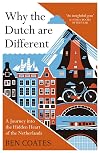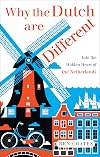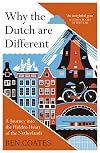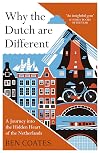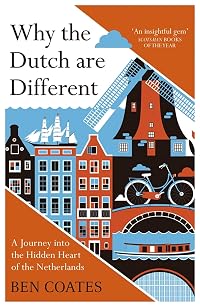
Why the Dutch Are Different: A Journey into the Hidden Heart of the Netherlands
by Ben Coates
On This Page
Description
Stranded at Schiphol airport, Ben Coates called up a friendly Dutch girl he'd met some months earlier. He stayed for dinner. Actually, he stayed for good. In the first book to consider the hidden heart and history of the Netherlands from a modern perspective, the author explores the length and breadth of his adopted homeland and discovers why one of the world's smallest countries is also so significant and so fascinating. Ben Coates investigates what makes the Dutch the Dutch, why the show more Netherlands is much more than Holland, and why the color orange is so important. Along the way he reveals why they are the world's tallest people and have the best carnival outside Brazil. He learns why Amsterdam's brothels are going out of business, who really killed Anne Frank, and how the Dutch manage to be richer than almost everyone else despite working far less. He also discovers a country which is changing fast, with the Dutch now questioning many of the liberal policies which made their nation famous. A personal portrait of a fascinating people, a sideways history, and an entertaining travelogue, Why the Dutch are Different is the story of an Englishman who went Dutch. And loved it. show lessTags
Recommendations










Member Reviews
When my best friend of almost 30 (gasp!) years and I were at university, she met a Dutchman who was spending a year studying abroad. In the way of such things, she married him and moved to the Netherlands. It took me about 5 years to get over that curiously American reluctance to travel overseas (so decadent!) to see her (time warp: that first non-stop round-trip ticket on KLM was $250), but once I did I was hooked and she was stuck with my not-infrequent visits until my move to Australia, where the sheer number of hours involved put a damper on my spontaneous visits.
Maybe because it was my first European destination, but I love the Netherlands best and Amsterdam is my favorite city in all the world. I'm forever quizzing my poor BF and show more her husband about all things Dutch ("what's the word for this? How do you say that again?) and I constantly gush about most of it: the architecture, the bike lane system, the flowers!!! So when MT saw this at the bookshop, it was a no-brainer. If you asked him, he'd probably say it was the easiest present decision for me he's ever had to make.
I devoured it and moderately tortured both him and my BF by quoting and exclaiming over particularly fascinating facts (people used to use windmills to send messages! NL actually invaded England in 1688/89!). At 297 pages the book is densely packed with information yet very readable. Coates uses Dutch history - both the good and the bad - to create a context for the liberal and tolerant culture they have today and muses over how and why that liberalism and tolerance is being tested.
Coates has done his research and includes a selected bibliography at the back with further reading and sources. He covers the gamut of what makes NL different, including the most sensitive topics and he makes frequent mention of how verboten some topics were with the normally open Dutch, making it awkward at best to objectively discuss these issues. While it was obvious to me that he tried to represent the largest cross-section of Dutch society he could and strived for objectivity, this remains a cross-section. I'm sure my BF's husband would find a few things he'd disagree with, but largely, I thought it just perfect: well-written, well-edited* and relatively objective; if you find Dutch culture interesting, this would be an excellent overview.
*The only editing errors I ever ran into was a handful of missing words. Oddly enough, it was actually the same word "to" every time. show less
Maybe because it was my first European destination, but I love the Netherlands best and Amsterdam is my favorite city in all the world. I'm forever quizzing my poor BF and show more her husband about all things Dutch ("what's the word for this? How do you say that again?) and I constantly gush about most of it: the architecture, the bike lane system, the flowers!!! So when MT saw this at the bookshop, it was a no-brainer. If you asked him, he'd probably say it was the easiest present decision for me he's ever had to make.
I devoured it and moderately tortured both him and my BF by quoting and exclaiming over particularly fascinating facts (people used to use windmills to send messages! NL actually invaded England in 1688/89!). At 297 pages the book is densely packed with information yet very readable. Coates uses Dutch history - both the good and the bad - to create a context for the liberal and tolerant culture they have today and muses over how and why that liberalism and tolerance is being tested.
Coates has done his research and includes a selected bibliography at the back with further reading and sources. He covers the gamut of what makes NL different, including the most sensitive topics and he makes frequent mention of how verboten some topics were with the normally open Dutch, making it awkward at best to objectively discuss these issues. While it was obvious to me that he tried to represent the largest cross-section of Dutch society he could and strived for objectivity, this remains a cross-section. I'm sure my BF's husband would find a few things he'd disagree with, but largely, I thought it just perfect: well-written, well-edited* and relatively objective; if you find Dutch culture interesting, this would be an excellent overview.
*The only editing errors I ever ran into was a handful of missing words. Oddly enough, it was actually the same word "to" every time. show less
There are interesting parts, and some of the history is reasonably presented, but Coates insists on inserting inane observations of his own. He prides himself on his integration (Look! I bought a bicycle!), but unfortunately, after having lived in the country for nearly five years, he still lacks a basic understanding of many aspects of life. Worse, he ridicules some things he doesn't understand. And worst of all, he cites numbers and statistics without sources.
And this is where the book really falls flat. There are too many inaccuracies and flat-out wrong statements to take it seriously. Many of the statistics quoted are right-wing nutcase scare stories. Given Coates's history as a hack writer for conservative British politicians, show more perhaps one ought to forgive his unfamiliarity with objective truth.
Just one example, from page 266: no, Ben, Amsterdam was not the fourth "most murderous" metropolis in Europe in 2012, as fifteen seconds on Google would have told you.
I started reading this with interest and sympathy, but ended doing so in annoyance and anger. Shame. show less
And this is where the book really falls flat. There are too many inaccuracies and flat-out wrong statements to take it seriously. Many of the statistics quoted are right-wing nutcase scare stories. Given Coates's history as a hack writer for conservative British politicians, show more perhaps one ought to forgive his unfamiliarity with objective truth.
Just one example, from page 266: no, Ben, Amsterdam was not the fourth "most murderous" metropolis in Europe in 2012, as fifteen seconds on Google would have told you.
I started reading this with interest and sympathy, but ended doing so in annoyance and anger. Shame. show less
A quick overview of the most distinctive features of modern Dutch society, as seen by a young British professional who settled here a few years ago. Despite the "hidden heart" bit in the subtitle, it doesn't go beyond the obvious things — the Golden Age and colonialism; World War II; football; bicycles; the Zwarte Piet crisis; Pim Fortuyn, Theo Van Gogh, Ayaan Hirsi Ali and Geert Wilders; euthanasia, soft-drugs and prostitution; carnival; etc. — but what it says about them seems to be sensible and well-researched.
Nothing much about the arts, except Rembrandt and Vermeer, and not much about places other than Rotterdam (where Coates lives) and Amsterdam (where he works). Maastricht, Eindhoven and Breda appear in the Carnival chapter, show more and there's a trip to Westerbork in the WWII section, but that's about it for geography.
Coates isn't the most exciting writer: he has learnt one trick, building chapters by breaking up passages of objective background material with short passages of mildly funny subjective experience, and he applies that scheme doggedly throughout the book. But he is clearly good at condensing an argument to the essentials, and doesn't take up more of the reader's time than he needs to.
Obviously I'm not the target audience for this book: I've been living in the Netherlands a lot longer than Coates, and there is little in what he says that was in any way new to me (except the stuff about football, which is something I have even less interest in than he claims to...). But it all seems to be reasonably fair.
One minor caveat I had was that the external baseline Coates typically compares the Netherlands to is his experience of a few years in a very high-pressure job in London, which is scarcely "normal" by anyone else's standards. Perhaps because of that he sometimes picks out characteristics as "typically Dutch" when they could equally well be called "typically German" or "typically Swedish", for example. But I still think this would be a valuable starting point for someone visiting the Netherlands or considering coming to work here. show less
Nothing much about the arts, except Rembrandt and Vermeer, and not much about places other than Rotterdam (where Coates lives) and Amsterdam (where he works). Maastricht, Eindhoven and Breda appear in the Carnival chapter, show more and there's a trip to Westerbork in the WWII section, but that's about it for geography.
Coates isn't the most exciting writer: he has learnt one trick, building chapters by breaking up passages of objective background material with short passages of mildly funny subjective experience, and he applies that scheme doggedly throughout the book. But he is clearly good at condensing an argument to the essentials, and doesn't take up more of the reader's time than he needs to.
Obviously I'm not the target audience for this book: I've been living in the Netherlands a lot longer than Coates, and there is little in what he says that was in any way new to me (except the stuff about football, which is something I have even less interest in than he claims to...). But it all seems to be reasonably fair.
One minor caveat I had was that the external baseline Coates typically compares the Netherlands to is his experience of a few years in a very high-pressure job in London, which is scarcely "normal" by anyone else's standards. Perhaps because of that he sometimes picks out characteristics as "typically Dutch" when they could equally well be called "typically German" or "typically Swedish", for example. But I still think this would be a valuable starting point for someone visiting the Netherlands or considering coming to work here. show less
Witty and fairly informative, although the author's past as a sort of spin doctor sometimes makes him talk nonsense for the sake of sounding witty. Like when he claims that the Dutch are as serious about WWII as the British are about WWI, and would never make a WWII comedy like Dad's Army ... or Blackadder. Or when he admires the high numbers of Dutch football associations, their members and games played "in a country half the size of Scotland", happily ignoring the fact that the Netherlands has more than three times as many inhabitants, which is far more relevant. One wonders how much blarney one's presented without knowing it.
Ben Coates hadn’t meant to go to the Netherlands, a flight was diverted and he ended up in Schiphol Airport with no hope of a flight out for a few days. Somewhere at the back of his mind he recalled having a contact in the country, so he gave her a ring to see if she could put him up for a couple of nights.
He’s never left.
When people think of the Netherlands, several national stereotypes would spring to mind; windmills, bicycles, tulips and Edam and that it was called Holland. These quintessential Dutch icons are all still there, but Holland is a district of the Netherlands. This small country is only twice the area of Wales (the default geographical unit of country size), but in all manner of ways its influence and success has show more always had a larger global presence than belies its size. One of the lowest nations on the planet has somehow managed to produce the tallest people, they are liberally minded and gregarious, up for parties and having a lot of fun whilst on the flip side taking a stern view on minor transgressions such as putting your bin out on the wrong day.
In this fascinating book about a fellow European country, Coates sets aside his English reserve and takes us beyond the classic tourist routes to see the other side to his adopted country. He is prepared to celebrate and share with us, the reader, what makes this a great country to live in, whilst also not being afraid to examine the darker sides of the Dutch history. We learn about the way that the Jewish population suffered greatly during the Second World War, with vast numbers of them sent to the camps in central Europe, why they seem to have a desire to eradicate the natural world, how they became so good at land reclamation, why they are so passionate about their football team and why they are so obsessed with the colour orange. Just how much Coates has gone native is evident when he returns to the UK to collect a new passport where he considers the common ground and the stark differences between the two countries. I have been to the Netherlands twice once to Delft and a second time to Amstelveen way back in the 1980’s, and I remember it being a special country, reading this book though makes me want to re-visit it again. show less
He’s never left.
When people think of the Netherlands, several national stereotypes would spring to mind; windmills, bicycles, tulips and Edam and that it was called Holland. These quintessential Dutch icons are all still there, but Holland is a district of the Netherlands. This small country is only twice the area of Wales (the default geographical unit of country size), but in all manner of ways its influence and success has show more always had a larger global presence than belies its size. One of the lowest nations on the planet has somehow managed to produce the tallest people, they are liberally minded and gregarious, up for parties and having a lot of fun whilst on the flip side taking a stern view on minor transgressions such as putting your bin out on the wrong day.
In this fascinating book about a fellow European country, Coates sets aside his English reserve and takes us beyond the classic tourist routes to see the other side to his adopted country. He is prepared to celebrate and share with us, the reader, what makes this a great country to live in, whilst also not being afraid to examine the darker sides of the Dutch history. We learn about the way that the Jewish population suffered greatly during the Second World War, with vast numbers of them sent to the camps in central Europe, why they seem to have a desire to eradicate the natural world, how they became so good at land reclamation, why they are so passionate about their football team and why they are so obsessed with the colour orange. Just how much Coates has gone native is evident when he returns to the UK to collect a new passport where he considers the common ground and the stark differences between the two countries. I have been to the Netherlands twice once to Delft and a second time to Amstelveen way back in the 1980’s, and I remember it being a special country, reading this book though makes me want to re-visit it again. show less
As we're shortly due to depart on holiday to the Netherlands, I was interested in learning more about real Dutch society beyond the tourist images of windmills and coffee shops. Part travelogue, part history lesson, part social commentary, this book succeeds and at the same time fails a little in all three areas.
The author - Ben Coates - is a English writer who, at the time of writing, had been living in the Netherlands for five years with his new Dutch wife. Whilst overall I found the book an informative insight into the Netherlands and Dutch people, it was noticeably based on Coates' own views garnered over a short period of time, hence I viewed it as a social opinion rather than complete abject fact.
Rarely do I consider the age of an show more author when I'm reading a book, but in this book I couldn't help but notice a liberal peppering of laddish immaturity (there were several references to "leggy blondes" which seemed ill-placed in the book). The path of his research was also glaringly obvious - clearly he had written himself a short list of key events and sights to attend within a smallish radius of the Netherlands from a centre pint of Rotterdam and built an entire book around that. Somehow it felt like a lazy journalistic approach to a book about the Dutch as a whole. He also made numerous comparisons with Britain, which felt unnecessary for a book about the Dutch. If I was a non-British person reading this book, these references would no doubt feel completely out of context to the subject.
Having said that, the book was certainly interesting - despite expecting more of a social rather than a historical commentary, I enjoyed the sections on the Netherlands' Golden Age and religious conflicts. A section on the Rijkmuseum encouraged me to dust off a previously unread book languishing on my bookshelf, and I enjoyed looking at the works of art in that book in tandem with Coates' references to the more famous and popular works. A large chapter on the ongoing challenges with keeping water at bay across the land was informative, and a brief look at the Dutch suffering during WWII was very interesting.
Perhaps of most interest were the social commentary chapters. Coates spends some time looking at the ingrained Dutch culture of tolerance and the challenges that rising Islamic fundamentalism and intolerance has placed on that. Similarly, prior tolerance on drug use and legalised prostitution seems now to be forcing a liberal nation to examine whether this tolerant utopia of sorts actually works in practice, and if Coates stats on policies to clamp down on some of this are to be believed, the answer seems to be that it doesn't.
Coates has a few personal comments on the Dutch as a whole, which seem to be summarised as incredibly social, happy and enjoying a better work/life balance than much of the rest of the developed world, but with much more relaxed attitudes to social manners such as talking when eating, shouting across people on public transport and generally not recognising 'personal space' as a concept. I recognise this as one person's sweeping opinion (and will no doubt make my own sweeping generalisations in due course!).
3.5 stars - an interesting read which has certainly made me more informed at a basic level about the Netherlands, but it smacked too much of personal opinions and large swathes of information lifted from other sources. show less
The author - Ben Coates - is a English writer who, at the time of writing, had been living in the Netherlands for five years with his new Dutch wife. Whilst overall I found the book an informative insight into the Netherlands and Dutch people, it was noticeably based on Coates' own views garnered over a short period of time, hence I viewed it as a social opinion rather than complete abject fact.
Rarely do I consider the age of an show more author when I'm reading a book, but in this book I couldn't help but notice a liberal peppering of laddish immaturity (there were several references to "leggy blondes" which seemed ill-placed in the book). The path of his research was also glaringly obvious - clearly he had written himself a short list of key events and sights to attend within a smallish radius of the Netherlands from a centre pint of Rotterdam and built an entire book around that. Somehow it felt like a lazy journalistic approach to a book about the Dutch as a whole. He also made numerous comparisons with Britain, which felt unnecessary for a book about the Dutch. If I was a non-British person reading this book, these references would no doubt feel completely out of context to the subject.
Having said that, the book was certainly interesting - despite expecting more of a social rather than a historical commentary, I enjoyed the sections on the Netherlands' Golden Age and religious conflicts. A section on the Rijkmuseum encouraged me to dust off a previously unread book languishing on my bookshelf, and I enjoyed looking at the works of art in that book in tandem with Coates' references to the more famous and popular works. A large chapter on the ongoing challenges with keeping water at bay across the land was informative, and a brief look at the Dutch suffering during WWII was very interesting.
Perhaps of most interest were the social commentary chapters. Coates spends some time looking at the ingrained Dutch culture of tolerance and the challenges that rising Islamic fundamentalism and intolerance has placed on that. Similarly, prior tolerance on drug use and legalised prostitution seems now to be forcing a liberal nation to examine whether this tolerant utopia of sorts actually works in practice, and if Coates stats on policies to clamp down on some of this are to be believed, the answer seems to be that it doesn't.
Coates has a few personal comments on the Dutch as a whole, which seem to be summarised as incredibly social, happy and enjoying a better work/life balance than much of the rest of the developed world, but with much more relaxed attitudes to social manners such as talking when eating, shouting across people on public transport and generally not recognising 'personal space' as a concept. I recognise this as one person's sweeping opinion (and will no doubt make my own sweeping generalisations in due course!).
3.5 stars - an interesting read which has certainly made me more informed at a basic level about the Netherlands, but it smacked too much of personal opinions and large swathes of information lifted from other sources. show less
I enjoyed this look into life in Holland from an outsiders point of view. Ben Coates gives the history of Holland in a language I can understand although I will not remember names or dates. Learned a lot about the early history of the country, of the land mass itself and the water hazards !! Good insight into why Dutch people are the way they arelike how friendly to strangers, all come to family birthday parties as they love family get togethers, and how the love of the color orange came about.
Because I come from a Dutch background, I found this very interesting, not just a book full of flattery but true to life as it is in the Netherlands.
Because I come from a Dutch background, I found this very interesting, not just a book full of flattery but true to life as it is in the Netherlands.
Members
- Recently Added By
Author Information
3 Works 422 Members
Ben Coates was born in Britain in 1982, lives in Rotterdam with his Dutch wife, and now works for an international charity. During his career he has been a political advisor, corporate speechwriter, lobbyist and aid worker. He has written articles for numerous publications including the Guardian, Financial Times and Huffington Post. Ben-coates.com
Common Knowledge
- Canonical title
- Why the Dutch Are Different: A Journey into the Hidden Heart of the Netherlands
- Alternate titles
- Why the Dutch Are Different: Into the Hidden Heart of the Netherlands
- Original publication date
- 2015
- People/Characters
- Johan Cruijff; Pim Fortuyn; Theo van Gogh; Ayaan Hirsi Ali; Geert Wilders; Louis van Gaal
- Important places
- The Netherlands; Rotterdam, South Holland, Netherlands
- Dedication
- For Kim, of course
- First words
- Rotterdam is not a beautiful city. [Introduction]
One night, Johan dreamed it was going to rain. [Chapter 1]
The Queen had resigned, and it was the new King's first day at work. [Preface] - Quotations
- The Netherlands, for all its faults, was happier than Britain, more efficient than France, more tolerant than America, more worldly than Norway, more modern than Belgium and more fun than Germany.
- Last words
- (Click to show. Warning: May contain spoilers.)It was getting late, and I wanted to go home. [Epilogue]
(Click to show. Warning: May contain spoilers.)The Dutch, A’s always, we’re determined to keep having a good time. [Chapter 7] - Original language
- English
Classifications
- Genres
- Travel, Nonfiction, General Nonfiction, Biography & Memoir
- DDC/MDS
- 949.2 — History & geography History of Europe Greece, Albania, Yugoslavia, Serbia, Romania, Bulgaria Netherlands
- LCC
- DJ71 .C63 — History of Europe, Asia, Africa and Oceania Netherlands (Holland) History of Netherlands (Holland) Antiquities. Social life and customs. Ethnography
- BISAC
Statistics
- Members
- 312
- Popularity
- 102,446
- Reviews
- 10
- Rating
- (3.51)
- Languages
- English
- Media
- Paper, Audiobook, Ebook
- ISBNs
- 7
- ASINs
- 3