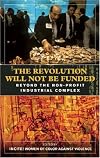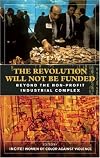
The Revolution Will Not Be Funded: Beyond the Non-Profit Industrial Complex
by Incite! Women of Color Against Violence
On This Page
Description
A trillion-dollar industry, the US non-profit sector is one of the world's largest economies. From art museums and university hospitals to think tanks and church charities, over 1.5 million organizations of staggering diversity share the tax-exempt 501(c)(3) designation, if little else. Many social justice organizations have joined this world, often blunting political goals to satisfy government and foundation mandates. But even as funding shrinks, many activists often find it difficult to show more imagine movement-building outside the non-profit model. The Revolution Will Not Be Funded gathers essays by radical activists, educators, and non-profit staff from around the globe who critically rethink the long-term consequences of what they call the "non-profit industrial complex." Drawing on their own experiences, the contributors track the history of non-profits and provide strategies to transform and work outside them. Urgent and visionary, The Revolution Will Not Be Funded presents a biting critique of the quietly devastating role the non-profit industrial complex plays in managing dissent.Contributors. Christine E. Ahn, Robert L. Allen, Alisa Bierria, Nicole Burrowes, Communities Against Rape and Abuse (CARA), William Cordery, Morgan Cousins, Ruth Wilson Gilmore, Stephanie Guilloud, Adjoa Florência Jones de Almeida, Tiffany Lethabo King, Paul Kivel, Soniya Munshi, Ewuare Osayande, Amara H. Pérez, Project South: Institute for the Elimination of Poverty and Genocide, Dylan Rodríguez, Paula X. Rojas, Ana Clarissa Rojas Durazo, Sisters in Action for Power, Andrea Smith, Eric Tang, Madonna Thunder Hawk, Ije Ude, Craig Willse show lessTags
Recommendations








































Member Reviews
This was genuinely a phenomenal book and made me reconsider so much of what I thought I knew about nonprofits and organizing. I became interested in this book because I took a class on Fundraising in Nonprofits last quarter and became increasing distressed about the amount of groveling we were being taught to do in order to secure mediocre fundraising to help people in need. Reading this sort of confirmed what I was already thinking, but expanded it so much more than I had conceived of. Anyone who wants to work in the nonprofit sector should definitely read this.
Although it does get a little repetitive at times, because this is a series of essays, they really drive home the point of how the state has been able to co-opt organizing power show more by making organization into nonprofit, and therefore turning that energy and time that could be used towards making systemic change to getting funding to pay employees (they use examples from the 60s and 70s when most organizing was volunteer-based). It also means that nonprofits are focusing on social services, when they should be focusing on social change.
There was a lot of critique on foundations, saying that "valuable time is spent securing cozy relationships with major donors instead of organizing to dismantle the very systems of oppression that allow this owning class to accumulate unearned wealth," where major donors are both foundations and individuals donating large amounts of money.
I also liked the final section where they talked about revolutionary movements in Latin America and how almost none of them are through nonprofits, if they work with nonprofits it is to help the movement along, nonprofits are specifically NOT the movement. A quote I liked from that section was "revolution is about the process of making power and creating autonomous communities that divest from the state."
At the risk of leaving an insanely long review, I'll leave you with this question from the preface, "Do you think the system is really going to fund you to dismantle it?" show less
Although it does get a little repetitive at times, because this is a series of essays, they really drive home the point of how the state has been able to co-opt organizing power show more by making organization into nonprofit, and therefore turning that energy and time that could be used towards making systemic change to getting funding to pay employees (they use examples from the 60s and 70s when most organizing was volunteer-based). It also means that nonprofits are focusing on social services, when they should be focusing on social change.
There was a lot of critique on foundations, saying that "valuable time is spent securing cozy relationships with major donors instead of organizing to dismantle the very systems of oppression that allow this owning class to accumulate unearned wealth," where major donors are both foundations and individuals donating large amounts of money.
I also liked the final section where they talked about revolutionary movements in Latin America and how almost none of them are through nonprofits, if they work with nonprofits it is to help the movement along, nonprofits are specifically NOT the movement. A quote I liked from that section was "revolution is about the process of making power and creating autonomous communities that divest from the state."
At the risk of leaving an insanely long review, I'll leave you with this question from the preface, "Do you think the system is really going to fund you to dismantle it?" show less
This isn't a hard book to get through from a vocabulary stand point, but the theories are far more radical than I can identify with - thus it took more than a week to get through the first essay. It does raise some awesome ideas to ponder. But I guess since I am a professional feminist, I've already sold out to the man.
A must-read for a generation of young people going into or considering nonprofit work. This is a great compilation of essays defining and exploring how nonprofits and foundations co-opt and dominate struggles and make them complicit with capitalism and the state. As disenchanted as I already was with nonprofits, I could take a lot from this book.
A great look at how nonprofit organizations undermine radical community change and grassroots organizing by working within the US capitalist model. However, I found some of the essays to be rather repetitive, so I skimmed/skipped the last two. I found the essay on organizing for Palestine liberation to be the best one in the book.
Ratings
Members
- Recently Added By
Lists

South End Press
35 works; 1 member
Author Information

5 Works 891 Members
Awards and Honors
Classifications
- Genres
- Nonfiction, General Nonfiction, Economics, Sexuality and Gender Studies
- DDC/MDS
- 303.484 — Society, government, & culture Social sciences, sociology & anthropology Social processes Social change Causes of change Purposefully induced change
- LCC
- HM671 .R48 — Social sciences Sociology (General) Sociology Social control
- BISAC
Statistics
- Members
- 580
- Popularity
- 50,785
- Reviews
- 4
- Rating
- (4.15)
- Languages
- English
- Media
- Paper, Ebook
- ISBNs
- 5
- ASINs
- 4