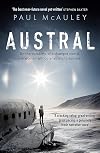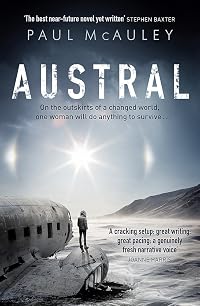
Austral
by Paul McAuley
On This Page
Description
The great geoengineering projects have failed. The world is still warming, sea levels are still rising, and the Antarctic Peninsula is home to Earth's newest nation, with life quickened by ecopoets spreading across valleys and fjords exposed by the retreat of the ice. Austral Morales Ferrado, a child of the last generation of ecopoets, is a husky: an edited person adapted to the unforgiving climate of the far south, feared and despised by most of its population. She's been a convict, a show more corrections officer in a labour camp, and consort to a criminal, and now, out of desperation, she has committed the kidnapping of the century. But before she can collect the ransom and make a new life elsewhere, she must find a place of safety amongst the peninsula's forests and icy plateaus, and evade a criminal gang that has its own plans for the teenage girl she's taken hostage. show lessTags
Recommendations

















Member Reviews
In his Quiet War sequence, Paul McAuley built a convincing post-human future across the Solar System and beyond, based on a future Earth where global political power had shifted to the south as a consequence of environmental collapse. In this novel, he returns to that idea, with a setting in the Global South as a backdrop to a crime thriller that takes us to a different place.
We are in a late 21st/early 22nd century Antarctic peninsula, settled for a good seventy years or so by ecologists and their genetically-modified offspring who have been adapted in the womb to cope with a sub-Arctic climate. Global warming has raised sea levels; the Antarctic peninsula has declared independence and has a flourishing economy based on natural but show more bioengineered resources. The land supports settlements, but in its past bioengineers - 'ecopoets' - have started rewilding and released bioengineered organisms. The environment is roughly what we see today in sub-Arctic Norway; harsh but livable (with care).
The plot concerns Austral, a bioengineered 'husky', adapted to survive in this environment. She becomes embroiled in the plots of a local crime boss; in the course of this, she kidnaps, almost by accident, the daughter of a politician and goes on the run. This is the opportunity for a close look at the new environment of the peninsula. Along the way, we get an impression of the wider world, one where the nations of the southern hemisphere are pre-eminent and the Global North hardly merits a mention.
McAuley builds an exciting chase story whilst deftly showing us a different world adapting to climate change. We see Austral's story in flashback; the narrative takes the form of a history related to her unborn child. There is a twist in the story which brought me up short, because of my own personal history.
I started out with uncertainty, not fully expecting to engage with the characters; but Austral, and the girl she kidnaps are well-drawn and neither slip into stereotype. I think this is probably the best thing McAuley has written; in showing us a plausible future impacted by climate change, he has probably transcended the boundaries of science fiction. The shame is that because of that label, this book's audience is likely to be restricted to those who already seek out this sort of thing. It deserves a wider readership. show less
We are in a late 21st/early 22nd century Antarctic peninsula, settled for a good seventy years or so by ecologists and their genetically-modified offspring who have been adapted in the womb to cope with a sub-Arctic climate. Global warming has raised sea levels; the Antarctic peninsula has declared independence and has a flourishing economy based on natural but show more bioengineered resources. The land supports settlements, but in its past bioengineers - 'ecopoets' - have started rewilding and released bioengineered organisms. The environment is roughly what we see today in sub-Arctic Norway; harsh but livable (with care).
The plot concerns Austral, a bioengineered 'husky', adapted to survive in this environment. She becomes embroiled in the plots of a local crime boss; in the course of this, she kidnaps, almost by accident, the daughter of a politician and goes on the run. This is the opportunity for a close look at the new environment of the peninsula. Along the way, we get an impression of the wider world, one where the nations of the southern hemisphere are pre-eminent and the Global North hardly merits a mention.
McAuley builds an exciting chase story whilst deftly showing us a different world adapting to climate change. We see Austral's story in flashback; the narrative takes the form of a history related to her unborn child. There is a twist in the story which brought me up short, because of my own personal history.
I started out with uncertainty, not fully expecting to engage with the characters; but Austral, and the girl she kidnaps are well-drawn and neither slip into stereotype. I think this is probably the best thing McAuley has written; in showing us a plausible future impacted by climate change, he has probably transcended the boundaries of science fiction. The shame is that because of that label, this book's audience is likely to be restricted to those who already seek out this sort of thing. It deserves a wider readership. show less
After enjoying a non-fiction book about rewilding recently ([b:Wilding|38891828|Wilding|Isabella Tree|https://images.gr-assets.com/books/1521964296s/38891828.jpg|60437379]), I was delighted to realise that this is essentially a sci-fi novel on the same topic. While the central plot is is a snowy chase similar to [b:The Left Hand of Darkness|18423|The Left Hand of Darkness (Hainish Cycle #6)|Ursula K. Le Guin|https://images.gr-assets.com/books/1488213612s/18423.jpg|817527], it is as far from being a straightforward thriller as Le Guin’s novel. The story is being recounted by the protagonist Austral, who is both contemplating her past and justifying her choices. Her family were ecopoets, a group that sought to introduce dynamic show more biodiverse ecosystems to Antarctica as climate changed melted the ice. The political economy of the future world is delineated with remarkable clarity within a first person chase narrative. There is a depressingly convincing progression of events: attempts to create new ecosystems and ways of living in Antarctica are eventually controlled and exploited by capitalism; grand geoengineering projects are doomed to fail thanks to short-termism.
Austral the protagonist ends up trapped in poverty and crime after her mother dies and she’s stuck in a state orphanage. Her status as a Husky, genetically modified to cope with extreme cold, is a barely veiled allegory for indigenous populations and refugees. Thus ‘Austral’ feels very timely, as it confronts questions about borders, climate change, geoengineering, biodiversity, racism, and xenophobia. The central narrative voice is strong and compelling enough to bring all this together. Balancing weighty themes with a thrilling adventure plot is no mean feat and I was really impressed by how well McAuley pulled it off. I was also sufficiently invested in Austral to find the final twist very moving. An excellent climate change novel, to recommend with its urban sibling [b:New York 2140|29570143|New York 2140|Kim Stanley Robinson|https://images.gr-assets.com/books/1471618737s/29570143.jpg|49898123]. show less
Austral the protagonist ends up trapped in poverty and crime after her mother dies and she’s stuck in a state orphanage. Her status as a Husky, genetically modified to cope with extreme cold, is a barely veiled allegory for indigenous populations and refugees. Thus ‘Austral’ feels very timely, as it confronts questions about borders, climate change, geoengineering, biodiversity, racism, and xenophobia. The central narrative voice is strong and compelling enough to bring all this together. Balancing weighty themes with a thrilling adventure plot is no mean feat and I was really impressed by how well McAuley pulled it off. I was also sufficiently invested in Austral to find the final twist very moving. An excellent climate change novel, to recommend with its urban sibling [b:New York 2140|29570143|New York 2140|Kim Stanley Robinson|https://images.gr-assets.com/books/1471618737s/29570143.jpg|49898123]. show less
Set in a post-climate change Antartica, Austral is a thoughtful thriller, a long chase scene with lots of story along the way. Austral, is also the name of our narrator, our heroine (or perhaps anti-heroine depending on which way you look at it). The book begins:
My birth was a political act. Conceived in a laboratory dish by direct injection of a sperm into an egg, I was customized by a suite of targeted genes, grown inside a smart little chamber to a ball of about a hundred cells, and on the fifth day transferred to my mother’s uterus. I drew my first breath among the snows of the south, spent much of my childhood in exile on a volcanic island and most of the rest working in the farm stacks of a state orphanage. I’ve been a show more convict, a corrections officer, and consort to a criminal. I committed the so-called kidnapping of the century, but first and foremost I’m a husky. An edited person. Something more than human, according to Mama and the other free copouts. A victim of discrimination and intersectional inequality, according to do-gooders trying to make excuses on my behalf. A remorseless monster driven by greed and an unreasoning lust for revenge, according to the news feeds which sucked my story to the bare marrow….
The story captured me then and there, and more or less never let me go. We follow Austral and her young kidnap victim across an intriguing and vivid Antartic landscape as they attempt to survive a pursuit by more than one entity.
I admit that Austral kept appearing in my mind as a certain very tall, blonde actress who was then (during my reading) on the cast of a very popular television show which shall not be named. I tried to shake that but eventually just let it be (I don’t think it took anything away from the story). I’ve noted before that I don’t read much SF these days beyond dystopias and similar post apocalyptic tales, but, I have read most of Paul McAuley’s work over the decades and do keep my eye out what he produces. And, of what of I have read (and can remember), this is one of his best. show less
My birth was a political act. Conceived in a laboratory dish by direct injection of a sperm into an egg, I was customized by a suite of targeted genes, grown inside a smart little chamber to a ball of about a hundred cells, and on the fifth day transferred to my mother’s uterus. I drew my first breath among the snows of the south, spent much of my childhood in exile on a volcanic island and most of the rest working in the farm stacks of a state orphanage. I’ve been a show more convict, a corrections officer, and consort to a criminal. I committed the so-called kidnapping of the century, but first and foremost I’m a husky. An edited person. Something more than human, according to Mama and the other free copouts. A victim of discrimination and intersectional inequality, according to do-gooders trying to make excuses on my behalf. A remorseless monster driven by greed and an unreasoning lust for revenge, according to the news feeds which sucked my story to the bare marrow….
The story captured me then and there, and more or less never let me go. We follow Austral and her young kidnap victim across an intriguing and vivid Antartic landscape as they attempt to survive a pursuit by more than one entity.
I admit that Austral kept appearing in my mind as a certain very tall, blonde actress who was then (during my reading) on the cast of a very popular television show which shall not be named. I tried to shake that but eventually just let it be (I don’t think it took anything away from the story). I’ve noted before that I don’t read much SF these days beyond dystopias and similar post apocalyptic tales, but, I have read most of Paul McAuley’s work over the decades and do keep my eye out what he produces. And, of what of I have read (and can remember), this is one of his best. show less
This was a cracking good read. The plot is simple enough but the worldbuilding is very good, the descriptions of a Antarctica being transformed by climate change, geo-engineering and human settlement are incredible, and the protagonist a wonderfully well drawn character. Its been many many years since I last read something by Paul McAuley and I really do need to go back and read some of what I've missed.
The newest nation on Earth is on the Antarctica Peninsula, a place that has now been made habitable by global warming, rising sea levels and the advent of ecopoets. These genetically modified humans had special adaptions to cope with the extreme cold and climate at the far south of the planet. Seen as sub-human, they were despised and feared by the rest of the population.
Austral Ferrado is a second generation ecopoet, or husky, as they are often called, and she has been in and out of prison as a convict and a is now corrections officer. Always skirting at the edge of the law she has been involved with the criminal mastermind there, Keever, he has a favour to ask and it is going to be one she cannot refuse. He wants her to speak to show more Deputy Alberto Toom, who is her uncle, as he arrives and the disturbance that will cause will be a distraction helping Keever make his escape. Except Austral has a something that she is keeping from Keever, a secret that could threaten her life if he knew.
Instead, she abandons the plan when she realises what is going to really happen, and almost by accident, kidnaps Kamilah, Toom's teenage daughter. Now on the run with her cousin, Kamilah is her ticket off Antarctica. She is going to be reliant on all her skills to stay ahead of the authorities and Keevers gang in the forests and across icy plateaus of the peninsula, but even though all their tech is off to stop them being tracked, there is still someone who knows where they are.
This alternative spin on a dystopian future set on the continent of Antarctica is a great concept by McAuley, he has taken what will become mankind's greatest challenge in the coming years and places a thriller story on it. The geoengineering that humanity had tried has not worked as they thought; some think because they shouldn't have bothered and others in the story think that they didn't go far enough. On this bleak future is the story of Austral, a woman driven by wanting to get what she feels she is owed. The plot is essentially a thriller and it is varied, fast paced and action packed at times and at others slow as she gets to know her cousin and fills in the backstory. He has managed to get a society that blends high tech elements with the low tech way that most people will be living. I am not a huge fan of thrillers, twists and turns aside, it is fairly straightforward to predict where they are going, but that shouldn't put you off reading this alternative future. show less
Austral Ferrado is a second generation ecopoet, or husky, as they are often called, and she has been in and out of prison as a convict and a is now corrections officer. Always skirting at the edge of the law she has been involved with the criminal mastermind there, Keever, he has a favour to ask and it is going to be one she cannot refuse. He wants her to speak to show more Deputy Alberto Toom, who is her uncle, as he arrives and the disturbance that will cause will be a distraction helping Keever make his escape. Except Austral has a something that she is keeping from Keever, a secret that could threaten her life if he knew.
Instead, she abandons the plan when she realises what is going to really happen, and almost by accident, kidnaps Kamilah, Toom's teenage daughter. Now on the run with her cousin, Kamilah is her ticket off Antarctica. She is going to be reliant on all her skills to stay ahead of the authorities and Keevers gang in the forests and across icy plateaus of the peninsula, but even though all their tech is off to stop them being tracked, there is still someone who knows where they are.
This alternative spin on a dystopian future set on the continent of Antarctica is a great concept by McAuley, he has taken what will become mankind's greatest challenge in the coming years and places a thriller story on it. The geoengineering that humanity had tried has not worked as they thought; some think because they shouldn't have bothered and others in the story think that they didn't go far enough. On this bleak future is the story of Austral, a woman driven by wanting to get what she feels she is owed. The plot is essentially a thriller and it is varied, fast paced and action packed at times and at others slow as she gets to know her cousin and fills in the backstory. He has managed to get a society that blends high tech elements with the low tech way that most people will be living. I am not a huge fan of thrillers, twists and turns aside, it is fairly straightforward to predict where they are going, but that shouldn't put you off reading this alternative future. show less
Wonderful world building, believable, lovable main characters, and a meandering journey through multiple lives on several lines.
Unlike some of the other reviewers, I found the one main story with two other threads to be a nice technique. The fictional thread seemed more real than the historical one, and less in doubt. Just the way it should have been.
The elf stones were hauntingly perfect, the background politics depressingly realistic.
Highly recommended.
Unlike some of the other reviewers, I found the one main story with two other threads to be a nice technique. The fictional thread seemed more real than the historical one, and less in doubt. Just the way it should have been.
The elf stones were hauntingly perfect, the background politics depressingly realistic.
Highly recommended.
A saga of a young girl making her way in Antarctica after the environmental disaster has arrived. It is habitable, but thawing; Austral has been genetically engineered to survive in this challenging climate. This is interesting world building and Austral is a sympathetic character.
Members
- Recently Added By
Lists

2017 Locus recommended reading list SciFi
28 works; 2 members

Top Five Books of 2018
802 works; 265 members

2018 Hugo Eligible Novels
170 works; 16 members
Author Information

138+ Works 6,603 Members
Awards and Honors
Common Knowledge
- Original publication date
- 2017
Classifications
Statistics
- Members
- 148
- Popularity
- 221,743
- Reviews
- 10
- Rating
- (3.53)
- Languages
- English
- Media
- Paper, Ebook
- ISBNs
- 3
- ASINs
- 3