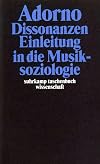
Dissonanzen. Einleitung in die Musiksoziologie/ Theodor W. Adorno
by Theodor W. Adorno
39 Members (4.50)
On This Page
Description
En Disonancias e Introducci?n a la sociolog?a de la m?sica Adorno expone sus consideraciones sociol?gico-musicales sobre las que desarroll? su filosof?a sobre la nueva m?sica. En ambos escritos, el fil?sofo expone su visi?n sobre las transformaciones sufridas por la m?sica ante la pujanza de la sociedad industrial y de masas, as? como la posici?n que debe adoptar el m?sico ante tales cambios.Tags
Recommendations































Member Reviews
Members
- Recently Added By
Author Information

323+ Works 14,296 Members
Theodor W. Adorno is the progenitor of critical theory, a central figure in aesthetics, and the century's foremost philosopher of music. He was born and educated in Frankfurt, Germany. After completing his Ph.D. in philosophy, he went to Vienna, where he studied composition with Alban Berg. He soon was bitterly disappointed with his own lack of show more talent and turned to musicology. In 1928 Adorno returned to Frankfurt to join the Institute for Social Research, commonly known as The Frankfurt School. At first a privately endowed center for Marxist studies, the school was merged with Frankfort's university under Adorno's directorship in the 1950s. As a refugee from Nazi Germany during World War II, Adorno lived for several years in Los Angeles before returning to Frankfurt. Much of his most significant work was produced at that time. Critics find Adorno's aesthetics to be rich in insight, even when they disagree with its broad conclusions. Although Adorno was hostile to jazz and popular music, he advanced the cause of contemporary music by writing seminal studies of many key composers. To the distress of some of his admirers, he remained pessimistic about the prospects for art in mass society. Adorno was a neo-Marxist who believed that the only hope for democracy was to be found in an interpretation of Marxism opposed to both positivism and dogmatic materialism. His opposition to positivisim and advocacy of a method of dialectics grounded in critical rationalism propelled him into intellectual conflict with Georg Hegel, Martin Heidegger, and Heideggerian hermeneutics. (Bowker Author Biography) show less
Series
Belongs to Publisher Series
Gesammelte Schriften in zwanzig Bänden (Band 14)
Classifications
Statistics
- Members
- 39
- Popularity
- 746,562
- Rating
- (4.50)
- Languages
- English, German, Italian, Spanish
- Media
- Paper, Ebook
- ISBNs
- 7
- ASINs
- 1