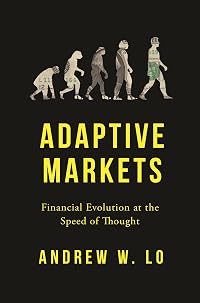
Adaptive Markets: Financial Evolution at the Speed of Thought
by Andrew W. Lo
On This Page
Description
A new, evolutionary explanation of markets and investor behaviorHalf of all Americans have money in the stock market, yet economists can't agree on whether investors and markets are rational and efficient, as modern financial theory assumes, or irrational and inefficient, as behavioral economists believe. The debate is one of the biggest in economics, and the value or futility of investment management and financial regulation hangs on the answer. In this groundbreaking book, Andrew Lo show more transforms the debate with a powerful new framework in which rationality and irrationality coexist--the Adaptive Markets Hypothesis. Drawing on psychology, evolutionary biology, neuroscience, artificial intelligence, and other fields, Adaptive Markets shows that the theory of market efficiency is incomplete. When markets are unstable, investors react instinctively, creating inefficiencies for others to exploit. Lo's new paradigm explains how financial evolution shapes behavior and markets at the speed of thought--a fact revealed by swings between stability and crisis, profit and loss, and innovation and regulation. An ambitious new answer to fundamental questions about economics and investing, Adaptive Markets is essential reading for anyone who wants to understand how markets really work. show lessTags
Recommendations








Member Reviews
My review is not really of the whole book but of a Blinkist Summary. I'm using these summaries to help me absorb more new ideas in the time I have left. (Which is rapidly contracting). If a book summary especially appeals to me, then I might indulge by reading the full book. However, I've noticed a tendency for Blinkist Summaries to be made of books by very prolific authors who are clearly just writing for a bulk market (especially with the self-help genre). So my hopes for Blinkist books are not high.
This is really my first attempt for years with Blinkist and I thought the summary was pretty good. As I also have the full book I will attempt a cross check by reading it. I took some notes of what I thought were key points from Blinkist show more (that's a summary of a summary) and here they are:
The Efficient Market Hypothesis is the most widely accepted theory for how the market works.
In a nutshell, EMH theory suggests that the price of stocks, bonds and similar investment assets will always provide an accurate reflection of the health, profitability and general value of a company.
Since you can’t beat the market, the standard advice is to “join the market” by investing in long-term, low-risk index funds, or mutual funds, which comprise a collection of stocks that will remain more or less untouched over time.
Humans are reliably irrational in dealing with money.
People tend to be more concerned with avoiding losses than making gains, which means we will generally take greater risks in order to avoid those losses than we will to hit the jackpot.
Human behavior is shaped by our emotions and instincts.
Through extensive research, neurologists have concluded that dopamine plays a central role in causing people to take irrational risks. This is something that the gambling industry is well aware of, as slot machines are designed to keep dopamine levels pumping so that gamblers will keep at it even as their money disappears.
Unfortunately, when dealing with money and trying to make the right decisions, we’re often in a fearful state of mind and experience the heightened emotional state of panic that accompanies it. This, in turn, is how we end up making irrational mistakes and piling up avoidable losses.
Survival of the richest is the ultimate force behind competition, innovation and adaptation.
Even though the exact methods used by hedge funds are still kept secret, they were soon popping up everywhere.
This is the evolutionary nature of the adaptive market in action: a new, superior species is introduced and soon begins to multiply and dominate.
The Adaptive Market Hypothesis can be used to make better financial decisions.
After all, there are some markets that will go through downturns longer than any investor can reasonably expect to wait out. For example, the Japanese market crashed in 1991 and remained stagnant for the next 20 years, a period known as the “lost decades.”
However, in some cases like this, what’s known as a behavioural premium may arise. This is when the irrational action becomes the dominant train of thought and more investors start pushing to sell, thus adversely affecting the long-term value of the company. In this scenario, relying on the efficient market would be unwise.
Financial crises are the result of markets evolving without proper oversight.
Most financial crises are an example of what happens when a market changes faster than investors can adapt.
The Adaptive Market Hypothesis can cure more than just our financial system.
If the Adaptive Market Hypothesis can help us see what went wrong in 2008, can it perhaps also point us to a better way forward, with more reliable markets? What history tells us is that we need better legislation to help prevent greed and fear-based decisions from ruining and damaging our economy.
There’s no reason why the financial industry should remain synonymous with greed and selfishness when it could use its power for the good of all humankind. [At this point he seems to be floating off into fantasy land.....ok, noble sentiments but a far cry from the realities of the market]
For example, there could be a “CancerCures” fund, managed by a panel of biomedical experts and experienced healthcare investors. Within it could be 150 independent research projects
With 150 independent projects looking at a wide range of treatments, we can estimate a 98-percent probability that at least three of them would be successful.
[I wonder where he got this idea from.....seems both fairly ambitious and does not really suggest that a "cure" might result. Most of these sorts of treatments are of a pretty simplistic nature....like Do you get better outcomes by combining chemotherapy with radiation every third week instead of every fourth week.]
Final summary
We’re long overdue for a new approach to our financial markets, one that acknowledges the human flaws of those participating in the system and recognizes the great potential the system has to do good. This is what the Adaptive Markets Hypothesis attempts to provide by incorporating the evolutionary element of markets.
Interesting ideas but not really new and where he does come up with new ideas they seem rather fanciful to me. Two stars from me. show less
This is really my first attempt for years with Blinkist and I thought the summary was pretty good. As I also have the full book I will attempt a cross check by reading it. I took some notes of what I thought were key points from Blinkist show more (that's a summary of a summary) and here they are:
The Efficient Market Hypothesis is the most widely accepted theory for how the market works.
In a nutshell, EMH theory suggests that the price of stocks, bonds and similar investment assets will always provide an accurate reflection of the health, profitability and general value of a company.
Since you can’t beat the market, the standard advice is to “join the market” by investing in long-term, low-risk index funds, or mutual funds, which comprise a collection of stocks that will remain more or less untouched over time.
Humans are reliably irrational in dealing with money.
People tend to be more concerned with avoiding losses than making gains, which means we will generally take greater risks in order to avoid those losses than we will to hit the jackpot.
Human behavior is shaped by our emotions and instincts.
Through extensive research, neurologists have concluded that dopamine plays a central role in causing people to take irrational risks. This is something that the gambling industry is well aware of, as slot machines are designed to keep dopamine levels pumping so that gamblers will keep at it even as their money disappears.
Unfortunately, when dealing with money and trying to make the right decisions, we’re often in a fearful state of mind and experience the heightened emotional state of panic that accompanies it. This, in turn, is how we end up making irrational mistakes and piling up avoidable losses.
Survival of the richest is the ultimate force behind competition, innovation and adaptation.
Even though the exact methods used by hedge funds are still kept secret, they were soon popping up everywhere.
This is the evolutionary nature of the adaptive market in action: a new, superior species is introduced and soon begins to multiply and dominate.
The Adaptive Market Hypothesis can be used to make better financial decisions.
After all, there are some markets that will go through downturns longer than any investor can reasonably expect to wait out. For example, the Japanese market crashed in 1991 and remained stagnant for the next 20 years, a period known as the “lost decades.”
However, in some cases like this, what’s known as a behavioural premium may arise. This is when the irrational action becomes the dominant train of thought and more investors start pushing to sell, thus adversely affecting the long-term value of the company. In this scenario, relying on the efficient market would be unwise.
Financial crises are the result of markets evolving without proper oversight.
Most financial crises are an example of what happens when a market changes faster than investors can adapt.
The Adaptive Market Hypothesis can cure more than just our financial system.
If the Adaptive Market Hypothesis can help us see what went wrong in 2008, can it perhaps also point us to a better way forward, with more reliable markets? What history tells us is that we need better legislation to help prevent greed and fear-based decisions from ruining and damaging our economy.
There’s no reason why the financial industry should remain synonymous with greed and selfishness when it could use its power for the good of all humankind. [At this point he seems to be floating off into fantasy land.....ok, noble sentiments but a far cry from the realities of the market]
For example, there could be a “CancerCures” fund, managed by a panel of biomedical experts and experienced healthcare investors. Within it could be 150 independent research projects
With 150 independent projects looking at a wide range of treatments, we can estimate a 98-percent probability that at least three of them would be successful.
[I wonder where he got this idea from.....seems both fairly ambitious and does not really suggest that a "cure" might result. Most of these sorts of treatments are of a pretty simplistic nature....like Do you get better outcomes by combining chemotherapy with radiation every third week instead of every fourth week.]
Final summary
We’re long overdue for a new approach to our financial markets, one that acknowledges the human flaws of those participating in the system and recognizes the great potential the system has to do good. This is what the Adaptive Markets Hypothesis attempts to provide by incorporating the evolutionary element of markets.
Interesting ideas but not really new and where he does come up with new ideas they seem rather fanciful to me. Two stars from me. show less
See my Blinkist review of this book.
Ratings
Members
- Recently Added By
Author Information

26 Works 433 Members
Andrew W. Lo is the Charles E. and Susan T. Harris Professor at the MIT Sloan School of Management and director of the MIT Laboratory for Financial Engineering. He is the author of Hedge Funds and the coauthor of A Non-Random Walk Down Wall Street (both Princeton), among other books.
Awards and Honors
Common Knowledge
- Quotations
- Evolution can even explain how our behaviors interact. Remember how the amygdala can suppress higher brain functions—for example, in the expression “His mind was clouded by fear.” This is manifestly irrational behavior,... (show all) but it makes perfect sense from an evolutionary standpoint. Strong emotions like fear are an immediate call-to-arms to survive, selected by evolution over millions of generations of life in hostile environments. Our more recently evolved cognitive functions, such as language and logical reasoning, are suppressed until the perceived threat to our survival is over, that is, until our emotional reaction subsides. The universality of this fear response means that fear has been so useful in past environments that it has evolved to override all other neural components under sufficient threat.
financial analyst A. Gary Shilling said, “The market can remain irrational a lot longer than you and I can remain solvent.
leverage effect is even stronger among companies that carry no debt.
An efficient market is simply the steady-state limit of a market in an unchanging financial environment. Such an idealized market is unlikely to ever exist in practice, but it's still a useful abstraction whose performance ca... (show all)n be approximated under certain conditions
We are short-term demanding and long-term inattentive by nature.
The same basic principles of mutation, competition, and natural selection that determine the life history of a herd of antelope also apply to the banking industry, albeit with somewhat different population dynamics.
The financial crisis didn't happen because its techniques didn't work; it happened because they worked all too well. There is an element of truth to Warren Buffett's characterization of these techniques as 'financial weapons ... (show all)of mass destruction.' Securization, credit default swaps, and other derivative securities are the financial equivalent of Einstein's famous formula. Global financial markets contain enormous financial energy, and when detonated in an uncontrolled and irresponsible manner, you get bubbles, crashes, and years of nuclear fallout. But the analogy works both ways - it also implies that when we use these tools carefully and responsibly, we get virtually unlimited power for fueling innovation and economic growth.
What if we looked at the law as a piece of software, the operating system of the United States of America. After all, laws play the same role as software in providing instructions for a given system - if this, then that, and ... (show all)so on. If a team of software engineers was asked to analyze the entire body of federal law, they would see tens of thousand of pages of poorly documented code, with a multitude of complex, spaghetti-like interdependencies between the individual components. Could the principles of good software design be used to improve the way we write financial regulations?
Li, William, Pablo Azar, David Larochelle, Phil Hill, and Andrew W. Lo. 2015. 'Law Is Code: A Software Engineering Approach to Analyzing the United States Code.' Journal of Business and Technology Law 10: 297.
A useful feature of network graphs if the ability to model contagion. Like an epidemiologist studying the spread of a contagious disease from its point of origin, we should identify the potential linkages through which a financial crisis may travel.
Billio, Monica, Mila Getmansky, Andrew W. Lo, and Loriana Pelizzon, 2012. 'Econometric Measures of Connectedness and Systemic Risk in the Finance and Insurance Sectors.' Journal of Financial Economics, 104: 535-559.
This approach can also be used to measure the network of banks, insurance companies, and sovereign nations. The idea is to see how macroeconomic problems facing countries might get transmitted to the financial system and vice versa.
Billio, Monica, Mila Getmansky, Dale Gray, Andrew W. Lo, Robert C. Merton, and Loriana Pelizzon. 2016. 'Granger-Causality Networks of Sovereign Risk.' Working Paper, MIT Laboratory for Financial Engineering.
In the Adaptive Markets framework, complexity means we don't have a good narrative for the system. The solution is obvious: we need to get smarter. Complexity can sometimes be reduced by developing a deeper understanding of t... (show all)he underlying structure of the system. For example, now that we understand the potential for liquidity spirals in statarb portfolios, thanks to August 2007, we can better prepare for them.
But the Adaptive Markets framework points to a second problem with complexity, which is the potential divisiveness of special knowledge and the potential for conflict. If the financial system becomes so complex that only a small number of elites truly understand its function and proper maintenance, this knowledge divides the population into those who know and those who don't. Of course, this situation arises with any piece of unique information - I know how to make scallion pancakes in a particular way so they're crispy on the outside but soft and chewy on the inside, and you probably don't. But that piece of knowledge is hardly worth keeping a secret, and the fact that you don't have that knowledge isn't going to get you too upset.
But suppose I know how to cure diabetes and you don't. Or I know how to prevent cancer by avoiding certain common foods and you don't. Or I know how to price mortgage-backed securities and credit default swaps and you don't. In these cases, the knowledge I possess confers a certain power and status to me. Complexity creates the need for better narratives and those who have those narratives will become the high priests of complex systems, the gatekeepers of critical, life-altering knowledge. And the difficulty in joining the priesthood - earning an MD/Ph.D. in molecular biology and having twenty year of work experience at biotech and pharmaceutical companies, in the case of curing diabetes - coupled with the societal values of the special knowledge will determine the divisiveness of this elitism.
A hedge fund is a private partnership that has a start and an end, and involves a general partner and several limited partners, each of whom brings something to the partnership. At the start, the general partner brings all th... (show all)e experience and limit partners bring all the money. At the end, the general partner leaves with all the money and the limited partners leave with all the experience.
the wisdom of crowds is sometimes overwhelmed by the madness of mobs.
Classifications
Statistics
- Members
- 152
- Popularity
- 214,950
- Reviews
- 2
- Rating
- (3.53)
- Languages
- English, Spanish
- Media
- Paper, Audiobook, Ebook
- ISBNs
- 8
- ASINs
- 3