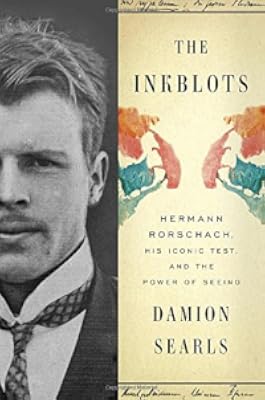
The Inkblots: Hermann Rorschach, His Iconic Test, and the Power of Seeing
by Damion Searls
On This Page
Description
In 1917, working alone in a remote Swiss asylum, psychiatrist Hermann Rorschach devised an experiment to probe the human mind. For years he had grappled with the theories of Freud and Jung while also absorbing the aesthetic of a new generation of modern artists. He had come to believe that who we are is less a matter of what we say, as Freud thought, than what we see. Rorschach himself was a visual artist, and his test, a set of ten carefully designed inkblots, quickly made its way to show more America, where it took on a life of its own. Co-opted by the military after Pearl Harbor, it was a fixture at the Nuremberg trials and in the jungles of Vietnam. It became an advertising staple, a cliché in Hollywood and journalism, and an inspiration to everyone from Andy Warhol to Jay-Z. The test was also given to millions of defendants, job applicants, parents in custody battles, workers applying for jobs, and people suffering from mental illness -- or simply trying to understand themselves better. And it is still used today. Damion Searls draws on unpublished letters and diaries, and a cache of interviews with Rorschach's family, friends, and colleagues, to tell the story of the test's creation, its controversial reinvention, and its endurance -- and what it all reveals about the power of perception. show lessTags
Recommendations




Member Reviews
Hermann Rorschach, with a unique perspective on the world given his visual mind, invented a new way to probe the unconscious mind mainly as a tool to experiment with Jungian personality types. What he found was the relatively simple set of images and a corresponding analysis methodology opened up so much more - including diagnosis for severe psychosis, or even the potential for future breakdown. And as a change from Freudian psychoanalysis, this methodology was quantitative, even correlated to other diagnostic tools. But asking a question like "What do you see" is ripe for interpretation, leading to the fatal flaw of the inkblot test: the open-ended responses must be graded to get the quantative analysis, so are subject to bias or show more misinterpretation, or just the desire of the examiner to poke into the "meaning" of the responses themselves.
Searls' book is part biography of Rorschach and part story of the birth and rise of the inkblot test, peaking in the US with the WWII draft, absorption into pop culture, and eventual discredit as the test fractured into different versions based around the same images. It's an interesting, and surprisingly deeper than expected, look at this tool and the ideas behind psychological testing across the 20th century. show less
Searls' book is part biography of Rorschach and part story of the birth and rise of the inkblot test, peaking in the US with the WWII draft, absorption into pop culture, and eventual discredit as the test fractured into different versions based around the same images. It's an interesting, and surprisingly deeper than expected, look at this tool and the ideas behind psychological testing across the 20th century. show less
 This review was written for LibraryThing Early Reviewers.
A fascinating story about a surprisingly enlightened mind. Whatever you may think about the tests themselves, the man was head and shoulders above Jung and Freud in thinking progressively about people (a low bar, I admit). And, unlike Jung and Freud, Rorschach would pass my "I'd let you into my house party, even though you showed up uninvited" test (you might be surprised by who would NOT pass that test). There is an earnestness, a kindness to him that truly took me by surprise. I found myself engaged with Searls' characterization of Rorschach much the way I would a beloved fictional character. The section on the test is almost like a different book (at least in the way I connected with it), but is still a very interesting read.
This review was written for LibraryThing Early Reviewers.This is so much more than I anticipated, more intense, in depth. I was not aware that there are “officially” only 10 inkblots used in Rorschach’s tests and that “most of the Rorschach blots we see in everyday life are imitations or remakes,” that “even in academic articles or museum exhibitions , the blots are usually reproduced in outline, blurred, or modified to reveal something about the images but not everything. “ So secretive, sacred were these cards before their copyright expired and the internet took hold. Now, they are as main stream as an emoji. (There are 7 included in this book, along with photos of the dashing Rorschach, his family and some of his other later paintings.)
The belief that “you can manage what show more you want to say but you can’t manage what you want to see” has negated many an applicants attempt for employment after acing every test but the blots. Fascinating! But what I found most interesting is how such tests can still be referred to everyday life, as in our media reports. You see what YOU see and that is your truth.
And so we go into his early years, his birth in 1884 and events alongside. His father was a painter, his mother, a doting, fun-filled woman with both combined to make their children’s lives enjoyable and successful to adulthood. And we follow him, in great visual and dialogue through to such. His schooling, his early practice, his many successes and earned accolades, some of his cases/patients. This book has so much information, so many elements, that it would take me a book itself to highlight them. Suffice it to say that this is an exceptional biography, spanning (it feels) every day in the life of Rorschach.
When it got into the psychology of the cards, I did get lost a time or two, not knowing the lingo, but none of the book was written in a “scholarly” fashion, more so that anyone could read, enjoy and learn from its contents. We DO have the internet, after all, so look up the “Zipf curve” and read on!
Bravo, Searls. This is a book I will read again and again. show less
The belief that “you can manage what show more you want to say but you can’t manage what you want to see” has negated many an applicants attempt for employment after acing every test but the blots. Fascinating! But what I found most interesting is how such tests can still be referred to everyday life, as in our media reports. You see what YOU see and that is your truth.
And so we go into his early years, his birth in 1884 and events alongside. His father was a painter, his mother, a doting, fun-filled woman with both combined to make their children’s lives enjoyable and successful to adulthood. And we follow him, in great visual and dialogue through to such. His schooling, his early practice, his many successes and earned accolades, some of his cases/patients. This book has so much information, so many elements, that it would take me a book itself to highlight them. Suffice it to say that this is an exceptional biography, spanning (it feels) every day in the life of Rorschach.
When it got into the psychology of the cards, I did get lost a time or two, not knowing the lingo, but none of the book was written in a “scholarly” fashion, more so that anyone could read, enjoy and learn from its contents. We DO have the internet, after all, so look up the “Zipf curve” and read on!
Bravo, Searls. This is a book I will read again and again. show less
This is a fascinating book about a hugely interesting subject that we all recognize but don't think about very much. I really love that this book goes beyond the standard popular biography stuff of narrativizing the life of a person. That's fine, i suppose, but I am really more interested in the test itself, and the second half of this book is essentially a biography of the test, which is very cool. Searls does a great job of dealing with the implications of the test and what it reveals about psychology and perception.
This review was written for LibraryThing Early Reviewers.The Inkblots: Hermann Rorschach, His Iconic Test, and the Power of Seeing by Damion Searls is a very highly recommended fascinating examination of the short life of Rorschach and the phenomenal spread and influence of the iconic test he developed. The first part of The Inkblots is an account of Rorschach's life, while the second is the history of the Rorschach Test and psychological evaluation.
In 1917 Rorschach was working at an asylum in Switzerland when he developed his inkblot test. Rorschach, the son of an artist, had artistic talent himself which aided him in carefully designing all of the final ten inkblots. His goal was to find a tool to use what we see and how we describe it as a way to find insight into the human mind. show more "Rorschach had come to believe that who we are is less a matter of what we say, as Freud thought, than what we see." The shapes he developed are bilaterally symmetrical. The shapes suggest both movement and form. This is a test where the psychological insight it reveals is based on the interpretation of what you see as it strives to measure imagination and personality. It is not a test with correct or incorrect answers. Today the ten shapes can readily be seen with a simple online search.
Rorschach tragically died in 1922 at age 37, but his test took on a life of its own, spreading across the world and especially took hold in America. It was used as a means of psychological evaluation in a wide variety of different situations. In the second half of the book Searls covers the history of psychology and the problems and changes associated with scoring the test. It also entered the realm of popular culture and at one time inkblots imitating the test could even be found in advertising.
I especially enjoyed this biography/history of psychology and thought the writing was exceptional. It is easy to understand while providing the background information and details you need to follow the information presented. It is well-researched, thoughtful, and intriguing. While I was totally engrossed in the whole book, the first part detailing Rorschach's life was especially detailed and interesting. Searls biographical account covers Rorschach's early life and his progressive beliefs as he grew up. Rorschach is presented as a very likeable man. Searls found a vast amount of material on Rorschach from a biographer who died before he wrote his book. Once we reach the second part of the book, which focuses on the spread of the test, the feuds, controversy, and revisions begin.
The Inkblots has all the special elements I love to see in nonfiction. The book includes many photos. There is an appendix focusing on his wife, Olga, and an excerpt of a tribute to her husband she wrote years later. There is a note by Searls in his acknowledgements explaining how he found original source material. Finally, there are extensive source notes for each chapter, which is always appreciated.
IF you are anything like me, you will want to see the original ten inkblots. They are easily found online (Wikipedia) and there is even an online inkblot test (which I didn't take therefore can't vouch for its validity.)
Disclosure: My review copy was courtesy of Crown/Archetype via Library Thing.
http://www.shetreadssoftly.com/2017/05/the-inkblots.html
https://www.goodreads.com/review/show/2000067809 show less
In 1917 Rorschach was working at an asylum in Switzerland when he developed his inkblot test. Rorschach, the son of an artist, had artistic talent himself which aided him in carefully designing all of the final ten inkblots. His goal was to find a tool to use what we see and how we describe it as a way to find insight into the human mind. show more "Rorschach had come to believe that who we are is less a matter of what we say, as Freud thought, than what we see." The shapes he developed are bilaterally symmetrical. The shapes suggest both movement and form. This is a test where the psychological insight it reveals is based on the interpretation of what you see as it strives to measure imagination and personality. It is not a test with correct or incorrect answers. Today the ten shapes can readily be seen with a simple online search.
Rorschach tragically died in 1922 at age 37, but his test took on a life of its own, spreading across the world and especially took hold in America. It was used as a means of psychological evaluation in a wide variety of different situations. In the second half of the book Searls covers the history of psychology and the problems and changes associated with scoring the test. It also entered the realm of popular culture and at one time inkblots imitating the test could even be found in advertising.
I especially enjoyed this biography/history of psychology and thought the writing was exceptional. It is easy to understand while providing the background information and details you need to follow the information presented. It is well-researched, thoughtful, and intriguing. While I was totally engrossed in the whole book, the first part detailing Rorschach's life was especially detailed and interesting. Searls biographical account covers Rorschach's early life and his progressive beliefs as he grew up. Rorschach is presented as a very likeable man. Searls found a vast amount of material on Rorschach from a biographer who died before he wrote his book. Once we reach the second part of the book, which focuses on the spread of the test, the feuds, controversy, and revisions begin.
The Inkblots has all the special elements I love to see in nonfiction. The book includes many photos. There is an appendix focusing on his wife, Olga, and an excerpt of a tribute to her husband she wrote years later. There is a note by Searls in his acknowledgements explaining how he found original source material. Finally, there are extensive source notes for each chapter, which is always appreciated.
IF you are anything like me, you will want to see the original ten inkblots. They are easily found online (Wikipedia) and there is even an online inkblot test (which I didn't take therefore can't vouch for its validity.)
Disclosure: My review copy was courtesy of Crown/Archetype via Library Thing.
http://www.shetreadssoftly.com/2017/05/the-inkblots.html
https://www.goodreads.com/review/show/2000067809 show less
This review was written for LibraryThing Early Reviewers.The Inkblots by Damion Searls is nominally a biography of Hermann Rorschach but is more interesting as the story of the Rorschach or inkblot test using Rorschach's life as a window on its creation.
The biography is interesting in its own right but the manner in which his life and work led to the test's development is fascinating. I will admit that my main interest was the history of the inkblot test over time.
Don't let anyone without any background in the subject tell you that either psychoanalysis is a thing of the past or that the inkblot test is no longer in use. Such a person is probably grinding their own personal axe at the expense of truth. Psychoanalysis is not a monolithic entity, some techniques are more popular than others and show more are useful in different settings. While many ideas, Freudian and otherwise, have been either refuted or carry less weight, many other ideas from Freud and many others are still valuable and relevant.
As for the test itself, don't believe anyone who claims it is out of use. It is still in use and, like any psychological test, has its proponents as well as its detractors. Anyone who claims it is a poor diagnostic test really misses the boat because it is not used to make a diagnosis any more than an EEG is used to make a diagnosis. Both are used primarily to point to possibilities and either open or close avenues for further testing and treatment. Additionally, and this is where my firsthand experience with inkblots comes in, they are used in neuroscience research. So the test has changed and been found lacking in some areas and helpful in others.
This book does a very good job of charting the ups and downs of the inkblots usage and popularity, both within the medical community and in popular culture, along with the reasons for each drop and rise. I found one portion near the end where a practitioner would like to use the tests more but, among other reasons, has issues with it becoming so quantitative.
I would recommend this book to anyone interested in psychology and psychological testing, particularly the history of medicine. A lover of biographies might be a little disappointed unless that love is coupled with a curiosity about the life of the subject's creation.
Reviewed from a copy made available by the publisher via LibraryThing Early Reviewers. show less
The biography is interesting in its own right but the manner in which his life and work led to the test's development is fascinating. I will admit that my main interest was the history of the inkblot test over time.
Don't let anyone without any background in the subject tell you that either psychoanalysis is a thing of the past or that the inkblot test is no longer in use. Such a person is probably grinding their own personal axe at the expense of truth. Psychoanalysis is not a monolithic entity, some techniques are more popular than others and show more are useful in different settings. While many ideas, Freudian and otherwise, have been either refuted or carry less weight, many other ideas from Freud and many others are still valuable and relevant.
As for the test itself, don't believe anyone who claims it is out of use. It is still in use and, like any psychological test, has its proponents as well as its detractors. Anyone who claims it is a poor diagnostic test really misses the boat because it is not used to make a diagnosis any more than an EEG is used to make a diagnosis. Both are used primarily to point to possibilities and either open or close avenues for further testing and treatment. Additionally, and this is where my firsthand experience with inkblots comes in, they are used in neuroscience research. So the test has changed and been found lacking in some areas and helpful in others.
This book does a very good job of charting the ups and downs of the inkblots usage and popularity, both within the medical community and in popular culture, along with the reasons for each drop and rise. I found one portion near the end where a practitioner would like to use the tests more but, among other reasons, has issues with it becoming so quantitative.
I would recommend this book to anyone interested in psychology and psychological testing, particularly the history of medicine. A lover of biographies might be a little disappointed unless that love is coupled with a curiosity about the life of the subject's creation.
Reviewed from a copy made available by the publisher via LibraryThing Early Reviewers. show less
This review was written for LibraryThing Early Reviewers.In the course of reading this book, I must have come across at least six references to the Rorschach test while reading news stories or advertising copy. Without any real knowledge of what they mean, people regularly use the idea of the test to illustrate a point or liven up a sentence. That being said, the actual inkblots and their detailed history explored in this book is quite a story. Like so many other thoughtful originating voices -Jesus, Nietzsche, Marx, even Wagner - the years have clouded Hermann Rorschach's idea that certain shapes might yield insight into the human mind. Unlike those others voices however, Rorschach proceeded to obfuscate his own idea and create a monster of psychological testing that divides the show more practitioners of this gentle science right down the middle. Having "taken the test" twice myself, I must side with the naysayers-mostly psychiatrists and neurologists as opposed to psychologists - that deem it unscientific and murky at best. This book, however, is a bold effort to explore both the beginnings and outcomes of what has become an almost never-ending cultural reference point and that is to be commended. show less
This review was written for LibraryThing Early Reviewers.Members
- Recently Added By
Author Information

7+ Works 402 Members
Some Editions
Awards and Honors
Distinctions
Common Knowledge
- Canonical title
- The Inkblots: Hermann Rorschach, His Iconic Test, and the Power of Seeing
- Original publication date
- 2017
- People/Characters
- Hermann Rorschach
- Epigraph
- The soul of the mind requires marvelously little to make it produce all that it envisages and employ all its reserve forces in order to be itself.... A few drops of ink and a sheet of paper, as material allowing... (show all) for the accumulation and co-ordination of moments and acts, are enough.
— Paul Valéry, Degas Dance Drawing
In Eternity All is Vision
— William Blake - First words
- AUTHOR'S NOTE
The Rorschach test uses ten and only ten inkblots, originally created by Hermann Rorschach and reproduced on cardboard cards.
Classifications
- Genres
- Nonfiction, General Nonfiction, Biography & Memoir, History, Science & Nature
- DDC/MDS
- 616.890092 — Applied science & technology Medicine & health Diseases, Allergies, Skin Conditions Nervous Disorders: Autism, Anorexia, OCD Mental disorders: bi-polar/schizophrenia History, geographic treatment, biography Biography
- LCC
- RC438.6 .R667 .S43 — Medicine Internal medicine Internal medicine Neurosciences. Biological psychiatry. Neuropsychiatry Psychiatry
- BISAC
Statistics
- Members
- 295
- Popularity
- 108,569
- Reviews
- 62
- Rating
- (3.94)
- Languages
- English
- Media
- Paper, Audiobook, Ebook
- ISBNs
- 9
- ASINs
- 3