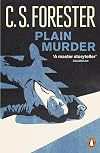
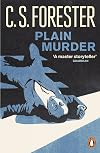
Plain Murder
by C. S. Forester
On This Page
Description
An excellent story, told in style: Three advertising men decide to kill a colleague to avoid dismissal and the grim prospect of joblessness. Their leader acquires a taste for crime, but eventually gets his comeuppance.Copyright © Libri GmbH. All rights reserved.Tags
Recommendations

















Member Reviews
"Killing for killing's sake is extraordinarily rare, but killing for quite inadequate motives is much more usual."
London in the 1920s is a grim place if you don't have a job, and three men at the Universal Advertising Agency are facing the prospect of unemployment after their supervisor, Harrison, caught them taking bribes. But before Harrison can report their doings to the big boss, one of the men, Morris, decides that the best way out of their predicament is to kill him. After all, nobody else knows what they did, so the fuss ends with a well-planned murder. Right?
Well, those best-laid plans have a way of not going quite right, and the killing instinct has a way of catching up to a man. Forester's portrait of Morris, the murderer of show more "necessity", as he develops a taste for blood, is a chilling one, and the story never lets up over its 200 pages. I could not put this book down. The polished writing helps the story go down smoothly despite its almost reckless fast pace. Like Forester's first crime novel, Payment Deferred, this is a very satisfying book for those who like mysteries but get literary indigestion from the doorstoppers many writers feel obligated to churn out these days. This is mystery writing boiled down to the essence. Another book I will buy simply for loaning to people. Highly recommended. show less
London in the 1920s is a grim place if you don't have a job, and three men at the Universal Advertising Agency are facing the prospect of unemployment after their supervisor, Harrison, caught them taking bribes. But before Harrison can report their doings to the big boss, one of the men, Morris, decides that the best way out of their predicament is to kill him. After all, nobody else knows what they did, so the fuss ends with a well-planned murder. Right?
Well, those best-laid plans have a way of not going quite right, and the killing instinct has a way of catching up to a man. Forester's portrait of Morris, the murderer of show more "necessity", as he develops a taste for blood, is a chilling one, and the story never lets up over its 200 pages. I could not put this book down. The polished writing helps the story go down smoothly despite its almost reckless fast pace. Like Forester's first crime novel, Payment Deferred, this is a very satisfying book for those who like mysteries but get literary indigestion from the doorstoppers many writers feel obligated to churn out these days. This is mystery writing boiled down to the essence. Another book I will buy simply for loaning to people. Highly recommended. show less
This isn't so much a whodunit as a whydoneit - and will he get away with it. Published in 1930, this feels older and is of its time. No forensics, no electronic tracking. Charlie Morris is a man with a chip on his shoulder, he feels that he is owed more than he has in life. At the start we find Morris and two of his colleagues having been discovered in a bribery scam at their advertising agency. It is Guy Fawkes night and this pops an idea in Morris' head - to murder their supervisor who is about to tell the agency boss and get them all fired. He involves both of his colleagues in the act, such that they are both implicated as accessories. From here is continues as a psychological study of how actions build upon each other.
In a sense show more it us a bit like Patricia Highsmith's Ripley, you know he's a villain, you are waiting to see what he does next and if he gets away with it. This is told by an omnipresent narrator and we see events and actions that impact on 2 main protagonists. Morris is also a lot less charming than Ripley, you don;t want him to get away with it in quite the same way. I listened to it and I'd certainly read or listen to more by Forester in this vein. show less
In a sense show more it us a bit like Patricia Highsmith's Ripley, you know he's a villain, you are waiting to see what he does next and if he gets away with it. This is told by an omnipresent narrator and we see events and actions that impact on 2 main protagonists. Morris is also a lot less charming than Ripley, you don;t want him to get away with it in quite the same way. I listened to it and I'd certainly read or listen to more by Forester in this vein. show less
This riveting psychological mystery published in 1930 is set in a London advertising agency of the 1920s. One of the employees, Morris, has persuaded two other men to take part in a scheme to make a bit of extra money. When their supervisor discovers the fraud he threatens to report them to the top. Before he was able to do so, he became the first victim. Getting away with murder motivates Morris to tackle other problems. It’s a clever, compelling story that doesn’t let up.
Forester is better known for the fantastic Hornblower series. How disappointing that he wrote only three mysteries.
Forester is better known for the fantastic Hornblower series. How disappointing that he wrote only three mysteries.
Another hidden gem from C.S. Forester; one of a short cannon of his early works, this is a dark study of a psychopath and his murderous activities. Charles Morris is the uninspiring advertising agency clerk, who embarks on a murder as the solution to his problems - a one-off event which inevitably leads to more killings before eventually spiralling out of control.
Forester's grasp of his narrative is iron-tight and despite the darkness of the subject matter, displays an ironic humour alongside an antipathy towards his protagonist. Some of the prose feels a bit heavy at times, but this was written in the early 1930s, and is a product of its time in terms of style and the use of language. But don't let this put you off, because this is a show more fascinating and gripping psychological study of the murderous intent of a man who refuses to be thwarted by the realities and limits of acceptable behaviour.
These days we're used to reading 'why-dunnits', as opposed to 'who-dunnits', but in the 1930s, this depth of characterisation and psychosocial insight was rare in mainstream crime fiction. Forester's long-forgotten and little known early thrillers are must-reads for all lovers of quality crime fiction.
© Koplowitz 2012 show less
Forester's grasp of his narrative is iron-tight and despite the darkness of the subject matter, displays an ironic humour alongside an antipathy towards his protagonist. Some of the prose feels a bit heavy at times, but this was written in the early 1930s, and is a product of its time in terms of style and the use of language. But don't let this put you off, because this is a show more fascinating and gripping psychological study of the murderous intent of a man who refuses to be thwarted by the realities and limits of acceptable behaviour.
These days we're used to reading 'why-dunnits', as opposed to 'who-dunnits', but in the 1930s, this depth of characterisation and psychosocial insight was rare in mainstream crime fiction. Forester's long-forgotten and little known early thrillers are must-reads for all lovers of quality crime fiction.
© Koplowitz 2012 show less
Murder in a London advertising agency. Gets into the mind of the murderer. Quite shocking reall. Good read
Ratings
Members
- Recently Added By
Author Information

182+ Works 34,778 Members
Born Cecil Louis Troughton Smith on August 27, 1899, in Cairo, Egypt, where his father was a government official, C. S. Forester grew up mainly in England. He was educated at Dulwich College, studying medicine briefly before decidint to become a writer. Forester moved to the United States before the start of World War II, and lived in Berkeley, show more California, until his death in 1966. Although Forester was a journalist, a novelist and a Hollywood scriptwriter, he is probably best known for his historical fiction, particularly the series of novels that feature Horatio Hornblower. The eleven-book series begins with Mr. Midshipmen Hornblower, in which the seventeen-year old Hornblower joins the British navy in 1793, just as the Napoleonic Wars are about to begin. Hornblower's continuing adventures, as well as his advancement to the highest ranks of the navy, are chronicled in further books, including Beat to Quarters, Flying Colours, Commodore Hornblower, Lord Hornblower, The Happy Return, and A Ship of the Line, for which Forester recived the James Tait Black Memorial Prize in 1939. Several of Forester's novels were made into films, most notably Payment Deferred (his first novel published in 1926), Eagle Squadron, The Commandos (the movie title was The Commandos Strike at Dawn), Captain Horatio Hornblower, Sink the Bismarck!, and The African Queen, starring Katharine Hepburn and Humphrey Bogart. Forester's nonfiction includes The Age of Fighting Sail: The Story of the Naval War of 1812, as well as biographies of Lord Nelson, Napoleon, Josephine, and King Louis XIV. He also wrote an autobiography, Long Before Forty. (Bowker Author Biography) show less
Some Editions
Series
Belongs to Publisher Series
Work Relationships
Is abridged in
Common Knowledge
- Canonical title
- Plain Murder
- Original publication date
- 1930
- Related movies
- Plain Murder (1978 | IMDb)
- Epigraph
- [None]
- Dedication
- [None]
- First words
- The three young men sat together at a marble-topped table in the teashop.
Classifications
Statistics
- Members
- 164
- Popularity
- 200,148
- Reviews
- 5
- Rating
- (3.81)
- Languages
- 5 — Dutch, English, French, German, Norwegian (Bokmål)
- Media
- Paper, Audiobook, Ebook
- ISBNs
- 26
- ASINs
- 16