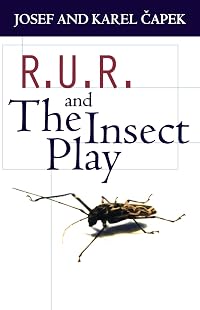
R.U.R. and The Insect Play (Oxford Paperbacks)
by Karel Čapek, Josef Čapek
On This Page
Description
Josef and Karel Capek were the best known literary figures of liberated Czechoslovakia after 1918. Josef won a considerable reputation as a painter of the Cubist school, later developing his own playful primitive style. He collaborated with his brother in composing sketches, stories, andplays, as well as writing two short novels of his own and critical essays in which he defended the art of the unconscious, of children, and of savages. Following Hitler's invasion of 1939, Josef Capek was show more sent to a German concentration camp. He died at Belsen in April 1945. Karel Capek became a journalist and for a time stage manager of the theatre in Vinohrady. Though a writer of novels, visionary romances, travel books, stories , and essays, Karel is best known for his plays. His last plays, written just before the entry of Hitler into Czechoslovakia, deal with therise of dictatorship and the terrible consequences of war. Karel Capek died on Christmas day, 1938. After the success of R.U.R. (Rossums' Universal Robots, 1920) seen in London in 1923, the brothers collaborated in their best-known work, The Insect Play (1921). Both plays are satires depicting the horrors of a regimented technical world and the terrible end of the populace if they fail to riseagainst their oppressors. They reflect the world in which the Capeks lived and give a commentary on its grosser follies. show lessTags
Recommendations
















Member Reviews
It seems particularily powerful to me that Josef Čapek died in the concentration camp of Bergen-Belsen. One of the only voices we can hear of the millions silenced in those camp.
Less excited about this one, from language to observations. (This edition repping my edition of just Ze života hmyzu.)
R.U.R. (Rossum's Universal Robots) was written in 1920, premiered in Prague early in 1921, was performed in New York in 1922, and published in English translation in 1923. Virtually every encyclopedia or textbook etymology of the word "robot" mentions the play R.U.R. Although the immediate worldwide success of the play immediately popularized the word (supplanting the earlier "automaton"), it was actually not Karel Capek but his brother Josef, also a respected Czech writer, who coined the word. The Czech word robota means "drudgery" or "servitude"; a robotnik is a peasant or serf. Although the term today conjures up images of clanking metal contraptions, Capek's Robots (always capitalized) are more accurately the product of what we show more would now call genetic engineering.
The translator (Paul Selver) changed the play quite a bit while preparing the English version, combining two Robot characters into one, and considerably toning down the ending. If you're interested in reading the play as it was originally presented to American audiences, read the 1920s version (most university libraries will have a copy -- it was tremendously popular in its day).
In the 1990s, a new translation, with much better dialogue and a chilling new final speech (new to English audiences, anyway) by the Robot Damon, was published in a Capek reader called Toward the Radical Center (with a short introduction by Arthur Miller).
[http://jerz.setonhill.edu/resources/RUR/]
Written just before WWII the Insect Play is a wonderful fantasy full of political allegory and social commentary. It is important to keep in mind when reading the Insect Play that Josef Capek died in a Nazi concentration camp. show less
The translator (Paul Selver) changed the play quite a bit while preparing the English version, combining two Robot characters into one, and considerably toning down the ending. If you're interested in reading the play as it was originally presented to American audiences, read the 1920s version (most university libraries will have a copy -- it was tremendously popular in its day).
In the 1990s, a new translation, with much better dialogue and a chilling new final speech (new to English audiences, anyway) by the Robot Damon, was published in a Capek reader called Toward the Radical Center (with a short introduction by Arthur Miller).
[http://jerz.setonhill.edu/resources/RUR/]
Written just before WWII the Insect Play is a wonderful fantasy full of political allegory and social commentary. It is important to keep in mind when reading the Insect Play that Josef Capek died in a Nazi concentration camp. show less
Ratings
Members
- Recently Added By
Lists

Books in the Bibliography of Humans: A Monstrous History by Surekha Davies
346 works; 1 member
Author Information

255+ Works 7,168 Members
Karel Capek is best known abroad for his plays, but at home he is also revered as an accomplished novelist, short-story writer, essayist, and writer of political articles. His bitingly satirical novel The War with the Newts (1936) reveals his understanding of the possible consequences of scientific advance. The novel Krakatit (1924), about an show more explosive that could destroy the world, foreshadows the feared potential of a nuclear disaster. In his numerous short stories he depicts the problems of modern life and common people in a humorous and whimsically philosophical fashion. The plays of Karel Capek presage the Theater of the Absurd. R.U.R. (Rossum's Universal Robots) (1921) was a satire on the machine age. He created the word robot from the Czech noun robota, meaning "work" for the human-made automatons who in that play took over the world, leaving only one human being alive. The Insect Comedy (1921), whose characters are insects, is an ironic fantasy on human weakness. The Makropoulos Secret (1923), later used as the basis for Leos Janacek's opera, was an experimental piece that questioned whether immortality is really desirable. All the plays have been produced successfully in New York. Most deal satirically with the modern machine age or with war. Underlying all his work, though, is a faith in humanity, truth, justice, and democracy, which has made him one of the most beloved of all Czech writers. (Bowker Author Biography) show less
45+ Works 272 Members
Some Editions
Series
Belongs to Publisher Series
Work Relationships
Classifications
- Genres
- Fiction and Literature, Science Fiction
- DDC/MDS
- 891.862 — Literature & rhetoric Literatures of other languages East Indo-European and Celtic literatures West and South Slavic languages (Bulgarian, Slovene, Polish, Czech, Slovak, Serbo-Croatian, and Macedonian) Czech Czech drama
- LCC
- PG5038 .C3 .R6 — Language and Literature Slavic languages and literatures. Baltic languages. Albanian language Slavic. Baltic. Albanian Slavic Czech
- BISAC
Statistics
- Members
- 194
- Popularity
- 169,195
- Reviews
- 3
- Rating
- (3.41)
- Languages
- English
- Media
- Paper
- ISBNs
- 1
- ASINs
- 5