Soft Targets
by Dean Ing
On This Page
Description
America thought it was safe from the dreadful plague of terrorism scouring the rest of the world. Somehow, the cruel violence could never pass our borders. Somehow, the oceans, or God, would spare us. But jets do not stop for oceans, and the northern and southern borders of the United States are wide open. And while there may be some small effort at security on the East or West coasts, in the heartland there is none. Americans doesn't like security measures. Americans are going to like Hakim show more Arif even less. Hakim Arif, leader of Fat'ah, a militant Islamic terrorist organization, knows how vulnerable the United States really is. And he intends to demonstrate that to the world. Fat'ah will bring war on innocents home to the American heartland, in a way no one will ever forget. show lessTags
Recommendations





























Member Reviews
My reactions to reading this novel in 2001. Spoilers follow.
Given the times, I thought I'd read Ing's novel about how he thought terrorism might be handled. Given that it was first published in October 1979 and this paperback edition, with a new afterword by Ing, was published in May 1980, I expected it to have dated some given that it's sort of a near future piece of sf. (Very near future given that the plot takes place in late 1980 and early 1981. In the afterword, Ing justifies calling this sf since it speculates on the application of two "sciences", psycholinguistics theory and media theory. But it fails on several levels and not all have to do with the passing of time.
Ing has learned a lot about writing since this novel. The show more novels I've read of his were all written later and much more enjoyable. His story is too sparse in parts, particularly describing the collusion between Federal Communications Board member and protagonist, Maurice Everett, and the media. His descriptions of the media war on terrorism, on the other hand, are bloated. Basically, they consist of mocking terrorist actions and refusing to publicize terrorists' political points. However, Ing, perhaps because of his advanced degree work in psycholinguistics and media theory and the desire to put the story on a scientific footing, dresses this basic idea up with too much jargon. The presence of Gina Vercours was annoying. (Must all espionage thrillers have beautiful babes in them? This one has two -- Vercours and the terrorist Leah Talith.) Her combination of bodyguard and journalist was very implausible and never convincingly explained. (She guards one Wallace Conklin, a pretty obvious stand-in for Walter Cronkite. Comedian Charlie George might be a stand-in for George Carlin.)
The novel is surprisingly filled with rather unconventional sex given its brevity. Of course, there is the eventually consummated Vercours and Everett relationship. Homosexuality is mentioned several times, and one male homosexual is killed via the exotic method of a poison filled dildo put in his mouth. Ing seems to have a thing for exotic sex since the Quantrill novels featured a female committing beastality with a giant wild boar. The KGB's interest in destroying Hakim, head of the terrorist organization Fat'ah, was not adequately explained.
Besides these literary shortcomings, the near future of Ing was jarringly inaccurate of my memories of the social and technological milieu of the late '70s and early '80s. The whole thing with the wonders of Hewlett Packard integrated chips was not fully explained. I don't think the mixing of news and comedy -- or doing the unofficial bidding of the FCC -- would have been possible to the newsrooms' cultures of that time, either. On the other hand, there were things I liked about the book.
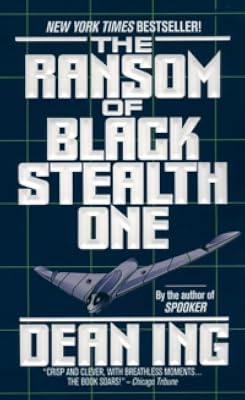
While not as polished as some of his later novels, particularly the exotic aviation trilogy starting with The Ransom of Black Stealth One, Ing's knowledge of espionage and tradecraft and the world of interlocking terrorist organizations mostly matched my non-fiction readings in the area. Like most fictional terrorists, the machinations of his Fat'ah were more complicated than real ones but less brutal in their ultimate actions. I did like radical members of Neturay Karta being amongst the Fat'ah. Neturay Karta aka Neturai Karta is a real organization (the name means "Guardians of the City") whose opinions and views pretty much are (at least reading their website in 2001) as Ing describes -- to wit, regarding the existence of the State of Israel as a blasphemy since the Messiah can not return while the nation remains. And Fat'ah reminded me in its personal devotion (if not the improbable skill of its members) and size of the Symbionese Liberation Army. Main terrorist Hakim was all right as was its media hungry leader who needs attention to gain funding. His pretensions at disciplined masochism are uncovered when tortured by a KGB double agent in his group -- who certainly doesn't enjoy torturing as much as Hakim does.
I thought the 276 page novel definitely improved after page 217 when Everett and George are tortured by Fat'ah. Ing has many unexpected plot twists, some of the bizarre and random sort which I found realistic. Not the least twist is that Vercours or law enforcement do not rescue Everett and George. (Rather, in another good twist, Vercours, at novel's end, succumbs -- though the murder does not take place in the book -- to the temptation of a KGB bounty on Everett. Everett, who will die but not be conquered, seems, at novel's end, an allegorical stand-in for Western democracies not giving in to terrorism.) KGB agent Guerrero dies by Hakim's booby-trapped van -- but shortly before Hakim himself dies after Guerrero injects him with slow poison. Guerrero's KGB comrades show up unexpectedly to kill Talith and, briefly, imprison Chaim who goes berserk and, in his psychologically wounded state, mistakes the maimed George for an apparition of vengeance, and shoots himself. show less
Given the times, I thought I'd read Ing's novel about how he thought terrorism might be handled. Given that it was first published in October 1979 and this paperback edition, with a new afterword by Ing, was published in May 1980, I expected it to have dated some given that it's sort of a near future piece of sf. (Very near future given that the plot takes place in late 1980 and early 1981. In the afterword, Ing justifies calling this sf since it speculates on the application of two "sciences", psycholinguistics theory and media theory. But it fails on several levels and not all have to do with the passing of time.
Ing has learned a lot about writing since this novel. The show more novels I've read of his were all written later and much more enjoyable. His story is too sparse in parts, particularly describing the collusion between Federal Communications Board member and protagonist, Maurice Everett, and the media. His descriptions of the media war on terrorism, on the other hand, are bloated. Basically, they consist of mocking terrorist actions and refusing to publicize terrorists' political points. However, Ing, perhaps because of his advanced degree work in psycholinguistics and media theory and the desire to put the story on a scientific footing, dresses this basic idea up with too much jargon. The presence of Gina Vercours was annoying. (Must all espionage thrillers have beautiful babes in them? This one has two -- Vercours and the terrorist Leah Talith.) Her combination of bodyguard and journalist was very implausible and never convincingly explained. (She guards one Wallace Conklin, a pretty obvious stand-in for Walter Cronkite. Comedian Charlie George might be a stand-in for George Carlin.)
The novel is surprisingly filled with rather unconventional sex given its brevity. Of course, there is the eventually consummated Vercours and Everett relationship. Homosexuality is mentioned several times, and one male homosexual is killed via the exotic method of a poison filled dildo put in his mouth. Ing seems to have a thing for exotic sex since the Quantrill novels featured a female committing beastality with a giant wild boar. The KGB's interest in destroying Hakim, head of the terrorist organization Fat'ah, was not adequately explained.
Besides these literary shortcomings, the near future of Ing was jarringly inaccurate of my memories of the social and technological milieu of the late '70s and early '80s. The whole thing with the wonders of Hewlett Packard integrated chips was not fully explained. I don't think the mixing of news and comedy -- or doing the unofficial bidding of the FCC -- would have been possible to the newsrooms' cultures of that time, either. On the other hand, there were things I liked about the book.
While not as polished as some of his later novels, particularly the exotic aviation trilogy starting with The Ransom of Black Stealth One, Ing's knowledge of espionage and tradecraft and the world of interlocking terrorist organizations mostly matched my non-fiction readings in the area. Like most fictional terrorists, the machinations of his Fat'ah were more complicated than real ones but less brutal in their ultimate actions. I did like radical members of Neturay Karta being amongst the Fat'ah. Neturay Karta aka Neturai Karta is a real organization (the name means "Guardians of the City") whose opinions and views pretty much are (at least reading their website in 2001) as Ing describes -- to wit, regarding the existence of the State of Israel as a blasphemy since the Messiah can not return while the nation remains. And Fat'ah reminded me in its personal devotion (if not the improbable skill of its members) and size of the Symbionese Liberation Army. Main terrorist Hakim was all right as was its media hungry leader who needs attention to gain funding. His pretensions at disciplined masochism are uncovered when tortured by a KGB double agent in his group -- who certainly doesn't enjoy torturing as much as Hakim does.
I thought the 276 page novel definitely improved after page 217 when Everett and George are tortured by Fat'ah. Ing has many unexpected plot twists, some of the bizarre and random sort which I found realistic. Not the least twist is that Vercours or law enforcement do not rescue Everett and George. (Rather, in another good twist, Vercours, at novel's end, succumbs -- though the murder does not take place in the book -- to the temptation of a KGB bounty on Everett. Everett, who will die but not be conquered, seems, at novel's end, an allegorical stand-in for Western democracies not giving in to terrorism.) KGB agent Guerrero dies by Hakim's booby-trapped van -- but shortly before Hakim himself dies after Guerrero injects him with slow poison. Guerrero's KGB comrades show up unexpectedly to kill Talith and, briefly, imprison Chaim who goes berserk and, in his psychologically wounded state, mistakes the maimed George for an apparition of vengeance, and shoots himself. show less
Ratings
Members
- Recently Added By
Author Information

35+ Works 2,411 Members
Common Knowledge
- Canonical title
- Soft Targets
- Original publication date
- 1979-10
- Epigraph
- . . . I found fear a mean, overrated, motive; no deterrent and, though a stimulant, a poisonous stimulant whose every injection served to consume more of the system ..." - T.E. Lawrence, Seven Pillars of Wisdom
- Dedication
- For my parents
- First words
- Still naked and sleep-fogged after his morning coffee, the wire-muscled little man retrieved his attaché case from his pillowslip and placed it with reverence on the apartment's sleazy table.
- Last words
- (Click to show. Warning: May contain spoilers.)"You look," she said, "like a million dollars."
- Original language
- English US
Classifications
Statistics
- Members
- 86
- Popularity
- 367,517
- Reviews
- 1
- Rating
- (3.64)
- Languages
- English
- Media
- Paper
- ISBNs
- 5
- ASINs
- 2