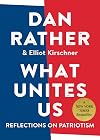
What Unites Us: Reflections on Patriotism
by Dan Rather, Elliot Kirschener (Author)
On This Page
Description
AN INSTANT NEW YORK TIMES BESTSELLER“I find myself thinking deeply about what it means to love America, as I surely do.” —Dan Rather
“A tonic for our times . . . Rather's writing shows why he has won the admiration of a new generation. In these essays, he gives voice to the marginalized and rips off the journalistic shield of objectivity to ring the alarm bell when he witnesses actions he fears undermine the principles of American democracy. That, undoubtedly, is patriotic. And show more it takes courage.”
—USA Today
At a moment of crisis over our national identity, venerated journalist Dan Rather has emerged as a voice of reason and integrity, reflecting on—and writing passionately about—what it means to be an American. Now, with this collection of original essays, he reminds us of the principles upon which the United States was founded. Looking at the freedoms that define us, from the vote to the press; the values that have transformed us, from empathy to inclusion to service; the institutions that sustain us, such as public education; and the traits that helped form our young country, such as the audacity to take on daunting challenges in science and medicine, Rather brings to bear his decades of experience on the frontlines of the world’s biggest stories. As a living witness to historical change, he offers up an intimate view of history, tracing where we have been in order to help us chart a way forward and heal our bitter divisions.
With a fundamental sense of hope, What Unites Us is the book to inspire conversation and listening, and to remind us all how we are, finally, one. show less
Tags
Recommendations









Member Reviews
In these troubling days, I often turned to comedians such as Trevor Noah and Stephen Colbert to keep me sane. Another person with a voice of reason is Dan Rather, the ex-CBS news anchor, who recently re-emerged in social media with his thoughts on the current political situation and life in the U.S.A. Written in an essay format, Rather elaborates on his views on 15 themes, the sum of which is his definition of true patriotism. Inevitably, these viewpoints will be treated negatively by selected readers as his perspective leans against the current administration (big surprise). He shared intimately of his background, his youth, his family, his old neighborhood, and his profession to explain the source of his passion and his viewpoints.
Our show more Freedom is dependent on our responsibility in exercising our Vote, to express Dissent when it is necessary and right, and for the Press to accurately and thoroughly message the situation, which is far from the sound-bite type of news that we are getting these days. To have a meaningful Community (=nation), we must have Inclusion of the diverse population, Empathy for those with less, and embrace Immigration as a founding pillar of this country and a source of growth and betterment. To grow and improve, we must have Exploration of Science, enable literacy through Books, and allow The Arts to flourish and express the truth. As individuals and especially for the leaders of this nation, we have a Responsibility towards The Environment, to ensure quality Public Education is available to all, and to participate in Service to this country. Lastly, for our Character, we must have the Audacity to think BIG, to have the fortification to remain Steady on our courses especially in times of distress, and last but not least, to have Courage to accomplish our dreams and goals.
All the capitalized words, excluding start of sentences, in the above paragraph are the section and chapter titles of this book. Read the book to get the extended version of his messages. :)
Some Quotes:
On Patriotism:
“It is important not to confuse ‘patriotism’ with ‘nationalism.’ As I define it, nationalism is a monologue in which you place your country in a position of moral and cultural supremacy over others. Patriotism, while deeply personal is a dialogue with your fellow citizens, and a larger world, about not only what you love about your country but also how it can be improved. Unchecked nationalism leads to conflict and war. Unbridled patriotism can lead to the betterment of society. Patriotism is rooted in humility. Nationalism is rooted in arrogance.”
On the role of the Press:
“…We are seeing living proof of the wisdom of our Founders, who conceived of the First Amendment as a check on tyranny – an accountability that was missing in Orwell’s vision in 1984. But while these may be heroic times for journalists, the outcome of the battle between propaganda and deception on the one hand and unbiased reporting on the other is far from clear. No one has a monopoly on the truth, but the whole premise of our democracy is that truth and justice must win out. And the role of a trained journalist is to get as close to the truth as is humanly possible. Make no mistake: We are being tested. Without a vibrant, fearless free press, our great American experiment may fail.”
On Inclusion:
“…A society worthy of our ideals would be a much more inclusive one, a more integrated one. It would be a place where we continually strive to create a better whole out of our many separate parts. This is a sentiment that itself stretches back our founding. Our first national motto was E pluribus unum, ‘From many, one.” From many states, we are one nation. And from many peoples, we should be society. Under this framework, building tolerance is a worthy way station to a much grander destination of inclusion…”
On Science and its intolerance:
“…Back in 1980, the science-fiction author Isaac Asimov wrote, ‘There is a cult of ignorance in the United States, and there always has been. The strain of anti-intellectualism has been a constant thread winding its way through our political and cultural life, nurtured by the false notion that democracy means that ‘my ignorance is just as good as your knowledge.’’ It is what the comedian Stephen Colbert dubbed ‘truthiness,’ a feeling that an erroneous opinion that ‘sounds’ just as valid as the actual truth. But while these forces have always been present in American society, I have never seen them infect our national discourse as much as they do now…”
On Art:
“…art shouldn’t be about impressing others; whether you are an individual or a nation, art is about engaging in a candid dialogue with yourself.” show less
Our show more Freedom is dependent on our responsibility in exercising our Vote, to express Dissent when it is necessary and right, and for the Press to accurately and thoroughly message the situation, which is far from the sound-bite type of news that we are getting these days. To have a meaningful Community (=nation), we must have Inclusion of the diverse population, Empathy for those with less, and embrace Immigration as a founding pillar of this country and a source of growth and betterment. To grow and improve, we must have Exploration of Science, enable literacy through Books, and allow The Arts to flourish and express the truth. As individuals and especially for the leaders of this nation, we have a Responsibility towards The Environment, to ensure quality Public Education is available to all, and to participate in Service to this country. Lastly, for our Character, we must have the Audacity to think BIG, to have the fortification to remain Steady on our courses especially in times of distress, and last but not least, to have Courage to accomplish our dreams and goals.
All the capitalized words, excluding start of sentences, in the above paragraph are the section and chapter titles of this book. Read the book to get the extended version of his messages. :)
Some Quotes:
On Patriotism:
“It is important not to confuse ‘patriotism’ with ‘nationalism.’ As I define it, nationalism is a monologue in which you place your country in a position of moral and cultural supremacy over others. Patriotism, while deeply personal is a dialogue with your fellow citizens, and a larger world, about not only what you love about your country but also how it can be improved. Unchecked nationalism leads to conflict and war. Unbridled patriotism can lead to the betterment of society. Patriotism is rooted in humility. Nationalism is rooted in arrogance.”
On the role of the Press:
“…We are seeing living proof of the wisdom of our Founders, who conceived of the First Amendment as a check on tyranny – an accountability that was missing in Orwell’s vision in 1984. But while these may be heroic times for journalists, the outcome of the battle between propaganda and deception on the one hand and unbiased reporting on the other is far from clear. No one has a monopoly on the truth, but the whole premise of our democracy is that truth and justice must win out. And the role of a trained journalist is to get as close to the truth as is humanly possible. Make no mistake: We are being tested. Without a vibrant, fearless free press, our great American experiment may fail.”
On Inclusion:
“…A society worthy of our ideals would be a much more inclusive one, a more integrated one. It would be a place where we continually strive to create a better whole out of our many separate parts. This is a sentiment that itself stretches back our founding. Our first national motto was E pluribus unum, ‘From many, one.” From many states, we are one nation. And from many peoples, we should be society. Under this framework, building tolerance is a worthy way station to a much grander destination of inclusion…”
On Science and its intolerance:
“…Back in 1980, the science-fiction author Isaac Asimov wrote, ‘There is a cult of ignorance in the United States, and there always has been. The strain of anti-intellectualism has been a constant thread winding its way through our political and cultural life, nurtured by the false notion that democracy means that ‘my ignorance is just as good as your knowledge.’’ It is what the comedian Stephen Colbert dubbed ‘truthiness,’ a feeling that an erroneous opinion that ‘sounds’ just as valid as the actual truth. But while these forces have always been present in American society, I have never seen them infect our national discourse as much as they do now…”
On Art:
“…art shouldn’t be about impressing others; whether you are an individual or a nation, art is about engaging in a candid dialogue with yourself.” show less
Dan Rather has had a storied career in journalism that spans almost seven decades. As the former news anchor for the CBS Evening News, Rather was a witness to and reported on several historic events including Watergate and Nixon’s administration. In What Unites Us, Dan Rather draws from those experiences (as well as his own childhood) to describe the changes in America and suggest what more can be done for progress. The ideas encompassed in the book (e.g. extolling patriotism over nationalism, advocating the importance of education and the arts) are nothing new or revolutionary, but they are written in a way that is compelling. In these divisive times, one can only hope that more people will read this book and take its message to show more heart. Courage. show less
Rather's collection of essays offers both hope and warning about the future of America. He understands and deeply appreciates the elements that have uniquely combined to become the American Ideal and Character and his book is a worning about the dangers we bring upon ourselves as we abandon those very values and virtues. Yet, the book has an overall positive tone, one that asserts that the problems are serious and great and the failure to resolve them treaten disasterous consequences, yet he clearly tempers that warning with the belief that we can and will rise above the threats to ourselves that we now endure.
The book is a must read for all of us who want to believe in a better future than the one we appear to be building for ourselves show more today. He sounds the warning to be "steady" and not to give in to dispair while also not reaching for simplist solutions. While most Americans take their news and information from a network that offers only propoganda and imbalance is a serious problem, and the return to long suppressed racist values speaks badly of a nation which had previously been the world leader in hope, truth and justice, we remain a nation where the arc of justice can prevail, and we can once again ascend to very ideals that built our character and provided our greatness. But we have to turn the ship around and look again to what we can do and become rather than working so hard to return to an ideal of times past which never really existed as we remember them anyway. show less
The book is a must read for all of us who want to believe in a better future than the one we appear to be building for ourselves show more today. He sounds the warning to be "steady" and not to give in to dispair while also not reaching for simplist solutions. While most Americans take their news and information from a network that offers only propoganda and imbalance is a serious problem, and the return to long suppressed racist values speaks badly of a nation which had previously been the world leader in hope, truth and justice, we remain a nation where the arc of justice can prevail, and we can once again ascend to very ideals that built our character and provided our greatness. But we have to turn the ship around and look again to what we can do and become rather than working so hard to return to an ideal of times past which never really existed as we remember them anyway. show less
Rather's collection of essays offers both hope and warning about the future of America. He understands and deeply appreciates the elements that have uniquely combined to become the American Ideal and Character and his book is a worning about the dangers we bring upon ourselves as we abandon those very values and virtues. Yet, the book has an overall positive tone, one that asserts that the problems are serious and great and the failure to resolve them treaten disasterous consequences, yet he clearly tempers that warning with the belief that we can and will rise above the threats to ourselves that we now endure.
The book is a must read for all of us who want to believe in a better future than the one we appear to be building for ourselves show more today. He sounds the warning to be "steady" and not to give in to dispair while also not reaching for simplist solutions. While most Americans take their news and information from a network that offers only propoganda and imbalance is a serious problem, and the return to long suppressed racist values speaks badly of a nation which had previously been the world leader in hope, truth and justice, we remain a nation where the arc of justice can prevail, and we can once again ascend to very ideals that built our character and provided our greatness. But we have to turn the ship around and look again to what we can do and become rather than working so hard to return to an ideal of times past which never really existed as we remember them anyway. show less
The book is a must read for all of us who want to believe in a better future than the one we appear to be building for ourselves show more today. He sounds the warning to be "steady" and not to give in to dispair while also not reaching for simplist solutions. While most Americans take their news and information from a network that offers only propoganda and imbalance is a serious problem, and the return to long suppressed racist values speaks badly of a nation which had previously been the world leader in hope, truth and justice, we remain a nation where the arc of justice can prevail, and we can once again ascend to very ideals that built our character and provided our greatness. But we have to turn the ship around and look again to what we can do and become rather than working so hard to return to an ideal of times past which never really existed as we remember them anyway. show less
Rather's collection of essays offers both hope and warning about the future of America. He understands and deeply appreciates the elements that have uniquely combined to become the American Ideal and Character and his book is a worning about the dangers we bring upon ourselves as we abandon those very values and virtues. Yet, the book has an overall positive tone, one that asserts that the problems are serious and great and the failure to resolve them treaten disasterous consequences, yet he clearly tempers that warning with the belief that we can and will rise above the threats to ourselves that we now endure.
The book is a must read for all of us who want to believe in a better future than the one we appear to be building for ourselves show more today. He sounds the warning to be "steady" and not to give in to dispair while also not reaching for simplist solutions. While most Americans take their news and information from a network that offers only propoganda and imbalance is a serious problem, and the return to long suppressed racist values speaks badly of a nation which had previously been the world leader in hope, truth and justice, we remain a nation where the arc of justice can prevail, and we can once again ascend to very ideals that built our character and provided our greatness. But we have to turn the ship around and look again to what we can do and become rather than working so hard to return to an ideal of times past which never really existed as we remember them anyway. show less
The book is a must read for all of us who want to believe in a better future than the one we appear to be building for ourselves show more today. He sounds the warning to be "steady" and not to give in to dispair while also not reaching for simplist solutions. While most Americans take their news and information from a network that offers only propoganda and imbalance is a serious problem, and the return to long suppressed racist values speaks badly of a nation which had previously been the world leader in hope, truth and justice, we remain a nation where the arc of justice can prevail, and we can once again ascend to very ideals that built our character and provided our greatness. But we have to turn the ship around and look again to what we can do and become rather than working so hard to return to an ideal of times past which never really existed as we remember them anyway. show less
Journalists have long been some of my biggest heroes. I once wanted to become one, but I wound up married to one instead.
In a time when we have elected a man sized toddler to lead the nation, it's good to read the reflections of a great journalist on how we may direct this nation back towards the road of rational thinking.
In a time when we have elected a man sized toddler to lead the nation, it's good to read the reflections of a great journalist on how we may direct this nation back towards the road of rational thinking.
POLITICS/GOVERNMENT
Dan Rather, Elliot Kirschner
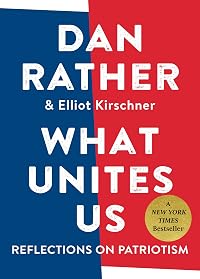
What Unites Us: Reflections on Patriotism
Algonquin Books
Hardcover, 978-1-6162-0782-3, (also available as an e-book and audio book), 288 pgs., $22.95
November 7, 2017
“Who can say definitely when and how it begins, that first, faint sense of place, of belonging; that trickle that eventually becomes a wellspring of deep emotional ties to one’s homeland?”
What is Patriotism? This is the question Dan Rather examines in What Unites Us: Reflections on Patriotism, the new collection of sixteen essays written with his longtime collaborator Elliot Kirschner. “It is important not to confuse ‘patriotism’ with ‘nationalism,’” Rather says. Then he separates Patriotism into what he show more believes are its five essential components: Freedom, Community, Exploration, Responsibility, and Character. These five components are further subdivided into such subjects as voting, dissent, immigration, the arts, service, and education. Rather feels that Americans are being tested and there’s a task before us. He also believes that we are up to the challenge.
Rather writes passionately and eloquently about his sense of urgency that moved him to write this book, stirring me to tears at times. His “greatest desire for this book is that it encourage conversation and debate about what it means to be an American today.” Rather’s career is currently enjoying a renaissance, especially his Facebook notes. At eighty-six, he is Texas’s elder statesman of journalism. His life has spanned enormous changes in our world, and his career has allowed him a front-row seat to many of them. Rather’s vantage point offers a sweeping view of these transformations, from his Great Depression and World War II childhood, to the beginnings of his career when he reported on civil rights, the assassination of JFK, and the Vietnam War, through Watergate, Iran-Contra, hanging chads, and the terror attacks of 9/11. What Unites Us benefits from these experiences as Rather illustrates many of his subjects with examples from Texas history and his childhood in East Texas during Jim Crow.
There are a few valuable, concise history lessons in What Unites Us, including immigration, Carnegie libraries in Texas, and public education. Rather is mostly balanced in his writing without resorting to the spreading plague of false equivalency. A man after my own heart, he includes an entire essay devoted to books. He urges us to return to the audacity of big ideas and exploration, but simultaneously “steady as she goes.”
What Unites Us is not a work that breaks new ground. The collection is basic, or it should be. Our current times are infected by willful ignorance and aggressive hostility. Rather emphasizes the “purgatory of tolerance” as not good enough, and he is correct—our goal should be inclusion. We should love our country like adults, not like a four-year-old loves his mother. As Rather writes, “I see my love of country imbued with a responsibility to bear witness to its faults.”
Save Oh, the Places You’ll Go for your kindergartener; What Unites Us would be a terrific gift to ground high school graduates in the principles of good citizenship. “We are bound together by a grand experiment in government, the rule of law, and common bonds of citizenship,” Rather writes. “This is what it means to be an American.”
Originally published in Lone Star Literary Life. show less
Dan Rather, Elliot Kirschner
What Unites Us: Reflections on Patriotism
Algonquin Books
Hardcover, 978-1-6162-0782-3, (also available as an e-book and audio book), 288 pgs., $22.95
November 7, 2017
“Who can say definitely when and how it begins, that first, faint sense of place, of belonging; that trickle that eventually becomes a wellspring of deep emotional ties to one’s homeland?”
What is Patriotism? This is the question Dan Rather examines in What Unites Us: Reflections on Patriotism, the new collection of sixteen essays written with his longtime collaborator Elliot Kirschner. “It is important not to confuse ‘patriotism’ with ‘nationalism,’” Rather says. Then he separates Patriotism into what he show more believes are its five essential components: Freedom, Community, Exploration, Responsibility, and Character. These five components are further subdivided into such subjects as voting, dissent, immigration, the arts, service, and education. Rather feels that Americans are being tested and there’s a task before us. He also believes that we are up to the challenge.
Rather writes passionately and eloquently about his sense of urgency that moved him to write this book, stirring me to tears at times. His “greatest desire for this book is that it encourage conversation and debate about what it means to be an American today.” Rather’s career is currently enjoying a renaissance, especially his Facebook notes. At eighty-six, he is Texas’s elder statesman of journalism. His life has spanned enormous changes in our world, and his career has allowed him a front-row seat to many of them. Rather’s vantage point offers a sweeping view of these transformations, from his Great Depression and World War II childhood, to the beginnings of his career when he reported on civil rights, the assassination of JFK, and the Vietnam War, through Watergate, Iran-Contra, hanging chads, and the terror attacks of 9/11. What Unites Us benefits from these experiences as Rather illustrates many of his subjects with examples from Texas history and his childhood in East Texas during Jim Crow.
There are a few valuable, concise history lessons in What Unites Us, including immigration, Carnegie libraries in Texas, and public education. Rather is mostly balanced in his writing without resorting to the spreading plague of false equivalency. A man after my own heart, he includes an entire essay devoted to books. He urges us to return to the audacity of big ideas and exploration, but simultaneously “steady as she goes.”
What Unites Us is not a work that breaks new ground. The collection is basic, or it should be. Our current times are infected by willful ignorance and aggressive hostility. Rather emphasizes the “purgatory of tolerance” as not good enough, and he is correct—our goal should be inclusion. We should love our country like adults, not like a four-year-old loves his mother. As Rather writes, “I see my love of country imbued with a responsibility to bear witness to its faults.”
Save Oh, the Places You’ll Go for your kindergartener; What Unites Us would be a terrific gift to ground high school graduates in the principles of good citizenship. “We are bound together by a grand experiment in government, the rule of law, and common bonds of citizenship,” Rather writes. “This is what it means to be an American.”
Originally published in Lone Star Literary Life. show less
Members
- Recently Added By
Author Information

21+ Works 1,766 Members
Dan Rather was born in Wharton, Texas, October 31, 1931. He attended Sam Houston State College at Huntsville, Texas, and earned his B.A. in Journalism in 1953. He went on to earn his Law degree from the University of Houston and South Texas School of Law. After graduation he became a Journalism instructor at Sam Houston State College and worked show more for United Press International, and the Houston Chronicle as a news writer, reporter, and news director. He joined the CBS radio affiliate KTRH in Houston in the mid-late 1950s. He became the director of news and public affairs for CBS television affiliate KHOU in Houston in the late 1950s to 1961. From 1961 to 1964 he was the chief of CBS's southwestern bureau in Dallas. In 1963 he became the CBS White House Correspondent, and two years later the chief of the CBS London bureau for a year. In 1966 he was a war correspondent in Vietnam and returned to a position as CBS White House correspondent from 1966 to 1974. In 1974, Rather became the anchor-correspondent for CBS Reports for a year before becoming the correspondent and co-editor for 60 Minutes until 1981. He has been an anchor for Dan Rather Reporting on the CBS Radio Network since 1977 and anchor and managing editor of the CBS Evening News with Dan Rather form 1981 to 2005. In 1988 he became the anchor for 48 Hours and has anchored numerous CBS news specials. Rather is the recipient of the Texas Associated Press Broadcasters' awards for spot news coverage in 1956 and 1959. He has received numerous Emmy Awards for his outstanding news reports. In May 2007, Rather received an honorary Doctor of Humane Letters from Siena College in Loudonville, New York, for his lifetime contributions to journalism. Rather is also a columnist whose work is distributed by King Features Syndicate. On May 28, 2007, Rather compared historical events to events in the Star Wars films in the History Channel special, "Star Wars: The Legacy Revealed". Rather continues to speak out against alleged influence in journalism by corporations and governments. At a recent conference in Minneapolis, Minnesota, sponsored by the group Free Press, Rather criticized both local and national news organizations, stating, according to reports, that there is no longer incentive to do "good and valuable news." Rather has since resumed his career with HDNet, a high-definition cable television station as a producer and hosts a weekly one-hour show called Dan Rather Reports as of October 24, 2006. Rather also has contributed as a guest on The Chris Matthews Show, and on The Daily Show. He has also formed an independent company called News and Guts Media. (Bowker Author Biography) show less
Some Editions
Work Relationships
Has the adaptation
Common Knowledge
- Original title
- What Unites Us
- Original publication date
- 2017
- People/Characters
- Dan Rather
- Important places
- United States of America
- Epigraph
- The greatness of America lies not in being more enlightened than any other nation, but rather in her ability to repair her faults.
-- Alexis de Toqueville - Dedication
- To my grandsons, Martin and Andy, whose spirit of service and love for this country fill me with pride and confidence that our nation can unite and see better days ahead.
-- D.R.
To Malia, Eva, and Helena -- my inspiration, hope, and love.
-- E.K. - First words
- The sun has set long ago and the sky is dark. (Preface: "Night Flights")
When I was a young boy, we didn't have much in the way of material possessions. - Last words
- (Click to show. Warning: May contain spoilers.)And I believe in all of you to help make it a reality. Courage.
- Publisher's editor
- Pories, Kathy; Gleick, Betsy
- Canonical DDC/MDS
- 323.650973
- Canonical LCC
- JK1759
Classifications
- Genres
- General Nonfiction, Nonfiction, History, Biography & Memoir
- DDC/MDS
- 323.650973 — Society, government, & culture Political science Civil Rights & Liberties/ Human Rights Citizenship Duties and obligations of citizens
- LCC
- JK1759 — Political Science Political institutions and public administration (United States) Political institutions and public administration United States Political rights. Practical politics Citizenship
- BISAC
Statistics
- Members
- 578
- Popularity
- 50,880
- Reviews
- 26
- Rating
- (4.03)
- Languages
- English
- Media
- Paper, Audiobook, Ebook
- ISBNs
- 10
- ASINs
- 2