
Philip Rucker
Author of A Very Stable Genius: Donald J. Trump's Testing of America
About the Author
Image credit: Phil Rucker at the 2018 Pulitzer Prizes awards ceremony
Works by Philip Rucker
Associated Works
A Very Stable Genius {and} The Beautiful Poetry of Donald Trump (2020) — Contributor — 1 copy, 1 review
Siege Trump Under Fire, Trump The Art of the Deal, A Very Stable Genius Donald J. Trump's Testing of America (2020) — Contributor — 1 copy
Tagged
Common Knowledge
- Birthdate
- 1984-03-20
- Gender
- male
- Education
- Yale University (History)
- Occupations
- investigative journalist
political analyst - Organizations
- Washington Post
NBC
MSNBC - Awards and honors
- George Polk Award
- Nationality
- USA
- Associated Place (for map)
- USA
Members
Reviews
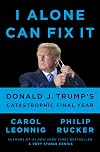
The second book by Carol Leonnig and Philip Rucker about the Trump presidency - the first, A Very Stable Genius - was a national best seller - is another page turner from beginning to end. They demonstrate time after time that the subtitle of I Alone Can Fix It, i.e., “catastrophic final year,” is more than apt.
The prize-winning reporters show how Trump’s pig-headed refusal to confront the reality of COVID-19 caused hundreds of thousands of needless deaths. But even more gripping is show more the nearly day-by-day narration of Trump’s unconstitutional and ultimately futile (thankfully) efforts to overturn the results of the 2020 presidential election.
If there is a hero in their story, it is General Mark Milley, Chairman of the Joint Chiefs of Staff, whose steadfast opposition to Trump’s efforts to enlist the military in overturning the election may have saved our democracy. A few, and only a few, other characters in Trump’s administration can be said to have acted somewhat honorably during the crucial days from immediately before the election to Biden’s final assumption of the presidency. Mark Esper, Secretary of Defense, generally advocated constitutionally acceptable behavior. And William Barr, who had done Trump’s bidding and had grossly mischaracterized the results of the Mueller Report for Trump’s benefit, finally refused (for whatever reason) to use the Justice Department to further Trump’s unfounded claims of election fraud.
Some of the most chilling passages in the book appear in the Epilogue, which is a recapitulation of a two and one half hour interview that Trump gave to the authors. There they use Trump’s own words to show how demented he has become. His depiction of what happened on January 6, 2021, for example, can be justifiably characterized as bonkers. Not only does he claim it was “a loving crowd,” but that the Capitol Police were ushering people in… hugging and kissing them.”
Then there was Trump claiming he won Arizona in 2020: “I won Arizona, okay? By a lot. Didn’t turn out that way in terms of the vote, but I won Arizona.” It would be funny if it were spoken by anyone who didn’t have the power to turn millions into rabid mobs based on his lies.
Many in the crowd storming the Capital on January 6, for example, were yelling that “Our president wants us here.” Believing Trump’s claims that Biden “stole” the election and that House Speaker Nancy Pelosi and Vice President Mike Pence aided and abetted the thieves, the crowd reacted accordingly:
"Under battle flags bearing Donald Trump’s name, the Capitol’s attackers pinned a bloodied police officer in a doorway, his twisted face and screams captured on video. They mortally wounded another officer with a blunt weapon and body-slammed a third over a railing into the crowd.
'Hang Mike Pence!' the insurrectionists chanted as they pressed inside, beating police with pipes. They demanded House Speaker Nancy Pelosi’s whereabouts, too. They hunted any and all lawmakers: 'Where are they?' Outside, makeshift gallows stood, complete with sturdy wooden steps and the noose. Guns and pipe bombs had been stashed in the vicinity."
Thankfully, they were ultimately thwarted although Trump continues to encourage hate groups and political violence. (See, for example, this timeline of Trump’s incitement.)
The book ends by the authors observing that Trump is spending his post-presidency in much the same way he spent his time in office: watching television all morning, or playing golf at one of his nearby clubs [and still charging the Secret Service, it might be added.]. Then, as the authors write, “he puts on his suit, applies his makeup, and merges for meetings with whichever politician or acolytes have made the pilgrimage to Mar-a-Lago.”
After reading this book , one would have to agree with Nancy Pelosi’s estimation of Trump she made on January 8, 2021:
“This guy’s crazy….He’s dangerous. He’s a maniac. We have deep concerns.”
(JAB) show less
The prize-winning reporters show how Trump’s pig-headed refusal to confront the reality of COVID-19 caused hundreds of thousands of needless deaths. But even more gripping is show more the nearly day-by-day narration of Trump’s unconstitutional and ultimately futile (thankfully) efforts to overturn the results of the 2020 presidential election.
If there is a hero in their story, it is General Mark Milley, Chairman of the Joint Chiefs of Staff, whose steadfast opposition to Trump’s efforts to enlist the military in overturning the election may have saved our democracy. A few, and only a few, other characters in Trump’s administration can be said to have acted somewhat honorably during the crucial days from immediately before the election to Biden’s final assumption of the presidency. Mark Esper, Secretary of Defense, generally advocated constitutionally acceptable behavior. And William Barr, who had done Trump’s bidding and had grossly mischaracterized the results of the Mueller Report for Trump’s benefit, finally refused (for whatever reason) to use the Justice Department to further Trump’s unfounded claims of election fraud.
Some of the most chilling passages in the book appear in the Epilogue, which is a recapitulation of a two and one half hour interview that Trump gave to the authors. There they use Trump’s own words to show how demented he has become. His depiction of what happened on January 6, 2021, for example, can be justifiably characterized as bonkers. Not only does he claim it was “a loving crowd,” but that the Capitol Police were ushering people in… hugging and kissing them.”
Then there was Trump claiming he won Arizona in 2020: “I won Arizona, okay? By a lot. Didn’t turn out that way in terms of the vote, but I won Arizona.” It would be funny if it were spoken by anyone who didn’t have the power to turn millions into rabid mobs based on his lies.
Many in the crowd storming the Capital on January 6, for example, were yelling that “Our president wants us here.” Believing Trump’s claims that Biden “stole” the election and that House Speaker Nancy Pelosi and Vice President Mike Pence aided and abetted the thieves, the crowd reacted accordingly:
"Under battle flags bearing Donald Trump’s name, the Capitol’s attackers pinned a bloodied police officer in a doorway, his twisted face and screams captured on video. They mortally wounded another officer with a blunt weapon and body-slammed a third over a railing into the crowd.
'Hang Mike Pence!' the insurrectionists chanted as they pressed inside, beating police with pipes. They demanded House Speaker Nancy Pelosi’s whereabouts, too. They hunted any and all lawmakers: 'Where are they?' Outside, makeshift gallows stood, complete with sturdy wooden steps and the noose. Guns and pipe bombs had been stashed in the vicinity."
Thankfully, they were ultimately thwarted although Trump continues to encourage hate groups and political violence. (See, for example, this timeline of Trump’s incitement.)
The book ends by the authors observing that Trump is spending his post-presidency in much the same way he spent his time in office: watching television all morning, or playing golf at one of his nearby clubs [and still charging the Secret Service, it might be added.]. Then, as the authors write, “he puts on his suit, applies his makeup, and merges for meetings with whichever politician or acolytes have made the pilgrimage to Mar-a-Lago.”
After reading this book , one would have to agree with Nancy Pelosi’s estimation of Trump she made on January 8, 2021:
“This guy’s crazy….He’s dangerous. He’s a maniac. We have deep concerns.”
(JAB) show less
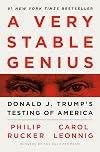
Rucker, Philip, and Carol Leonnig. A Very Stable Genius: Donald J. Trump’s Testing of America. Penguin, 2020.
If you are a regular reader of The Washington Post, not much in A Very Stable Genius will be new to you. That should be no surprise because the authors are star reporters covering the White House. Nor is there any breaking news, because the book’s epilog gets us only so far as the beginnings of the impeachment hearings. But that does not mean that even a regular reader of the Post show more will not find this book valuable. In a clear way, it explains some of the havoc the mercurial personality of the president has wrought on the governance of defense, foreign policy, and justice. Trump predictably called the book all lies, even though none of the information or quotations in the book were challenged. Most of the information in the book comes either from Trump’s own speeches and tweets or from people who were in the room when the disasters were being hatched. The result is excellent explanatory journalism. There are no rants or polemics from the authors. Like the Mueller report, they leave the readers to draw their own conclusions. For this reader, the evidence they have assembled and the story they tell provides a chill to the bone, as the only people I can admire are the ones who had the guts to quit and tell Trump why. But the downside is that all those folks were, in fact, forced out. An exception is Chris Christie, who had the good sense to turn down the chance to be Trump's chief of staff, a job that could have damaged his reputation even more than Bridgegate. show less
If you are a regular reader of The Washington Post, not much in A Very Stable Genius will be new to you. That should be no surprise because the authors are star reporters covering the White House. Nor is there any breaking news, because the book’s epilog gets us only so far as the beginnings of the impeachment hearings. But that does not mean that even a regular reader of the Post show more will not find this book valuable. In a clear way, it explains some of the havoc the mercurial personality of the president has wrought on the governance of defense, foreign policy, and justice. Trump predictably called the book all lies, even though none of the information or quotations in the book were challenged. Most of the information in the book comes either from Trump’s own speeches and tweets or from people who were in the room when the disasters were being hatched. The result is excellent explanatory journalism. There are no rants or polemics from the authors. Like the Mueller report, they leave the readers to draw their own conclusions. For this reader, the evidence they have assembled and the story they tell provides a chill to the bone, as the only people I can admire are the ones who had the guts to quit and tell Trump why. But the downside is that all those folks were, in fact, forced out. An exception is Chris Christie, who had the good sense to turn down the chance to be Trump's chief of staff, a job that could have damaged his reputation even more than Bridgegate. show less
If you listen to the news - all the news, not just Fox news - you can't help but question some of the antics of our POTUS. Still, after reading this book and learning about the behind-the-scene-shenanigans being carried out by our politicians in the White House, I believe this book is scarier than any Stephen King novel I've read to date. Congrats to Philip Rucker and Carol Leonnig (both Pulitzer prize winners) for laying this out in clear and irrefutable terms. DJT is not fit to be running show more our country, and yet he has survived a two-year FBI probe into collusion with a foreign power, proven obstruction of the investigation, and impeachment for blatantly using his office for political gain. What else is our republican party going to allow him to get away with? As quoted in the book by William A. Galston, "We haven't seen anything like this in my lifetime. He (Trump) appears to be daring the rest of the political system to stop him—and if it doesn't, he'll go further. What we're discovering is that the Constitution is not a mechanism that runs by itself. Ultimately, we are a government of men and not law. The law has no force without people who are willing to enforce it." Where are our enforcers, and where is this going to end? show less
I'm sure everyone reading this lived through 2020. This book lets you relive the events in a nifty chronological package that I could not put down. It was interesting to match my recollection against the book's actual account.
No one in the Trump administration connected in any way to COVID-19 fared well. Those who tried to warn the president got fired. Those, like Pence, the "oleaginous sycophant", in George Will's memorable characterization, deferentially who did their master's bidding, got show more burned.
The authors clearly had a lot of these folks as sources; even Trump agreed to be interviewed. But that also means the reader must be careful as many of the comments, made with full hindsight, are clearly attempts to put themselves and their own actions in the best light possible.
Even where Trump's policies were popular and would have benefited the country, his administration's incompetence prevented their implementation. The Supreme Court turned away several petitions because of incompetent presentation; the proposal to reduce drug costs failed because they ignored the rules, and it was tossed in court; and we all know about the Great Wall.
If there is any hero, it has to be General Mark Milley who repeatedly tried to be the adult in the room during meetings and was devoted to the concept of civilian control of the military, which he interpreted as also implying that civilians could not use the military as their own police force. Trump's recurring fantasy was that, as president, all the people and agencies owed personal loyalty to him and him alone, not the Constitution nor its principles.
Trump, who had refused to be interviewed for the authors' first book, gladly agreed to two hours for this one. It's recounted in the epilogue and consisted primarily of diatribes against those he had initially lauded but now despised and how he really won the election by the greatest margin in the history of the world. The man doesn't know how to speak in anything but hyperbole and superlatives. Doesn't say much for his ability to judge people.
A great read. show less
No one in the Trump administration connected in any way to COVID-19 fared well. Those who tried to warn the president got fired. Those, like Pence, the "oleaginous sycophant", in George Will's memorable characterization, deferentially who did their master's bidding, got show more burned.
The authors clearly had a lot of these folks as sources; even Trump agreed to be interviewed. But that also means the reader must be careful as many of the comments, made with full hindsight, are clearly attempts to put themselves and their own actions in the best light possible.
Even where Trump's policies were popular and would have benefited the country, his administration's incompetence prevented their implementation. The Supreme Court turned away several petitions because of incompetent presentation; the proposal to reduce drug costs failed because they ignored the rules, and it was tossed in court; and we all know about the Great Wall.
If there is any hero, it has to be General Mark Milley who repeatedly tried to be the adult in the room during meetings and was devoted to the concept of civilian control of the military, which he interpreted as also implying that civilians could not use the military as their own police force. Trump's recurring fantasy was that, as president, all the people and agencies owed personal loyalty to him and him alone, not the Constitution nor its principles.
Trump, who had refused to be interviewed for the authors' first book, gladly agreed to two hours for this one. It's recounted in the epilogue and consisted primarily of diatribes against those he had initially lauded but now despised and how he really won the election by the greatest margin in the history of the world. The man doesn't know how to speak in anything but hyperbole and superlatives. Doesn't say much for his ability to judge people.
A great read. show less
Lists
Awards


You May Also Like


Associated Authors
Statistics
- Works
- 3
- Also by
- 4
- Members
- 1,312
- Popularity
- #19,573
- Rating
- 4.1
- Reviews
- 51
- ISBNs
- 34
- Languages
- 4