Nadia's Hands
by Karen English
On This Page
Description
A Pakistani-American girl takes part in her aunt's traditional Pakistani wedding.Tags
Recommendations





Member Reviews
There were four reasons I liked this book. I liked that the author provides a glossary of Urdu words at the beginning of the story. It gives the reader a sense of entering another world or culture and prepares the reader for the text. Words like “mehndi,” a paste made from a henna tree, are defined that enhance the reader’s understanding of the story when the main character’s aunt uses the term. I think the glossary allowed the author to make the story more culturally in-depth without disconnecting the text from readers unacquainted with the traditions.
I also liked the rhythm and flow of the language. Several times, Nadia thinks “she didn’t want these hands that didn’t look like her hands.” This repetition brings the show more reader back to a central point; Nadia’s hands are part of her, and regardless of her wishes, so is her culture. The connection between a body part and ethnic background shows the permanence of culture in formation of identity. I think the repetition of this phrase showed Nadia’s desire to be similar to the norms of mainstream culture.
The use of this repetition was also insightful because when Nadia finally accepts her hands, and by extension her family traditions, the author uses the same rhythm. Nadia “likes these hands” that make her family happy. I think the repetition allows the reader to glimpse inside Nadia’s thought processes.
Finally, I liked the warmth of the supporting characters. The big idea or central theme of the book is to accept one’s individuality and cultural traditions. Nadia begins to accept her differences from the children at school because of the encouragement of the supporting characters. Her Uncle Abdul Raheem says kind words to Nadia about her hands and patience, as he visits with her in the kitchen. Her parents, aunts, and uncles smile at her supportively as she walks down the aisle as a flower girl. The overwhelming love that is felt from these supporting characters is what eventually causes Nadia to accept her hands. She says her hands make her family happy, so they make her happy too.
Supporting the big idea of individuality, I liked that we never find out how the children at Nadia’s school feel about her hands. She expresses anxiety throughout the entire book over what these classmates will say about her painted hands and the reader never sees the final result. I think this reinforces the idea of family and individuality because it is no longer important what her classmates think, but what Nadia thinks of herself. I enjoyed this book and its message. show less
I also liked the rhythm and flow of the language. Several times, Nadia thinks “she didn’t want these hands that didn’t look like her hands.” This repetition brings the show more reader back to a central point; Nadia’s hands are part of her, and regardless of her wishes, so is her culture. The connection between a body part and ethnic background shows the permanence of culture in formation of identity. I think the repetition of this phrase showed Nadia’s desire to be similar to the norms of mainstream culture.
The use of this repetition was also insightful because when Nadia finally accepts her hands, and by extension her family traditions, the author uses the same rhythm. Nadia “likes these hands” that make her family happy. I think the repetition allows the reader to glimpse inside Nadia’s thought processes.
Finally, I liked the warmth of the supporting characters. The big idea or central theme of the book is to accept one’s individuality and cultural traditions. Nadia begins to accept her differences from the children at school because of the encouragement of the supporting characters. Her Uncle Abdul Raheem says kind words to Nadia about her hands and patience, as he visits with her in the kitchen. Her parents, aunts, and uncles smile at her supportively as she walks down the aisle as a flower girl. The overwhelming love that is felt from these supporting characters is what eventually causes Nadia to accept her hands. She says her hands make her family happy, so they make her happy too.
Supporting the big idea of individuality, I liked that we never find out how the children at Nadia’s school feel about her hands. She expresses anxiety throughout the entire book over what these classmates will say about her painted hands and the reader never sees the final result. I think this reinforces the idea of family and individuality because it is no longer important what her classmates think, but what Nadia thinks of herself. I enjoyed this book and its message. show less
Though the protagonist seemed a bit overly preoccupied with what the kids at school would think on Monday, the rest of the story was heartwarming and nicely written. The illustrations were beautiful as well. Good book about a culture that doesn't get reported on terribly often. I wondered what Urdu was when I was reading. In fact, I had to read about it online afterward.
I thought this was a beautiful story about a Pakistani-American girl named Nadia. I loved reading this story because Nadia shows her excitement, yet nervousness, for being a flower girl in her family member’s wedding. I related to this because when I was Nadia’s age, I was also a nervous flower girl. This book gave me a step-by-step understanding of traditional Pakistani weddings. The focus on the mehndi, which is semi-permanent hand designs used for special occasions, was interesting, as I had seen such designs before, but never knew the real purpose. This story is beautiful because as Nadia is anxious about going to school with the hand designs still on her hands, her anxiety slowly goes away as she realizes the importance of her show more culture. This book really emphasizes different cultures, and that it is acceptable to be different. I thought this book did a wonderful job of putting into perspective how necessary it is to not only accept differences, but also embrace them. show less
I liked this book for several reasons. Nadia is a Pakistan-American girl and was chosen to be the flower girl in one of her family member’s Pakistani wedding. Since it was such a special occasion her hands were decorated in mehndi (henna), which is part of Pakistani tradition. Nadia was very worried what her classmates would say and think about her “orange hands,” instead of being excited and honored to be a part of the wedding ceremony. The language used was very descriptive and patterned at times, for example, “She didn’t want these hands that didn’t look like her hands.” I thought that this was a very ironic statement and touches on how immigrants feel the need to suppress their culture and become “Americanized.” At show more that moment, with the traditional drawings on her hands, Nadia’s hands represented her customs and cultural identity. But she was afraid of being different from her classmates and didn’t want the henna. Fortunately, Nadia has a transformation in the book. During the ceremony, while walking down the isle, she looked at her hands and “Her heart began to pound at the sight of those hands that she’d have to take to school on Monday—those hands that looked as if they belonged to someone else.” She messed up a step, received glances from her relatives causing her to do better. She realized her hands made her family happy, so they made her happy too. She decided that she could talk about her hands during share time in school. The last sentence of the book brought her transformation full circle: “Her hands didn’t look as if they belonged to someone else, she decided. They looked as if they belonged to her.” This quote demonstrates that Nadia had realized the importance of her culture and it was very similar to a previous quite, but with an entirely different meaning. This book is a great multicultural book because it encompasses the issues with becoming “Americanized” while simultaneously showing how important cultural identity is. It also has various words written in the native Pakistan language of Urdu and their definitions throughout the book. The big idea of this book is that one’s cultural identity is important. It demonstrates who each person is as an individual, while also representing his or her heritage. People should not suppress their culture simply because it is different, rather, they should embrace it and appropriately share it with the people around them. show less
Nadia’s hands is a book about a young girl who is going to be a flower girl in her Aunt’s traditional Pakistani wedding and how she has to get her hands painted for the wedding, a Pakistani tradition. I liked this book for the overall message, illustrations and all the Urdu incorporated in the book, this being the language spoken in Pakistan.
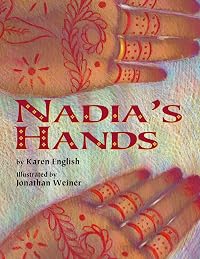
First off I enjoyed the illustrations because they were sketched and hand drawn images. I feel this made the pictures stand out on the page and helped to convey just how beautiful Nadia’s hands looked painted. An example is when Nadia got her hands done and after the author shows you the painting on her hands. The red flower designs on her hands really stand out. This I feel made the book show more special and helped the reader to understand the Pakistani culture and the beauty in it. This also related to the overall message of the book, which is what I really liked about it. The message was that you need to embrace your culture. I loved this because I feel readers of all cultures can relate to this and learn from it. An example I saw was that throughout the whole book Nadia did not want her hands painted because she didn’t want people at school on Monday to see them but in the end she loved her hands when she saw how happy it made her mother and grandmother. I feel this helped the reader to understand that everybody is different but that doesn’t make it a bad thing. This I feel made the book as special as it is. The final thing I liked was the Urdu incorporated throughout the book. An example of this is when Nadia is saying what she is wearing she says she will wear “Shalwar” or silky trousers in English. I liked this because I feel it helped the reader to understand the culture and the relationship between the English and Pakistani culture. Overall I enjoyed this book and feel that it helped to convey the message that you should embrace who you are. show less
First off I enjoyed the illustrations because they were sketched and hand drawn images. I feel this made the pictures stand out on the page and helped to convey just how beautiful Nadia’s hands looked painted. An example is when Nadia got her hands done and after the author shows you the painting on her hands. The red flower designs on her hands really stand out. This I feel made the book show more special and helped the reader to understand the Pakistani culture and the beauty in it. This also related to the overall message of the book, which is what I really liked about it. The message was that you need to embrace your culture. I loved this because I feel readers of all cultures can relate to this and learn from it. An example I saw was that throughout the whole book Nadia did not want her hands painted because she didn’t want people at school on Monday to see them but in the end she loved her hands when she saw how happy it made her mother and grandmother. I feel this helped the reader to understand that everybody is different but that doesn’t make it a bad thing. This I feel made the book as special as it is. The final thing I liked was the Urdu incorporated throughout the book. An example of this is when Nadia is saying what she is wearing she says she will wear “Shalwar” or silky trousers in English. I liked this because I feel it helped the reader to understand the culture and the relationship between the English and Pakistani culture. Overall I enjoyed this book and feel that it helped to convey the message that you should embrace who you are. show less
There are many reasons a liked this book. First of all this book is educational for anyone reading it. I learned a lot about the Pakistani culture that I did not know about before. Nadia is a Pakistani-American girl who is a flower girl in her Aunts wedding. For the wedding, Nadia's Aunt puts mehndi on her hands which is only put on their hands for important occasions. I enjoyed this book because it pushes readers to think about other cultures besides their own and try to connect their own experiences to another culture or learn more about something they may have never experienced. The book also explains what it's like to be a part of a culture that isn't like your classmates. Nadia was embarrassed to go to school Monday with her hands show more covered in mehndi but after the wedding and seeing how proud her entire family was of her she accepts the fact that she is different, and she is proud of her culture. She even thinks about showing her hands during sharing time. The book has an important message for young readers - to accept who you are and to be proud of it. show less
This book was enjoyable to read because I was able to learn about the Pakistani culture. I could relate to this book because I too was in a wedding when I was a little girl. The pictures also made the book enticing because they show the Pakistani culture and how they dress, which is different from what I have seen.
I like how the authored created an underlying issue that the character was facing and turned it into a good ending. The little girl Nadia was afraid of what her friends might think about her painted hands at school on Monday morning. However, add the end of the book she realizes that the paint on her hands is a way for her to teach everyone at school about her culture. I believe that this is a message all children should show more learn. The pictures are beautiful, unique and shows the styles of the people of their culture. Jonathan Weiner uses warm colors and adds the swirls that Nadia’s hands are marked with on each page as a design. Another reason I thought this book was great was because in the beginning of the book, she gives the readers a note. The note defines 5 different words in Urdu. I like that she defined these words in the beginning of the book, rather than the end, because the readers get a better understanding. It gives the readers a task to look out for those words while reading. I believe this story also pushes readers to use their imagination and how they would feel if they were Nadia. Readers might be able to relate to her situation because some children might’ve been forced to do something that they didn’t want to do based on their traditions.
I think the overall message of the book is to be proud of your heritage and culture. Additionally, don’t be afraid to be different. show less
I like how the authored created an underlying issue that the character was facing and turned it into a good ending. The little girl Nadia was afraid of what her friends might think about her painted hands at school on Monday morning. However, add the end of the book she realizes that the paint on her hands is a way for her to teach everyone at school about her culture. I believe that this is a message all children should show more learn. The pictures are beautiful, unique and shows the styles of the people of their culture. Jonathan Weiner uses warm colors and adds the swirls that Nadia’s hands are marked with on each page as a design. Another reason I thought this book was great was because in the beginning of the book, she gives the readers a note. The note defines 5 different words in Urdu. I like that she defined these words in the beginning of the book, rather than the end, because the readers get a better understanding. It gives the readers a task to look out for those words while reading. I believe this story also pushes readers to use their imagination and how they would feel if they were Nadia. Readers might be able to relate to her situation because some children might’ve been forced to do something that they didn’t want to do based on their traditions.
I think the overall message of the book is to be proud of your heritage and culture. Additionally, don’t be afraid to be different. show less
Members
- Recently Added By
Author Information

34 Works 3,016 Members
Awards and Honors
Awards
Common Knowledge
- Important places
- Pakistan
- Dedication
- For Nadia, Sajjad, Maliha, Manar, Mohammed, Dzeneta, and April -K.E.
To my parents, Joel and Laurie, for their love, support, and trust -J.W. - First words
- For Auntie Laila's wedding, the aunts decided that it was Nadia's turn to be the flower girl.
- Last words
- (Click to show. Warning: May contain spoilers.)They looked as if they belonged to her.
Classifications
Statistics
- Members
- 183
- Popularity
- 179,906
- Reviews
- 33
- Rating
- (4.08)
- Languages
- English
- Media
- Paper, Ebook
- ISBNs
- 7