On This Page
Description
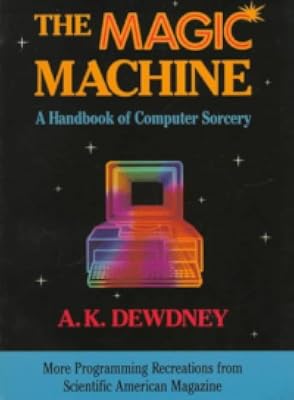
A collection of columns named "Computer Recreations" from Scientific American magazine.Tags
Recommendations


















Member Reviews
First there was Martin Gardener, then there was Doug Hofstadter, then here was...this Dewdney dude. They were successive writers of the "recreational" column in Scientific American. Dewdney's was "Computer Recreations" and here they are, neatly collected up in a book and updated, too! Except the column ran from 1984-86 and my brother helpful scrawled "1988" in his copy - so it's hideously out-of-date now. There isn't a topic in here that hasn't advanced enormously in the intervening time, perhaps most alarmingly in the discussion of malware, which provoked some readers to write their own disc or network propagated viruses!
That said, because these are recreations, the book has in an important sense not gone out of date; one can still show more have a go at implementing the simple and not so simple programs discussed oneself - which is the point of these columns, after all - just don't expect to be contributing to the cutting edge of any of these topics anymore.
Some topics were more interesting than others but I think individual opinions on which are most engaging will vary a lot. It's a diverse collection ranging from chaos theory and fractals to mathematical automata (which are a lot more fun than they sound) to simulated zombies and banks to anagrams and pangrams to the aforementioned malware and simple genetic algorithms (which interested me a lot).
The coding challenges seem to become greater as the book progresses but one need not try any of them in order to derive some amusement from this collection - one can live vicariously through the author's discussion of the efforts of the readers of the original articles and see how they got on. show less
That said, because these are recreations, the book has in an important sense not gone out of date; one can still show more have a go at implementing the simple and not so simple programs discussed oneself - which is the point of these columns, after all - just don't expect to be contributing to the cutting edge of any of these topics anymore.
Some topics were more interesting than others but I think individual opinions on which are most engaging will vary a lot. It's a diverse collection ranging from chaos theory and fractals to mathematical automata (which are a lot more fun than they sound) to simulated zombies and banks to anagrams and pangrams to the aforementioned malware and simple genetic algorithms (which interested me a lot).
The coding challenges seem to become greater as the book progresses but one need not try any of them in order to derive some amusement from this collection - one can live vicariously through the author's discussion of the efforts of the readers of the original articles and see how they got on. show less
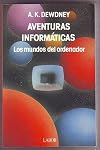
The armchair universe contains many worlds, each accessible through the magic of computing. An office, study, or living room becomes a spaceship, provided it is equipped with a computer and an armchair. The computer (whether micro or mainframe) is loaded with one or more of the programs outlined in this book. The armchair is occupied by the reader ready for high adventure in the infinitesimal reaches of the Mandelbrot Set, the mind-bending four-dimensionality of hypercubes, the graceful ballet of a cluster of stars.
The world's described here first appeared in my monthly ""Computer Recreations"" column in SCIENTIFIC AMERICAN magazine. Each world contains columns grouped by common themes such as artificial intelligence, simulation, and so show more on. It is no accident that many of these themes correspond to topics in computer science; professing the subject at a North American university has worn certain grooves in my brain. Readers largely unfamiliar with the subject may glean a partial education merely by engaging in the projects suggested herein. show less
The world's described here first appeared in my monthly ""Computer Recreations"" column in SCIENTIFIC AMERICAN magazine. Each world contains columns grouped by common themes such as artificial intelligence, simulation, and so show more on. It is no accident that many of these themes correspond to topics in computer science; professing the subject at a North American university has worn certain grooves in my brain. Readers largely unfamiliar with the subject may glean a partial education merely by engaging in the projects suggested herein. show less
1
Un excelente libro que reencuentro tras años de seguir a Dewdney en Investigación y Ciencia. Aunque ahora pueda sonar un tanto obsoleto en lo que a desarrollo se refiere, las ideas que maneja siguen siendo seductoras y abren fronteras a posibles elaboraciones aún hoy innovadoras.
Oct 30, 2017Spanish
Ratings
Members
- Recently Added By
Author Information

27+ Works 1,950 Members
Recreations, his column which appeared in Scientific American for more than eight years. He has been an Associate Professor of Computer Science at the University of Western Ontario in Canada since 1968, and is president of Turing Omnibus, Inc. Among his many books on computer science, science and mathematics are Two Hundred Percent of Nothing show more (1993), an effort to expose abuses of math and statistics in everyday life and its companion work, Yes, We Have No Neutrons (1997). Dewdney is also interested in growing and distributing rare native trees, as manifested in his book, Hungry Hollow: The Story of a Natural Place (1998). Hungry Hollow examines the elements of a natural habitat in both time and space. (Bowker Author Biography) show less
Series

Common Knowledge
- Canonical title
- The Armchair Universe: An Exploration of Computer Worlds
- Original publication date
- 1988
- Original language
- English
Classifications
- Genres
- Technology, Nonfiction, General Nonfiction, Science & Nature
- DDC/MDS
- 005.26 — Computer science, information & general works Computer science, knowledge & systems Artificial Intelligence/Virtual Reality Programming for Specific Environments Personal Computers
- LCC
- QA76.6 .D517 — Science Mathematics Mathematics Instruments and machines Calculating machines Electronic computers. Computer science
Statistics
- Members
- 205
- Popularity
- 160,208
- Reviews
- 3
- Rating
- (3.84)
- Languages
- English, Spanish
- Media
- Paper
- ISBNs
- 4
- ASINs
- 1