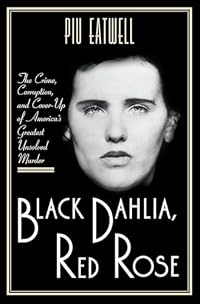
Black Dahlia, Red Rose: The Crime, Corruption, and Cover-Up of America's Greatest Unsolved Murder
by Piu Eatwell
On This Page
Description
Los Angeles, 1947. The mutilated body of Elizabeth Short, an aspiring starlet from Massachusetts is found; her killer never would be. As the "Black Dahlia" she became a warning for "loose" women in postwar America, and her death has maintained an almost mythic place in American lore. Eatwell gained access to newly-released evidence and has persuasively identified the culprit, using clues to the case that have never surfaced in public.Tags
Recommendations





Member Reviews
On the same subject as James Ellroy's gripping pulp novel, Black Dahlia (a fictional reworking of the 1947 murder of Elizabeth Short, in Los Angeles), but non-fiction. Piu Eatwell's book is a true crime account, based on unredacted FBI and police files and new interviews, but it's no less of a page-turner.
"In the following pages I tell the story of this extraordinary case. However, despite its narrative form, this is not a work of fiction. Anything written between quotation marks comes from a letter, memoir, or other written document. If I describe the weather on a particular day, it is because I checked the contemporary weather reports. " (from the preface)
I won't give spoilers, but Eatwell makes a very convincing case for the suspect show more she fancies as the killer.
It's a plot so thick you could stand a spoon up in it. But events are gone over several times, from different angles, which makes it easier to understand.
Psychopathic bellhops, dodgy nightclub owners, pornographers,cynical chain - smoking journalists, cops who run protection rackets (extorting the gangsters), girls arriving on the bus hoping to make it in the movies (Ann Toth, a friend of the victim,later had a bit part in the film Smash-Up - you can still see this today, on DVD) --they're all in this book.
There's even one suspect who was a physician,who was suspected of murdering his secretary, as well as the Black Dahlia. He ran an illegal abortion clinic, was into surrealist art, and was even suspected by the police of having Communist sympathies. (He escaped to the Philippines.)
One of the gangster suspects gets shot in the back with a twenty-five-caliber automatic pistol, by his dancer girlfriend, accusing him of being a "goddam cop lover". She wound up in a lunatic asylum.
The books a great read, and a real window on a previous era. Even the chapter titles are in an atmospheric art deco typeface.
Highly recommended! show less
"In the following pages I tell the story of this extraordinary case. However, despite its narrative form, this is not a work of fiction. Anything written between quotation marks comes from a letter, memoir, or other written document. If I describe the weather on a particular day, it is because I checked the contemporary weather reports. " (from the preface)
I won't give spoilers, but Eatwell makes a very convincing case for the suspect show more she fancies as the killer.
It's a plot so thick you could stand a spoon up in it. But events are gone over several times, from different angles, which makes it easier to understand.
Psychopathic bellhops, dodgy nightclub owners, pornographers,cynical chain - smoking journalists, cops who run protection rackets (extorting the gangsters), girls arriving on the bus hoping to make it in the movies (Ann Toth, a friend of the victim,later had a bit part in the film Smash-Up - you can still see this today, on DVD) --they're all in this book.
There's even one suspect who was a physician,who was suspected of murdering his secretary, as well as the Black Dahlia. He ran an illegal abortion clinic, was into surrealist art, and was even suspected by the police of having Communist sympathies. (He escaped to the Philippines.)
One of the gangster suspects gets shot in the back with a twenty-five-caliber automatic pistol, by his dancer girlfriend, accusing him of being a "goddam cop lover". She wound up in a lunatic asylum.
The books a great read, and a real window on a previous era. Even the chapter titles are in an atmospheric art deco typeface.
Highly recommended! show less
This is a fascinating, meticulous and heartfelt retelling of the 70 year old (and officially unsolved) Black Dahlia murder case, packed with great detail about both the investigation and the state of Los Angeles and the USA at the time. It’s sensitively handled and packed with a rich cast of characters that the author seems to have really taken the time to get to know. The victim, Elizabeth Short, remains a cipher, but the personalities of those caught up in the aftermath of her death are richly and memorable described.
The author comes to her own conclusion about the perpetrator, and it was in the final few chapters where the narrative switches to her present day investigations, that the book most came alive for me.
I’ve not read show more much true crime, but what struck me most about this book was the emphasis on the people rather that the crime. It’s never titillating or ghoulish (as I, perhaps wrongly, imagine much true crime writing is) but rather a suitably somber analysis of a tragic and brutal death.
. show less
The author comes to her own conclusion about the perpetrator, and it was in the final few chapters where the narrative switches to her present day investigations, that the book most came alive for me.
I’ve not read show more much true crime, but what struck me most about this book was the emphasis on the people rather that the crime. It’s never titillating or ghoulish (as I, perhaps wrongly, imagine much true crime writing is) but rather a suitably somber analysis of a tragic and brutal death.
. show less
The information here, including a very plausible theory of who was involved in the Dahlia killing, is very solid. But it's bogged down by messy writing. I frequently couldn't parse sentences or figure out what the writer was saying, and I am not a bad reader. If the quality of the writing had reached the level of the facts provided, this would be a classic of true crime writing. As it is, I'm sticking with 3.0 stars.
Well researched re examination of the well known black dahlia murder mystery. I 've read numerous books on this case and was able to still learn more . I got a real feel of 1947 LA.
Wow! Just wow. Meticulously researched and very compelling. I was shocked by the police corruption; it was just so in-your-face. The author did a terrific job putting this to bed. It will never officially be closed because the LAPD destroyed too much of the evidence, but if I was on a jury, I would find her arguments to be beyond a reasonable doubt. Very well written.
While there's nothing particularly "new," it's still a great book if you're unfamiliar with the Black Dahlia case. The narrative style makes it easier to digest and a great read.
However, if you're already familiar with the case, there are numerous podcasts and books exploring various theories. This book presents just another perspective while going through ALL of the gruesome details.
The research and format are excellent, but personally, I found it a bit lengthy for information I already knew.
However, if you're already familiar with the case, there are numerous podcasts and books exploring various theories. This book presents just another perspective while going through ALL of the gruesome details.
The research and format are excellent, but personally, I found it a bit lengthy for information I already knew.
The brutal murder of Elizabeth Short (Black Dahlia) has fascinated crime aficionados since it occurred in the late 1940s. There have been many theories, books and movies made on the topic. "Black Dahlia, Red Rose" by Piu Eatwell offers a thoroughly researched account of the available evidence in the case. Her conclusions (I won't give them away) are, on the balance of probability, likely to be correct. The piece offers a comprehensive examination of the functioning (or lack there of) of the police investigation, interference (and withholding of information) by the press, and difficulty gathering evidence from the less than cooperative members of the dregs of LA society. The book is over referenced, and is full of unnecessary facts and show more back stories - but this may just be an irritation for me. I'm a "just the facts ma'am" sort of a gal, when it comes to true crime. show less
Members
- Recently Added By
Lists

Non Fiction
4 works; 1 member
Author Information

4 Works 649 Members
Piu Marie Eatwell attended Oxford University and has produced and researched historical documentaries for the BBC. She divides her time between Paris and London with her husband and three children.
Some Editions
Awards and Honors
Classifications
- Genres
- Nonfiction, General Nonfiction, Politics and Government, History
- DDC/MDS
- 364.152 — Society, Government, and Culture Social problems and social services Crime Criminal offenses Offenses against the person Homicide
- LCC
- HV6534 .L67 .E23 — Social sciences Social pathology. Social and public welfare. Criminology Social pathology. Social and public welfare. Criminology Crimes and offenses
- BISAC
Statistics
- Members
- 186
- Popularity
- 175,434
- Reviews
- 9
- Rating
- (3.67)
- Languages
- English
- Media
- Paper, Audiobook, Ebook
- ISBNs
- 9
- ASINs
- 1