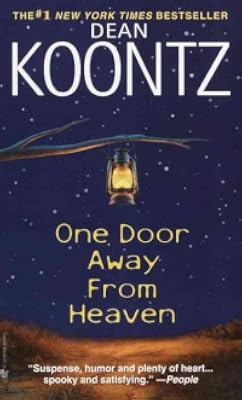
One Door Away from Heaven
by Dean Koontz
On This Page
Description
#1 NEW YORK TIMES BESTSELLERMichelina Bellsong is on a mission. She is following a missing family to the edge of America . . . to a place she never knew existed—a place of terror, wonder, and shattering revelation. What awaits her there will change her life and the life of everyone she knows—if she can find the key to survival. At stake are a young girl of extraordinary goodness, a young boy with killers on his trail, and Micky’s own wounded soul. Ahead lie incredible peril, show more startling discoveries, and paths that lead through terrible darkness to unexpected light. show less
Tags
Recommendations







Member Reviews
A Koontz novel about a boy(who is not a boy and a dog that is not a dog) Imagine that. Great so far. A little too much going on though. Seems to me like he had two or three ideas and decided to put them all in one story. A rather congested book. It did not grab me like "From the Corner of His Eye" All of the characters are well written but kind of seemed crammed together.
This book is a freaking door stopper. I read this the first time on a very long flight and since my other books were packed in my luggage I plugged on through this. I think maybe I went hard shrug about it all and said well that's just three stars. Reading it now years later I have no idea how I muddled through this the first time. This book is peak sanctimony Koontz. There's a damn dog and then even more dogs. Koontz does that weird thing he did for a while where he had people with disabilities either physical or mental into super special people which felt wrong in a way. I don't know if you can call it pandering or what, it just felt off and not sincere. There are like four plots in this one (if you can call them that) and a question show more again about religion versus science, but with no real horror elements.
"One Door Away from Heaven" is about Michelina (Micky) Bellsong a woman with a mysterious past who does what she can to save a young girl she meets. Seriously though, why do most of Koontz's characters have a mysterious past? It takes a while to figure out what happened to Micky, but one can hazard a guess. There is not much there there with Micky. Sorry, not sorry. The other characters read as paper thin too. Micky meets a young girl named Leilani who tells her her life story and at least something comes across to Micky, that the young girl is going to be killed by her stepfather. Micky has a drinking problem, but is still beautiful (I think that is said repeatedly). When she realizes that Leilani is really in danger, she does what she can by following her to keep her safe.
Leilani is a 9 year old precocious child who talks like Einstein. She has a physical disability, but shines (according to another character). I can't even with that since it started to make me think of "The Shining" and Stephen King. I think I have said this before, Koontz cannot write children. He writes them as little Buddhas and it's old. I give King some grief when he writes something that is not 100 percent amazing (still feeling salty about 11/22/63) but the man can and always has been able to write kids.
We also have a PI named Noah who is out to help Micky with her tracking down Leilani.
There is a mysterious boy named Curtis who I hope you like reading him talking about a playful presence a lot. He sucks and I cannot with him. The reveal about Curtis wasn't much of a reveal since I was going for he is really an android for most of the book.
The bad guy seems like he should be going around screeching about cooties most of the time. Preston Maddoc is a scientist (EVIL) who is very popular in the scientific world pushing out his belief in bioethics. He believes in aliens (which don't even get me started) and that those who are not perfect should be murdered. Too bad he is Leilani's stepfather. I think Koontz could have gone at this more subtle. If Koontz wanted to have a real discussion about bioethics as it relates to the poor and people who are not white, have at it. But he turned this into all bioethics is evil/wrong.
There are other characters in this one that I cannot even get into right now. One was Micky's aunt Geneva that also made me roll my eyes. For most of the book everyone doesn't meet up and then Koontz throws them all together in a way that doesn't even make any sense.
The writing didn't work. I think because for some reason Koontz wrote some characters in past tense and others in present tense. It was hard work to even get through this because that drove me up the freaking wall. This one also reminded me a bit about "Intensity" which had another woman who put herself in harm's way to save a young girl.
The flow was awful and every time someone spoke it took like ten pages to make it end. Suffice it to say that the book is just about apparently people spreading the word and there are aliens. That's all I got.
And the book ends with people talking about a riddle and here is the answer which was too much even for me.
My eyes finally stopped rolling. That whole thing went on forever. I don't think that Koontz gets how preachy his books come across and how off-putting it is to read some of his works. I think this was Koontz's way of flipping off his critics cause he manages to tie dogs into being connected to God even more in this one that just made me shake my head. show less
"One Door Away from Heaven" is about Michelina (Micky) Bellsong a woman with a mysterious past who does what she can to save a young girl she meets. Seriously though, why do most of Koontz's characters have a mysterious past? It takes a while to figure out what happened to Micky, but one can hazard a guess. There is not much there there with Micky. Sorry, not sorry. The other characters read as paper thin too. Micky meets a young girl named Leilani who tells her her life story and at least something comes across to Micky, that the young girl is going to be killed by her stepfather. Micky has a drinking problem, but is still beautiful (I think that is said repeatedly). When she realizes that Leilani is really in danger, she does what she can by following her to keep her safe.
Leilani is a 9 year old precocious child who talks like Einstein. She has a physical disability, but shines (according to another character). I can't even with that since it started to make me think of "The Shining" and Stephen King. I think I have said this before, Koontz cannot write children. He writes them as little Buddhas and it's old. I give King some grief when he writes something that is not 100 percent amazing (still feeling salty about 11/22/63) but the man can and always has been able to write kids.
We also have a PI named Noah who is out to help Micky with her tracking down Leilani.
There is a mysterious boy named Curtis who I hope you like reading him talking about a playful presence a lot. He sucks and I cannot with him. The reveal about Curtis wasn't much of a reveal since I was going for he is really an android for most of the book.
The bad guy seems like he should be going around screeching about cooties most of the time. Preston Maddoc is a scientist (EVIL) who is very popular in the scientific world pushing out his belief in bioethics. He believes in aliens (which don't even get me started) and that those who are not perfect should be murdered. Too bad he is Leilani's stepfather. I think Koontz could have gone at this more subtle. If Koontz wanted to have a real discussion about bioethics as it relates to the poor and people who are not white, have at it. But he turned this into all bioethics is evil/wrong.
There are other characters in this one that I cannot even get into right now. One was Micky's aunt Geneva that also made me roll my eyes. For most of the book everyone doesn't meet up and then Koontz throws them all together in a way that doesn't even make any sense.
The writing didn't work. I think because for some reason Koontz wrote some characters in past tense and others in present tense. It was hard work to even get through this because that drove me up the freaking wall. This one also reminded me a bit about "Intensity" which had another woman who put herself in harm's way to save a young girl.
The flow was awful and every time someone spoke it took like ten pages to make it end. Suffice it to say that the book is just about apparently people spreading the word and there are aliens. That's all I got.
And the book ends with people talking about a riddle and here is the answer which was too much even for me.
"If your heart is closed, then you will find behind that door nothing to light your way. But if your heart is open, you will find behind that door people who, like you, are searching, and you will find the right door together with them. None of us can ever save himself; we are the instruments of one another's salvation, and only by the hope that we give to others do we lift ourselves out of the darkness into light."
"For those who despair that their lives are without meaning and without purpose, for those who dwell in a loneliness so terrible that it has withered their hearts, for those who hate because they have no recognition of the destiny they share with all humanity, for those who would squander their lives in self-pity and in self-destruction because they have lost the saving wisdom with which they were born, for all these and many more, hope waits in the dreams of a dog, where the sacred nature of life may be clearly experienced without the all but blinding filter of human need, desire, greed, envy, and endless fear. And here, in dream woods and fields, along the shores of dream seas, with a profound awareness of the playful Presence abiding in all things, Curtis is able to prove to Leilani what she has thus far only dared to hope is true: that although her mother never loved her, there is One who always has."
My eyes finally stopped rolling. That whole thing went on forever. I don't think that Koontz gets how preachy his books come across and how off-putting it is to read some of his works. I think this was Koontz's way of flipping off his critics cause he manages to tie dogs into being connected to God even more in this one that just made me shake my head. show less
Since this is going to be a rather critical review, I should preface it by saying that I am a big Dean Koontz fan, I grew up reading Koontz, and I loved most of his books up until this one. This is where he got unbearably preachy (in a sort of quasi-New Age/born-again Christian kind of way). I suppose he'd been hinting at it in his stories and novels for years, but it wasn't until toward the end of the book immediately prior to this one, From the Corner of His Eye, that he became more boldly explicit about it---and since that book still sold millions of copies, I guess he felt he had a mandate to go into full-blown Jesus freak mode in this one. Well, here's one reader he lost. I finally got all the way through this one, but only because show more I already had it on audiobook and had nothing better to listen to at work one day. This book is still two steps above, say, the Left Behind series, but the fact that it can be put in the same category with it for comparison at all is not complimentary.
Similarly, Koontz has lost all sense of restraint in terms of style. After all, why say something in only one way, when you could treat the reader to three witty metaphors, or four...or five (usually three, though, I don't know if there's supposed to be some special religious significance to that)? And enough with the alliterative triplets! Koontz seems to think they're amusing, or poetic, or something, but a "gaggle of giggling girls?" Gag me. To be fair, Koontz can really turn a phrase, and he's generally a fine writer, but it really seems like he's trying too hard...or not trying hard enough to edit. I suppose with the super-blockbuster status he's achieved, Koontz's publisher allowed him to de facto fire his editor.
As for the specific content of the novel, it's part detective story about a drunken ex-cop private investigator who is good at what he does but cares too much, part drama about a deformed little girl living with her abusive mother and stepfather and the neighbors who try to help her, and part road-trip/buddy movie about a little boy and his dog and all the interesting characters they meet on their trek...all familiar, almost cliche elements, but Koontz puts his own touches on each and manages to bring them all together at the end plausibly, though not terribly satisfyingly (the ending is frankly, even leaving aside the stupid theological elements, dumb). The main characters are sympathetic and wonderfully heroic at times (although his spunky heroines are all pretty much the same, just at different ages), and some of the side characters the boy meets during the road trip movie part of the story are hilarious (a Gabby Hayes lookalike in particular is great). The villain, however, is simply a strawman who represents the ideas Koontz disagrees with for him to rail against.
Which brings us to the book's thematic problems, of which there are really too many to discuss here, but some of the major ones can't be overlooked. To be sure, Koontz is right to explicitly criticize (and even label as evil) Peter Singer, a real-life ethicist who is surely among the worst in modern academia (and that's saying something). And Koontz's broader criticisms of utilitarianism generally are often on-target. But he combines Singer with Jack Kevorkian to create his villain (whom he actually calls "Dr. Doom"), thereby attempting to brand anyone who disagrees in any respect with G. W. Bush's "culture of life" b.s. as a monster. And in case you haven't gotten the point yet, believe it or not there are more than one of these thinly-veiled Kevorkian characters (in entirely separate storylines, not just like there's a whole gang of them running around or something). Entirely absent are any considerations of whether a patient is terminally ill with no hope of anything that could really be called a human life in their future, of whether all their other options have been exhausted, and most importantly of whether *they* *choose* to end their own suffering; to assist them humanely and compassionately is literally no different from the most gruesome murder in Koontz's eyes---thus Koontz has his villain dispatch people whom *he* (the villain) views as unhappy indiscriminately, with or without their consent, sometimes with a painless injection, sometimes with an axe. In short, Koontz offers us God as the sole source and arbiter of ethics---an extremely dubious position, to say the least---or (an incredibly extreme version of) utilitarianism, as our only ultimate alternative. It should go without saying that this is a false alternative.
Turning to psychology, Koontz offers us more of the same sort of nonsense. One character is a self-destructive drug addict who likes to cut herself---and Koontz informs us that her problem is...wait for it...too MUCH self-esteem? Is he serious?! Unfortunately, he is. It's perfectly true that the "self-esteem" movement that is so prevalent in our educational system today turns out neurotic, narcissistic sociopaths with absolutely zero ability to relate to other human beings, but this has nothing to do with genuine self-esteem, based on actual achievement. Rather, what Koontz has clumsily taken their word to be real esteem for the self is mere pseudo-"self-esteem", based not on an individual's actual choices or character but simply on having been born, as they are told that "everybody's special" regardless of what they actually make of their lives and selves.
Koontz fares no better when he ventures into metaphysics than he did in ethics. The worst bit is at the end, when the hero asks the villain, who believes that life on earth was designed by super-intelligent aliens, "Well then who created the aliens?" Koontz seems to think that this question obliterates the villain's position, and that the obvious answer is, "God." But he seems to have failed to notice that the same question can be applied to God with equal validity. After all, if life is allegedly so complex as to require an intelligent designer in order to explain it, any designer able to fill that role would have to be even more complex, and thus in even greater need of such an explanation in turn. The only real answer the intelligent design people have to this is that the chain has to stop somewhere in order to avoid an infinite regress, so it should stop with God, who is eternal. But why have God at all, when one could just as easily posit that the universe itself is eternal (and extend this to any "irreducible complexities" within it, though I don't think there really are any in the sense the intelligent design crowd means it)?
The problem with Koontz's attempts to incorporate philosophy into his novels is that he's not a very good philosopher, and this kind of sloppy thinking only hurts his books. He writes (or used to write) good thrillers, and he writes with great humor, and he should stick to that...and get a better editor. show less
Similarly, Koontz has lost all sense of restraint in terms of style. After all, why say something in only one way, when you could treat the reader to three witty metaphors, or four...or five (usually three, though, I don't know if there's supposed to be some special religious significance to that)? And enough with the alliterative triplets! Koontz seems to think they're amusing, or poetic, or something, but a "gaggle of giggling girls?" Gag me. To be fair, Koontz can really turn a phrase, and he's generally a fine writer, but it really seems like he's trying too hard...or not trying hard enough to edit. I suppose with the super-blockbuster status he's achieved, Koontz's publisher allowed him to de facto fire his editor.
As for the specific content of the novel, it's part detective story about a drunken ex-cop private investigator who is good at what he does but cares too much, part drama about a deformed little girl living with her abusive mother and stepfather and the neighbors who try to help her, and part road-trip/buddy movie about a little boy and his dog and all the interesting characters they meet on their trek...all familiar, almost cliche elements, but Koontz puts his own touches on each and manages to bring them all together at the end plausibly, though not terribly satisfyingly (the ending is frankly, even leaving aside the stupid theological elements, dumb). The main characters are sympathetic and wonderfully heroic at times (although his spunky heroines are all pretty much the same, just at different ages), and some of the side characters the boy meets during the road trip movie part of the story are hilarious (a Gabby Hayes lookalike in particular is great). The villain, however, is simply a strawman who represents the ideas Koontz disagrees with for him to rail against.
Which brings us to the book's thematic problems, of which there are really too many to discuss here, but some of the major ones can't be overlooked. To be sure, Koontz is right to explicitly criticize (and even label as evil) Peter Singer, a real-life ethicist who is surely among the worst in modern academia (and that's saying something). And Koontz's broader criticisms of utilitarianism generally are often on-target. But he combines Singer with Jack Kevorkian to create his villain (whom he actually calls "Dr. Doom"), thereby attempting to brand anyone who disagrees in any respect with G. W. Bush's "culture of life" b.s. as a monster. And in case you haven't gotten the point yet, believe it or not there are more than one of these thinly-veiled Kevorkian characters (in entirely separate storylines, not just like there's a whole gang of them running around or something). Entirely absent are any considerations of whether a patient is terminally ill with no hope of anything that could really be called a human life in their future, of whether all their other options have been exhausted, and most importantly of whether *they* *choose* to end their own suffering; to assist them humanely and compassionately is literally no different from the most gruesome murder in Koontz's eyes---thus Koontz has his villain dispatch people whom *he* (the villain) views as unhappy indiscriminately, with or without their consent, sometimes with a painless injection, sometimes with an axe. In short, Koontz offers us God as the sole source and arbiter of ethics---an extremely dubious position, to say the least---or (an incredibly extreme version of) utilitarianism, as our only ultimate alternative. It should go without saying that this is a false alternative.
Turning to psychology, Koontz offers us more of the same sort of nonsense. One character is a self-destructive drug addict who likes to cut herself---and Koontz informs us that her problem is...wait for it...too MUCH self-esteem? Is he serious?! Unfortunately, he is. It's perfectly true that the "self-esteem" movement that is so prevalent in our educational system today turns out neurotic, narcissistic sociopaths with absolutely zero ability to relate to other human beings, but this has nothing to do with genuine self-esteem, based on actual achievement. Rather, what Koontz has clumsily taken their word to be real esteem for the self is mere pseudo-"self-esteem", based not on an individual's actual choices or character but simply on having been born, as they are told that "everybody's special" regardless of what they actually make of their lives and selves.
Koontz fares no better when he ventures into metaphysics than he did in ethics. The worst bit is at the end, when the hero asks the villain, who believes that life on earth was designed by super-intelligent aliens, "Well then who created the aliens?" Koontz seems to think that this question obliterates the villain's position, and that the obvious answer is, "God." But he seems to have failed to notice that the same question can be applied to God with equal validity. After all, if life is allegedly so complex as to require an intelligent designer in order to explain it, any designer able to fill that role would have to be even more complex, and thus in even greater need of such an explanation in turn. The only real answer the intelligent design people have to this is that the chain has to stop somewhere in order to avoid an infinite regress, so it should stop with God, who is eternal. But why have God at all, when one could just as easily posit that the universe itself is eternal (and extend this to any "irreducible complexities" within it, though I don't think there really are any in the sense the intelligent design crowd means it)?
The problem with Koontz's attempts to incorporate philosophy into his novels is that he's not a very good philosopher, and this kind of sloppy thinking only hurts his books. He writes (or used to write) good thrillers, and he writes with great humor, and he should stick to that...and get a better editor. show less
Leilani Klonk is under a death sentence, her mother is drugged out and will be no help, her only hope is the neighbors next door. Mi my and Aunt Gen have their own problems. The alien who will be known as Curtis Hammond may be her salvation if he can survive the hunt by the FBI and the evil aliens. Great concept, strong characters, good pacing.
I remember (correctly? who knows!) liking Odd Thomas. ODAfH starts out fine, with three distinct storylines. Then it makes a slow, painful, nothing-but-cruel slog up to a wholly unsatisfying ending "tying" the three together. The only reason I finished it was because I was sure (?!) Koontz was going to make the ending worth it. Big mistake!
The book, as a whole, was unrelentingly violent and cruel, as well as being repetitive and mind-bogglingly boring.
There is a particularly brutal and disgusting scene involving a pet snake about which this snake mom would have appreciated having a trigger warning.
The book, as a whole, was unrelentingly violent and cruel, as well as being repetitive and mind-bogglingly boring.
This book had been on my wish list for a while, but given that I have precious little bookshelf space these days, I ended up purchasing the e-book. Did I enjoy it? Yes, but I do think it was a little different.
The majority of the book follows separate plot lines and each time I settled into one of the plot lines I was reluctant to leave that character and jump to the next. I knew that that they must all come together in the end somehow, and probably spent too much time second guessing how Koontz was going to bring them all together.
I didn't quite 'get' the character of the 'motherless boy' in the beginning, but by the end of the story, his character was quite powerful. I loved the portrayal of the evil bioethicist Preston Maddoc, and show more the descriptions of his character were terrifying and thrilling! I was both repulsed and intrigued by his evil nature, and enjoyed (if that's the right word) when the book was told from his perspective in the first person. Very chilling!
I wanted to spend longer in the house of the hoarder, and wanted to find out what else was in the 100s of coffee cans. (One was full of toenail clippings and another was full of the bones of dead birds). I'm always interested in the obsessive compulsive, and this character had it all!
Leilani Klonk tugged on my heart strings and I wanted her mother to fall off the face of the earth for her cruelty.
Ultimately, this was a very enjoyable read, and had many of the Koontz trade marks! The messages of hope, love, and a higher presence was contained within the pages and dominated the story. show less
The majority of the book follows separate plot lines and each time I settled into one of the plot lines I was reluctant to leave that character and jump to the next. I knew that that they must all come together in the end somehow, and probably spent too much time second guessing how Koontz was going to bring them all together.
I didn't quite 'get' the character of the 'motherless boy' in the beginning, but by the end of the story, his character was quite powerful. I loved the portrayal of the evil bioethicist Preston Maddoc, and show more the descriptions of his character were terrifying and thrilling! I was both repulsed and intrigued by his evil nature, and enjoyed (if that's the right word) when the book was told from his perspective in the first person. Very chilling!
I wanted to spend longer in the house of the hoarder, and wanted to find out what else was in the 100s of coffee cans. (One was full of toenail clippings and another was full of the bones of dead birds). I'm always interested in the obsessive compulsive, and this character had it all!
Leilani Klonk tugged on my heart strings and I wanted her mother to fall off the face of the earth for her cruelty.
Ultimately, this was a very enjoyable read, and had many of the Koontz trade marks! The messages of hope, love, and a higher presence was contained within the pages and dominated the story. show less
UFOs, aliens, an empathetic dog, a crippled girl, and a host of supporting characters overcoming past traumas to reach out to others all are combined by Dean Koontz in a book that is the most compelling statement I have ever seen made about the right to life, no matter what one's condition. As always with his novels, few things are what they seem.Two basic plots run parallel before their heroes find themselves coming together to fight off a very evil villain. "What is one door away from heaven," is a question that one character has asked another since her childhood. The answer, along with the overall theme of the book, is enough to make us all examine our lives more carefully ... and be thankful that Koontz's writing reflects his show more beliefs so honestly show less
Members
- Recently Added By
Lists

Books Read in 2014
2,344 works; 86 members
Author Information

487+ Works 229,554 Members
Dean Koontz was born on July 9, 1945 in Everett, Pennsylvania. He received a degree in education from Shippensburg State College in 1967. A former high school English teacher as well as a teacher-counselor with the Appalachian Poverty Program, he began writing as a child to escape an ugly home life caused by his alcoholic father. A prolific writer show more at a young age, he had sold a dozen novels by the age of 25. Early in his career, he wrote under numerous pen names including David Axton, Brian Coffey, K. R. Dwyer, Leigh Nichols, Richard Paige, and Owen West. He is best known for the books written under his own name, many of which are bestsellers, including Midnight, Cold Fire, The Bad Place, Hideaway, The Husband, Odd Hours, 77 Shadow Street, Innocence, The City, Saint Odd, and The Silent Corner. (Bowker Author Biography) show less
Awards and Honors
Awards
Distinctions
Common Knowledge
- Canonical title
- One Door Away from Heaven
- Original title
- One door Away from heaven
- Original publication date
- 2001
- People/Characters
- Mickey Bellsong; Leilani Klonk; Aunt Geneva; Preston Maddoc-Dr,Doom; Noah Farrel; Richard Velnod (show all 8); Laura; Curtis Hammond
- Important places
- Cielo Vista Care Home
- Epigraph*
- Humor is emotionele chaos die in rust herinnerd wordt. -James Thurber
Lachen schokt het universum, brengt het buiten zichzelf en toont zijn ingewanden. - Octavio Paz
Waarom moordt een man? Hij doodt om te eten. En niet alleen om te eten: vaak moet er ook iets te drinken bij. - Woody Allen
Uiteindelijk is alles een grap. - Charlie Chaplin
Eeuwig lachen schokt de goden. - Homerus, Ilias
Grappig kan maar beter ergens triest zijn. - Jerry Lewis - Dedication
- This book is dedicated to Irwyn Applebaum, who has encouraged me "to take the train out there where the trains don't usually go," and whose character as both a publisher and a man has restored my lost faith in the publishing ... (show all)industry, or business, or folly, or whatever else it might accurately be called.
And:
To Tracy Devine, my editor, who never panics when, far past my deadline, I want to take yet more time to do draft number forty before turning in the script, whose editorial eye has twenty-ten vision, who is graciousness personified, who makes every phase of the work a delight—and who will think that this dedication is too effusive and in need of cutting. Well, this time she's wrong. - First words
- The world is full of broken people.
- Last words
- (Click to show. Warning: May contain spoilers.)The playful Presence must love her even more than He loves others of her kind, and He sees in Curtis not merely one who will save a world, but also a perfect foil for His jokes.
*Some information comes from Common Knowledge in other languages. Click "Edit" for more information.
Classifications
- Genres
- Fiction and Literature, Horror, Suspense & Thriller, Science Fiction
- DDC/MDS
- 813.54 — Literature & rhetoric American literature in English American fiction in English 1900-1999 1945-1999
- LCC
- PS3561 .O55 .O54 — Language and Literature American literature American literature Individual authors 1961-
- BISAC
Statistics
- Members
- 3,323
- Popularity
- 5,146
- Reviews
- 35
- Rating
- (3.70)
- Languages
- 11 — Danish, Dutch, English, Finnish, French, German, Greek, Hungarian, Italian, Polish, Swedish
- Media
- Paper, Audiobook, Ebook
- ISBNs
- 47
- ASINs
- 20