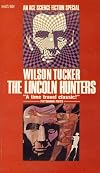
The Lincoln Hunters
by Wilson Tucker
On This Page
Tags
Recommendations
















Member Reviews
I was sore disappointed. Not only was this selected for reprint in the early Ace Science Fiction Specials, a series that contained some great books, but I was really impressed with Tucker's The Long Loud Silence. But Silence, from 1952, was was far more modern than this novel from 1958. The setup is a popular one in science fiction: a time travel agency in the far future that recovers or records lost historical artifacts. In this case, a team is sent back to record Lincoln's first major political speech in Illinois. The opening scenes set 600 years in the future, date the book the most. They read as if they were written in the 1930's, i.e., the future is just like the 1950's. Wire recorders are a central technology, we still haven't show more gone into space, and work at the office feels just like work at the office ever did. Once the team travels into the past, the story improves to readable, but there's nothing break out here. This is no Vintage Season, just an adventure that ends pretty much as you expect it will. show less
This 1958 time-travel story is about retrieving the text of Lincoln's 'lost speech' made in Bloomington, Illinois in 1856 at the beginning of his political career. It is told from the perspective of researchers from a distant future where much historical knowledge has been lost. The scene-setting is good, and the time paradox nature of the story, though it works specifically on contrived plot devices, is well carried through.
The big problem for me was the central character, the time-travelling researcher, Benjamin Steward. Tucker makes a lot out of his (and his colleagues') acting skills which are required for them to blend into the background of whatever era they are visiting. However, Tucker makes this character speak in a mix of show more 1950s slang and cod-Shakespearean archaic English. The overall effect, for me at least, was to make him completely bogus, which is a shame. He displays admirable qualities of responsibility and leadership, but I just kept on getting irritated with him.
In passing, I learnt some more American history, which was interesting when put into the perspective of current-day political arguments coming out of America. And Tucker's depiction of Future America, shown to us in odd snippets, had interesting resonances with our own time. But the story hardly involves Abraham Lincoln at all, and it employs two or three turns of plot along different tracks before we reach the conclusion. There are more worthwhile books to spend your time on. show less
The big problem for me was the central character, the time-travelling researcher, Benjamin Steward. Tucker makes a lot out of his (and his colleagues') acting skills which are required for them to blend into the background of whatever era they are visiting. However, Tucker makes this character speak in a mix of show more 1950s slang and cod-Shakespearean archaic English. The overall effect, for me at least, was to make him completely bogus, which is a shame. He displays admirable qualities of responsibility and leadership, but I just kept on getting irritated with him.
In passing, I learnt some more American history, which was interesting when put into the perspective of current-day political arguments coming out of America. And Tucker's depiction of Future America, shown to us in odd snippets, had interesting resonances with our own time. But the story hardly involves Abraham Lincoln at all, and it employs two or three turns of plot along different tracks before we reach the conclusion. There are more worthwhile books to spend your time on. show less
In the far future a gentleman who runs a museum wants to find a copy of a speech that Abraham Lincoln gave in 1856 in Bloomington, Illinois which has since been lost. Time Researchers is the only company with the ability to travel through time, and this seems like a pretty easy job. They’ll send an advance man back in time to get the lay of the land. After his return and debriefing, he will lead a team of four back to 1856 to record the lost speech. It should have been routine. But when the advance shoot is off by 48 hours, the advance man has a strange encounter with a local, and one of the team members gets drunk, it bodes very poorly for the shoot.
Time travel is my favorite sub-genre of science fiction. This story is fun and since show more I am an Illinoisan, even scratches the itch for a bit of local history. Given that the book is written in the 1950s, it does have its issues with sexism and racism, especially toward Native Americans. As such it is a product of its time, but it can also turn away some readers, and understandably so. Aside from those issues, I enjoyed the story. The main character is charismatic and funny. The descriptions of the future world painted a picture of a world that is definitely more technologically advanced than our own, yet certainly not perfect. I wasn’t terribly satisfied with the ending, but it didn’t ruin the book for me either. show less
Time travel is my favorite sub-genre of science fiction. This story is fun and since show more I am an Illinoisan, even scratches the itch for a bit of local history. Given that the book is written in the 1950s, it does have its issues with sexism and racism, especially toward Native Americans. As such it is a product of its time, but it can also turn away some readers, and understandably so. Aside from those issues, I enjoyed the story. The main character is charismatic and funny. The descriptions of the future world painted a picture of a world that is definitely more technologically advanced than our own, yet certainly not perfect. I wasn’t terribly satisfied with the ending, but it didn’t ruin the book for me either. show less
The first third of this novel feels very dated, and the protagonist was not very likable by today's standards. However, the narrative became much more compelling as it went on, and the main character became much more easy to relate to. Overall it is a memorable story and could be considered essential reading for people who enjoy time-travel fiction.
The power of time travel to open up the past provides the starting point of Wilson Tucker’s novel. In the 26th century, a business specializing in time travel is hired to record a speech made by Abraham Lincoln in 1856. What seems like an ordinary assignment, though, is soon complicated by an error that sends the team leader, Benjamin Steward, to the morning after speech. Now risking a fatal paradox that may lead to his death, he travels back with his team to the day of the speech itself, where he faces complications that threaten to undermine his mission and may lead even to his death.
Tucker’s novel is a short and engaging venture about the perils and complications of time travel. His premise of a history only half-remembered is an show more entertaining one and his characters, while somewhat dated, are interesting and sympathetic. While not as good as his later time-travel novel, , Wilson provides one of the better efforts at a time travel novel and an enjoyable adventure that entertains the reader. show less
Tucker’s novel is a short and engaging venture about the perils and complications of time travel. His premise of a history only half-remembered is an show more entertaining one and his characters, while somewhat dated, are interesting and sympathetic. While not as good as his later time-travel novel, , Wilson provides one of the better efforts at a time travel novel and an enjoyable adventure that entertains the reader. show less
There was small mention of this slim volume in Stephen King’s recent book, “11/22/63”. It too had some concept of the problems relating to time travel so I picked up “The Lincoln Hunters.”
First Impressions:
I read Tucker’s “Year of the Quiet Sun” which is more fast-paced and interesting with a twist ending. “Lincoln Hunters” lacks that twist and is a bit anti-climatic.
Plots:
It’s not a bad book but really has little to do with Lincoln. Time Researchers scour the past for lost treasures. This 24th century company employs “Characters” who go into the past and record actual events for museums and other clients. One Benjamin Stewart is chosen for the trip to Lincoln’s first speech which was never recorded nor show more written down by reporters of the time, somewhere in Bloomington, IL at the Republican convention, many years before the Civil War.
What’s interesting is Tucker’s explanations of the time – the warm, subtropical climate of Cincinnati, the USA went through a Second Revolution and is now run by an Emperor in city-states, and the unemployment problem is solved with labor camps (a fate most of the characters in the book shudder to contemplate!).
Most of the book deals with personalities and a somewhat soap opera style with a woman engineer, secretly married to the guy who died under Benjamin’s watch in a Roman gladiator adventure and less-described characters including a drunk who thinks he’s a Shakespearean actor, a doctor and an adventurer.
The actual traveling to the 19th century and meeting Lincoln was a bit anti-climatic, but I did not know a lot about Lincoln’s start in politics so I did learn something.
The writing is at times hard to follow. Tucker will say Benjamin, then later say “The Character then ….” implying that Ben is also the Character named. It’s confusing not to use pronouns, Tucker!
Bottom Line:
“The Lincoln Hunters” is not a historical novel so much as a book about societies, where we look towards the past, whether personal past or Man’s past, and regret a little too much rather than look towards the future. Cute little novel. show less
First Impressions:
I read Tucker’s “Year of the Quiet Sun” which is more fast-paced and interesting with a twist ending. “Lincoln Hunters” lacks that twist and is a bit anti-climatic.
Plots:
It’s not a bad book but really has little to do with Lincoln. Time Researchers scour the past for lost treasures. This 24th century company employs “Characters” who go into the past and record actual events for museums and other clients. One Benjamin Stewart is chosen for the trip to Lincoln’s first speech which was never recorded nor show more written down by reporters of the time, somewhere in Bloomington, IL at the Republican convention, many years before the Civil War.
What’s interesting is Tucker’s explanations of the time – the warm, subtropical climate of Cincinnati, the USA went through a Second Revolution and is now run by an Emperor in city-states, and the unemployment problem is solved with labor camps (a fate most of the characters in the book shudder to contemplate!).
Most of the book deals with personalities and a somewhat soap opera style with a woman engineer, secretly married to the guy who died under Benjamin’s watch in a Roman gladiator adventure and less-described characters including a drunk who thinks he’s a Shakespearean actor, a doctor and an adventurer.
The actual traveling to the 19th century and meeting Lincoln was a bit anti-climatic, but I did not know a lot about Lincoln’s start in politics so I did learn something.
The writing is at times hard to follow. Tucker will say Benjamin, then later say “The Character then ….” implying that Ben is also the Character named. It’s confusing not to use pronouns, Tucker!
Bottom Line:
“The Lincoln Hunters” is not a historical novel so much as a book about societies, where we look towards the past, whether personal past or Man’s past, and regret a little too much rather than look towards the future. Cute little novel. show less
This is a tale of time agents--people from the future who time travel unto the past on a mission. Unlike many such tales, where the travellers are secret agents trained in various forms of hand-to-hand combat, the agents of The Lincoln Hunters are more actors than warriors. Their job is to maintain their cover while accomplishing their objective. In this case, the objective is to record a speech given by Abraham Lincoln in 1856. There are four agents assigned to such a task, but the leader, Benjamin Steward, is sent in first to get the lay of the land and finish planning the operation. The problem is, there's an engineering glitch and his re-con has to take place the day after the speech. Steward returns to get his team and arrive on show more the correct date, but it becomes a race against time to get the speech and get out of there before his past self arrives. According to the engineers, a person can't exist twice in the same moment of time. They've never been willing to test what, exactly, will happen, but they're pretty sure it will be bad. All in all this story is not a masterpiece, but it's certainly good enough for some lunch time reading.
--J. show less
--J. show less
Members
- Recently Added By
Author Information

52+ Works 1,829 Members
Some Editions
Series
Belongs to Publisher Series
Common Knowledge
- Canonical title*
- Die Lincoln-Jäger
- Original title
- The Lincoln Hunters
- Original publication date
- 1958
- People/Characters
- Benjamin Steward; Abraham Lincoln
- Important places
- USA; Bloomington, Illinois, USA; Illinois, USA
- Epigraph
- Plausible impossibilities should be preferred to unconvincing possibilities. Aristotle
- Dedication
- To the diligent, salutary Staff of the Withers Public Library, Bloomington, Illinois
- First words
- The prim elderly gentleman with rocks in his repository was the causative agent.
- Last words
- (Click to show. Warning: May contain spoilers.)Lay on, Running Tongue.
*Some information comes from Common Knowledge in other languages. Click "Edit" for more information.
Classifications
- Genres
- Science Fiction, Fiction and Literature, Historical Fiction
- DDC/MDS
- 820 — Literature & rhetoric English & Old English literatures English and Old English (Anglo-Saxon) literatures
- LCC
- PZ3 .T8 — Language and Literature Fiction and juvenile belles lettres Fiction and juvenile belles lettres Fiction in English
- BISAC
Statistics
- Members
- 230
- Popularity
- 141,507
- Reviews
- 13
- Rating
- (2.98)
- Languages
- 5 — Dutch, English, German, Italian, Swedish
- Media
- Paper
- ISBNs
- 8
- ASINs
- 13