
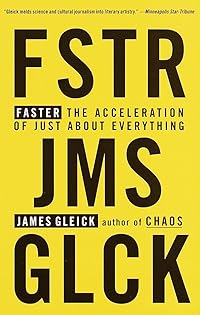
Faster: The Acceleration of Just About Everything
by James Gleick
On This Page
Description
Biography & Autobiography. Nonfiction. From the bestselling, National Book Award-nominated auhtor of Genius and Chaos, a bracing new work about the accelerating pace of change in today's world. Most of us suffer some degree of "hurry sickness." a malady that has launched us into the "epoch of the nanosecond," a need-everything-yesterday sphere dominated by cell phones, computers, faxes, and remote controls. Yet for all the hours, minutes, and even seconds being saved, we're still filling our show more days to the point that we have no time for such basic human activities as eating, sex, and relating to our families. Written with fresh insight and thorough research, Faster is a wise and witty look at a harried world not likely to slow down anytime soon. show lessTags
Recommendations

























Member Reviews
Funny. Funny. Funny. From the moment Gleick started talking about fast-working medication for a yeast infection (because only slackers have time for one of those) I knew I would be in for a fun ride. He may go on and on about a topic (the impatience one feels one when the elevator doors do not close fast enough, for example) but his points are valid. It's as if he is holding up a huge mirror and asking us to really look at how we behave when impatience or boredom sets in. Exactly how long does it take before YOU push the "door close" button in an elevator? It's an interesting test.
And when Gleick says "the acceleration of just about everything" he means everything.
A cool element to Faster! is that each chapter is independent of each show more other and therefore do not need to be read in order. But, something to be aware of - the subject material is a little dated. If he thinks the conveniences of microwaves, television remote controls and synchronized watches are indications of our need-it-now society,what does he now think of what the 21st century has been up to with our texting, smart phones, Twitter accounts and 65 mph toll booths (because who needs to stop driving incessantly on those long road trips?). He mentions computer watches (a la Dick Tracy). Funny how Apple just released their version this past year. Gleick moves on to talk about computer chips embedded in the human body, and why not? We are already comfortable with metal piercing our bodies in the oh so most interesting of places. Why not a computer chip? Gleick brings up photography and the need to see our pictures within the hour. How about the ability to take a picture and share it with the world within seconds ala Instagram and FB? There are so many examples of our world getting faster. What about the need for speed for athletic competition? Doping. Amphetamines. And speaking of drugs, what's that saying about liquor being quicker? It was interesting to think of hard liquor coming about because wine was too slow for the desired reaction to consumption. The list goes on. This was a great eye-opening read & I would love to know what Gleick would say about our need for speed these days. show less
And when Gleick says "the acceleration of just about everything" he means everything.
A cool element to Faster! is that each chapter is independent of each show more other and therefore do not need to be read in order. But, something to be aware of - the subject material is a little dated. If he thinks the conveniences of microwaves, television remote controls and synchronized watches are indications of our need-it-now society,what does he now think of what the 21st century has been up to with our texting, smart phones, Twitter accounts and 65 mph toll booths (because who needs to stop driving incessantly on those long road trips?). He mentions computer watches (a la Dick Tracy). Funny how Apple just released their version this past year. Gleick moves on to talk about computer chips embedded in the human body, and why not? We are already comfortable with metal piercing our bodies in the oh so most interesting of places. Why not a computer chip? Gleick brings up photography and the need to see our pictures within the hour. How about the ability to take a picture and share it with the world within seconds ala Instagram and FB? There are so many examples of our world getting faster. What about the need for speed for athletic competition? Doping. Amphetamines. And speaking of drugs, what's that saying about liquor being quicker? It was interesting to think of hard liquor coming about because wine was too slow for the desired reaction to consumption. The list goes on. This was a great eye-opening read & I would love to know what Gleick would say about our need for speed these days. show less
Funny. Funny. Funny. From the moment Gleick started talking about fast-working medication for a yeast infection (because only slackers have time for one of those) I knew I would be in for a fun ride. He may go on and on about a topic (the impatience one feels one when the elevator doors do not close fast enough, for example) but his points are valid. It's as if he is holding up a huge mirror and asking us to really look at how we behave when impatience or boredom sets in. Exactly how long does it take before YOU push the "door close" button in an elevator? It's an interesting test.
And when Gleick says "the acceleration of just about everything" he means everything.
A cool element to Faster! is that each chapter is independent of each show more other and therefore do not need to be read in order. But, something to be aware of - the subject material is a little dated. If he thinks the conveniences of microwaves, television remote controls and synchronized watches are indications of our need-it-now society,what does he now think of what the 21st century has been up to with our texting, smart phones, Twitter accounts and 65 mph toll booths (because who needs to stop driving incessantly on those long road trips?). He mentions computer watches (a la Dick Tracy). Funny how Apple just released their version this past year. Gleick moves on to talk about computer chips embedded in the human body, and why not? We are already comfortable with metal piercing our bodies in the oh so most interesting of places. Why not a computer chip? Gleick brings up photography and the need to see our pictures within the hour. How about the ability to take a picture and share it with the world within seconds ala Instagram and FB? There are so many examples of our world getting faster. What about the need for speed for athletic competition? Doping. Amphetamines. And speaking of drugs, what's that saying about liquor being quicker? It was interesting to think of hard liquor coming about because wine was too slow for the desired reaction to consumption. The list goes on. This was a great eye-opening read & I would love to know what Gleick would say about our need for speed these days. show less
And when Gleick says "the acceleration of just about everything" he means everything.
A cool element to Faster! is that each chapter is independent of each show more other and therefore do not need to be read in order. But, something to be aware of - the subject material is a little dated. If he thinks the conveniences of microwaves, television remote controls and synchronized watches are indications of our need-it-now society,what does he now think of what the 21st century has been up to with our texting, smart phones, Twitter accounts and 65 mph toll booths (because who needs to stop driving incessantly on those long road trips?). He mentions computer watches (a la Dick Tracy). Funny how Apple just released their version this past year. Gleick moves on to talk about computer chips embedded in the human body, and why not? We are already comfortable with metal piercing our bodies in the oh so most interesting of places. Why not a computer chip? Gleick brings up photography and the need to see our pictures within the hour. How about the ability to take a picture and share it with the world within seconds ala Instagram and FB? There are so many examples of our world getting faster. What about the need for speed for athletic competition? Doping. Amphetamines. And speaking of drugs, what's that saying about liquor being quicker? It was interesting to think of hard liquor coming about because wine was too slow for the desired reaction to consumption. The list goes on. This was a great eye-opening read & I would love to know what Gleick would say about our need for speed these days. show less
Society's in overdrive with no sign of braking. In elevators we maniacally smack the DOOR CLOSE button in the hope of saving a handful of seconds. Politicians average 8.2 seconds to answer a question. Top industries are hiring on the basis of quick wits. A buffet in Japan charges by the minute. And the most advanced cases of hurry sickness punch 88 seconds on the microwave instead of 90 because it's faster to tap the same digit twice. Yet for all the hustle and all of technology's increasing speed, there still seems to be less and less time to spare. When was it we began the slide down this long, strange slope of milliseconds, and when, if ever, will it come to a stop?
James Gleick, author of the bestselling National Book Award nominee show more Genius, now gives us Faster, a marvel of a book that probes the roots of today's accelerated living and dares to wonder at the ramifications. Thoroughly researched and written with a sharp-edged prose that cuts fast and sure to all the relevant bones, this book is compulsory reading for all of those looking at the hurried world and scratching their heads in harried wonder. show less
James Gleick, author of the bestselling National Book Award nominee show more Genius, now gives us Faster, a marvel of a book that probes the roots of today's accelerated living and dares to wonder at the ramifications. Thoroughly researched and written with a sharp-edged prose that cuts fast and sure to all the relevant bones, this book is compulsory reading for all of those looking at the hurried world and scratching their heads in harried wonder. show less
James Gleick considers our modern obsession with time, with subdividing the hours and minutes into smaller and smaller pieces, with cramming as much as possible into every moment, with saving time and spending time. Which is a potentially very interesting subject, but I found this book kind of disappointing. It's jumpy and unfocused, flitting around from topic to topic in a rather superficial way. Possibly this is Gleick attempting to capture the nature of his subject material by echoing it in his writing style, but whatever the motivation, I found the result unsatisfying and often rather tiring. He also, frankly, leaves me with the impression that he cares more about sounding clever and zippy than he does about conveying information or show more making any kind of coherent point.
Oddly enough, I think the most interesting thing about this volume is in the way that it's dated -- it was originally published in 1999. Some of the social and technological topics it touches on just seem rather quaint now, but it's surprising how often I had the feeling that I was getting a glimpse back at the early days of many trends that have become fundamental parts of our current Internet Age, with all that that's meant for the acceleration of our society and our lives. show less
Oddly enough, I think the most interesting thing about this volume is in the way that it's dated -- it was originally published in 1999. Some of the social and technological topics it touches on just seem rather quaint now, but it's surprising how often I had the feeling that I was getting a glimpse back at the early days of many trends that have become fundamental parts of our current Internet Age, with all that that's meant for the acceleration of our society and our lives. show less
As befits a book about peoples' increasingly shortening attention spans, the chapters in 'Faster' are short and zippy. This makes it an easy book to read, in contrast, say, to the author's latest work, 'The Information', which is much denser. And many of the chapters deal with relatively lightweight subjects such as MTV and time management self-help books.
But there are plenty of interesting and valuable insights here, in chapters like 'The Paradox of Efficiency', and 'Decomposition takes time'. And Gleick is refreshingly esoteric and literary in his references, quoting Kafka, Sophocles, and Dostoyevsky along the way.
Reading this book in 2011, there's no doubt that parts of it are a little dated, as you'd expect of a 12-year-old book show more dealing with societal change. But then a book that serves up gems like this will always stay current: "What we have learned to see, we can start to imagine." show less
But there are plenty of interesting and valuable insights here, in chapters like 'The Paradox of Efficiency', and 'Decomposition takes time'. And Gleick is refreshingly esoteric and literary in his references, quoting Kafka, Sophocles, and Dostoyevsky along the way.
Reading this book in 2011, there's no doubt that parts of it are a little dated, as you'd expect of a 12-year-old book show more dealing with societal change. But then a book that serves up gems like this will always stay current: "What we have learned to see, we can start to imagine." show less
This book captures a specific period in history where booming technology came with many promises.
Looking back this book foreshadows the problems arising from this technopositive exhuberance whose price is paid in externalities of resource waste and fragmented sense of shared evidence based reality.
Looking back this book foreshadows the problems arising from this technopositive exhuberance whose price is paid in externalities of resource waste and fragmented sense of shared evidence based reality.
I dislike preachy books that tell us how some aspect of our culture is making our lives worse. Luckily, this isn't one of those books. It is about how we seem to keep moving faster and faster, and get more efficient, yet seem to always not have enough time. I like it becaues Gleick doesn't make value judgements about this phenomenon, and he doesn't try to offer "solutions" to the "problem". Rather, it's a collection of observations on our rushed world. It discusses things like the "close door" button on the elevator, and how people push "88" instead of "90" on their microwave to save time. Highly entertaining.
Members
- Recently Added By
Published Reviews
ThingScore 78
[W]hile the book excels descriptively, it falls short analytically and prescriptively.
added by Katya0133
[W]hile it is fascinating to crawl through the fine points of MTV video cutting, even the most sympathetic reader will begin to wonder whether he has anything else to tell us.
added by Katya0133
Gleick doesn't alight long enough on any subject to give it depth.
added by Katya0133
Author Information

19+ Works 19,704 Members
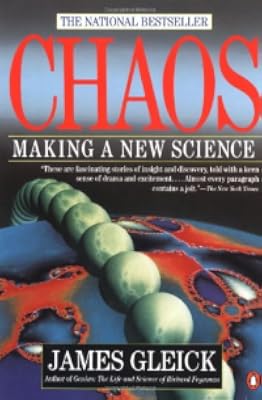
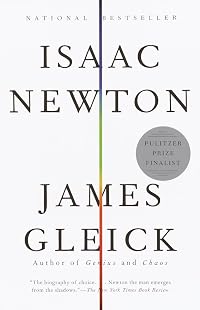
He wrote the worldwide bestseller Chaos, which was nominated for the National Book Award. He was the 1990 McGraw Distinguished Lecturer at Princeton University. (Publisher Provided) James Gleick was born in New York City on August 1, 1954. He received a degree in English and linguistics from Harvard College in 1976. He helped found Metropolis, an show more alternative weekly newspaper in Minneapolis. After the newspaper folded, he worked for ten years as an editor and reporter for The New York Times. In 1989-1990, he was the McGraw Distinguished Lecturer at Princeton University. He has written several books including Chaos: Making a New Science, Genius: The Life and Science of Richard Feynman, Faster: The Acceleration of Just About Everything, What Just Happened: A Chronicle from the Information Frontier, and The Information: A History, a Theory, a Flood. (Bowker Author Biography) show less
Some Editions
Awards and Honors
Awards
Notable Lists
Work Relationships
Common Knowledge
- Alternate titles
- Faster: Our Race Against Time
- Original publication date
- 1999
Classifications
Statistics
- Members
- 1,380
- Popularity
- 17,141
- Reviews
- 18
- Rating
- (3.50)
- Languages
- 9 — Danish, Dutch, English, Finnish, French, German, Italian, Polish, Swedish
- Media
- Paper, Audiobook, Ebook
- ISBNs
- 24
- ASINs
- 3