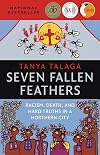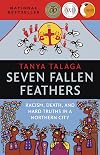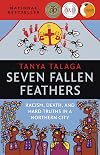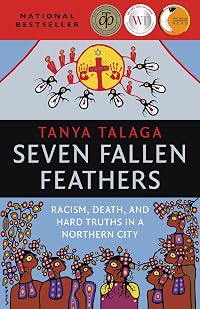
Seven Fallen Feathers: Racism, Death, and Hard Truths in a Northern City
by Tanya Talaga
On This Page
Description
In 1966, twelve-year-old Chanie Wenjack froze to death on the railway tracks after running away from residential school. An inquest was called and four recommendations were made to prevent another tragedy. None of those recommendations were applied. More than a quarter of a century later, from 2000 to 2011, seven Indigenous high school students died in Thunder Bay, Ontario. The seven were hundreds of miles away from their families, forced to leave home and live in a foreign and unwelcoming show more city. Five were found dead in the rivers surrounding Lake Superior, below a sacred Indigenous site. Jordan Wabasse, a gentle boy and star hockey player, disappeared into the minus twenty degrees Celsius night. The body of celebrated artist Norval Morrisseau's grandson, Kyle, was pulled from a river, as was Curran Strang's. Robyn Harper died in her boarding-house hallway and Paul Panacheese inexplicably collapsed on his kitchen floor. Reggie Bushie's death finally prompted an inquest, seven years after the discovery of Jethro Anderson, the first boy whose body was found in the water. Using a sweeping narrative focusing on the lives of the students, award-winning investigative journalist Tanya Talaga delves into the history of this small northern city that has come to manifest Canada's long struggle with human rights violations against Indigenous communities. show lessTags
Recommendations














Member Reviews
This book tells the stories of seven Indigenous youths who died in tragic and unusual circumstances while attending high school in Thunder Bay, Ontario. They’d had to travel hundreds of kilometres from home to attend school, often living with families not their own, and having to make their way in a city that could be actively hostile toward Indigenous people. This book tells their stories and goes even further back, to families scarred and traumatized by the Canadian government’s programme of residential schools and chronic underfunding of reserves, preventing today’s Indigenous youth from realizing their full potential.
This book is heartbreaking and harrowing. How can people be so cruel and thoughtless? And what will it take for show more the Canadian government to pull its finger out and actually give Indigenous groups the funding they need to maintain schools closer to home, and um, maybe actually have clean drinking water and indoor plumbing? Canada has failed and continues to fail the Indigenous peoples, and it is shameful.
Talaga has told these stories with sensitivity and respect, and they deserve to be heard. Every Canadian needs to read this, and most importantly, needs to work to change things. show less
This book is heartbreaking and harrowing. How can people be so cruel and thoughtless? And what will it take for show more the Canadian government to pull its finger out and actually give Indigenous groups the funding they need to maintain schools closer to home, and um, maybe actually have clean drinking water and indoor plumbing? Canada has failed and continues to fail the Indigenous peoples, and it is shameful.
Talaga has told these stories with sensitivity and respect, and they deserve to be heard. Every Canadian needs to read this, and most importantly, needs to work to change things. show less
Every year, around this time, my place of employment offers up a book that deals with our troubled history with our Indigenous population. I'm grateful for this, because it demands that I pay attention to something that—as a white, middle-class male—typically would fly under my radar.
None of this should fly under anyone's radar. Canada's great shame is that we have done wrong by those people who inhabited this land long before any white faces showed up. And, due to Canadian indifference and governmental stalling and excuse and delay and excuse and delay...we're still doing wrong by them.
This is an important work, and I dare any parent to read this and put themselves in the shoes of the parents and caregivers in this book. Put your show more kid in place of one of the seven who died tragically, and then were ignored by everyone who should have done their jobs to ensure it never happened again.
It's a hard, dreadful book to read.
And every Canadian should read it. show less
None of this should fly under anyone's radar. Canada's great shame is that we have done wrong by those people who inhabited this land long before any white faces showed up. And, due to Canadian indifference and governmental stalling and excuse and delay and excuse and delay...we're still doing wrong by them.
This is an important work, and I dare any parent to read this and put themselves in the shoes of the parents and caregivers in this book. Put your show more kid in place of one of the seven who died tragically, and then were ignored by everyone who should have done their jobs to ensure it never happened again.
It's a hard, dreadful book to read.
And every Canadian should read it. show less
I would never have read this book if a friend hadn't recommended it, and I'm very glad I did. The book description says it's about the deaths of 7 First Nations students in Thunder Bay, but it's not a true crime story at all, and it's about so much more than their deaths. It's the story of those 7 children, and how their lives and deaths were the product of history and institutional failures that continue to the present day. Residential schools traumatized First Nations communities in Ontario (and across Canada), and the government has failed to provide an appropriate and equal education on reserves today--leading to the unprepared teens being sent off to Thunder Bay because they lack an alternative closer to home.
This is not a show more dispassionate book. Talaga is herself First Nations and her goal here is to amplify the voices and the stories of the communities of Northern Ontario--to discuss the racism they faced and still face. But this isn't a tale of passive victimhood. The individual children were, but the community is not passive. They are fighting for agency and equality from the Canadian government. Not only is the story compelling, but it's beautifully and sensitively written.
In the US, we tend to hear a lot less about anti-Native racism--especially on the East Coast, where I'm from--because anti black racism has been so dominant. But I have to mention that our own history and present, while different in specifics, has been no better. show less
This is not a show more dispassionate book. Talaga is herself First Nations and her goal here is to amplify the voices and the stories of the communities of Northern Ontario--to discuss the racism they faced and still face. But this isn't a tale of passive victimhood. The individual children were, but the community is not passive. They are fighting for agency and equality from the Canadian government. Not only is the story compelling, but it's beautifully and sensitively written.
In the US, we tend to hear a lot less about anti-Native racism--especially on the East Coast, where I'm from--because anti black racism has been so dominant. But I have to mention that our own history and present, while different in specifics, has been no better. show less
This was not an easy book to listen to but it is certainly an important book. Canadians all know that how the original people of the land were treated by those who came after was shameful and racist and violent. However, I think that most of us think we are treating our indigenous peoples better this day. This book, which details the deaths of seven indigenous students who were attending high school in Thunder Bay in the 21st century, shows that not much has changed.
Thunder Bay Ontario has a separate school for indigenous youth from reservations in North West Ontario to attend high school. All of the teachers are indigenous, there are elders present for guidance during the school day, counsellors are assigned to each student and each show more student is boarded with a family in Thunder Bay so this is not a residential school. There are very few reservations with schools going up to Grade 13 so for those indigenous youth who want to pursue higher education they have to leave home. They are of course homesick but also entranced by the attractions of the big city which includes alcohol and drugs. The high school has a van staffed by counsellors who drive the streets at night looking for their students who might be out late and may be intoxicated or in some other kind of trouble. If a student violates curfew or is found intoxicated they must sign a form accepting responsibility and agreeing to refrain from getting into trouble. There is usually some form of punishment such as writing an essay or taking special classes. The ultimate sanction is to suspend the student and send them home. For some students this may work but all seven of the students who died had run afoul of the authorities at least once prior to their death. Most of the bodies were found in one of the rivers in Thunder Bay and the police determined that these deaths were not suspicious. However, the author and others think that it is unlikely these students would have drowned unless there was some other factor because all of them came from reserves where they lived close to water. One boy whose brother was lost in this manner had been with him on the bank of the river and then the next thing he knew he was under the water and had a very sore back. When his brother's body was recovered he also sported a significant bruise on his back. Another man narrowly missed dying after he was attacked by some white men who hit him and called him names and then dumped him in the river. It seems pretty clear that there was some gang of racists who were targeting young indigenous students but the Thunder Bay Police never charged anyone. The other deaths that did not involve drowning are equally mysterious but proper investigations were not done at the time so it is unclear why one student suddenly collapsed and died. I am pretty sure that if a white student living away from home had died suddenly there would have been a thorough examination and an inquest. Instead it took seven deaths and ten years for an inquest to look into these deaths. So not much has changed from the bad old days. show less
Thunder Bay Ontario has a separate school for indigenous youth from reservations in North West Ontario to attend high school. All of the teachers are indigenous, there are elders present for guidance during the school day, counsellors are assigned to each student and each show more student is boarded with a family in Thunder Bay so this is not a residential school. There are very few reservations with schools going up to Grade 13 so for those indigenous youth who want to pursue higher education they have to leave home. They are of course homesick but also entranced by the attractions of the big city which includes alcohol and drugs. The high school has a van staffed by counsellors who drive the streets at night looking for their students who might be out late and may be intoxicated or in some other kind of trouble. If a student violates curfew or is found intoxicated they must sign a form accepting responsibility and agreeing to refrain from getting into trouble. There is usually some form of punishment such as writing an essay or taking special classes. The ultimate sanction is to suspend the student and send them home. For some students this may work but all seven of the students who died had run afoul of the authorities at least once prior to their death. Most of the bodies were found in one of the rivers in Thunder Bay and the police determined that these deaths were not suspicious. However, the author and others think that it is unlikely these students would have drowned unless there was some other factor because all of them came from reserves where they lived close to water. One boy whose brother was lost in this manner had been with him on the bank of the river and then the next thing he knew he was under the water and had a very sore back. When his brother's body was recovered he also sported a significant bruise on his back. Another man narrowly missed dying after he was attacked by some white men who hit him and called him names and then dumped him in the river. It seems pretty clear that there was some gang of racists who were targeting young indigenous students but the Thunder Bay Police never charged anyone. The other deaths that did not involve drowning are equally mysterious but proper investigations were not done at the time so it is unclear why one student suddenly collapsed and died. I am pretty sure that if a white student living away from home had died suddenly there would have been a thorough examination and an inquest. Instead it took seven deaths and ten years for an inquest to look into these deaths. So not much has changed from the bad old days. show less
4.5 stars
There are all kinds of issues on indigenous reservations in Canada. Education is just one of them. In 2000(?), a group of indigenous people built and started running a high school in Thunder Bay, Ontario for those students living north who didn’t have a high school to go to. Unfortunately, it wasn’t long before some of those kids – many who were away from home for the first time, who had never been in a city before, a new culture, a new language, no (or not many) family or friends to help – started disappearing. And dying. Over 11 years, seven teenagers died.
The Thunder Bay police did very little to help, often not even contacting the families on the reserves to let them know their kids had disappeared. In some cases, show more they went too long before starting to look for the kids. Five of the kids were found in the river, and in most cases, just written off as “no foul play suspected”. But the indigenous people running the school, the families and friends question this. It was so unlike these kids to just get drunk and drown in the river. It has never really been figured out what exactly happened to these kids.
Wow, this is so sad. And aggravating that not enough is being done to help the indigenous kids and their communities. It’s an eye-opener and definitely worth reading. There are some repetitive bits and the author kind of went all over the place sometimes – between telling the kids’ stories, then working in other information about other people or communities. But really worth the read. show less
There are all kinds of issues on indigenous reservations in Canada. Education is just one of them. In 2000(?), a group of indigenous people built and started running a high school in Thunder Bay, Ontario for those students living north who didn’t have a high school to go to. Unfortunately, it wasn’t long before some of those kids – many who were away from home for the first time, who had never been in a city before, a new culture, a new language, no (or not many) family or friends to help – started disappearing. And dying. Over 11 years, seven teenagers died.
The Thunder Bay police did very little to help, often not even contacting the families on the reserves to let them know their kids had disappeared. In some cases, show more they went too long before starting to look for the kids. Five of the kids were found in the river, and in most cases, just written off as “no foul play suspected”. But the indigenous people running the school, the families and friends question this. It was so unlike these kids to just get drunk and drown in the river. It has never really been figured out what exactly happened to these kids.
Wow, this is so sad. And aggravating that not enough is being done to help the indigenous kids and their communities. It’s an eye-opener and definitely worth reading. There are some repetitive bits and the author kind of went all over the place sometimes – between telling the kids’ stories, then working in other information about other people or communities. But really worth the read. show less
Heartbreaking. An examination of the tragic loss of Indigenous communities forced to send their high school age students to a different culture thousands of kilometers away. The failures of colonial governments continue to destroy Indigenous communities.
As I write this review, the residents of Kashechewan First Nation are being evacuated in what has become an annual ritual. Promises to relocate the community have again come to naught. This situation emphasizes how we do not treat our Indigenous people as equals; were it a white community of 2,500 people which was evacuated every spring, something would have been done to spare people the trauma of evacuations and disrupted schooling for children.
It is the education of Indigenous children that is a central issue in this book. Between 2000 and 2011, seven Indigenous children died in Thunder Bay. They had to leave their isolated home communities to pursue education. The author tells the stories of each of the seven; their movements before show more their deaths are detailed. What is not detailed is the police work because, in all cases, police searches for the missing and investigations after a body was discovered were cursory. (In fact, in December of 2018, after the publication of this book, Ontario's police watchdog reported finding systemic racism in the Thunder Bay Police Service and revealed deficiencies in how the local force investigated the deaths and disappearances of Indigenous people.)
The author focuses on the failure of government to properly address the education needs of Indigenous children. Besides describing the current situation, she gives a brief history of residential schools which she shows to be an act of cultural genocide. Teenagers are still required to leave their home communities for an education; in an alien environment, they become vulnerable. The author argues that there must have been foul play in the deaths in Thunder Bay, that systemic racism led to whites preying on vulnerable Indigenous youth.
The treatment of our Indigenous people is an important subject; the stories of these seven children need to be told. Canadians need to educate themselves and become activists to ensure that Indigenous people are treated as equal citizens. Unfortunately, I don’t think the writing in this book does justice to the vital importance of its subject matter. The author is a journalist so I expected stronger writing and I found myself increasingly frustrated as I read.
The author has a definite bias. Having an opinion is unavoidable but I hoped that, as befits a professional journalist, there would have been some attempt to present a balanced view. Even if readers were given a less one-sided perspective, they would still have seen “the racism, police indifference, bureaucratic ineptitude, lateral violence.” The author’s bias against non-Indigenous people, presumably the book’s target audience, will alienate some readers. To suggest, even indirectly, that all Indigenous people are good and all non-Indigenous are bad is to be unjust to all.
For instance, it is emphasized that the staff at Dennis Franklin Cromarty High School (“Indigenous run and directed, and staffed with Indigenous teachers”) is exceptional: “Everyone on staff – from the teachers to the office workers to the Elders and the custodial staff – pitched in to look after the kids” (101). This evaluation is even repeated: “They knew they weren’t just teachers or receptionists or janitors; they were also caring for the nearly 150 kids enrolled at the school . . . DFC staff did everything they could to be parents to their students” (255). However when an inquest directed 25 recommendations to the Nishnawbe Aski Nation, these are never outlined; the reader is only told that all recommendations have been addressed “as far as their capacity allows” (312). An Indigenous support worker/ boarding parent leaves an inebriated young girl lying on a hallway floor without keeping close watch and that girl dies, yet the boarding parent is not considered negligent (189)?
There are contradictions concerning boarding parents. At the beginning, the author explains that “Boarding parents were given $500 a student, every month, to cover living expenses such as the roof over their head, snacks, and dinner. The ‘parents’ were under no obligation to supervise the kids at night, eat meals with them, help them with their homework, or take them to any after-school activities” (27). Fifty pages later, there’s a different explanation: Boarding parents “need to ‘be responsible for the welfare and conduct of students while he or she is in your care.’ They need to discuss and set up ‘reasonable patterns of conduct and discipline with the students regarding meal times, curfews, access to the kitchen, telephone,’ and they are instructed to ‘treat the students as your own children and include them in as many family and social activities as possible’” (97). And the Northern Nishnawbe Education Council thoroughly investigates prospective boarding parents?
The book needs revision and editing. For example, why is the same information repeated again and again, often within a few pages? For example, “Rhoda King, Reggie Bushie’s mother, was told that her son was missing three days after he had disappeared” (208) is followed by “In fact, Rhoda King, Reggie and Ricki’s mother, did not know that Reggie was missing until October 29 – three days after he was last seen” (212) which is followed by “She had not been informed by authorities or the school that her son had disappeared until three days after he was last seen down by the McIntyre River” (226).
There are unnecessary details. Why describe the area around the Air Canada Centre (49)? Do we need to know that searchers “went to Walmart to unwind and then grabbed something to eat at McDonald’s” (38)? At times, it seems that the author feels she has to include and explain everything, yet at other times, information is missing. For example, the painting on the cover is explained, but not completely (301). I had never heard about the starvation experiments at residential schools (73), but they are mentioned only in passing.
Poor organization sometimes has the reader shaking his/her head: the author explains how Norval Morrisseau met his wife and names his children and then launches into a description of his childhood (244-245). Who can follow this: “Coroners believe Kyle died of drowning. They also noted Kyle consumed alcohol before he died and that while it was a contributing factor to his death, it wasn’t the cause. [Kyle’s father] was full of rage. ‘I was fucking mad.’” (263)?
Some statements make little sense. “It is an old [Pikangikum First Nation] tradition to bury your dead in your front yard” (135)? “[Elder Sam Achneepineskum’s] wisdom comes from the ten thousand lives he has lived” (275)? “The rest [of the rivers] flow south to the Great Lakes and the urban centres that malignantly pock the turtle’s shell” (54)? Yes, I understand that Turtle Island refers to North America, but every city is a malignancy? So why would the author bemoan that “There was no McDonald’s or local shopping mall [in Pikangikum] and there still isn’t” (138)?
Sentences are choppy and clunky: “Norma spent the next several minutes pacing the halls. Rhoda and Berenson King arrived and they went directly to the Elders’ room. Norma paced in front of the room until she saw Alvin walking down the hallway with the chief. She stopped him and asked if they had found Reggie. He said they had. She warned Alvin that the parents had arrived and were in the Elders’ room. She told him she was going to find a more private room . . . They found an empty office . . . Norma was turning to leave when she ran into Josias. She asked him to sit with the others in the Elders’ room” (224-225).
What’s with the diction and clichés? For example, “People often threw eggs at him from moving cars or would holler Hollywood-style Indian war cries” (166) and “But it all came crashing down again in the 1980s, when he hit the bottle hard and burned through his money” (246).
I feel as if it is wrong to criticize a book that discusses such an important subject, one which Canadians must face. However, I have to be honest and state that I wish the writing were of much better quality so the reader can focus on the information and is not frustratingly distracted by the poor style.
Note: Please check out my reader's blog (https://schatjesshelves.blogspot.com/) and follow me on Twitter (@DCYakabuski). show less
It is the education of Indigenous children that is a central issue in this book. Between 2000 and 2011, seven Indigenous children died in Thunder Bay. They had to leave their isolated home communities to pursue education. The author tells the stories of each of the seven; their movements before show more their deaths are detailed. What is not detailed is the police work because, in all cases, police searches for the missing and investigations after a body was discovered were cursory. (In fact, in December of 2018, after the publication of this book, Ontario's police watchdog reported finding systemic racism in the Thunder Bay Police Service and revealed deficiencies in how the local force investigated the deaths and disappearances of Indigenous people.)
The author focuses on the failure of government to properly address the education needs of Indigenous children. Besides describing the current situation, she gives a brief history of residential schools which she shows to be an act of cultural genocide. Teenagers are still required to leave their home communities for an education; in an alien environment, they become vulnerable. The author argues that there must have been foul play in the deaths in Thunder Bay, that systemic racism led to whites preying on vulnerable Indigenous youth.
The treatment of our Indigenous people is an important subject; the stories of these seven children need to be told. Canadians need to educate themselves and become activists to ensure that Indigenous people are treated as equal citizens. Unfortunately, I don’t think the writing in this book does justice to the vital importance of its subject matter. The author is a journalist so I expected stronger writing and I found myself increasingly frustrated as I read.
The author has a definite bias. Having an opinion is unavoidable but I hoped that, as befits a professional journalist, there would have been some attempt to present a balanced view. Even if readers were given a less one-sided perspective, they would still have seen “the racism, police indifference, bureaucratic ineptitude, lateral violence.” The author’s bias against non-Indigenous people, presumably the book’s target audience, will alienate some readers. To suggest, even indirectly, that all Indigenous people are good and all non-Indigenous are bad is to be unjust to all.
For instance, it is emphasized that the staff at Dennis Franklin Cromarty High School (“Indigenous run and directed, and staffed with Indigenous teachers”) is exceptional: “Everyone on staff – from the teachers to the office workers to the Elders and the custodial staff – pitched in to look after the kids” (101). This evaluation is even repeated: “They knew they weren’t just teachers or receptionists or janitors; they were also caring for the nearly 150 kids enrolled at the school . . . DFC staff did everything they could to be parents to their students” (255). However when an inquest directed 25 recommendations to the Nishnawbe Aski Nation, these are never outlined; the reader is only told that all recommendations have been addressed “as far as their capacity allows” (312). An Indigenous support worker/ boarding parent leaves an inebriated young girl lying on a hallway floor without keeping close watch and that girl dies, yet the boarding parent is not considered negligent (189)?
There are contradictions concerning boarding parents. At the beginning, the author explains that “Boarding parents were given $500 a student, every month, to cover living expenses such as the roof over their head, snacks, and dinner. The ‘parents’ were under no obligation to supervise the kids at night, eat meals with them, help them with their homework, or take them to any after-school activities” (27). Fifty pages later, there’s a different explanation: Boarding parents “need to ‘be responsible for the welfare and conduct of students while he or she is in your care.’ They need to discuss and set up ‘reasonable patterns of conduct and discipline with the students regarding meal times, curfews, access to the kitchen, telephone,’ and they are instructed to ‘treat the students as your own children and include them in as many family and social activities as possible’” (97). And the Northern Nishnawbe Education Council thoroughly investigates prospective boarding parents?
The book needs revision and editing. For example, why is the same information repeated again and again, often within a few pages? For example, “Rhoda King, Reggie Bushie’s mother, was told that her son was missing three days after he had disappeared” (208) is followed by “In fact, Rhoda King, Reggie and Ricki’s mother, did not know that Reggie was missing until October 29 – three days after he was last seen” (212) which is followed by “She had not been informed by authorities or the school that her son had disappeared until three days after he was last seen down by the McIntyre River” (226).
There are unnecessary details. Why describe the area around the Air Canada Centre (49)? Do we need to know that searchers “went to Walmart to unwind and then grabbed something to eat at McDonald’s” (38)? At times, it seems that the author feels she has to include and explain everything, yet at other times, information is missing. For example, the painting on the cover is explained, but not completely (301). I had never heard about the starvation experiments at residential schools (73), but they are mentioned only in passing.
Poor organization sometimes has the reader shaking his/her head: the author explains how Norval Morrisseau met his wife and names his children and then launches into a description of his childhood (244-245). Who can follow this: “Coroners believe Kyle died of drowning. They also noted Kyle consumed alcohol before he died and that while it was a contributing factor to his death, it wasn’t the cause. [Kyle’s father] was full of rage. ‘I was fucking mad.’” (263)?
Some statements make little sense. “It is an old [Pikangikum First Nation] tradition to bury your dead in your front yard” (135)? “[Elder Sam Achneepineskum’s] wisdom comes from the ten thousand lives he has lived” (275)? “The rest [of the rivers] flow south to the Great Lakes and the urban centres that malignantly pock the turtle’s shell” (54)? Yes, I understand that Turtle Island refers to North America, but every city is a malignancy? So why would the author bemoan that “There was no McDonald’s or local shopping mall [in Pikangikum] and there still isn’t” (138)?
Sentences are choppy and clunky: “Norma spent the next several minutes pacing the halls. Rhoda and Berenson King arrived and they went directly to the Elders’ room. Norma paced in front of the room until she saw Alvin walking down the hallway with the chief. She stopped him and asked if they had found Reggie. He said they had. She warned Alvin that the parents had arrived and were in the Elders’ room. She told him she was going to find a more private room . . . They found an empty office . . . Norma was turning to leave when she ran into Josias. She asked him to sit with the others in the Elders’ room” (224-225).
What’s with the diction and clichés? For example, “People often threw eggs at him from moving cars or would holler Hollywood-style Indian war cries” (166) and “But it all came crashing down again in the 1980s, when he hit the bottle hard and burned through his money” (246).
I feel as if it is wrong to criticize a book that discusses such an important subject, one which Canadians must face. However, I have to be honest and state that I wish the writing were of much better quality so the reader can focus on the information and is not frustratingly distracted by the poor style.
Note: Please check out my reader's blog (https://schatjesshelves.blogspot.com/) and follow me on Twitter (@DCYakabuski). show less
Members
- Recently Added By
Lists

Native American / Indigenous Literature
172 works; 99 members

Top Five Books of 2021
604 works; 181 members

Globe and Mail | Canadian Non-Fiction: Oct. 9, 2021
10 works; 1 member

Books Read in 2019
4,052 works; 110 members

Five star books
1,767 works; 110 members

Indigenous America Reader
145 works; 12 members

Native American Heritage
52 works; 2 members
Author Information

4 Works 820 Members
Awards and Honors
Awards
Distinctions
Common Knowledge
- Original publication date
- 2017
- Important places
- Thunder Bay, Ontario, Canada
- Dedication
- For the next generation, Natasha and William
For strong mothers, Sheila and Margaret
And for Jethro, Curran, Robyn, Paul, Reggie, Kyle, and Jordan - First words
- You see, the giant Nanabijou made a deal.
- Last words
- (Click to show. Warning: May contain spoilers.)Fiddler hopes against hope that the colonial past will be overcome and that for the good of the country we call Canada, the Anishinaabe Nation will rise strong.
- Canonical DDC/MDS
- 305.897071312
- Canonical LCC
- E78.O5
Classifications
- Genres
- Politics and Government, Nonfiction, General Nonfiction, History, Biography & Memoir
- DDC/MDS
- 305.897071312 — Society, government, & culture Social sciences, sociology & anthropology Social group - Age, Gender, Ethnicity Ethnic and national groups Other ethnic and national groups North American native peoples
- LCC
- E78 .O5 — History of the United States America Indians of North America
- BISAC
Statistics
- Members
- 520
- Popularity
- 57,866
- Reviews
- 14
- Rating
- (4.31)
- Languages
- English
- Media
- Paper, Audiobook, Ebook
- ISBNs
- 7
- ASINs
- 4