
On This Page
Description
After the No. 1 Ladies' Detective Agency is firmly established, founder Precious Ramotswe faces new challenges at home and at work, from problems with her adopted son to an assistant who dreams of opening a typing school for men.Tags
Recommendations












Member Reviews
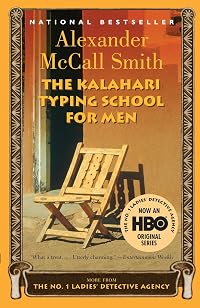
The Kalahari Typing School for Men is the fourth installment of The No. 1 Ladies' Detective Agency series and involves a mystery that isn't really a mystery, a romance that isn't really a romance, and a competitor that isn't really a competitor. The only story in the book that isn't completely inverted is Mma Makutsi's creation of a new side business to earn extra money, but even that, involving her teaching men the secretarial skill of typing, is something of a cultural reversal.
The primary mystery in the book isn't actually a mystery at all: The reader knows who the culprit in the tale is from the beginning, because he is Mma Ramotswe's client and he tells her of the wrongs he committed years before, making this a kind of inverted show more mystery where the criminal and crime is identified at the beginning, but the victims must be located. After an epiphany, the client decided that he needed to find the people he had injured as a young man and make amends with them, a choice that led him to hire a private detective to do the leg work. Through the book, Mma Ramotswe uses her usual techniques of calling people on the phone, talking to people over cups of tea, and otherwise pursuing the truth to find both the woman whose radio was stolen, and the woman whose heart was broken and ferret out how their lives had gone since her client knew them. In the end, Mma Ramotswe is able to get the information her client wants, but more importantly, she is able to serve as a kind of confessor for him, patiently guiding him to make the real sacrifices in order to meaningfully atone for the crimes he had committed. And that, I think, is one of the most critical point made in the book - in order to truly seek forgiveness, one has to take actual action. This story line is also the first time that the AIDS epidemic is directly referenced in the book, in the form of a child who has been afflicted with the disease.
The story line that gives the book its title revolves around Mma Makutsi's efforts to earn more money. Although she enjoys the titles of assistant detective and assistant manager that come with her dual roles working for the No. 1 Ladies' Detective Agency and Tlokweng Road Speedy Motors, Mma Makutsi is aware that neither business can afford to raise her salary by any substantial amount. But, as she both takes care of her brother and sends a portion of her paychecks home to the rest of her family, she realizes that her finances are stretched to the breaking point. After briefly considering opening a driving school (notwithstanding the fact that she cannot drive), Mma Makutsi settles upon the idea of opening a typing school aimed at training men to type based upon the theory that while men are too proud to stoop so low as to attend an institution like the Botswana Secretarial College, they would benefit from learning to type so as to be better able to use the computer keyboards entering office use. Putting her formidable organizational skills to the task, Mma Makutsi soon acquires the typewriters, space, and students she needs to make her business a success. Soon, she is engaged in teaching men how to type, a situation that seems to make some of her students uncomfortable, although in the end they seem reconciled to it, as her obvious expertise shines through.
And while Mma Makutsi's start-up business seems to get off to an almost improbably successful start, and it also leads to another significant plot point as she engages in a dalliance with a well-dressed student of the school named Bernard Seleliping. In the course of her romance, Mma Makutsi is taken to an expensive bar and a fancy restaurant, but unbeknownst to her her relationship is threatened by her suitor's duplicity. Early in the book Mma Ramotswe discovers that a new detective agency has opened in Gabarone - the Satisfaction Guaranteed Detective Agency, run by former police officer Cephas Buthelezi, a man who turns out to be arrogant, overbearingly sexist, and dismissive of both Mma Ramotswe and Mma Makutsi. This story line is more or less dropped until substantially later in the book when a disgruntled former client of Mr. Buthelezi's shows up on Mma Ramotswe's door. She believes that her husband has been cheating on her, and is dissatisfied by Buthelezi's finding that her husband has been spending his time in church, a suggestion that she simply does not believe. Before too long, the reader realizes that the church the wayward husband has been going to is the same one Mma Makutsi has been using to give her typing lessons.
This results in yet another moral dilemma for Mma Ramotswe, as she figures out that the romantic suitor she has been hearing about from Mma Makutsi is none other than the wandering husband of her new client. As is typical of the series, the real problem is not unraveling the mystery, which is almost a trivial exercise, but rather trying to figure out how to resolve the situation. Mma Ramotswe likes Mma Makutsi, and doesn't want her to get hurt by the revelation that her paramour is a married man and also feels an obligation to her client who happens to be Mr. Seleliping's wife. As usual, Mma Ramotswe deals with the issue in her direct and fairly forthright manner, and Mma Makutsi unknowingly solves the moral dilemma on her own. But the interesting development in this story line is the transformation of the character of Mma Makutsi, from someone who was mostly just an object of pity renowned for her score of 97% at the Botswana Secretarial College to a fully realized individual who is aware of her own worth both as an employee and as a romantic figure.
Like the previous books in the series, The Kalahari Typing School for Men is a book with a gentle and almost languid sensibility. There is a mystery, but it involves a stolen radio and a broken relationship, not a murder or a bank heist. There is a romance of sorts, but it is a placid one, involving getting drinks at fancy bars and dinner at fancy restaurants before fizzling out from disinterest leavened with a helping of dishonesty. Mma Ramotswe has some trouble with her newly adopted children, but this difficulty fades after a fairly easy prescription is applied. Even the competitor that dominates much of the discussion in the early portion of the book basically blows away like a dead leaf on the wind. The plot-lines all come very close to resolving in ways that are simply too serendipitously convenient, but stop just short of crossing that line. The problems Mma Ramotswe and those around her face are mundane and in some cases almost trivial, but they are solved, not so much by chance, but rather because those facing these problems approach them with common sense, a willingness to engage in hard work, and caring and compassion. The Kalahari Typing School for Men is a quiet book, but it is quiet in the best way.
This review has also been posted to my blog Dreaming About Other Worlds. show less
The primary mystery in the book isn't actually a mystery at all: The reader knows who the culprit in the tale is from the beginning, because he is Mma Ramotswe's client and he tells her of the wrongs he committed years before, making this a kind of inverted show more mystery where the criminal and crime is identified at the beginning, but the victims must be located. After an epiphany, the client decided that he needed to find the people he had injured as a young man and make amends with them, a choice that led him to hire a private detective to do the leg work. Through the book, Mma Ramotswe uses her usual techniques of calling people on the phone, talking to people over cups of tea, and otherwise pursuing the truth to find both the woman whose radio was stolen, and the woman whose heart was broken and ferret out how their lives had gone since her client knew them. In the end, Mma Ramotswe is able to get the information her client wants, but more importantly, she is able to serve as a kind of confessor for him, patiently guiding him to make the real sacrifices in order to meaningfully atone for the crimes he had committed. And that, I think, is one of the most critical point made in the book - in order to truly seek forgiveness, one has to take actual action. This story line is also the first time that the AIDS epidemic is directly referenced in the book, in the form of a child who has been afflicted with the disease.
The story line that gives the book its title revolves around Mma Makutsi's efforts to earn more money. Although she enjoys the titles of assistant detective and assistant manager that come with her dual roles working for the No. 1 Ladies' Detective Agency and Tlokweng Road Speedy Motors, Mma Makutsi is aware that neither business can afford to raise her salary by any substantial amount. But, as she both takes care of her brother and sends a portion of her paychecks home to the rest of her family, she realizes that her finances are stretched to the breaking point. After briefly considering opening a driving school (notwithstanding the fact that she cannot drive), Mma Makutsi settles upon the idea of opening a typing school aimed at training men to type based upon the theory that while men are too proud to stoop so low as to attend an institution like the Botswana Secretarial College, they would benefit from learning to type so as to be better able to use the computer keyboards entering office use. Putting her formidable organizational skills to the task, Mma Makutsi soon acquires the typewriters, space, and students she needs to make her business a success. Soon, she is engaged in teaching men how to type, a situation that seems to make some of her students uncomfortable, although in the end they seem reconciled to it, as her obvious expertise shines through.
And while Mma Makutsi's start-up business seems to get off to an almost improbably successful start, and it also leads to another significant plot point as she engages in a dalliance with a well-dressed student of the school named Bernard Seleliping. In the course of her romance, Mma Makutsi is taken to an expensive bar and a fancy restaurant, but unbeknownst to her her relationship is threatened by her suitor's duplicity. Early in the book Mma Ramotswe discovers that a new detective agency has opened in Gabarone - the Satisfaction Guaranteed Detective Agency, run by former police officer Cephas Buthelezi, a man who turns out to be arrogant, overbearingly sexist, and dismissive of both Mma Ramotswe and Mma Makutsi. This story line is more or less dropped until substantially later in the book when a disgruntled former client of Mr. Buthelezi's shows up on Mma Ramotswe's door. She believes that her husband has been cheating on her, and is dissatisfied by Buthelezi's finding that her husband has been spending his time in church, a suggestion that she simply does not believe. Before too long, the reader realizes that the church the wayward husband has been going to is the same one Mma Makutsi has been using to give her typing lessons.
This results in yet another moral dilemma for Mma Ramotswe, as she figures out that the romantic suitor she has been hearing about from Mma Makutsi is none other than the wandering husband of her new client. As is typical of the series, the real problem is not unraveling the mystery, which is almost a trivial exercise, but rather trying to figure out how to resolve the situation. Mma Ramotswe likes Mma Makutsi, and doesn't want her to get hurt by the revelation that her paramour is a married man and also feels an obligation to her client who happens to be Mr. Seleliping's wife. As usual, Mma Ramotswe deals with the issue in her direct and fairly forthright manner, and Mma Makutsi unknowingly solves the moral dilemma on her own. But the interesting development in this story line is the transformation of the character of Mma Makutsi, from someone who was mostly just an object of pity renowned for her score of 97% at the Botswana Secretarial College to a fully realized individual who is aware of her own worth both as an employee and as a romantic figure.
Like the previous books in the series, The Kalahari Typing School for Men is a book with a gentle and almost languid sensibility. There is a mystery, but it involves a stolen radio and a broken relationship, not a murder or a bank heist. There is a romance of sorts, but it is a placid one, involving getting drinks at fancy bars and dinner at fancy restaurants before fizzling out from disinterest leavened with a helping of dishonesty. Mma Ramotswe has some trouble with her newly adopted children, but this difficulty fades after a fairly easy prescription is applied. Even the competitor that dominates much of the discussion in the early portion of the book basically blows away like a dead leaf on the wind. The plot-lines all come very close to resolving in ways that are simply too serendipitously convenient, but stop just short of crossing that line. The problems Mma Ramotswe and those around her face are mundane and in some cases almost trivial, but they are solved, not so much by chance, but rather because those facing these problems approach them with common sense, a willingness to engage in hard work, and caring and compassion. The Kalahari Typing School for Men is a quiet book, but it is quiet in the best way.
This review has also been posted to my blog Dreaming About Other Worlds. show less
After reading the No. 1 Ladies Detective Agency a couple of years ago, I accumulated a few of these, and went through 6 in less than a month. They're very quick reads - I read 2 and part-of-a-third in one day.
They're very entertaining, charming, and compulsively readable. Although marketed as mysteries; they're not, really. Rather they follow Mma Ramotswe and those around her through their daily lives - it's almost besides-the-point that the business she runs is a detective agency. The stories are suffused with McCall-Smith's obvious sincere love of Africa (where he grew up), and the reader feels that a genuine window has opened up into the lives and mindsets of ordinary Africans. I don't agree with many aspects of Precious Ramotswe's show more view on the world, and I probably wouldn't get along with her in real life - but these books made me feel like I might understand people like her more than before.
However... there's also a weird aspect to the books. They're so relentlessly cozy. It's not that McCall-Smith ignores the poverty, the devastation of AIDS, the lack of education, etc... these things are acknowledged, but then almost swept to the side. On the one hand, it's a celebration of the spirit of the people of Botswana and their love of their homeland... but on the other hand, it sometimes feels like a minimization of these things. It's not just larger social issues: there's domestic abuse, adultery, etc... all the normal foibles of humanity (although all reference to sex of any kind are totally non-existent)- but all the unpleasant things somehow get almost drowned out in the cozy, feel-good atmosphere of the books. Maybe it's just that I usually read darker, grittier material [especially in mysteries {McCall-Smith is no Stieg Larsson!}] but it felt a bit strange to me. I can't decide if it's a detriment or a positive asset to the books.
In 'The Kalahari Typing School for Men,' Mma Makutsi opens her own side business - teching typing to men who might find office skills useful, but might be embarrased to go to a secretarial class poopulated by women. She also has a hope of meeting a nice man... Meanwhile, one of Mr. JLB Maketoni's lazy apprentices has a religious conversion, the orphaned foster children deal with emotional issues, and the detective agency has to deal with a new problem - competion from a rival business. Meanwhile, Mma Ramotswe handles the case of how to deal with a man who is guilty over having treated his first girlfriend poorly, many years ago. show less
They're very entertaining, charming, and compulsively readable. Although marketed as mysteries; they're not, really. Rather they follow Mma Ramotswe and those around her through their daily lives - it's almost besides-the-point that the business she runs is a detective agency. The stories are suffused with McCall-Smith's obvious sincere love of Africa (where he grew up), and the reader feels that a genuine window has opened up into the lives and mindsets of ordinary Africans. I don't agree with many aspects of Precious Ramotswe's show more view on the world, and I probably wouldn't get along with her in real life - but these books made me feel like I might understand people like her more than before.
However... there's also a weird aspect to the books. They're so relentlessly cozy. It's not that McCall-Smith ignores the poverty, the devastation of AIDS, the lack of education, etc... these things are acknowledged, but then almost swept to the side. On the one hand, it's a celebration of the spirit of the people of Botswana and their love of their homeland... but on the other hand, it sometimes feels like a minimization of these things. It's not just larger social issues: there's domestic abuse, adultery, etc... all the normal foibles of humanity (although all reference to sex of any kind are totally non-existent)- but all the unpleasant things somehow get almost drowned out in the cozy, feel-good atmosphere of the books. Maybe it's just that I usually read darker, grittier material [especially in mysteries {McCall-Smith is no Stieg Larsson!}] but it felt a bit strange to me. I can't decide if it's a detriment or a positive asset to the books.
In 'The Kalahari Typing School for Men,' Mma Makutsi opens her own side business - teching typing to men who might find office skills useful, but might be embarrased to go to a secretarial class poopulated by women. She also has a hope of meeting a nice man... Meanwhile, one of Mr. JLB Maketoni's lazy apprentices has a religious conversion, the orphaned foster children deal with emotional issues, and the detective agency has to deal with a new problem - competion from a rival business. Meanwhile, Mma Ramotswe handles the case of how to deal with a man who is guilty over having treated his first girlfriend poorly, many years ago. show less
You don't have to read the first three Mma Ramotswe books in order to enjoy Kalahair Typing School for Men but I think you would enjoy them better if you did. In the fourth installment of The No. 1 Ladies Detective Agency the plot continues to move away from solving mysteries (as it had been in Morality for Beautiful Girls) and the emphasis is placed more on character development. To bring you up to speed: Mma Precious Ramotswe is Botswana's only female detective. She is engaged to Mr. J.L.B. Matekoni and together they have adopted two children, a brother and sister, but still haven't set a wedding date. It seems Mr. J.L.B. Matekoni is content to stay engaged for an indeterminate amount of time. Mma Ramotswe has two cases of interest. show more One is a gentleman wishing to repair his not so sterling past. He wants to make amends for a series of wrongs he has done as a youth. The other mystery is a typical marital woe of a woman thinking her man is cheating on her. The title of the story comes from Mma Matakutsi's side business of starting a typing school for men. show less
First one I've read - and I like the fact that it is all quite understated and subtle: as a detective Precious Ramotswe comes across more as a psychologist and counsellor than a hard-bitten scourge of the criminal classes. In fact, there aren't any 'real' criminals here, more ordinary people who have messed up one way or the other
Book four in the No. 1 Ladies' Detective Agency series. This one features, among other things, a new business venture, a client looking to make amends for past bad deeds, and the opening of a rival detective agency. As usual, it's a gentle, pleasant, slightly rambly character-based story that doesn't bother all that much with plot. And, as usual, that works surprisingly well. I particularly like the touches of sly, subtle humor in this one.
Lisette Lecat does a marvelous job narrating this audiobook. While the mystery is slight, the view of human nature and life in Botswana continued to charm.
Another good installment. This time the story provides more focus on Mma Makutsi. As with previous books in the series, the story is more about daily life in Botswana and provides a wonderful window into the unique cultural aspects of Botswanan life and society and how traditional ways are being impacted by First World priorities and points of view. Some may call these stories to be “cozy mysteries” but I like to think about them as stories where one gets to examine moral implications of actions, traditional folk wisdom and how common sense can prevail in sticky situations. Justice is not always best served when one does not take into account how an action may impact all parties involved. I really enjoyed the business ingenuity as show more Mma Makutsi looks to establish a new business to help her make enough money to live and care for her ailing brother. On a downside, McCall Smith does paint certain scenarios - such as the presence of a new, competing detective agency in the community - with a brush that focuses on pointing out extreme contrasts between the two agencies and fails to provide any real value, except as an easy mechanism to introduce further discussion about proper behaviour between Mma Ramotswe and Mma Makutsi.
Overall, An enjoyable series for readers seeking a light-hearted view of life from a different perspective, where discussions of proper behaviour occupies as much space in the stories as the cases to be solved. show less
Overall, An enjoyable series for readers seeking a light-hearted view of life from a different perspective, where discussions of proper behaviour occupies as much space in the stories as the cases to be solved. show less
Members
- Recently Added By
Lists

Female Protagonist
1,056 works; 56 members

Crime and Mysteries to Read
746 works; 31 members

Books tagged "feel good"
129 works; 20 members

Books Read in 2005
174 works; 7 members

Chronological 2017
30 works; 1 member

Most Popular Books Tagged Africa
35 works; 3 members

Detective Stories
343 works; 5 members

Books read in 2015
213 works; 5 members

Books With Place Names in the Title
215 works; 10 members
Author Information

309+ Works 125,161 Members
Alexander McCall Smith was born on August 24, 1948 in Zimbabwe. He was a professor of medical law at the University of Edinburgh, but he left in 2005 to focus on his writing. He has written over 60 books, including specialist academic titles including Forensic Aspects of Sleep and The Criminal Law of Botswana, short story collections including show more Portuguese Irregular Verbs, and children's books including The Perfect Hamburger. He is best known for the No. 1 Ladies' Detective Agency series. He also writes the Corduroy Mansions, Isabel Dalhousie and 44 Scotland Street series. He has received numerous awards, including The Crime Writers' Association Dagger in the Library Award and the 2004 United Kingdom's Author of the Year Award. His book, The Full Cupboard of Life, received the Saga Award for Wit in the United Kingdom. In 2007, he received a CBE for his services in literature. (Bowker Author Biography) show less
Some Editions
Awards and Honors
Distinctions
Series

Belongs to Publisher Series
Work Relationships
Is contained in
Has the adaptation
Is abridged in
Common Knowledge
- Canonical title
- The Kalahari Typing School for Men
- Original title
- The Kalahari typing school for men
- Original publication date
- 2002-06-01
- People/Characters
- Precious Ramotswe (Mma); J.L.B. Matekoni; Grace Makutsi (Mma); Silvia Potokwane (Mma)
- Important places
- Gaborone, Botswana
- Dedication
- This book is for
Amy Moore
Florence Christie
and
Elaine Gadd - First words
- I must remember, thought Mma Ramotswe, how fortunate I am in this life; at every moment, but especially now, sitting on the verandah of my house on Zebra Drive, and looking up at the high sky of Botswanna, so empty that the b... (show all)lue is almost white.
- Last words
- (Click to show. Warning: May contain spoilers.)Mma Ramotswe smiled, but only to herself.
- Original language
- English
Classifications
Statistics
- Members
- 6,063
- Popularity
- 2,085
- Reviews
- 106
- Rating
- (3.86)
- Languages
- 19 — Bulgarian, Catalan, Czech, Danish, Dutch, English, Estonian, Finnish, French, German, Hebrew, Italian, Korean, Lithuanian, Norwegian (Bokmål), Polish, Portuguese, Spanish, Swedish
- Media
- Paper, Audiobook, Ebook
- ISBNs
- 70
- UPCs
- 2
- ASINs
- 27