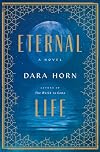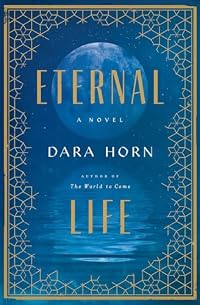
Eternal Life: A Novel
by Dara Horn 
On This Page
Description
A New York Times Notable Book A Booklist Editors' Choice A Chicago Public Library Best Book of the Year What would it really mean to live forever? Rachel is a woman with a problem: she can't die. Her recent troubles-widowhood, a failing business, an unemployed middle-aged son-are only the latest in a litany spanning dozens of countries, scores of marriages, and hundreds of children. In the 2,000 years since she made a spiritual bargain to save the life of her first son back in Roman-occupied show more Jerusalem, she's tried everything to free herself, and only one other person in the world understands: a man she once loved passionately, who has been stalking her through the centuries, convinced they belong together forever. But as the twenty-first century begins and her children and grandchildren-consumed with immortality in their own ways, from the frontiers of digital currency to genetic engineering-develop new technologies that could change her fate and theirs, Rachel knows she must find a way out. Gripping, hilarious, and profoundly moving, Eternal Life celebrates the bonds between generations, the power of faith, the purpose of death, and the reasons for being alive. show lessTags
Recommendations





Member Reviews
This book raises many intriguing questions about the meaning of life, the desire for immortality, quality of life vs length, what it means to be a good parent....It's well written; I felt as if I were there with the main character.
Rachel and Elazar give up their mortality to save their son's life. Over the centuries, they continually leave whatever lives they have created and start fresh. They aren't together, but seem to find each other when necessary.
My issue is with the main character, Rachel. After living for more than 2000 years, she doesn't seem to evolve with the times. She remains tied to traditional roles and doesn't seem to adapt to, or even notice, changes in the role and place of women in society. I guess it would be show more harder to show the price she'd paid if her incarnations were more varied and interesting, or if she hadn't constantly outlived her children. That said, I still found her extremely frustrating! show less
Rachel and Elazar give up their mortality to save their son's life. Over the centuries, they continually leave whatever lives they have created and start fresh. They aren't together, but seem to find each other when necessary.
My issue is with the main character, Rachel. After living for more than 2000 years, she doesn't seem to evolve with the times. She remains tied to traditional roles and doesn't seem to adapt to, or even notice, changes in the role and place of women in society. I guess it would be show more harder to show the price she'd paid if her incarnations were more varied and interesting, or if she hadn't constantly outlived her children. That said, I still found her extremely frustrating! show less
I'm loath to say that any piece of writing is awful because someone will surely see value in it, but for me, this was pretty awful. I picked it up because the premise sounded so interesting, but it was very much the opposite. This was not a story about a woman with eternal life trying to enable her children to live without her; it was story about a miserable woman who is unable to let go of the past and blames everyone around her to the point of near-delusional paranoia.
Every time the story would start to get interesting, it would abruptly halt with her repressed sexual desire for Elazar, her resentment toward her children for being "young and stupid," her growing malcontent, to the point of disgust, towards her first husband (who was a show more freakin' saint until the tail end of his life), her insane level of paranoia, her infuriatingly endless willful ignorance about everything (seriously, I can get not understanding cryptocurrency, but not understanding what therapy is?). Honestly, this character was baffling in the worst way possible.
She's lived her entire 2,000 year life resenting those around her, especially her own children, for being "young and stupid," but her entire reasoning throughout the book is absolutely selfish and backward. If she actually took time in her whole pointless life to reflect rather than avoid painful subjects with denial and redirection, then maybe she would have realized that her obsession with having children and trying to making them live as long as her is contrarian, selfish, and lacks any and all self-awareness. Even when she finally had some sense to be with the one man she truly loved, she decided that when she couldn't become pregnant by him that HE was the reason for all her problems, even though she's the one that begs for him to help her time and time again. There is a level of toxic relationship there between those two that I can't even begin to unpack. And there's only so much "because of my past trauma" excuse that one can really use when you're 2,000+ years old; at that point you should have surely learned a thing or two about being an adult.
Then at the very end, I guess because she saves her great grandson from dying, she has this mind-shift and starts this whole miserable cycle all over again, taking a different life path than the countless times before.... how it never occurred to her to try something different in the 2,000 previous years is beyond me. She has a baby again, naming him after her first son... because symbolism, and THIS time she decides she's happy? Umm... okay?
Ugh. I just can't. What a colossal waste of time. show less
Every time the story would start to get interesting, it would abruptly halt with her repressed sexual desire for Elazar, her resentment toward her children for being "young and stupid," her growing malcontent, to the point of disgust, towards her first husband (who was a show more freakin' saint until the tail end of his life), her insane level of paranoia, her infuriatingly endless willful ignorance about everything (seriously, I can get not understanding cryptocurrency, but not understanding what therapy is?). Honestly, this character was baffling in the worst way possible.
She's lived her entire 2,000 year life resenting those around her, especially her own children, for being "young and stupid," but her entire reasoning throughout the book is absolutely selfish and backward. If she actually took time in her whole pointless life to reflect rather than avoid painful subjects with denial and redirection, then maybe she would have realized that her obsession with having children and trying to making them live as long as her is contrarian, selfish, and lacks any and all self-awareness. Even when she finally had some sense to be with the one man she truly loved, she decided that when she couldn't become pregnant by him that HE was the reason for all her problems, even though she's the one that begs for him to help her time and time again. There is a level of toxic relationship there between those two that I can't even begin to unpack. And there's only so much "because of my past trauma" excuse that one can really use when you're 2,000+ years old; at that point you should have surely learned a thing or two about being an adult.
Then at the very end, I guess because she saves her great grandson from dying, she has this mind-shift and starts this whole miserable cycle all over again, taking a different life path than the countless times before.... how it never occurred to her to try something different in the 2,000 previous years is beyond me. She has a baby again, naming him after her first son... because symbolism, and THIS time she decides she's happy? Umm... okay?
Ugh. I just can't. What a colossal waste of time. show less
This book is about a first century couple: a woman, Rachel, and man, Elazar, who make an eternal vow with God, exchanging the right to have their own lives end for the healing of their son Yochanan, who fell deathly ill while still a baby. It could have been philosophically dense, but instead it is a love story (on many levels) that is full of wit as well as trenchant observations about the meaning of life. It is told from the point of view of Rachel, who is - in her current “version” - an 84-year-old Jewish grandmother in present-day New York. But of course Rachel has been around for much longer than she appears. (She doesn’t “look” 84, which she tells others is because of “good genes.”)
The story begins in Jerusalem 2000 show more years ago during the era of the Second Temple, so this book is somewhat of a retelling of ancient Jewish history. Three of the main characters have real historical antecedents, including Elazar, governor of the Temple at the time of its destruction; Elazar’s father, the high priest Hanania; and the son of Rachel and Elazar, Yochanan, son of Zakkai, who lived to become an important Talmudic sage in his era. The early part of the story includes the Jewish revolt against Rome, and destruction of Jerusalem in the year 70 CE.
Since Rachel and Elazar live on and on, it is also a story about memory. What stays with you over the years and what doesn’t? In one of the funniest motifs of the book, Rachel is still mad about something Elazar did two centuries ago. But in addition, how does current technology change the whole dynamic that determines what and who gets remembered? Does everyone live forever now, in a sense, when you can find them - dead or alive - on social media?
Fans of Dara Horn may recall that in her book A Guide for the Perplexed, she tackled the topic of memory as well. In that book, the main character created a computer program which she called Genizah, designed to store personal memories. (A Genizah is a storage area in a Jewish synagogue or cemetery designated for worn-out Hebrew-language books and papers on religious topics prior to proper cemetery burial. It is, in effect, it is a physical memory storage area.) The character Josie in that story hypothesized that if we can “recreate” people from these memories, haven’t we in some senses “resurrected” them from the dead? Haven’t we made them immortal?
Rachel might answer: yes, but at least they are only immortal in virtual form, and don’t have to live through immortality.
Rachel occupies the centuries mired down in the minutiae of every day life. She used to wonder if these trivial activities actually concealed something godly; whether "miracles" were actually manifested in the ordinary:
“Many days and years and people had passed before she understood that the details themselves were the still and sacred things, that there was nothing else, that the curtain of daily life itself was holy, that behind it was only a void. Yet some days she still wondered.”
She has considered the reasons for being alive, and comes up with a number of theories: To love the Lord; to serve others; to experience joy; to build for the future; to correct mistakes; to avoid regret; to accept regret; to change; to make oneself superfluous. About this last, she thinks: “And therein lay the root of the problem. There was no point in any of it, none at all, unless one had plans to leave.” So she spends her life having children and chasing them around when they are young, “running after another reason for living.”
Her current son’s girlfriend has a different twist on that theory:
“Children are a gift from God, right? Why? Because they’re so wonderful? Honestly, they aren’t so wonderful. They’re a gift because they give us permission to fail. Because then we can at least imagine we’ve done something for the future, and we can die without thinking about what we haven’t done.”
But Rachel doesn’t have that “luxury.” She is haunted by thinking about not only her own apparent lack of purpose, but by how many children she has lost, because they could die but she could not:
“New parents think of each day as a cascade of beginnings: the first time she smiled, the first time she rolled over, her first steps, her first words, her first day of school. But old parents like her saw only endings: the last time she crawled, the last time she spoke in a pure raw sound unsculpted into the words of others, the last time she stood before the world in braids and laughed when she shouldn’t have, not knowing.”
And every few years - sometimes after a few centuries - Elazar finds Rachel. (She tries to stay mad at him, however.) This time he warns Rachel it’s not as easy to “die” and take on a new life as before. He tells her: “…this is the fifty-eight century, Rachel.” She says, “Or the twenty-first.” “‘Fine,’ he responds. The point is, he explains, the technology governing international security, including biometric identification requirements, make starting over ever more difficult. But he will take care of arrangements for her. (As he told her when they met, 2000 years ago, “You need me. You just don’t know it yet.”)
But Rachel doesn’t want to “start over” anymore. She wants to die. She goes to a psychiatrist, Dr. Moskowitz, who asks her “What brings you here today?” Rachel answers, “I’m repeating old negative behavior patterns, and I feel it’s very destructive.” She tells Dr. Moskowitz she can’t die, to which the psychiatrist replies, “Everyone feels invincible when they’re young.” Rachel tries to summarize her many lives. The doctor gives up and prescribes an anti-psychotic for her.
Some readers might be reminded of “The 2000 Year Old Man,” the comedy skit persona originally created by Mel Brooks and Carl Reiner in 1961.
Mel Brooks played the oldest man in the world, who was interviewed by Carl Reiner in a series of comedy routines. (One of my favorites: “Did you know Joan of Arc?” "KNOW her? I WENT with her!”)
The humor in this book as well as the basic plot remind me of their routines. The idea of eternal life has such hilarious potential for comedy, although Horn adds poignancy to the mix. She also feminizes it, by focusing on Rachel’s life as a mother and a wife. (Rachel has always avoided doing something more “public,” so as not to draw attention to herself.)
Rachel’s current granddaughter Hannah is a geneticist, and gives Rachel the idea that she might be able to find a way to die, after all. Ironically, Hannah, “who looked more like [Rachel] than anyone else had in two thousand years,” is trying to solve the problem of how to achieve eternal life, which would also, as a by-product of that research, illuminate the processes that end life. (Rachel says to Elazar, “High priests used to have this power. Did it ever occur to you that Hannah [feminized form of Hanania] and people like her are the new high priests?”)
Rachel cautions Hannah: “The hard part isn’t living forever. It’s making life worth living.” As she once complained to Elazar (after 300 years): “We don’t grow. We’re like an old book, full of stories and also full of errors, and no one can completely understand us. . . . But the problem is that we don’t change. Only the people around us change.”
But this time, maybe Rachel can die. Or maybe she can find something new that would make life worth living.
Discussion: This is not a long book, but it is dense with thought-provoking ideas. An underlying theme of this story is one of the most important stories of the Old Testament: the Akedah, or Binding of Isaac, told in Genesis 22:1-19. God orders Abraham to sacrifice his son, Isaac, on Mount Moriah. Abraham agrees, but then is stopped at the last minute when God sends an angel who tells him to sacrifice a ram instead.
The Akedah became in Jewish thought the supreme example of self-sacrifice in obedience to God's will.
In this book, the characters do a reversal of sorts. They agree to die themselves an infinite number of times to save their child. Rachel, at least, thought the vow she took was “metaphorical” like other religious teachings. And if she just agreed to give up on her child instead? What if God felt that way, and gave up on His children?
The high priest Hanania (Elazar’s father), tells Rachel at the time of her vow: “This vow will make you die without dying. If you make this vow, your son will live, but so will you.” The sacrifice, he explains, is her death. She tells him: “I would gladly die for my son.” “‘No,’ he explains. You will live for him.” Rachel almost smiled. “I’m already living for him. All mothers live for their children.”
And over the years, Rachel does indeed live for her children, hundreds of times.
[Horn points out in the book that in around the ninth century, the Jews came up with the Kol Nidre declaration during Yom Kippur. The formula proactively annuls any personal or religious oaths or prohibitions made upon oneself to God for the next year, so as to preemptively avoid the sin of breaking vows made to God which cannot be or are not upheld. (The Kol Nidre declaration can invalidate only vows that one undertakes on one’s own volition. It has no effect on vows or oath imposed by someone else, or a court.) In any event, this somewhat conceptually extraordinary ceremony came too late for Rachel and Elazar.]
In another theme, just as there are different “versions” of Rachel, there are different versions of her children. Some remind her of past children, but of course she could never tell them. One reason she likes her own current incarnation so much is that her son Rocky reminds her more than anyone of her first son, Yochanan. Rocky is not quite as successful, however; he is 56 and living in his mother’s basement after several failed businesses and marriages. He doesn’t make any sense to Rachel, just as Yochanan did not. Both of them - Rocky with his ongoing study of “blockchains” and money mining, and Yochanan with his ongoing analysis of Torah passages are connected in a way we don’t fully discern until the end of the story. Rachel may not understand bitcoins or the Torah like her children, but she sees both Yochanan and Rocky as “trying to achieve what [their] mother already had: a permanent record of the past that can never change….”
Eternal love plays a role as well. Rachel’s love for Elazar abides even through centuries of anger. Her love of her children, especially her first child, never leaves her. Elazar, too, does not find time a barrier to love. Tweeting in the hashtag thread #EternalLife he complains: “After 2000 years she still doesn’t love me like I love her. In a normal lifespan I might not have noticed. #EternalLife’s a bitch.” Someone responds, “Um, maybe it’s time to move on? 2000 yrs seems like long enough to get over your ex.” But Elazar answers, #EternalLife: I will love her until the end of time. Every man on earth will tell her that, but I am the only one who will ever mean it.”
The changing roles of men and women over the ages inserts itself intermittently; for Rachel, perhaps the biggest miracle she has ever witnessed is men starting to help with household chores.
And the meaning of parenting is always in play. In some ways the novel is an ongoing joke riffing on the theme that motherhood and the sacrifices one must make for it seem never-ending.
Finally, on a higher level, there is God’s meaning. Yochanan theorized that every story in the Bible or Talmud was "kind of like a secret message,” because “people aren’t as smart as God, so everything is like a stupid version of the real story.” Maybe all we can ever hope to know is “the stupid version.”
Evaluation: Besides the themes mentioned above, there are others worth contemplating, but too many to delineate in a review. Horn incorporates so many clever references and topics into this story that it would take a book of my own to explicate them all. Or one can just read it as a love story that lasts through all of time. If you like intelligent fiction - fiction that makes you think about religious, philosophical, political, technical, and personal issues and how they intersect - Dara Horn is one of the best authors I know who makes this happen. show less
The story begins in Jerusalem 2000 show more years ago during the era of the Second Temple, so this book is somewhat of a retelling of ancient Jewish history. Three of the main characters have real historical antecedents, including Elazar, governor of the Temple at the time of its destruction; Elazar’s father, the high priest Hanania; and the son of Rachel and Elazar, Yochanan, son of Zakkai, who lived to become an important Talmudic sage in his era. The early part of the story includes the Jewish revolt against Rome, and destruction of Jerusalem in the year 70 CE.
Since Rachel and Elazar live on and on, it is also a story about memory. What stays with you over the years and what doesn’t? In one of the funniest motifs of the book, Rachel is still mad about something Elazar did two centuries ago. But in addition, how does current technology change the whole dynamic that determines what and who gets remembered? Does everyone live forever now, in a sense, when you can find them - dead or alive - on social media?
Fans of Dara Horn may recall that in her book A Guide for the Perplexed, she tackled the topic of memory as well. In that book, the main character created a computer program which she called Genizah, designed to store personal memories. (A Genizah is a storage area in a Jewish synagogue or cemetery designated for worn-out Hebrew-language books and papers on religious topics prior to proper cemetery burial. It is, in effect, it is a physical memory storage area.) The character Josie in that story hypothesized that if we can “recreate” people from these memories, haven’t we in some senses “resurrected” them from the dead? Haven’t we made them immortal?
Rachel might answer: yes, but at least they are only immortal in virtual form, and don’t have to live through immortality.
Rachel occupies the centuries mired down in the minutiae of every day life. She used to wonder if these trivial activities actually concealed something godly; whether "miracles" were actually manifested in the ordinary:
“Many days and years and people had passed before she understood that the details themselves were the still and sacred things, that there was nothing else, that the curtain of daily life itself was holy, that behind it was only a void. Yet some days she still wondered.”
She has considered the reasons for being alive, and comes up with a number of theories: To love the Lord; to serve others; to experience joy; to build for the future; to correct mistakes; to avoid regret; to accept regret; to change; to make oneself superfluous. About this last, she thinks: “And therein lay the root of the problem. There was no point in any of it, none at all, unless one had plans to leave.” So she spends her life having children and chasing them around when they are young, “running after another reason for living.”
Her current son’s girlfriend has a different twist on that theory:
“Children are a gift from God, right? Why? Because they’re so wonderful? Honestly, they aren’t so wonderful. They’re a gift because they give us permission to fail. Because then we can at least imagine we’ve done something for the future, and we can die without thinking about what we haven’t done.”
But Rachel doesn’t have that “luxury.” She is haunted by thinking about not only her own apparent lack of purpose, but by how many children she has lost, because they could die but she could not:
“New parents think of each day as a cascade of beginnings: the first time she smiled, the first time she rolled over, her first steps, her first words, her first day of school. But old parents like her saw only endings: the last time she crawled, the last time she spoke in a pure raw sound unsculpted into the words of others, the last time she stood before the world in braids and laughed when she shouldn’t have, not knowing.”
And every few years - sometimes after a few centuries - Elazar finds Rachel. (She tries to stay mad at him, however.) This time he warns Rachel it’s not as easy to “die” and take on a new life as before. He tells her: “…this is the fifty-eight century, Rachel.” She says, “Or the twenty-first.” “‘Fine,’ he responds. The point is, he explains, the technology governing international security, including biometric identification requirements, make starting over ever more difficult. But he will take care of arrangements for her. (As he told her when they met, 2000 years ago, “You need me. You just don’t know it yet.”)
But Rachel doesn’t want to “start over” anymore. She wants to die. She goes to a psychiatrist, Dr. Moskowitz, who asks her “What brings you here today?” Rachel answers, “I’m repeating old negative behavior patterns, and I feel it’s very destructive.” She tells Dr. Moskowitz she can’t die, to which the psychiatrist replies, “Everyone feels invincible when they’re young.” Rachel tries to summarize her many lives. The doctor gives up and prescribes an anti-psychotic for her.
Some readers might be reminded of “The 2000 Year Old Man,” the comedy skit persona originally created by Mel Brooks and Carl Reiner in 1961.
Mel Brooks played the oldest man in the world, who was interviewed by Carl Reiner in a series of comedy routines. (One of my favorites: “Did you know Joan of Arc?” "KNOW her? I WENT with her!”)
The humor in this book as well as the basic plot remind me of their routines. The idea of eternal life has such hilarious potential for comedy, although Horn adds poignancy to the mix. She also feminizes it, by focusing on Rachel’s life as a mother and a wife. (Rachel has always avoided doing something more “public,” so as not to draw attention to herself.)
Rachel’s current granddaughter Hannah is a geneticist, and gives Rachel the idea that she might be able to find a way to die, after all. Ironically, Hannah, “who looked more like [Rachel] than anyone else had in two thousand years,” is trying to solve the problem of how to achieve eternal life, which would also, as a by-product of that research, illuminate the processes that end life. (Rachel says to Elazar, “High priests used to have this power. Did it ever occur to you that Hannah [feminized form of Hanania] and people like her are the new high priests?”)
Rachel cautions Hannah: “The hard part isn’t living forever. It’s making life worth living.” As she once complained to Elazar (after 300 years): “We don’t grow. We’re like an old book, full of stories and also full of errors, and no one can completely understand us. . . . But the problem is that we don’t change. Only the people around us change.”
But this time, maybe Rachel can die. Or maybe she can find something new that would make life worth living.
Discussion: This is not a long book, but it is dense with thought-provoking ideas. An underlying theme of this story is one of the most important stories of the Old Testament: the Akedah, or Binding of Isaac, told in Genesis 22:1-19. God orders Abraham to sacrifice his son, Isaac, on Mount Moriah. Abraham agrees, but then is stopped at the last minute when God sends an angel who tells him to sacrifice a ram instead.
The Akedah became in Jewish thought the supreme example of self-sacrifice in obedience to God's will.
In this book, the characters do a reversal of sorts. They agree to die themselves an infinite number of times to save their child. Rachel, at least, thought the vow she took was “metaphorical” like other religious teachings. And if she just agreed to give up on her child instead? What if God felt that way, and gave up on His children?
The high priest Hanania (Elazar’s father), tells Rachel at the time of her vow: “This vow will make you die without dying. If you make this vow, your son will live, but so will you.” The sacrifice, he explains, is her death. She tells him: “I would gladly die for my son.” “‘No,’ he explains. You will live for him.” Rachel almost smiled. “I’m already living for him. All mothers live for their children.”
And over the years, Rachel does indeed live for her children, hundreds of times.
[Horn points out in the book that in around the ninth century, the Jews came up with the Kol Nidre declaration during Yom Kippur. The formula proactively annuls any personal or religious oaths or prohibitions made upon oneself to God for the next year, so as to preemptively avoid the sin of breaking vows made to God which cannot be or are not upheld. (The Kol Nidre declaration can invalidate only vows that one undertakes on one’s own volition. It has no effect on vows or oath imposed by someone else, or a court.) In any event, this somewhat conceptually extraordinary ceremony came too late for Rachel and Elazar.]
In another theme, just as there are different “versions” of Rachel, there are different versions of her children. Some remind her of past children, but of course she could never tell them. One reason she likes her own current incarnation so much is that her son Rocky reminds her more than anyone of her first son, Yochanan. Rocky is not quite as successful, however; he is 56 and living in his mother’s basement after several failed businesses and marriages. He doesn’t make any sense to Rachel, just as Yochanan did not. Both of them - Rocky with his ongoing study of “blockchains” and money mining, and Yochanan with his ongoing analysis of Torah passages are connected in a way we don’t fully discern until the end of the story. Rachel may not understand bitcoins or the Torah like her children, but she sees both Yochanan and Rocky as “trying to achieve what [their] mother already had: a permanent record of the past that can never change….”
Eternal love plays a role as well. Rachel’s love for Elazar abides even through centuries of anger. Her love of her children, especially her first child, never leaves her. Elazar, too, does not find time a barrier to love. Tweeting in the hashtag thread #EternalLife he complains: “After 2000 years she still doesn’t love me like I love her. In a normal lifespan I might not have noticed. #EternalLife’s a bitch.” Someone responds, “Um, maybe it’s time to move on? 2000 yrs seems like long enough to get over your ex.” But Elazar answers, #EternalLife: I will love her until the end of time. Every man on earth will tell her that, but I am the only one who will ever mean it.”
The changing roles of men and women over the ages inserts itself intermittently; for Rachel, perhaps the biggest miracle she has ever witnessed is men starting to help with household chores.
And the meaning of parenting is always in play. In some ways the novel is an ongoing joke riffing on the theme that motherhood and the sacrifices one must make for it seem never-ending.
Finally, on a higher level, there is God’s meaning. Yochanan theorized that every story in the Bible or Talmud was "kind of like a secret message,” because “people aren’t as smart as God, so everything is like a stupid version of the real story.” Maybe all we can ever hope to know is “the stupid version.”
Evaluation: Besides the themes mentioned above, there are others worth contemplating, but too many to delineate in a review. Horn incorporates so many clever references and topics into this story that it would take a book of my own to explicate them all. Or one can just read it as a love story that lasts through all of time. If you like intelligent fiction - fiction that makes you think about religious, philosophical, political, technical, and personal issues and how they intersect - Dara Horn is one of the best authors I know who makes this happen. show less
Wonderful book tells the story of Rachel, daughter of an important scribe at the end of the Second Temple era in Jerusalem and the mother of Yochanan Ben Zakkai, the sage disciple of Hillel who essentially founded modern Jewish practice in the wake of the destruction of the Temple by the Romans in 70 CE. Rachel has married an apprentice of her father, but carries on a torrid love affair with Elazar, a son of the High Priest. But when Rachel and Elazar's son Yochanan (thought by others to be the son of Zakkai) becomes gravely ill as an infant, the parents make a vow to save their son at a steep cost- they will live forever. The novel moves back and forth across 2000 years, giving back story and following Rachel in the present day, a show more grandmother getting ready to leave behind her current family and start anew, as she must do 70 years or so. Elazar, as he does from time to time, has found her in America where she's living and is begging her to return to him, while she cannot forgive him for an ancient sin.
The writing is great and I'm a sucker for sci fi so it's in my wheel house. It's not really sci fi, though, much more focused on the characters and the framing of eternal life as a curse rather than a blessing. I can't help thinking of a recent book in this vein, Wild Seed by Octavia Butler. I wonder if Horn read that- very similar in that both books are about immortal couples navigating the world of mortals including their own children, and trying to define what their relationship to each other means.
Anyway, I'm new to Horn, who has had some publicity lately for her new book "People Love Dead Jews", but I thought I'd try her fiction first. I'm hooked, and ready for more from her. show less
The writing is great and I'm a sucker for sci fi so it's in my wheel house. It's not really sci fi, though, much more focused on the characters and the framing of eternal life as a curse rather than a blessing. I can't help thinking of a recent book in this vein, Wild Seed by Octavia Butler. I wonder if Horn read that- very similar in that both books are about immortal couples navigating the world of mortals including their own children, and trying to define what their relationship to each other means.
Anyway, I'm new to Horn, who has had some publicity lately for her new book "People Love Dead Jews", but I thought I'd try her fiction first. I'm hooked, and ready for more from her. show less
ETERNAL LIFE by Dara Horn
So – was this a good book? It asks so many questions and doesn’t give many answers. The clear take away is: Be careful what you ask for – you might get it!
What would it be like to never die? To always return as an eighteen year old when one “life” is ended? What if this was punishment for sin? How many times can a person reinvent themselves and adapt to changing values, science, language, culture, etc, etc. Those are some of the questions this novel tries to answer. Rachel, a complex character born in Jerusalem 2000 years ago, lives in the pages of this book for centuries as does her co-sinner and lover. A basic knowledge of Bible history and a smattering of knowledge of the Jewish faith will help the show more reader grasp the nuances of the tale. When we meet Rachel in this current age, Rachel is desperate to die – permanently.
The book is well written, the characters are strong and sympathetic, the situation – well – that is a problem. First, the God who loves people, and is the God Rachel knows, wouldn’t condemn a penitent to an eternal punishment. The premise the plot is based on is false. Second, the probability of one person finding another in ancient times, or even in modern times, is minimal. So Rachel and Elazar would be unlikely to keep meeting. However, the questions the book asks are important to ponder.
So – suspend belief and enjoy the writing and the characters. It is fiction after all!
4 of 5 stars show less
So – was this a good book? It asks so many questions and doesn’t give many answers. The clear take away is: Be careful what you ask for – you might get it!
What would it be like to never die? To always return as an eighteen year old when one “life” is ended? What if this was punishment for sin? How many times can a person reinvent themselves and adapt to changing values, science, language, culture, etc, etc. Those are some of the questions this novel tries to answer. Rachel, a complex character born in Jerusalem 2000 years ago, lives in the pages of this book for centuries as does her co-sinner and lover. A basic knowledge of Bible history and a smattering of knowledge of the Jewish faith will help the show more reader grasp the nuances of the tale. When we meet Rachel in this current age, Rachel is desperate to die – permanently.
The book is well written, the characters are strong and sympathetic, the situation – well – that is a problem. First, the God who loves people, and is the God Rachel knows, wouldn’t condemn a penitent to an eternal punishment. The premise the plot is based on is false. Second, the probability of one person finding another in ancient times, or even in modern times, is minimal. So Rachel and Elazar would be unlikely to keep meeting. However, the questions the book asks are important to ponder.
So – suspend belief and enjoy the writing and the characters. It is fiction after all!
4 of 5 stars show less
"Either everything matters or nothing does."
This is a book about what matters and what doesn't, what's temporary and what's eternal, what it means to live, and how joy and sorrow juxtapose with purpose and expectation.
But more than anything, it's a book about the importance of the story itself.
What's impressive is how Dr. Horn explores all of that without the story ever feeling weighed down by the existential themes or the 2000 years of history. For the most part, the book feels light, fitting well into magical realism and/or fantasy genres.
This is an unapologetically Jewish book told from the perspective of a character whose Jewishness is so old and so engrained it barely seems to register for her unless there is an active show more persecution of Jews happening - she seems far more concerned with various other aspects of her identity and how they change and don't change over her very long life. The book is filled with references to Jewish culture, scripture, writings, and history, none of which are made explicit in any way. All the important characters are Jewish, very well fleshed out, very obviously flawed, and they reflect certain elements of global and historical Jewish communities. The story itself follows a Jewish narrative pattern to the point that the ending itself is not an ending, as Rachel and Elazar so often say through the book - there are no endings, only more beginnings.
I found this all very refreshing, and I find myself wondering if it might be challenging to connect with the story, and even with Rachel herself, if the reader is unfamiliar with Jewish culture and history.
I rather enjoyed the re-imagining of Rabbi Yochanan's parentage and lifetime, and I absolutely loved the idea of the High Priest's son becoming the youngest student of his own son. It just felt so very poignant and fit so beautifully with the whole exploration of parenthood as sacrifice, along with the tremendous value Jews place on generational transmission of wisdom.
Overall, this is a gorgeous, imperfect, and too short book about a gorgeous, imperfect, and too long life. show less
This is a book about what matters and what doesn't, what's temporary and what's eternal, what it means to live, and how joy and sorrow juxtapose with purpose and expectation.
But more than anything, it's a book about the importance of the story itself.
What's impressive is how Dr. Horn explores all of that without the story ever feeling weighed down by the existential themes or the 2000 years of history. For the most part, the book feels light, fitting well into magical realism and/or fantasy genres.
This is an unapologetically Jewish book told from the perspective of a character whose Jewishness is so old and so engrained it barely seems to register for her unless there is an active show more persecution of Jews happening - she seems far more concerned with various other aspects of her identity and how they change and don't change over her very long life. The book is filled with references to Jewish culture, scripture, writings, and history, none of which are made explicit in any way. All the important characters are Jewish, very well fleshed out, very obviously flawed, and they reflect certain elements of global and historical Jewish communities. The story itself follows a Jewish narrative pattern to the point that
I found this all very refreshing, and I find myself wondering if it might be challenging to connect with the story, and even with Rachel herself, if the reader is unfamiliar with Jewish culture and history.
I rather enjoyed the re-imagining of Rabbi Yochanan's parentage and lifetime, and I absolutely loved the idea of
Overall, this is a gorgeous, imperfect, and too short book about a gorgeous, imperfect, and too long life. show less
Brava, Dara Horn. Brava. When I first read the description for this book, I braced myself for another version of a story I'd heard again and again (e.g., Pete Hamill's [b:Forever|148465|Forever|Pete Hamill|https://images.gr-assets.com/books/1442120422s/148465.jpg|1038124]Forever, which I did not like-blech). NO! Eternal Life is so fresh, meticulously researched and detailed. One of my biggest pet peeves with historical fiction is when they have a character that feels like s/he has been copied out modern times and pasted into another historical period. However, Rachel, the main character, manages to be believable as someone who lived in 70 CE, but also appropriately interacts with people in the modern portions of the book. HOW DID YOU show more WORK THIS MAGIC, DARA HORN? Also, the writing is freaking beautiful. This author knows what she's doing, and her work lives up to the hype.
Trigger warnings: childhood illnesses/death, sexual assault show less
Trigger warnings: childhood illnesses/death, sexual assault show less
Members
- Recently Added By
Lists

Litsy Awards 2018
248 works; 9 members

Reading Glasses Podcast
410 works; 3 members

2024 Reading List
49 works; 1 member
Author Information

14+ Works 3,433 Members
Dara Horn is a LibraryThing Author, an author who lists their personal library on LibraryThing.
Some Editions
Awards and Honors
Awards
Common Knowledge
- Canonical title
- Eternal Life: A Novel
- Original title
- Eternal Life: A Novel
- Original publication date
- 2018-01-23
- People/Characters
- Rachel; Elazar; Rocky; Hannah Mendelsohn; Zakkai; Yochanan (show all 10); Meirav; Daniel; Ezra; Nir
- Dedication
- For my parents,
Susan and Matthew Horn,
And their grandchildren:
Maya, Ari, Eli, Ronen, Zev, Rami, Lila, Gabriella, Eliana, Orli, Abigail, Aliza, Yael, and Asher.
(My parents made it look easy.)
And for Brenda... (show all)n Schulman,
again and again and again. - First words
- Either everything matters, or everything is an outrageous waste of time.
- Last words
- (Click to show. Warning: May contain spoilers.)"Yochanan," she whispered, "I am watching."
- Blurbers
- Ozick, Cynthia; Batuman, Elif; Ferris, Joshua; Brooks, Geraldine
- Canonical DDC/MDS
- 813.6
- Canonical LCC
- PS3608.O76
Classifications
Statistics
- Members
- 442
- Popularity
- 68,978
- Reviews
- 26
- Rating
- (3.69)
- Languages
- English
- Media
- Paper, Audiobook, Ebook
- ISBNs
- 10
- ASINs
- 2