On This Page
Description
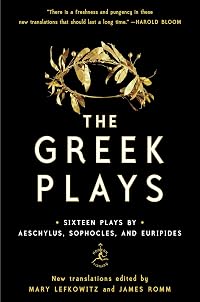
A landmark anthology of the masterpieces of Greek drama, featuring all-new, highly accessible translations of some of the world's most beloved plays, including Agamemnon, Prometheus Bound, Bacchae, Electra, Medea, Antigone, and Oedipus the King.Tags
Recommendations






Member Reviews
I like this solid anthology of and introduction to Athenian tragedy. I know that the literary qualities were much reduced in translation, but I could tell how beautiful the originals might be from the English versions. I welcomed the deep ideas suggested by the plays but appreciated the authors of the translations and closing essays pointing out what the deep ideas were not present, i.e., Antigone is not a proto-libertarian, Medea was not jealous of a younger woman but furious at Jason’s breaking of his word. I like that the plays were still great entertainment: the suspense in Agamemnon, Oedipus, and Medea; the happy endings in Alcestis and Helen; the shocking, liberating blasphemy of Prometheus; the strong women; the gory violence; show more the angry speeches. show less
This is a tremendous collection of sixteen of the most famous and vital Greek plays all of them in new translations, with comprehensive introductions and excellent critical apparatus. But its success stands and falls on the quality (so for me, clarity, dramatic sense and momentum) of the translations. All are strong and this is especially notable given that as the editor, Mary Leftowitz, explains, the translators were given a clear direction to stick to the Greek line count and placement and to use iambic pentameters. Sarah Ruden's translation of the Oresteia is the pick for me and I'd love to see this version performed. But as I say all are really good.
There's more. The ebook version is a model of its kind with well placed footnotes show more which work as they should and proper verse layouts with line numbering done properly. This is currently retailing on Amazon UK for £2.99, an astonishing bargain. show less
There's more. The ebook version is a model of its kind with well placed footnotes show more which work as they should and proper verse layouts with line numbering done properly. This is currently retailing on Amazon UK for £2.99, an astonishing bargain. show less
unreadable
Ratings
Members
- Recently Added By
Lists

In Our Time books
4,934 works; 2 members
Author Information

823+ Works 45,908 Members
Sophocles was born around 496 B.C. in Colonus (near Athens), Greece. In 480, he was selected to lead the paean (choral chant to a god) celebrating the decisive Greek sea victory over the Persians at the Battle of Salamis. He served as a treasurer and general for Athens when it was expanding its empire and influence. He wrote approximately 123 show more plays including Ajax, Antigone, Oedipus Tyrannus, Trachiniae, Electra, Philoctetes, and Oedipus at Colonus. His last recorded act was to lead a chorus in public mourning for Euripides. He died in 406 B. C. (Bowker Author Biography) show less

314+ Works 22,890 Members
Aeschylus was born at Eleusis of a noble family. He fought at the Battle of Marathon (490 b.c.), where a small Greek band heroically defeated the invading Persians. At the time of his death in Sicily, Athens was in its golden age. In all of his extant works, his intense love of Greece and Athens finds expression. Of the nearly 90 plays attributed show more to him, only 7 survive. These are The Persians (produced in 472 b.c.), Seven against Thebes (467 b.c.), The Oresteia (458 b.c.)---which includes Agamemnon, Libation Bearers, and Eumenides (or Furies) --- Suppliants (463 b.c.), and Prometheus Bound (c.460 b.c.). Six of the seven present mythological stories. The ornate language creates a mood of tragedy and reinforces the already stylized character of the Greek theater. Aeschylus called his prodigious output "dry scraps from Homer's banquet," because his plots and solemn language are derived from the epic poet. But a more accurate summation of Aeschylus would emphasize his grandeur of mind and spirit and the tragic dignity of his language. Because of his patriotism and belief in divine providence, there is a profound moral order to his plays. Characters such as Clytemnestra, Orestes, and Prometheus personify a great passion or principle. As individuals they conflict with divine will, but, ultimately, justice prevails. Aeschylus's introduction of the second actor made real theater possible, because the two could address each other and act several roles. His successors imitated his costumes, dances, spectacular effects, long descriptions, choral refrains, invocations, and dialogue. Swinburne's (see Vol. 1) enthusiasm for The Oresteia sums up all praises of Aeschylus; he called it simply "the greatest achievement of the human mind." Because of his great achievements, Aeschylus might be considered the "father of tragedy." (Bowker Author Biography) show less

Euripides was born in Attica, Greece probably in 480 B.C. He was the youngest of the three principal fifth-century tragic poets. In his youth he cultivated gymnastic pursuits and studied philosophy and rhetoric. Soon after he received recognition for a play that he had written, Euripides left Athens for the court of Archelaus, king of Macedonia. show more Fragments of about fifty-five plays survive. Among his best-known plays are Alcestis, Medea and Philoctetes, Electra, Iphigenia in Tauris, The Trojan Women, and Iphigenia in Aulis Iphigenia. He died in Athens in 406 B.C. (Bowker Author Biography) show less
Some Editions
Awards and Honors
Notable Lists
Common Knowledge
- First words
- Almost half a century ago, Robert F. Kennedy, announcing to a crowd of following the killing of Martin Luther King Jr., and speaking without a written text, recited words from the tragedy of Aeschylus (here quoted in Sarah Ru... (show all)den's translation):
In the heart is no sleep; there drips instead pain
that remembers wounds...
Aeschylus (c. 525–456 B.C.) came from a propertied family in Eleusis. - Last words
- (Click to show. Warning: May contain spoilers.)This is what has happened here today.
Classifications
- Genre
- Fiction and Literature
- DDC/MDS
- 882.0108 — Literature & rhetoric Classical & modern Greek literatures Classical Greek dramatic poetry and drama standard subdivisions; collections; history, description, critical appraisal; Specific periods Ancient period to ca. 499
- LCC
- PA3463 .G74 — Language and Literature Greek language and literature. Latin language and literature Greek literature Collections
- BISAC
Statistics
- Members
- 408
- Popularity
- 76,021
- Reviews
- 3
- Rating
- (4.09)
- Languages
- English
- Media
- Paper, Ebook
- ISBNs
- 4
- ASINs
- 1