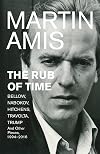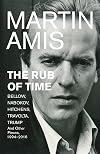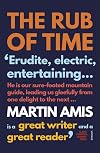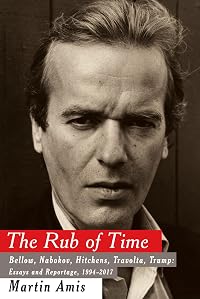
The Rub of Time: Bellow, Nabokov, Hitchens, Travolta, Trump: Essays and Reportage, 1994-2017
by Martin Amis
On This Page
Description
"A scintillating collection of essays, reportage and criticism by one of most provocative and widely read novelists of our time, with new commentary by the author. For decades now, Martin Amis has turned his keen intellect and unrivaled prose loose on an astonishing range of topics--politics, sports, celebrity, America, and, of course, literature. ... Over twenty years' worth of these incomparable essays are gathered together here, ranging from Bellow and Nabokov, his "twin peaks," to Roth, show more DeLillo, Philip Larkin and Jane Austen; from such peculiar worlds as Las Vegas and the pornography business to figures including Princess Diana, John Travolta and Christopher Hitchens. And running through The Rub of Time is politics, whether in Trump-era America, Britain, Iran, Colombia or elsewhere. From the earliest pieces to the most recent, this is Martin Amis at his prime: brilliant, incisive and savagely funny."--Jacket flap. show lessTags
Recommendations


























Member Reviews
This is a rich collection of essays on a wide variety of topics with emphasis on literature (Bellow, Updike, etc) and politics. There are also insightful looks at the World Series of Poker, the pornography industry and the rise and fall of soccer star Diego Maradona. All is done with quality writing and deep intellect. Amis is at the top of his game and shows why he has enjoyed such a long and respected career as an author. The fruit did not fall far from the tree as his dad is Kingley Amis was highly revered novelist of the mid twentieth century. A very smart read.
A tour-de-force volume of essays by a brilliant literary critic and observer. Beautiful English, often over my head.
Continues to be quite brilliant on literature and dreadful on politics.
I saw Martin Amis at the American Writers Museum last year and found him to be an engaging speaker. I read his book a bit at a time, as I do most collections of essays. He covers a wide swath of topics and is at his best when writing about literature or politics.
I am reading in the review below that Martin Amis is pretentious.
I am reminded of the episode he shares (I think in his autobiography) where the press learned that he came to America for a very expensive dental treatment. It was an emergency that had to be attended to immediately, and he debated first whether to get this major procedure done in the UK or in America. The end result was he didn't pick a dentist in his native country.
It's a few years ago that I read his autobiography, and I remember him saying that the press in the UK felt he did it out of movie-star-like vanity, similar to getting a face-lift or plastic surgery.
We have all had dental work done that was deemed to be essential. I say leave him alone and the topic of show more vanity trips to the dental or plastic surgery clinics.
That's a whole different story.
Anyway, what about this book?
I didn't discover any pretention.
I think that he writes honestly and forthrightly about every topic that he covered in this book, without pretentious attitude.
If somebody doesn't like Martin Amis's style or attitude, that's one thing, but then every author and public figure has to rest at the end of his/her labours and realize that nobody is always happy with the result. Some will like it and some won't. show less
I am reminded of the episode he shares (I think in his autobiography) where the press learned that he came to America for a very expensive dental treatment. It was an emergency that had to be attended to immediately, and he debated first whether to get this major procedure done in the UK or in America. The end result was he didn't pick a dentist in his native country.
It's a few years ago that I read his autobiography, and I remember him saying that the press in the UK felt he did it out of movie-star-like vanity, similar to getting a face-lift or plastic surgery.
We have all had dental work done that was deemed to be essential. I say leave him alone and the topic of show more vanity trips to the dental or plastic surgery clinics.
That's a whole different story.
Anyway, what about this book?
I didn't discover any pretention.
I think that he writes honestly and forthrightly about every topic that he covered in this book, without pretentious attitude.
If somebody doesn't like Martin Amis's style or attitude, that's one thing, but then every author and public figure has to rest at the end of his/her labours and realize that nobody is always happy with the result. Some will like it and some won't. show less
Continues to be quite brilliant on literature and dreadful on politics.
He can chill you with his awesome language skills. Perhaps non-fiction gaining the upper hand? So happy I'm a Martin Amis fan. Thanks to Knopf & Edelweiss for an advance copy for my nook.
Members
- Recently Added By
Author Information

58+ Works 29,872 Members
Martin Amis, son of the novelist Kingsley Amis, was born August 25, 1949. His childhood was spent traveling with his famous father. From 1969 to 1971 he attended Exeter College at Oxford University. After graduating, he worked for the Times Literary Supplement and later as special writer for the Observer. Amis published his first novel, The Rachel show more Papers, in 1973, which received the prestigious Somerset Maugham Award in 1974. Other titles include Dead Babies (1976), Other People: A Mystery Story (1981); London Fields (1989), The Information (1995), and Night Train (1997). Martin Amis has been called the voice of his generation. His novels are controversial, often satiric and dark, concentrating on urban low life. His style has been compared to that of Graham Greene, Philip Larkin and Saul Bellow, among others. He is currently Professor of Creative Writing at the Centre for New Writing at the University of Manchester. In 2008, The Times named him one of the 50 greatest British writers since 1945. (Bowker Author Biography) show less
Awards and Honors
Distinctions
The Guardian Book of the Day (2017-10-01)
Common Knowledge
- Dedication
- To Isaac and Eleanor
- First words
- Once upon a time, in a kingdom called England, literary fiction was an obscure and blameless pursuit.
- Last words
- (Click to show. Warning: May contain spoilers.)It is the prose itself that provides the permanent affirmation. The unresting responsiveness; the exquisite evocations of animals and of children (wholly unsinister, though the prototype of Lolita, The Enchanter, dates from 1939); the way that everyone he comes across is minutely individualised (a butler, a bureaucrat, a conductor on the Metro); the detailed visualisations of soirées and street scenes; the raw-nerved susceptibility to weather (he is the supreme poet of the skyscape); and underlying it all the lavishness, the freely offered gift, of his sublime energy.
Classifications
Statistics
- Members
- 246
- Popularity
- 132,640
- Reviews
- 8
- Rating
- (3.93)
- Languages
- 5 — Dutch, English, French, Italian, Spanish
- Media
- Paper, Ebook
- ISBNs
- 16
- ASINs
- 3