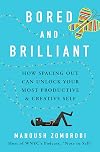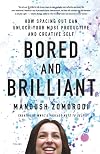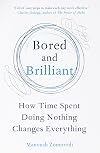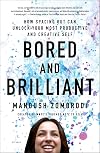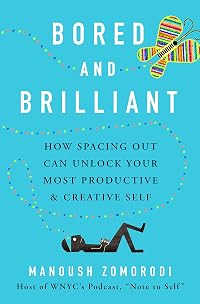
Bored and Brilliant: How Spacing Out Can Unlock Your Most Productive and Creative Self
by Manoush Zomorodi
On This Page
Description
*An AudioFile Magazine Earphones Award Winner*This program is read by the author.
"In this spirited exploration of our relationship with technological devices, Zomorodi's melodic voice beckons and inspires listeners to develop a deeper understanding of how tech devices affect our potential...Zomorodi persuasively conveys her compelling points on the need for reflection to make room for enlightenment in this age of technological overload." — AudioFile Magazine
It's time to move "doing show more nothing" to the top of your to-do list.
In 2015 Manoush Zomorodi, host of WNYC's popular podcast and radio show Note to Self, led tens of thousands of listeners through an experiment to help them unplug from their devices, get bored, jump-start their creativity, and change their lives. Bored and Brilliant builds on that experiment to show us how to rethink our gadget use to live better and smarter in this new digital ecosystem. In this fascinating new audiobook, Manoush explains the connection between boredom and original thinking, exploring how we can harness boredom's hidden benefits to become our most productive and creative selves, without totally abandoning our gadgets in the process.
Grounding her arguments in the neuroscience and cognitive psychology of "mind wandering" —what our brains do when we're doing nothing at all—Manoush includes practical steps you can take to ease the nonstop busyness and enhance your ability to dream, wonder, and gain clarity in your work and life. The outcome is mind-blowing.
"Bored and Brilliant shows the fascinating side of boredom. Manoush Zomorodi investigates cutting-edge research as well as compelling (and often funny) real-life examples to demonstrate that boredom is actually a crucial tool for making our lives happier, more productive, and more creative. What's more, the book is crammed with practical exercises for anyone who wants to reclaim the power of spacing out – deleting the Two Dots app, for instance, or having a photo-free day, or taking a 'fakecation'." — Gretchen Rubin, author of #1 NYT Bestseller The Happiness Project
. show less
Tags
Recommendations

Member Reviews
If you're like me and you fret about the impact of enslaving ourselves to our phones, social networks, and games -- especially the influence on our kids -- this book is for you! We can't begin to know the long term effects of our gadgets, but we can see the shorter term impacts of shorter attention spans, fatigue, and more inwardly focused behavior. Zomorodi's well-researched book highlights the importance of giving our brains an opportunity to be bored, allowing minds to wander, and opening the aperture for more creativity. When we spend our hours just skimming over posts, feeds, and nibbling at headlines, we're losing the discipline to read, to think, and to analyze more deeply. One of the better reads on how we relate to technology show more and the struggle to use it as a tool or become its supplicant. She has a number of exercises throughout that challenge the reader to reframe their relationships with tech and take back a bit of our agency over these amazing devices. Of course, everything in moderation. show less
Manoush Zomorodi is the woman behind the "Note to Self" podcast, and even though she talks tech she is concerned by how much we are on our phones and how distracting it can be for our brains. Does anyone just sit around bored, thinking and planning creatively anymore? She and her listeners participated in a one-week challenge in which she suggested ways to take control over our tech use. One day might be just tracking your phone use. The next, keep your phone out of sight any time you're "in transit" (walking, driving, etc.). Another, don't use the camera - at all. This book is basically the reading equivalent of that Bored and Brilliant challenge week. Each chapter gives interviews with experts in the field and scientific studies about show more the related challenge: for example, for the challenge to delete an app, she talks about video games, Two Dots, Candy Crush and the like. At the end in summarizing, she gives the day's challenge.
The subtitle "How Spacing Out Can Unlock Your Most Productive and Creative Self" really had me geared up for a different book. But it's less about the science of boredom and creativity, and much more about being on top of technology use. There are scientific studies, true, but sometimes they're very preliminary and other times they downright contradict each other, and there's no real attempt to bring together disparate findings. Zomorodi admits that science hasn't "kept up" with technology changes, but then at the end of the Bored and Brilliant challenge she brings in one "expert" opinion that an average decrease in phone usage of6 minute is significant. I'm not sure I buy that, so I had a real problem with her confidence that they'd "scientifically proven" anything by the end. I don't doubt that her central argument - we need to be more intentional about our phone/technology use - is valid, and that her challenges could be useful. But she makes some pretty great claims and doesn't back them up. For what it is, and for readers who would be looking for suggestions to reclaim their mental space from technology, it's recommended with those reservations. show less
The subtitle "How Spacing Out Can Unlock Your Most Productive and Creative Self" really had me geared up for a different book. But it's less about the science of boredom and creativity, and much more about being on top of technology use. There are scientific studies, true, but sometimes they're very preliminary and other times they downright contradict each other, and there's no real attempt to bring together disparate findings. Zomorodi admits that science hasn't "kept up" with technology changes, but then at the end of the Bored and Brilliant challenge she brings in one "expert" opinion that an average decrease in phone usage of
The premise of this book is that while technology adds lifechanging value to our lives, our reliance and constant attention to our phones comes at a cost. The author lays the groundwork for us to better diagnose how much time we actually spend in mindless phone distractions and diversions and that by increasing our awareness we can claim back and be more choiceful and deliberative about ensuring the way we spend our time so that it's truly in line with the results we want.
That's a run-on sentence, but you get the idea.
Some of the challenges are interesting, but they could stand to be better refined. They're slightly too conceptual as they're currently conceived--the tents are too big. As others have said, the book gets a little show more repetitive, but it's accessibly and warmly written, well-researched, but not too academic to put the ideas in practice.
Overall, recommended. show less
That's a run-on sentence, but you get the idea.
Some of the challenges are interesting, but they could stand to be better refined. They're slightly too conceptual as they're currently conceived--the tents are too big. As others have said, the book gets a little show more repetitive, but it's accessibly and warmly written, well-researched, but not too academic to put the ideas in practice.
Overall, recommended. show less
I love the Note to Self podcast, so I think I encountered the same problem here that I often have with books written by podcast hosts or bloggers: I had already heard the content. That said, this book is simplistic but motivational, and the variety of sources that Manoush speaks to provide some interesting research backing.
The main premise is that we fill our lives with too much distraction and do not realize how powerful allowing moments of boredom can be. Disconnecting, eliminating digital time suckers, and allowing for unfilled moments of time can jump start the creative juices. I appreciated the message and I think there is a lot of truth to it. The hard part is putting it into action.
The basic premise of the book is that people become creative when they get bored. However, it’s super easy to avoid boredom because of your phone and its easy access to games, social media, and the general internet. Want to be more creative? Stop using your phone so much. There’s more to it than this, of course, but that’s the nickel summary.
The message of the book was pretty predictable but one I needed to hear again. Making changes to my social media consumption as a result. The thing that hit home for me was that 25 mins of social media every day adds up to 2 years over a life time... and even just over 10 years, 30 mins a day adds up to almost 11 weeks. Crazy. And not how I want so spend my life.
Members
- Recently Added By
Author Information
3 Works 327 Members
Some Editions
Awards and Honors
Awards
Classifications
Statistics
- Members
- 307
- Popularity
- 103,888
- Reviews
- 9
- Rating
- (3.63)
- Languages
- English, Italian
- Media
- Paper, Audiobook, Ebook
- ISBNs
- 15
- ASINs
- 3