
Rob Walker (1)
Author of The Art of Noticing: 131 Ways to Spark Creativity, Find Inspiration, and Discover Joy in the Everyday
For other authors named Rob Walker, see the disambiguation page.
About the Author
Image credit: Journalist Rob Walker at the 2019 Texas Book Festival in Austin, Texas, United States. By Larry D. Moore, CC BY-SA 4.0, https://commons.wikimedia.org/w/index.php?curid=84741923
Works by Rob Walker
The Art of Noticing: 131 Ways to Spark Creativity, Find Inspiration, and Discover Joy in the Everyday (2019) 292 copies, 8 reviews
Significant Objects: 100 Extraordinary Stories about Ordinary Things (2012) — Editor — 64 copies, 1 review
Amateur Hour, Web Style 1 copy
Associated Works
Tagged
Common Knowledge
- Gender
- male
- Occupations
- journalist
- Organizations
- The New York Times Magazine
Members
Reviews
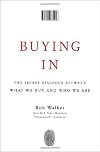
This sometimes fascinating, sometimes long-winded book explains about "murkablity". Murkablity = Murky Modern
Marketing.
Walker draws on the such histories as Proctor & Gamble, Timberland, Red Bull, Axe, and Ecko. It gave me a pause because I, like most Americans, consider myself wizened to the ploys of modern marketing. If we are all so immune to marketing ploys how come our collective behavior and buying habits say otherwise?
Some of the points that stuck out of me: how a labeled can of show more Coca-Cola beat an unlabeled can of Coca-Cola in taste test (the drinks were exactly the same), how Listerine invented the problem of halitosis (of course halitosis existed before but P&G created a market by creating a problem), and a quote by Miuccia Prada: "Buying a $5000 handbag just because it's a status symbol is a sign of weakness."
Walker talks a lot about the "story of a brand". His story meandered around a lot without making me feel like I really went anywhere. It felt more like he took me on a long walk in a small circle. There are really some good points in this book. Just remember to keep your eyes open because the trip can get boring. show less
The Art of Noticing: 131 Ways to Spark Creativity, Find Inspiration, and Discover Joy in the Everyday by Rob Walker
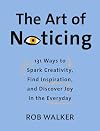
A wonderful little book of ideas on how to be more involved in this world. Some great, some fun, some strange, some I will never try ... but all valid, interesting, and worthwhile reading. Even if you choose not to use this book for the ideas on how to "notice", there's still some great reading on how other humans have navigated this life.
One of the best book on behavioral economics and identity I’ve read. Walker benefits from the wisdom of earlier writers, such as Ariely and Atkins, but brings his own ability to ask great questions to the table. Much better than more superficial works like Buyology, it is Walker's questions that elevate him above many others. Seeing modern marketing as targeting the ideal balance between empowering individual identity and fostering community, Walker finally brings advertisers onto a show more playing field that should be very familiar to religious professionals. Like Gladwell’s Tipping Point, Walker’s Buying In is analysis and reflection that is as helpful to those seeking to build meaningful spiritual communities as those seeking to hawk their wares. show less
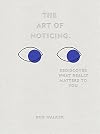
Rating:
3.5 Stars
In a nutshell:
A series of very short suggestions for ways to reconnect with one’s self and the world.
Best for:
Those of us who may find ourselves easily distracted and/or hoping to focus more on what is important in our lives.
Quote that made me think:
“What, among everything you encounter, could be made better somehow?”
Why I chose it:
I spend so much time on my phone, multi-tasking, and sort of floating through life, and I was hoping this would give me some ideas of how to show more be more intentional with my time and attention.
Review:
This book was not quite what I expected, which is my own fault, as I didn’t spend enough time looking through it when I bought it. Instead of containing traditional chapters, it has five sections, each containing suggested projects along a theme. Each project is rated on a scale of 1-4, with one being very easy to do and four being challenging / very involved.
The areas of focus are ‘looking,’ ‘sensing,’ ‘going places,’ ‘connecting with others,’ and ‘being alone.’
The book feels a bit more like a collection of bits of performance art, and indeed the author very openly borrows many of the suggested practices from performance and other types of artists. Which isn’t quite what I was expecting, but it was still interesting to contemplate nonetheless. Example projects are as basic as ‘notice something new every day’ and as complex as ‘exhaust a place.’
There are definitely some projects in here that I plan to pursue, but it will require some intentionality. Unlike, say, a ‘do this each day’ type of book, where each day you’re assigned a new task, this book is just a catalog of ideas, and its up to me to actually pick one and go with it. For me, the easiest ones would probably be in the ‘looking’ and ‘being alone’ sections, which probably means I should start with the other sections.
Would I recommend it to its target audience:
Yes, with the understanding that some of the suggestions will likely be a bit much. show less
3.5 Stars
In a nutshell:
A series of very short suggestions for ways to reconnect with one’s self and the world.
Best for:
Those of us who may find ourselves easily distracted and/or hoping to focus more on what is important in our lives.
Quote that made me think:
“What, among everything you encounter, could be made better somehow?”
Why I chose it:
I spend so much time on my phone, multi-tasking, and sort of floating through life, and I was hoping this would give me some ideas of how to show more be more intentional with my time and attention.
Review:
This book was not quite what I expected, which is my own fault, as I didn’t spend enough time looking through it when I bought it. Instead of containing traditional chapters, it has five sections, each containing suggested projects along a theme. Each project is rated on a scale of 1-4, with one being very easy to do and four being challenging / very involved.
The areas of focus are ‘looking,’ ‘sensing,’ ‘going places,’ ‘connecting with others,’ and ‘being alone.’
The book feels a bit more like a collection of bits of performance art, and indeed the author very openly borrows many of the suggested practices from performance and other types of artists. Which isn’t quite what I was expecting, but it was still interesting to contemplate nonetheless. Example projects are as basic as ‘notice something new every day’ and as complex as ‘exhaust a place.’
There are definitely some projects in here that I plan to pursue, but it will require some intentionality. Unlike, say, a ‘do this each day’ type of book, where each day you’re assigned a new task, this book is just a catalog of ideas, and its up to me to actually pick one and go with it. For me, the easiest ones would probably be in the ‘looking’ and ‘being alone’ sections, which probably means I should start with the other sections.
Would I recommend it to its target audience:
Yes, with the understanding that some of the suggestions will likely be a bit much. show less
Lists
Awards


You May Also Like


Associated Authors
Statistics
- Works
- 10
- Also by
- 1
- Members
- 716
- Popularity
- #35,435
- Rating
- 3.7
- Reviews
- 27
- ISBNs
- 72
- Languages
- 2
